




Abstract
Abstract
A crucial factor contributing to the high rate of road accidents involving young people is inexperience, in particular the inability to promptly identify risky situations. The aim of this study is to test the effectiveness of a riding simulator in improving this skill in young inexperienced riders. We use the first fixation latency to measure the improvement in detecting the hazardous object. Results show that four training sessions can significantly affect promptness in detecting new hazardous objects as they appear, decreasing the time needed to orient the eyes to the hazard.
Introduction
Eye tracking is a valuable methodology to evaluate the visual search patterns of drivers and the identification of a risky object when it appears. 3 As early as 1972 Mourant and Rockwell demonstrated that the scanning patterns of novice drivers were distributed over a smaller part of the visual scene with respect to those of experienced drivers. 4 Later, it was found that a measure of information processing, such as mean fixation duration, is influenced by driving experience with longer fixations for novice drivers. 5 Such differences are likely to influence the analysis of the visual scene. Moreover, Fisher and colleagues demonstrated that novices can improve their ability to deploy attention to critical regions during driving if they are trained to appreciate where they should be looking to reduce risks.6,7 This literature suggests the existence of lacks in the scanning patterns of novices probably due to an informational problem related to the absence of a mental model of what cues might hint at the upcoming dangerous situation. 8
We propose fixation latency (i.e., the time taken by the observer since the danger's appearance to first fixate on it) as a measure that can account for amelioration in hazard perception. We believe it conveys knowledge about the orienting of attention that is linked to the general alertness but also to the knowledge of the positions where the hazard is likely to appear/develop.
A rich opportunity to train inexperienced drivers/riders is provided today by simulators. The first advantage of such training techniques over practicing with real cars is obviously a safer training environment both for the trainee and for the other road users. 9 Interactivity is a second advantage that distinguishes simulator-based training from class-based training with visual material and lectures. 10
A third class of advantages pertains to the flexibility of the learning environment. A simulator makes available scenarios with varying levels of difficulty, environmental conditions, vehicle types, and feedback sources, allowing stepwise training by showing in a few sessions the consequences of hazards that would have taken much longer to experience in real life.
Our hypothesis is that the identification of risky situations can be trained on a simulator and the improvement measured via the latency of the first fixation on the hazard. More specifically, if the simulator can improve the ability to identify hazards, then the latency of the first fixation on the hazard should decrease from the first to the last training session.
Method
Participants
Fourteen students (7 females and 7 males; 20–25 years old, mean [M]=23.28, standard deviation [SD]=1.59) voluntarily took part in the experiment. Twelve out of 14 had a driver's license for automobiles, however they were not habitual drivers and reported the bicycle, instead, as the most frequently used means of transportation (traveling a mean of 25.35 km [SD=16.34] per week). Moreover no experience on scooters or motorcycles was reported. Such participants were therefore inexperienced drivers with no experience with the controls of a scooter. Participants had normal or corrected to normal visual acuity. The experiment was undertaken with the written consent of each participant.
Apparatus
Eye movements were recorded with a remote eye tracker (Tobii® 1750, 0.5° accuracy, 50 Hz sampling frequency). The TFT 17″ monitor (1,024×768 resolution) was located at approximately 60 cm from the participant, therefore providing a field of view approximately 32° wide and 27° high. The Honda Riding Trainer (Fig. 1), a fixed-base riding simulator with the commands of a real scooter, was used in the experiment.
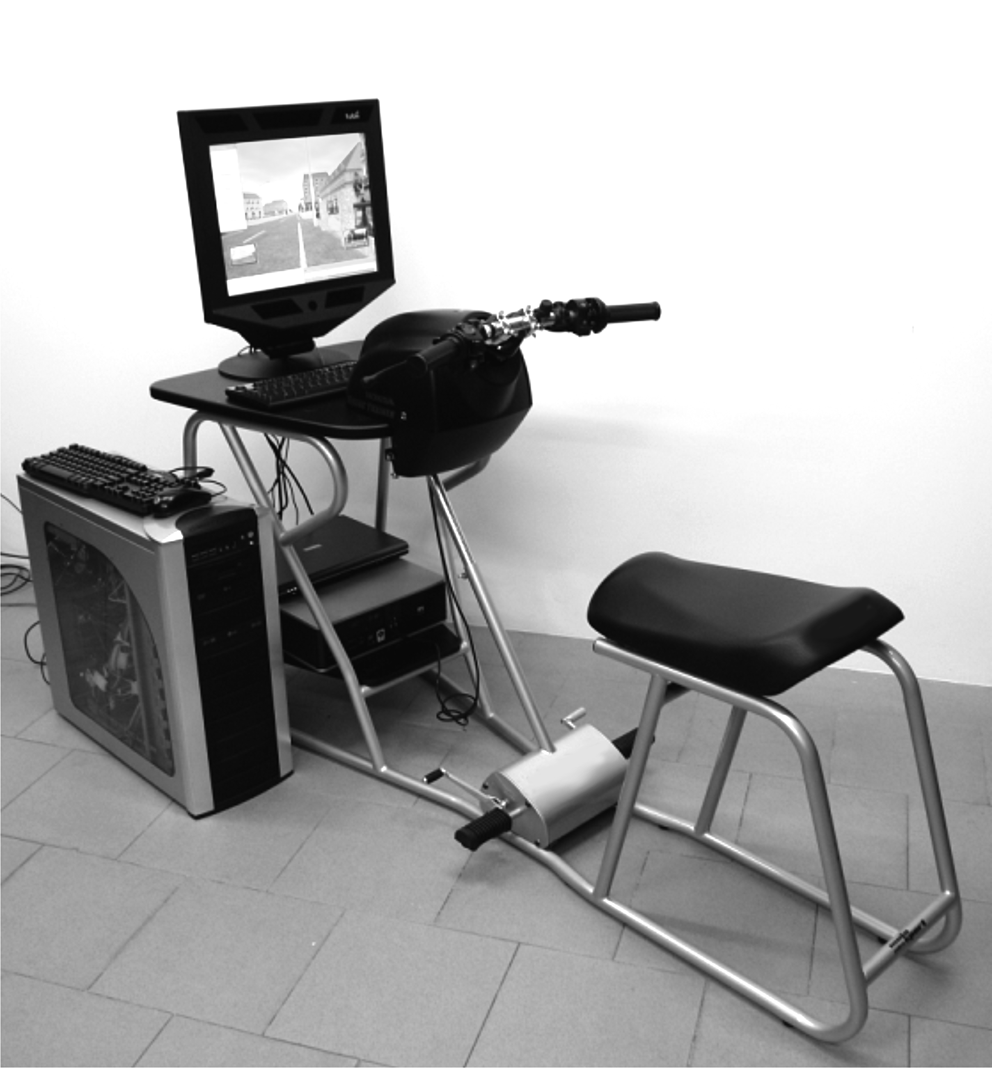
The experimental apparatus.
Stimuli
Participants completed four different routes among those offered by the simulator. Different kinds of vehicles, bicycles, and pedestrians appeared on the road. Participants were instructed to ride the scooter at a speed of 40 km/h while keeping an eye for hazards. Some examples of hazards were: a bicycle or a pedestrian entering the road, a right of way violation, a vehicle undertaking with a small gap. Only hazards appearing in a peripheral area of the screen (i.e., the area 3.57° away from the central vertical axis and the lateral borders of the screen) and heading across the rider's projected trajectory were considered for analysis, since the participant was required to move his/her gaze away from the central area of the screen where he/she was controlling the road. Hazards would start their course approximately near the borders of the screen (at a 15° eccentricity) and move in a collision course toward the car heading direction. Fixations could be directed to the hazard at any moment along this trajectory. Two routes contained four hazards each that matched this criterion; they were used as first or last routes in the training, in a counterbalanced order (to avoid the objection that the effect of training might be related to the idiosyncratic characteristics of the hazards presented). Only the experimenter was present with the participant during the training. 11
Design
A pre-post experimental design was used. The dependent variables were the latency of the first fixation and the number of crashes following a hazard. The first fixation latency was calculated with respect to the hazard onset, which was its actual appearance on the screen or—in case the object was already present on the screen—the moment at which it started moving across the trajectory of the scooter. Only fixations enclosed in the peripheral area were considered in the analysis.
Figure 2 shows a hazard appearing from the periphery and the sequence of fixations of a participant after the hazard's onset.

A hazard appearing at the periphery of the screen (marked off in the white rectangle) and directed across the scooter. Numbers on fixation circles indicate their incremental order. The first fixation on the hazard is marked by a thicker circle.
Results
The time required to spot an approaching hazard was significantly shorter in the last session (M=1,022.56 milliseconds ms, standard error [SE]=121.46) than in the first session (M=2,903.43 ms, SE=1,022.18) suggesting that the training had an effect on the first fixation latency (t=1.84, degrees of freedom [df]=13, p=0.04, Cohen's d=0.49).
The number of crashes with the selected hazards was not different in the first (14 percent of hazards determined an accident) than in the last session (9.43 percent; χ2 (1)>0.05).
Discussion
This experiment shows that after a relatively short practice with a riding simulator the time needed to spot a hazard decreases. A previous experiment demonstrated that the ability to fixate the hazard area within an appropriate time window can be trained with a PC-based training program that coaches trainees where they should be looking at to reduce risks. 7 In the current study we confirm this result without explicitly training participants to look at specific areas of the street. This research suggests that simulators could be not only a precious instrument for improving coordination and motor skills and a valid assessment instrument, but also a tool for ameliorating a crucial component of hazard perception in young users.
We did not find any difference in the number of crashes between the first and the last session. Although the virtual accident rate per se is not a reliable indicator of the training effectiveness as it might be due to causes that were not controlled in the study, 12 future research should address the practical validity of our results. Whether the results can be generalized to real world situations is a critical concern for trainings administered in simulated environment. The narrow size of the display could limit our conclusions on the efficacy of the training: a small display apart from limiting the immersion also makes the visual exploration of the scene unrealistic, lacking all the visual information that compete for attention in a real situation. 13 Recent work has demonstrated the effect of the size of the field of view on reactions to hazards. 14 Future researches should reproduce the training in a wider field of view investigating how fixation latency is influenced by the size of the visual field and whether it is related to reaction times.
Footnotes
Acknowledgments
This research was partially supported by EX60% national grant no. 60A17-7007/07. The authors would like to thank the anonymous reviewers and the Editor-in-Chief for their valuable help in refining the original submission.
Disclosure Statement
No competing financial interests exist