




Abstract
Abstract
Personalizing communication means creating persuasive messages that refer to aspects of a person's self. Although the use of personalization is increasing, research on its effectiveness is limited and the results are mixed. This study examined the persuasiveness of personalized e-mail newsletters in terms of increased attention, cognitive activity, evaluation, attitude, intention, and behavior by means of an experiment (n=109). Participants randomly received either a personalized or a generic newsletter advertising a sports center. Personalization triggered a more positive evaluation of the message; however, it did not influence the other effect variables. The effects were moderated by consumers' need for uniqueness, trust, and privacy concerns, suggesting that personalization is a good strategy to increase message evaluation only among individuals who have a high need for uniqueness.
Introduction
Personalized communication
Personalization means creating communication in which information about the recipient is used to refer to some aspects of his or her self. 19 Although personalization can be based on many concepts, the tactic that has gained prominence in current direct marketing is that of identifying the consumer. This strategy is based on acknowledging the recipient by including personalization cues, such as the recipient's name. 20 These cues do not change the content, but signal that the message is addressed to the individual. 2
Personalization is believed to lead to persuasion effects, such as enhanced attention, 4 involvement, 5 memory, 6 attitude, 7 intention, 8 and behavior. 6 Because people are cognitively sensitive to personal information (e.g., they tend to react when addressed by name 21 ), personalization leads to self-referencing. Once self-referencing is activated, the content is processed in the context of self, which makes the message personally relevant. 2 According to the elaboration likelihood model, people engage in central processing of such a message. 22 Therefore, personalized messages lead to more cognitive activity: individuals pay more attention to and better memorize communication. 23 Moreover, such communication exerts more influence on a person's judgments, 24 increases attitude certainty, and thus strengthens the attitude–behavior relationship, which makes it more likely that behavior will be influenced.25,26 Therefore, we hypothesized that
Personalization and personal characteristics
We focused on three moderating personal characteristics: consumers' need for uniqueness (CNFU), privacy concerns (PC), and trust in a company. According to the need for uniqueness theory, individuals with a high need for uniqueness aim to maintain a sense of being special in relation to others, 27 derive satisfaction from the perception that they are unique, 28 better memorize information that distinguishes “me” from “you,” 29 and are more likely to develop their uniqueness through exclusive consumer products. 30 Personalized offers and messages address each recipient as an individual, which allows recipients to differentiate themselves from others and makes each person believe that he or she is unique. 31 Therefore, individuals with higher CNFU are expected to react more positively toward personalization.17,32 In other words,
A possible downside of personalization is that consumers are becoming more concerned about their privacy 33 and are afraid that have lost control over it, 34 which may result in resistance to revealing personal information. 35 Therefore, PC may constitute a significant obstacle to successful personalization 36 by evoking reactance to communication. 37 Thus,
A range of studies have shown that consumers are willing to share personal information with organizations they trust.34,38 For this study, initial trust, which is developed after individuals' first experience with the company, 39 is especially important because individuals are not or are barely familiar with the company. Trust may positively influence customers' evaluation of a personalized service, 40 attitude toward the company, 39 and willingness to purchase products. 41 Therefore,
Methods
Materials
Two versions of an existing e-mail newsletter that advertised the University Sports Centre (USC) were created: a generic and a personalized version. Both newsletters had the same layout, and provided the same information about sports, locations, and prices at the USC. The only difference was that in the personalized version, the recipient's first name was mentioned in three widely spaced places in the text.
Respondents
Data were collected from a sample of Dutch undergraduate students (n=109, of which 73.4% were women) between the ages of 18 and 31 years (Mage=21.20 years, SD=2.85). The data of four (3.7%) students who were already members of the USC were not used. Post-hoc power analysis with G*Power 42 showed that the sample size was sufficient.
All individuals were randomly assigned to one of two experimental conditions: personalized (n=52) or generic (n=53). There were no differences between the participants in these two conditions in terms of demographic variables (e.g., age and gender). The newsletters were e-mailed to the participants as though they were real newsletters. At the bottom of each newsletter, participants were asked to take part in the survey regardless of their interest in the USC or sports in general. The chance of winning a 25- or 100-euro raffle encouraged them to take part in the study.
Measures
The questionnaire measured dependent variables, personal characteristics, and demographics. A behavioral measure was included at the end of the survey; individuals were given the option to go to the USC Web site to get more information.
As a manipulation check, awareness of personalization was assessed using a three-item scale answered on a five-point Likert scale (α=0.81). Attention was measured by the question, “How thoroughly did you read the newsletter?” There were four possible answers: not at all, only scanned it, read it partially, and read it all. Cognitive activity was measured with the thought listing task. 43 The number and the tone of participants' thoughts were coded by two coders. Intercoder reliability was assessed with intraclass correlation coefficients (all above 0.70) and alphas (all above 0.80). Evaluation of the newsletter was measured with a grade as used within the university (1=low, 10=high). Attitude toward the USC consisted of five-point semantic differentials (α=0.83). Intention was measured by two, five-point Likert-type questions: “How probable is it that you will contact the USC?” and “How probable is it that you will join the USC?”
Personal characteristics were measured using multi-item Likert scales anchored by 1 (totally disagree) and 5 (totally agree). We employed 9 items with the highest factor loadings from the 12-item Consumers' Need for Uniqueness (CNFU) Scale 44 (α=0.80), the three-item Global Information Privacy Concern Scale 45 (α=0.79), and the five-item Initial Trust Scale 39 (α=0.69). A principal components factor analysis with oblimin rotation proved that both convergent and discriminant validity of all scales were sufficient.
Results
The manipulation was successful. Participants in the personalized condition (M=2.96, SD=0.80) were significantly more aware of personalization, t(103)=3.47, p=0.001, than participants in the generic condition (M=2.38, SD=0.90).
Responses to personalization
There was a significant main effect of condition on evaluation of the newsletter, F(1, 103)=5.48, p=0.02, η2=0.05. Participants in the personalized condition evaluated the newsletter significantly more positively than those in the generic condition (Table 1). Analyses also showed a marginally significant main effect for condition on the mean number of positive thoughts, F(1, 103)=3.72, p=0.06, η2=0.04. Participants in the personalized condition expressed more positive thoughts than those in the generic condition.
USC, University Sports Centre.
The role of personal characteristics
To test for interaction effects, we performed regression analyses with condition (dummy coded), personal characteristics (standardized), and the interaction between condition and personal characteristics as predictors of the dependent variables (Table 2). Simple slope analyses were applied to disentangle significant interactions. An analysis of covariance with estimated marginal means was employed to assess the differences between the two conditions among individuals who scored low (−1 SD) or high (+1 SD) on the moderating variables (Fig. 1).
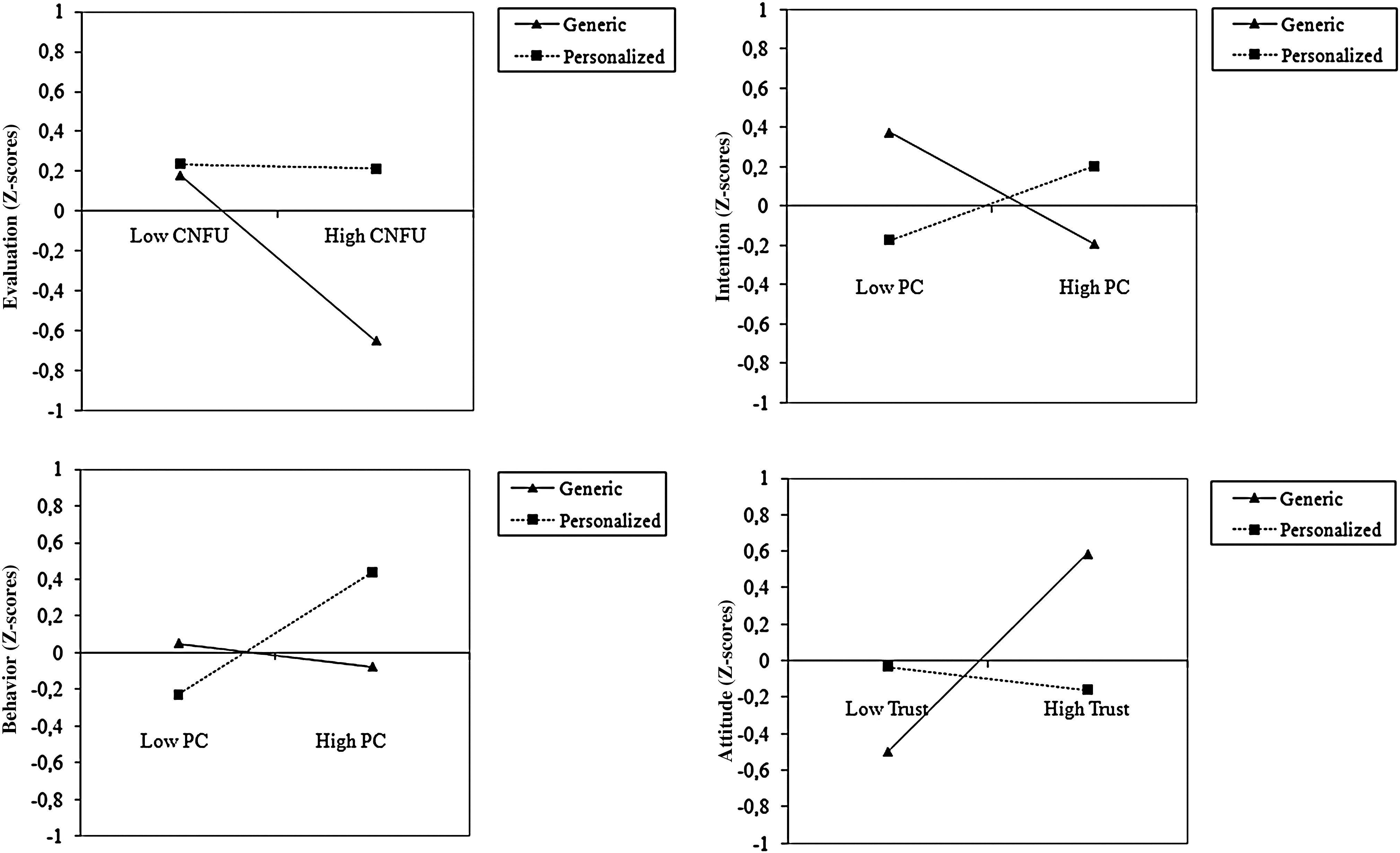
Visualized interaction effects between the personalization condition and personal characteristics: consumers' need for uniqueness (CNFU), privacy concerns (PC), and initial trust (Trust).
Note: Coefficients are standardized regressions coefficients (betas).
p<0.10, *p<0.05, **p<0.01, ***p<0.00.
CNFU, consumers' need for uniqueness.
CNFU significantly moderated the effect of condition on evaluation of the newsletter (β=0.30, t=2.14, p=0.04). The simple slope was significant for the generic condition (b=− 0.41, p=0.004), but not for the personalized condition (b=−0.01, p=0.92), suggesting that the level of CNFU was associated with evaluation only for participants who received the generic condition. Participants with a high CNFU were significantly more negative toward the generic than toward the personalized condition, F(1. 101)=10.59, p=0.002.
PC significantly influenced the effect of message condition on intention to contact the USC (β=0.32, t=2.37, p=0.02) and information-seeking behavior (β=0.27, t=1.99, p=0.05). The effect of PC on intention to contact the USC was significant for the generic condition (b=−0.28, p=0.04), but not for the personalized condition (b=0.19, p=0.19), suggesting that the level of PC was associated with intention only for participants who received the generic condition. Individuals with low PC were significantly more willing to contact the USC after seeing the generic condition than after seeing the personalized condition, F(1, 101)=3.83, p=0.05.
With respect to information-seeking behavior, the effect of PC was significant for the personalized condition (b=0.33, p=0.02), but not for the generic condition (b=−0.06, p=0.65), suggesting that the level of PC was associated with behavior only for participants who received the personalized condition. However, no difference was found between the two conditions among participants with a low or a high PC.
Trust in the USC significantly moderated the effect of condition on participants' attitude toward the USC (β=−0.41, t=−3.31, p=0.001). The positive effect of trust on the attitude toward the USC was significant for the generic condition (b=0.54, p<0.001), but not for the personalized condition (b=−0.06, p=0.64), suggesting that the level of trust was associated with attitude only for participants who received the generic condition. Participants with a higher trust level expressed a more negative attitude after reading the personalized message than after reading the generic one, F(1, 101)=8.28, p=0.01.
Discussion
The present study systematically compared personalized and generic messages, while taking personal characteristics into account. The results partially support H1, namely, that a personalized message is more persuasive than a generic message. This held for the evaluation of the newsletter and the number of positive thoughts. However, we did not find any significant differences between the personalized and generic messages with respect to attention, attitude, intention, and information-seeking behavior. With respect to the personal characteristics, we could partially support H2, viz., that need for uniqueness strengthens the persuasiveness of personalization. However, we had to reject H3 and H4, which stated that PC weakens and trust strengthens the persuasiveness of personalization. In contrast to what we expected, participants with a low level of PC expressed a significantly stronger intention to contact the USC in the generic condition than in the personalized condition. We were also surprised to learn that individuals who trusted the USC expressed a more positive attitude toward the company after reading the generic newsletter.
A plausible explanation for the relatively weak effect of personalization is that the personalization cues signaled the persuasion attempt, rather than the relevance of the message. 46 This may inhibit persuasion or even cause reactance, especially if personalization is not justified. 17 Moreover, when personalization is not perceived as genuine (the source announces personalization, but does not meet the individual's personal preferences), it may increase perceived liabilities, which in turn can make the attitude less positive, especially when people trust the organization.40,47
Although our results show that personalization is not very effective, it is too soon to draw definitive conclusions. Further work is required to gain a complete picture of the effectiveness of personalization. It seems that personalization has a positive influence on attitude toward the message, but there is no spillover effect on attitude toward the company or behavior; thus, research should focus on the mechanism of personalization in terms of stages of information processing.
Footnotes
Disclosure Statement
No competing financial interests exist.