




Abstract
Abstract
This study explores the relationships between consumers and mobile advertisements on attitude change over time. Two experiments were used to investigate both immediate and delayed effects of different media types on attitudes toward mobile advertisements. Experiment 1 formulated three types of advertisements corresponding to three media types: text, still pictures, and motion pictures. The results indicate that motion pictures on mobile phones significantly influence consumers' initial attitudes toward advertisements. Experiment 2, focusing on delayed effects, was conducted 4 weeks after Experiment 1. Ninety-five of the 117 participants in Experiment 1 were contacted via cellular phone. The results of Experiment 2 showed a decrease in attitude in relation to motion pictures, whereas an increase in attitude in relation to text and still pictures was observed. The findings were interpreted from the perspectives of media characteristics, consumer behavior, and advertising research.
Introduction
In this research, we focused on multimedia mobile advertisement that recent technologies like the Apple iPhone and Google's Android-based smart phones enable on mobile phones, which maximize their potential as a personal advertisement medium. However, much research has not been done enough in this area. We manipulated three media types (text, still pictures, and motion pictures), because attitudes toward mobile advertisements may depend on the three major types of media through which they are delivered. Although early mobile advertisement studies were limited to text-based or picture mobile advertisements such as short message service (SMS), multimedia message service, or location-based advertising, they were selectively shown to be effective in shaping attitudes toward brands and advertising.3–8 Therefore, the choice of media type is critical to maximize the effect of the advertisement. Otondoa et al. 9 argued that the choice of media type is critical to maximize satisfaction and affective motivations related to the advertisements because an individual's attitude is shaped by specific advertisements based on affective as well as cognitive components. 10
Theoretical Background and Hypothesis
Media types and attitudes
Previous research has shown that different types of media may produce differential attitudes toward advertisements. Texting is used to deliver content that is read as a written description in natural language and signs. Compared to still or motion pictures, texting conveys messages using inherently sequential sentences. 11 In mobile advertising, a caller usually decides to use mobile advertisements to convey text messages containing specific or detailed information. 12 Studies have suggested that text messages in SMS have become a new form of social communication in mobile advertising due to the informative, personalized nature of those messages.13,14 The major limitations of text, however, include lack of graphics, dynamic processes, and attractive designs.
Unlike text, still and motion pictures are figurative, containing graphics or images that may include colors and shapes. A major difference between still and motion pictures is that still pictures implicitly present messages representing a relationship among spatial locations without apparent movement or dynamic information changes. 11 In contrast, motion pictures mainly deliver dynamic information whose changes are simultaneously represented both temporally and sequentially.15,16 Also, messages in still pictures are typically presented visually, whereas messages in motion pictures tend to be presented both visually and aurally due to their multimodal characteristics. 17
In addition, the moving images in motion pictures (or movie clip) easily capture people's attention. Xu et al. 18 emphasized that the main components of motion pictures used in mobile advertising are dynamism through movement over time and multimodality. Finally, the sequential and temporal nature of motion pictures may allow a story to be presented in the form of dynamic information through a temporal sequence of events. 15 Text is also typically a good medium for story delivery.
However, people tend to more heuristically understand still and motion pictures than they do text. This heuristic processing may be more dominant with motion pictures. One of the benefits of heuristic processing that uses existing knowledge schema is the minimal use of cognitive resources and superficial processing during message management. In contrast to systematic processing, therefore, heuristic processing tends to promote user agreement without full semantic processing of the message. 19 Thus, motion pictures may be perceived to be more interesting in terms of their effects on emotions than is static content. Therefore, it is expected that initial attitudes toward advertising may be influenced more by motion pictures than by still pictures or text.20,21
Inspired by this line of thinking, Mitchell 22 showed that the visual component received more affective evaluations than did the verbal component, which in turn lead to more favorable attitudes toward advertisements and brand attitudes than was the case with the verbal component. Mitchell and Olson 23 found that advertisements with pictures have a greater influence on attitudes than those using only text. Reeves et al. 24 exposed participants to 30-second advertisements and found that the motion pictures were associated with higher levels of attention and emotional evaluations due to cortical arousal. Ritterfeld et al. 25 also reached a similar conclusion using an educational game. However, some studies in the learning sciences have found that motion pictures are not always effective when the message needs to be learned and sustained.16,26–30
Immediate and delayed attitude
According to Fazio et al., 31 an attitude is automatically activated from memory, which stores the associations between advertisements and their evaluation in memory. In other words, attitudes toward advertisements may change over time because of memory encoding and decay in the memory of the advertisement content. When people are exposed to advertisements, their initial attitudes may be mainly influenced by the media characteristics of the advertisements32,33; however, the media effect may be reduced over time, leaving the content remaining in memory to determine the attitude. Therefore, over time, the emotional component in advertisements might play a decreasing role in the attitude toward the advertisement, 10 whereas the cognitive component may take on a more important role.
The sleeper effect also makes a similar prediction. According to Cook et al., 34 initial attitudes tend to result from the peaked salience of a message in memory. Over time, the influences of different media features will be forgotten. Therefore, messages that were semantically or systematically processed would be salient with regard to recall. Different times of recall should produce different attitudes toward mobile advertisements.
In sum, it is expected that the various media types may have different immediate and delayed effects on attitudes toward mobile advertisements. Specifically, initial attitudes would be most influenced by motion pictures. However, the influences of text and still pictures on attitudes would increase over time.
Experiment 1: Immediate Attitude
It was predicted that still pictures would have a greater impact on attitude than would text, and that motion picture would have a greater impact on attitudes than would still pictures or text.
Methods
Participants
One-hundred-seventeen undergraduates (male=66, female=51) enrolled in business courses at a university in South Korea volunteered for the experiment. The mean age was 23.55 (standard deviation [SD]=1.89). All the participants had mobile phones. None had prior exposure to the advertisement used in this study.
Advertising stimuli
In this experiment, we decided to adapt airline commercials for the ecological validity that is critical in understanding and generalizing results. Therefore, we implemented a rigorous process for knowledge control. The stimuli were adapted. First, based on faces and content validity, three marketing experts selected nine candidate advertisements in the motion picture format at YouTube.com. Then, 20 undergraduates were asked to evaluate these candidate advertisements using a semantic differential scale 35 that included four seven-point rating scales anchored by the adjectives: “arousing-sleepy,” “exciting-gloomy,” “pleasant-unpleasant,” and “relaxing-distressing.” Three advertisements, Alaska, Russia, and Brazil, that received consistent, similar ratings were selected as the experimental advertisements. Nine different stimuli (three destinations×three media types) were developed so that each advertisement of the three countries included three different media types.
The motion picture version was an original advertisement. The still-picture version included six screen captures from the original advertisement. The text version included six screen captures showing advertisements containing only words. Figure 1 shows three destinations displayed as still pictures among the nine different stimuli. All materials were displayed for 30 seconds on a simulated mobile phone like Reeves et al. 24
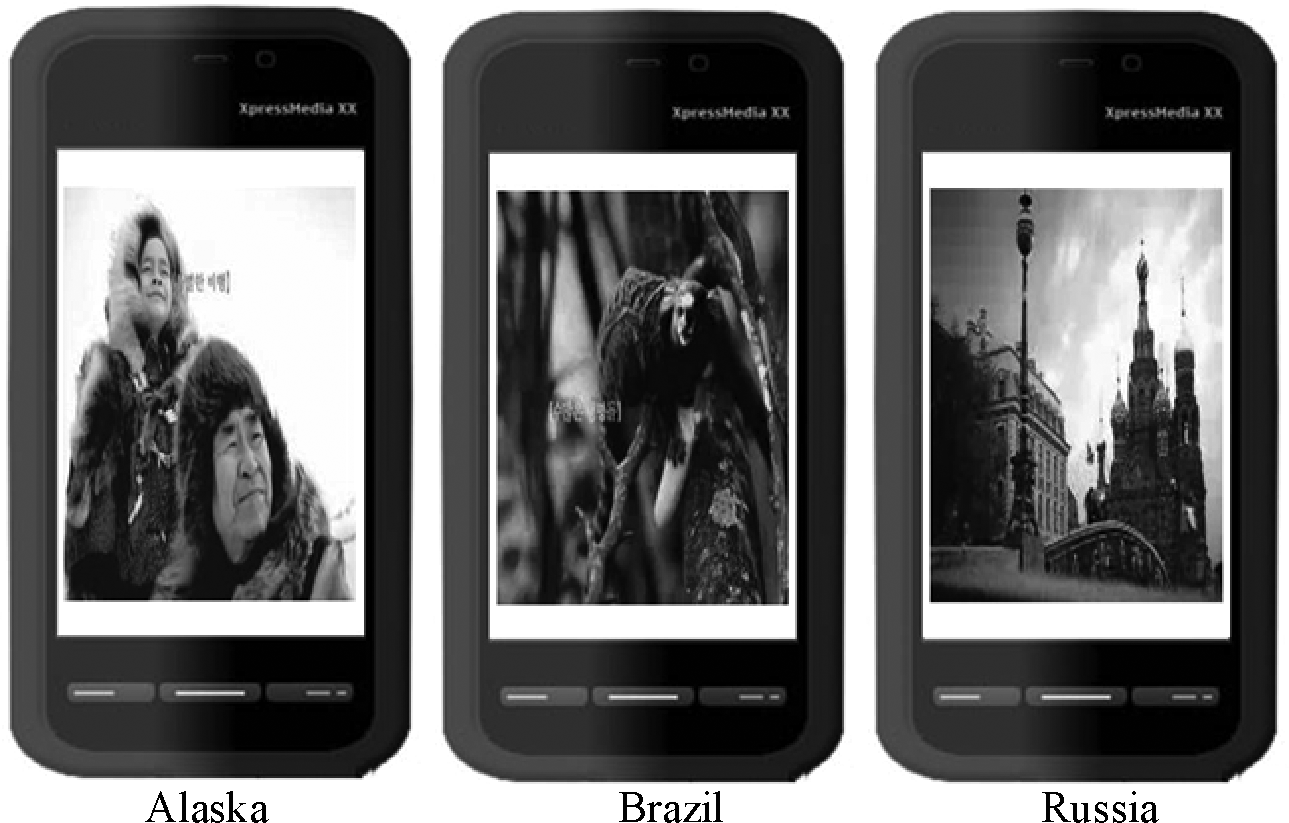
Example static pictures for three destinations.
Experimental design
A one-way within-subjects design with media type was conducted. Individual participants were exposed to advertisements in the three media types, each of which included only one of the three different destinations. The dependent measure was the participant's attitudes toward advertisements as measured by four questions on a seven-point rating scale.36,37 Each question was anchored by phrases based on three adjectives: “like-dislike,” “positive-negative,” “good-bad,” or “favorable-unfavorable.” The reliabilities measured using Chronbach's alpha were 0.97 for text, 0.97 for still pictures, and 0.94 for motion pictures.
Procedures
The experiment took place in a laboratory. Individuals were asked to use a simulated cell phone, and then received general instruction on how to use the phone for the experiment. Next, individual participants logged into the experimental program and were asked to complete questionnaires about their prior travel experiences and knowledge about the three destinations used in the experiment. The questions were randomly displayed.
The main session began by exposing participants to the experimental advertisements. Each advertisement started with a bell ring on a mobile-phone interface. The advertisements of the three travel destinations were delivered one by one in random order. In addition, each destination was presented in the different, randomly selected media types. For example, a participant received the Brazilian advertisement in text, the Alaskan advertisement in a still pictures, and the Russian advertisement in the form of a motion picture.
After watching each advertisement, the participants were asked to describe their attitudes toward the advertising questions, using a seven-point rating scale from 1=“strongly disagree” to 7=“strongly agree.” The entire session was complete in 15 minutes.
Empirical results
First, we examined past travel experiences and knowledge about the destinations to control for knowledge and experience about the three destinations. Only one participant reported having visited any of the areas. The trip knowledge was measured using a modified scale from Frewer et al. 38 that included four questions on a seven-point answering scale, ranging from 1=“strongly disagree” to 7=“strongly agree”: (1) “I have good knowledge about travel” (2) “I do not feel very knowledgeable about travel,” (3) “Among my circle of friends, I'm one of the ‘experts' on travel,” and (4) “Compared to most other people, I know more about travel.” The Chronbach's alphas of the four scale items were 0.96, with a mean of 2.89 (SD=1.53). In sum, these results showed that previous travel experience and knowledge about the three destinations were controlled for Experiment 1.
As shown in Figure 2, the attitudes toward motion pictures (M=5.41, SD=0.98) were the highest, followed by those toward still pictures (M=4.33, SD=1.27) and text (M=2.71, SD=1.36). A repeated measures analysis of variance (ANOVA) found a significant effect of media type, F(1, 116)=237.11, mean squared error (MSE)=1.45, p<0.001, ηp2=0.67, indicating a significant difference among the three media types with regard to effect on attitudes toward advertisements. The effect size explained 67 percent of the variance. Bonferroni's post hoc analyses (p<0.05/3) indicate that all of the pairwise differences were significant. Consistent with the hypotheses, motion pictures outperformed the other media types, whereas text was the rated lowest.

Means and standard error bars of attitudes toward advertisements.
Experiment 2: Delayed Attitude
Experiment 2 investigated the effect of media type in mobile advertisements on delayed attitudes. It was expected that attitudes toward motion pictures would decline over time because of the dynamic and multimodal properties, whereas those toward text and still pictures would increase.
Methods
Participants
All the participants in Experiment 1 were contacted via cell phones on a Saturday 4 weeks after Experiment 1. Ninety-five (53 males and 42 females; 81.20 percent) from Experiment 1 participated. The mean age was 23.52 (SD=1.94).
Measures
The participants' delayed attitudes were measured using the same questions used in Experiment 1.
Procedures
Four weeks after the initial experiment, one of the researchers made a phone call to each participant in random order. Participants were asked which advertisements they remembered. Then, their attitudes toward the advertisements were measured by repeating the same questions used in Experiment 1. Each interview lasted about 3 minutes. Most participants reported on only one advertisement (82.1 percent). When they mentioned multiple advertisements, only the first one that was recalled was included in the analysis.
Empirical results
A repeated-measures ANOVA was conducted on time (immediate and delayed attitudes) with the three media types as between-subjects. A significant difference of the media type was found, F(2, 92)=10.93, MSE=1.36, p<0.001, ηp2=0.19. Compared to Experiment 1, the effect size shows that 19 percent of the variance was explained by the media types. As shown in Figure 3 and Table 1 shows the immediate and delayed attitudes toward the advertisements: motion pictures registered the steepest decline among media types. Bonferroni's post hoc analyses (p<0.05/3) revealed significant differences between text and still pictures, and between text and motion pictures. A significant interaction effect was found between the media type and time, F(2, 92)=22.68, MSE=1.10, p<0.001, ηp2=0.33. As shown in Figure 3, the media effect differentially changed over time: the attitudes toward motion pictures declined, whereas attitudes toward text and still pictures grew more positive. No other effect was significant. Therefore, the proposed hypotheses were supported.
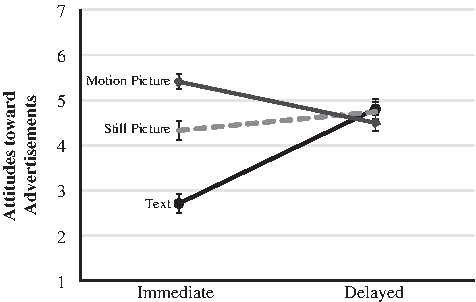
Means and standard error bars of immediate and delayed attitudes toward advertisements.
Discussion and Conclusions
The purpose of this study was to understand the perceived differences between various media types with regard to attitudes toward mobile advertisements and to investigate the nature of attitude changes over time. No previous studies have investigated the impacts of different media types on attitudes toward mobile advertisements over time.
As shown in Experiment 1, each media type available on mobile devices has differential influences on attitudes toward advertisements. Motion pictures have the strongest potential to shape consumers' initial attitudes. However, Experiment 2 shows that the impact of that particular media type changes over time; the impact of motion pictures drastically declined, whereas the roles of text and still pictures increased. This result is consistent with previous findings that text is more effective for providing information and promoting learning than are motion pictures or still pictures. For example, Wouters and Wetzels 39 found a positive effect on the recall of mobile advertising through only text-based SMS. They also found that still pictures play a growing role in attitude formation over time.
According to the heuristic-systematic processing theory, the properties of motion pictures, including dynamic information that changes over time, 16 are processed heuristically without semantic processing. Therefore, after 4 weeks, the impacts of motion pictures on attitude decrease sharply. In contrast, the impact of texts on attitudes toward advertisements increased over time because they are processed semantically or cognitively.
The sleeper effect seems to be well-demonstrated in this study. According to this hypothesis, 33 media features may initially shape attitudes in response to a highly persuasive message. Thus, the salience of media features in motion pictures compared to that in other media may dominate the development of an initial attitude toward an advertisement. However, the different media cues are forgotten as time goes by. Then, only the message content remains in memory to influence attitude toward advertising. Thus, the text media that initially has a lesser effect on attitudes may ultimately produce more favorable attitudes toward the advertisement's content. However, forgetting the media features that initially shaped the attitudes could lead to a less favorable attitude toward the content of the advertisement.
Iii and Woodside 40 also argued that dynamic information in motion pictures has multiple modalities for representing phenomena that change over time. Therefore, they suggested that appropriate forms of motion pictures should be used based on the intended time of impact. Further, these findings suggest an alternative method that allows advertisers to more successfully influence mobile phone users. Multimedia-related advertisements, especially motion pictures, have the potential to be particularly effective for multimedia service users in the short-term.
Despite the obvious significance, the findings need to be interpreted with caution. First, in this study, a simulated, actual-size mobile phone was used. Although this method allowed the study to be well controlled, the participating consumers might have responded differently if they had used their own mobile phones in their own everyday lives. Therefore, it is recommended that future research use real mobile phones in actual life circumstances. Second, though participants were actual mobile advertisement viewers, they were university students. Like younger populations tend to spend more time using media formats such as instant messaging, voice mail, etc.,41,42 studies including younger or older generations should be conducted to gain understanding of the interaction between media effects and age. Finally, although the participants had no differences in destination knowledge or experience and also were exposed to all the destinations in the experiment, some students might be exposed to a certain destination in a specific format between the first and second experiments. This might confound the result of the 2nd experiment.
The current research makes an important practical contribution for utilizing the advantage of mobile advertising according to media type. Motion pictures on mobile devices were identified as a successful new media presentation that influences consumer attitudes for a short duration of time, whereas text and still pictures are more effective over the long-term. Accessing the different traits of media types in mobile advertisements is necessary to more accurately capitalize on positive attitudes.
Footnotes
Acknowledgments
We thank anonymous reviewers for their constructive feedback. This study was supported by grants from the World-Class University program (R31-2008-000-10062-0) of the Korean Ministry of Education, Science and Technology via the National Research Foundation and from the Faculty Research Fund (2009), Sungkyunkwan University.
Disclosure Statement
No competing financial interests exist.