




Abstract
Abstract
Since Internet surfing became a daily activity, people have changed their behavior. This research analyzes the causes of problematic Internet use through an online survey, where 1,094 samples were collected. Based on the results of structural equation modeling analysis, the following conclusions are reached: First, novelty, security, and efficiency increase users' online trust. Second, information and efficiency enhance users' sharing and anonymity online. Third, greater trust in Internet environments leads to an increase in a user's cognitive bias toward online behavioral responsibility and Internet addiction. Fourth, a user's attitude toward online sharing further increases the cognitive bias toward online copyright. Fifth, a user's attitude toward anonymity increases cognitive bias toward online copyright, online behavioral responsibility, and deepens Internet addiction.
Introduction
The purposes of this research are as follows: (a) to summarize the characteristics of the Internet environment, while understanding user attitudes toward the Internet, and exploring problematic Internet use; (b) to establish a measuring model for investigating the relationships among the characteristics of the Internet environment, the users' attitudes toward usage, and problematic Internet use.
Literature Review
Internet environment characteristics
With the growth of the Internet, some studies have explored the value by the Internet. Schillewaert et al. 2 asserted that the Internet enables quick response, data collection, lower costs, high convenience, and flexibility. Moreover, Liu and Arnett 3 analyzed the key success factors behind e-commerce Web sites, and had found that information and service quality, utilization, entertainment, and design are the four key determinants of a Web site's success. Wolfinbarger and Gilly 4 had created an online retail quality (eTailQ) scale for businesses to develop a better business model online. Loiacono et al. 5 proposed the WebQual method, from which fundamentally four common features are determined: novelty, security, information, and efficiency. There are many studies related to the characteristics of the Internet environment, and this study has organized the above studies, and summarized into four main characteristics as follows:
Novelty
Novelty includes innovative e-commercial models and application services, aesthetic design, and dynamic audio, for entertainment purposes and for personalized services.4,6–9
Security
Security refers to the protection of personal privacy and an authentication mechanism for online transaction. Because online transactions are secure, e-commerce businesses have rapidly developed.4,7,10–12
Information
Information includes diverse products, services, and abundant information sources that can satisfy users' needs through online interactive processes.4,5,7,8,13
Efficiency
The efficiency of an Internet environment includes a 24/7 service, real-time service and response, time and cost savings, and easy usage.5–7,11,12
Attitude toward Internet usage
This research framework discusses the deviant behavior caused by users' experience after using the Internet. Past studies on Internet user attitude focused on trust, the key to whether a transaction can be successful. Studies regarding online deviant behavior had found that sharing and anonymity are the key attitudes affecting online deviant behavior. Therefore, we discuss the above three Internet usage attitudes to understand their importance between users and the Internet.
Trust
Many studies on e-commerce suggest trust is the most important.14–16 Dayal et al. 17 concluded that the Web sites cannot be established without trust. The guarantee of fulfillment and system reliability provided by online transactions are among the main factors enabling users to build trust.4,7,18–20 Jones and George 21 further asserted that, when trust is established, people share information with others unconditionally. In particular, Wang and Emurian 9 concluded Web site interfaces affecting trust. Thus, the establishment of trust is a prerequisite for e-commerce.
Sharing
This research delves into the users' attitude toward sharing information after using Web 2.0. O'Reilly22,23 mentioned that Web 2.0 is an aggregate of economic, social, and technical aspects, constituting the new generation of Internet environments featuring user participation, openness, mutual sharing, collective intelligence, cooperative development, and network effects. In subsequent research, Clarke 24 explored the characteristics of Web 2.0, which includes following features: (a) sociable; (b) interactive; (c) collaborative; (d) affiliated; and (e) versatile. Therefore, Web 2.0 emphasizes an Internet culture characterized by openness, interaction, and sharing.
Anonymity
Anonymity can be defined as “hiding individual names or relevant background information to prevent others from using his/her access.”25–28 Wallace 27 indicated people hide names for the following reasons: (a) to shirk personal responsibilities; (b) to ensure privacy; (c) to avoid being despised or defamed; (d) to promote communications; (e) to avoid revenge; and (f) to grasp the degree of individual social relationships. However, Akdeniz 28 deemed that online anonymity simultaneously makes it difficult to trace identities, thus causing problematic Internet use, such as spreading viral emails, pornography, and committing Internet fraud.
Wang and Emurian 9 had found the more novel characteristics a Web site possesses, the more likely to generate trust toward the Web site. These characteristics may include having well-designed pictures and layout, user-friendly design, clear information, and easy-to-use shopping cart function. Palme and Berglund 28 believed Internet users may create accounts in novel social Web sites for surf freely online.
Past studies on online service quality, online shopping, or online virtual communities has found that the security mechanisms increase visitors' trust toward the services.4,29 Palme and Berglund 28 identified personal information privacy policies or data transfer security agreement can protect personal information, but influence an attitude toward anonymity for Internet users.
Alba et al. 30 believed shopping Web sites provide the product-related information, it helps consumers to raises the efficiency of their purchase decisions, and would perceive the shopping Web site as trustworthy and reliable. Khoo et al. 31 believed children or teenagers access the Internet, the abundance of information would lead them to believe the information is shared, and generate an open-sharing attitude. Keen 1 identified that we can never be sure what we see online, because the Internet contains much information published anonymously. This also reinforces the attitude toward anonymity in Internet users.
Richmond 32 found Internet's time-saving characteristics, 24-hour availability, and convenience in terms of information search as resulted in a sense of trust in consumers toward the Internet. DeGeorge 33 stated P2P software and search engines have allowed users to download information from Web sites around the world, and to easily share their files with other users world-wide. This reinforces the attitude that the Internet is an open-sharing environment. Studies reached to Internet addiction have found that because online community lacks face-to-face communication, those users often lonely or upset may use the Internet's anonymity nature to satisfy their needs that cannot be fulfilled in the real world 34
Problematic Internet use
Cognitive bias toward online copyright
Keen 1 affirmed the Web 2.0 environment emphasizes openness, sharing, and freedom, which may confuse the concepts of copyrights. Some Internet users regard anything placed online as public goods. This attitude results in Internet users obtaining information through various illegal means. Khoo et al. 31 also indicated that most users downloading MP3 music illegally, arbitrarily duplicate files, and distribute illegal files to others. Bhattacharjee et al. 35 concluded that file-sharing software mislead some people on the copyrights.
Cognitive bias toward online behavioral responsibility
Khoo et al. 31 indicated the Internet has an anonymity function, enabling students to defame teachers. Khoo et al. 31 also summarized four frequently seen cognitive biases in behavioral responsibility, as follows: (a) unreasonable dialogue; (b) arbitrary use of capital letters and exclamation marks; (c) revealing personal information; and (d) rashly expressing personal feelings to others. Moreover, Keen 1 also indicated Internet users may make seriously biased and exaggerated remarks on Internet forums, and even create fake news or rumors; the function of online anonymity causes Internet users to ignore their responsibilities. 36
Internet addiction
Goldberg 37 first proposed the term “Internet addiction” in 1995. He indicated that overuse of the Internet results in individual adaption problems, having a negative impact on a person's daily life. Young 38 researched empirical examples of Internet addiction. Greenfield 39 confirmed that most users becoming Internet addicted are unable to handle the problems of mental disorders, serious health problems, disabilities, or interpersonal problems, while Morahan-Martin and Schumacher 34 indicated that those who tend to be lonely and depressed ease their pain through the Internet to gain friendship and support, which are highly deficient in their daily lives. However, though the Internet causes these people to be even more addicted to the Internet, consequently becoming even lonelier and depressed, which also results in addicted users avoiding face-to-face communication in real life.
Whitty 40 found users' experience Internet technology would influence their sense of trust in the Internet, and the longer they spend online, the more easy to create a trusting relationship toward Internet technology for users. Furthermore, since it is easier to acquire illegal information, it is more likely for users to conduct deviant behavior. Keen 1 identified that nowadays we have too many things that must be accomplished online, as a result more deviant behaviors, and more Internet addiction.
Bhattacharjee et al. 35 stated that users' misunderstanding toward intellectual ownership and copy right is a result of P2P software, free application services provided by Internet providers, and open information online, leading users to believe that all of the services and information online can be freely acquired, owned, and shared.
Willard 41 identified one of the main reasons online harassment is rapidly expanding because Internet users can easily remain anonymous. Martin and Schumacher 34 found that people habitually lonely or upset would be even more reliant on the Internet's anonymity function to satisfy needs that they cannot fulfill in the real world. Through online interaction, they can acquire equal support and friendship, and acknowledge the open and sharing attitude of the online environment, as a result they would spend more time on the Internet, and may even become addicted.
Measurement
This research adopts the online questionnaire format. To ensure that the sampling conforms to real Internet users in Taiwan and to acquire more accurate information, the sampling ratio for Internet users from Taiwan Network Information Center (TWNIC), 42 the only official and nonprofit organization offering the Internet statistics in Taiwan. Our study employed by setting age and gender quota to meet recent Internet users' profile provided by TWNIC. In addition, most research on problematic Internet use is aimed at students. 43 The sampling methodology, in which larger age ranges are included, is more representative. This study adopted the 6-point Likert scale. We designed the questionnaire with several confirmation questions to prevent the respondents to behave irresponsibly. That is, if someone does so, he/she will be screen out. This instrument works and successfully avoids the cognitive bias from respondents. In this research, 1,094 effective samples were collected. Table 1 displays the detailed gender and age distributions.
The participants' profile. (InsightXplorer, 2010; TWNIC, 2010).
The questionnaires' KMO value reaches 0.945, an excellent level for executing the Exploratory factor analysis (EFA). 44 EFA results show all items' factor loadings are between 0.62 and 0.89, with the total explained variance is 64.36 percent.
For examining the questionnaire's reliability, the overall Cronbach's alpha coefficient in the questionnaires' analysis in this research is 0.933, Cronbach's alpha of the cognitive bias toward online behavioral responsibility is 0.724, indicating acceptable reliability, while Cronbach's alphas of these dimensions exceed 0.8, implying high reliability. 45
As regards criteria for validity analysis, Fornell and Larcker 46 identified three criteria—first, completely standardized factor loading must exceed 0.5; second, the composite reliability (CR) must surpass 0.7, and finally, average variance extracted (AVE) must surpass 0.5. In this study, CR of these dimensions exceeds 0.8, and for AVE, only that of the cognitive bias in behavioral responsibility nearly reaches the acceptable level, 0.5, and those of the other variables all surpass, suggesting that the validity analysis results for the 10 variables proposed in this research meet high criteria. Fornell and Larcker 46 identified that root-mean square of factor AVE exceeding the relevant coefficients among other variables indicates good discriminant validity for the measurement model.
In this research, the discriminate validity analysis shows that there are striking differences among variables (for details, see Table 2). In addition, for measuring the fit of the SEM model, the proposed model's GFI is 0.924, AGFI=0.907, NC (χ2/df)=2.08, SRMR=0.0475, and RMSEA=0.0320, CFI=0.990. All the indices are well above the suggested standard of the fit of the model,47–50 and the results show an excellent fit with the proposed SEM model. Figure 1 displays the results of the analysis.
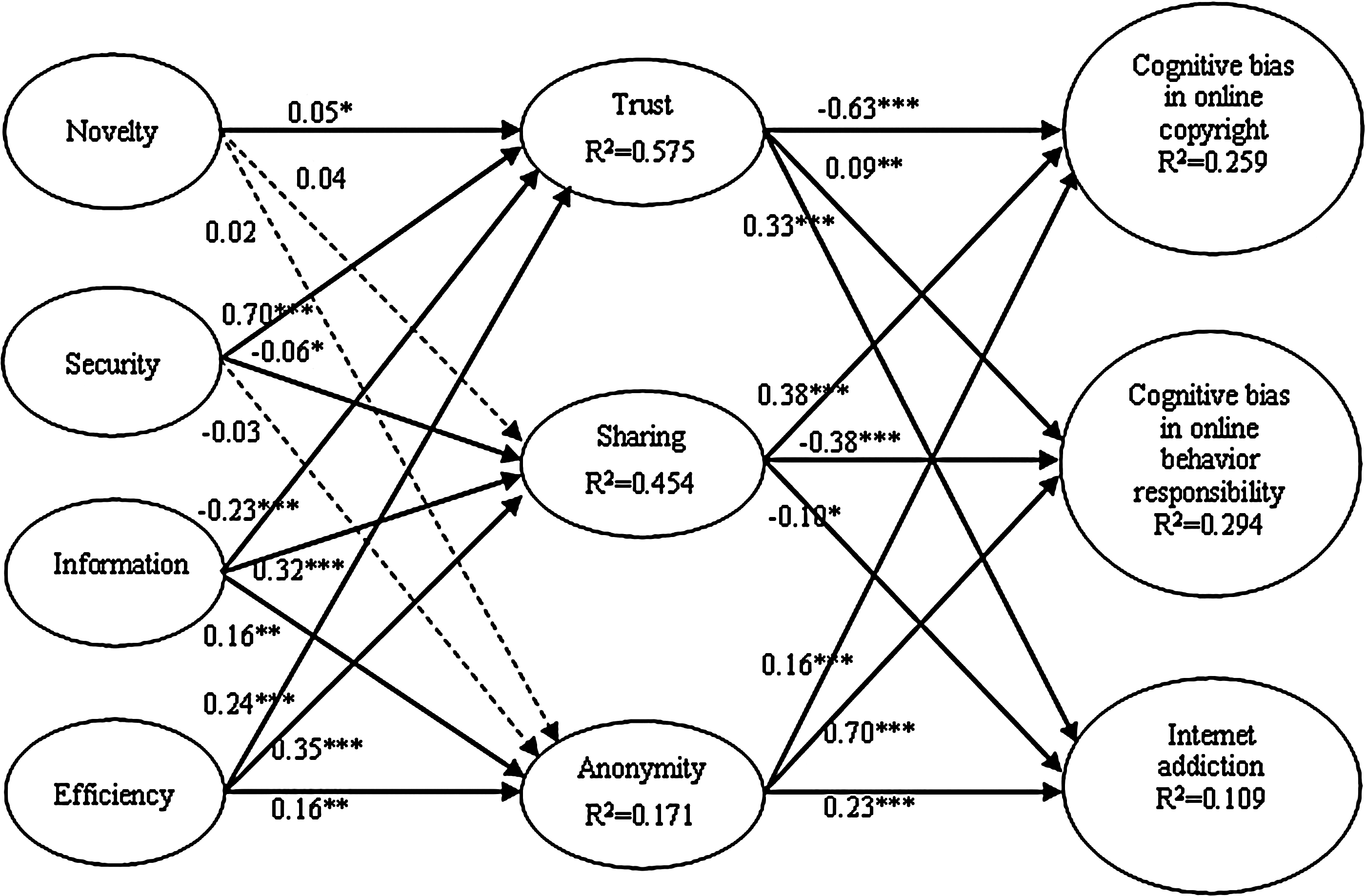
Results of structural equation model.
Mean-square root of average variance extracted is exhibited along the diagonal direction.
Bold indicates the square root of the variance shared between a construct.
Results and Analysis
The analysis results suggest that (Fig. 1), novelty of Internet environments has an obvious influence on attitude toward trust, wherein the relationship in between is specified (γ11=0.05, t=1.69*, p<0.05), supporting H1a, while the novelty of Internet environments has no obvious influence on attitude toward sharing, wherein γ12=0.04 (t=0.96, p>0.05), not supporting H1b; novelty of Internet environments also fails to exert obvious effects on attitude toward anonymity (γ13=0.02, t=0.47, p>0.05), not supporting H1c.
Security of Internet environments correlates positively and strongly with attitude toward trust, which is indicated by the relationship (γ21=0.70, t=22.73***, p<0.001), supporting H2a. However, security of Internet environments exerts obviously negative influences on attitude toward sharing (γ22=−0.06, t=−2.05*, p<0.05)), but exerts no obvious influences on attitude toward anonymity (γ23=−0.03, t=−0.96, p>0.05), not supporting both H2b and H2c. The analysis of information of Internet environments and attitude toward Internet usage implies that obviously, the former factor correlates negatively and strongly with the latter one (γ31=−0.23, t=−5.98***, p<0.001), not supporting H3a, whereas information of Internet environments correlates positively and strongly with attitude toward sharing (γ32=0.32, t=6.03***, p<0.001), supporting H3b. Finally, information of Internet environments also correlates positively and strongly with attitude toward anonymity (γ33=0.16, t=2.55**, p<0.01), supporting H3c.
Analysis of efficiency of Internet environments and attitude toward Internet usage further suggests that efficiency has a strong positive link with attitude toward trust (γ41=0.24, t=5.96***, p<0.001), supporting H4a; the analysis also suggests that perception of online efficiency enhances the willingness to share information (γ42=0.35, t=6.17***, p<0.001), supporting H4b. At last, the analysis reveals that the perception of online efficiency enhances the willingness to remain anonymous online (γ43=0.16, t=2.53**, p<0.01), supporting H4c.
Next, the discussions are aimed at the link between attitude toward Internet usage and problematic Internet use. First, more trust in the Internet leads to more cognitive bias toward online copyright (β11=−0.16, t=−5.37***, p<0.001), while more trust toward Internet is more likely to result in cognitive bias in online behavioral responsibility as well as Internet addiction (β12=0.09, t=2.76**, p<0.01; β13=0.33, t=10.01***, p<0.001). Therefore, H5a are not supported, but H5b and H5c are.
Sharing more information online leads to more cognitive bias toward online copyright (β21=0.38, t=7.77***, p<0.001), but is less likely to cause cognitive bias in online behavioral responsibility (β22=−0.38, t=−6.77***, p<0.001), supporting H6a, but not supporting H6b, respectively. Additionally, more willingness to share is less likely to cause Internet addiction, (β23=−0.10. t=−2.10*, p<0.05), not supporting H6c.
The analysis of connection between attitude toward anonymity and problematic Internet use suggests that more willingness to be anonymous is more apt to lead to cognitive bias in online copyright, and cognitive bias in online behavioral responsibility (β31=0.16, t=3.48***, p<0.001), and (β32=0.70,t=10.58***, p<0.001) verifying H7a and H7b, respectively. Finally, more willingness to be anonymous is more likely to cause Internet addiction (β33=0.23, t=4.74***, p<0.001), justifying H7c. Additionally, explanation (R 2 ) of dependent variables of the overall sample model for attitude toward trust, sharing, anonymity, cognitive bias in online copyright, cognitive bias in online behavioral responsibility, and Internet addiction in this research is 57.5 percent, 45.4 percent, 17.1 percent, 25.9 percent, 29.4 percent, and 10.9 percent, respectively.
Conclusions and Suggestion
In this study, novelty, security, and efficiency of Internet environments are the main factors enabling Internet users to have trust in the Internet, suggesting that a professional Web site layout, secure mechanism, privacy protection, agreement on service fulfillment, and quick response time are prerequisites for gaining users' trust in Web sites, services, or information technology.4,29,51–53 Next, empirical research reveals perception of online information are more likely to have less trust in the Internet, which may result from the information overload. Loose 54 identified that information overload occurs in Internet, indicating that much information may disable users from judging the the accuracy of the information, thus, failing to result in a positive attitude toward the Internet. Moreover, the attitude toward sharing originates from personalized services, abundant information, and quick services, as well as solutions acquired through mutual interactions offered by the Internet.29,31,33,51,52 However, Web site security is more likely to discourage Internet users from being more willing to share information. The attitude of Internet users toward anonymity mainly results from information and efficiency of Internet environmental characteristics, suggesting that personalized services and information that is abundant and easily acquired in Internet environments further enables more anonymous channels for Internet users, the anonymous effect can be enhanced by easy access to the Internet via computers and smart phones anytime and anywhere.1,28,34
In this research, we found that users' trust toward Internet environments are more likely to cause cognitive bias toward online behavioral responsibility and Internet addiction, indicating trust in the Internet tends to ignore their behavioral responsibility in daily life. However, conversely, those who have more trust in Internet environments are less likely to have cognitive bias toward the copyright of online information.
Additionally, users sharing more information online would less likely have cognitive bias toward online behavioral responsibility and Internet addiction. This research concludes that Internet users may transact business and conduct communications with customers through the Internet, discuss job-related content or shopping experiences with other members, share more positive information among members, and search for useful information.
Footnotes
Author Disclosure Statement
No competing financial interests exist.