




Abstract
Abstract
The influence of Facebook in social life keeps constantly growing. Recently, the communication of information has been vital to the success of the Tunisian revolution, and Facebook was its main “catalyst.” This study examines the key reasons that explain Facebook's contribution to this historical event, as perceived by Tunisian Internet users. To do so, we launched this study 5 days after the fall of the regime using an online questionnaire in which participants (N=333) first rated the importance of Facebook in the Tunisian revolution and then explained the reasons for their ratings. A cluster analysis based on the Euclidean distance between the most frequent words in the participants' text corpus (6,640 words), revealed three main clusters that we interpret as follows: 1: Facebook political function, 2: Facebook informational function, and 3: Facebook media platform function. It is likely that these factors reflect the dynamic of Tunisian cyberspace and the Tunisian Internet users' collective consciousness during the revolution.
Introduction
Since the inception of the Internet, new varieties of behavior have become the subject of psychological research. We face, almost each decade, a new technological revolution that drastically changes our (virtual) behavior and daily habits. Nowadays, the Internet is marked by information sharing and online social networking. In analogy with classical forms of social mobilization 4 where it has been demonstrated that people show particular ties to their communities, a social network is also a large place where virtual communities serve about the same people's needs in terms of freedom of expression.
As the first millennium revolution, the Tunisian revolution diverges in some ways from previous forms of uprisings. In the following paragraph we highlight its specificity through three interrelated criteria:
(a) The role of communication: One prominent feature is the massive use of communication channels in the new Internet era. Social networking was reported to be more or less effective in changing social and political attitudes toward elections in countries such as Canada, the United States, Iran, Thailand, China.5–7 However, with 850,000 active Facebook users among 3.6 millions Tunisian Internet users (∼35 percent of the general population) during the unrest, we witnessed the first reported massive use of an online social networking platform as an alternative militant media. 8 Unlike offline protest in an authoritarian political environment, virtual uprising tends to keep militant activity unnoticeable, and in the Tunisian case it resulted in a very fast-moving action on the field to oust the regime's main figures.
(b) The role of the youth: Many examples of revolutions and social movements in the 20th century such as the May 1968 French protest, the Portuguese carnation revolution (April 25, 1974), the color revolutions, the South African youth revolution (1990s), and more recently, the 2009 Moldavian civil unrest and the Iranian 2009 green movement took the youth among other contributing factors as a key component to their success. However, the Tunisian revolution was fully and spontaneously driven by the youth who were the only actors on the stage during the uprising. An obvious explanation of this fact can be attributed to the ease with which younger people cope with new communication platforms such as Facebook, Twitter, and YouTube. 9
(c) The leadership: All the above-mentioned political and social movements have a leadership in an organizing capacity that guides the youth action. In the Tunisian case the youth cyberprotest and street demonstrations were marked by the absence of any leader, association, or a political figure or party as a distant top–down leadership. Thus, this social and political uprising can be qualified as a leaderless revolution 10 when citizen are gaining control of their own decisions.
Many news articles and reports had pointed out to the central role of Facebook to the success of the Tunisian revolution but no substantial data has been gathered to study this question from a psychological perspective. In the present study, we hypothesized that a better understanding of Facebook's role in the Tunisian revolution may be obtained by assessing the perception of Tunisian Internet users of Facebook contribution to this event. We also made the assumption that implicit features of this perception can be uncovered by using advanced quantitative text corpus analyses and accordingly linked to the “collective consciousness” of our participants' cyberspace. Consequently, it was crucial to capture the key causes that explain Facebook's contribution to this historical event in a timely fashion. For this reason, we launched the present study 5 days after the fall of the brutal regime of Ben Ali.
Facebook is on the top list of all available social network platforms. Shih 11 gave three reasons for why Facebook was so special: (a) Trusted identity and visibly defined networks, (b) Exclusiveness, and (c) News feeds.a More recently, Kirkpatrick 12 provided a trend analysis stating that if the Internet and Facebook kept growing constantly it is highly expected that by 2013 almost every Internet user will have a Facebook page. Park et al. 13 conducted a Web survey aimed at examining the relationship between the gratifications of Facebook group users and their offline political and social life. They showed the presence of four primary needs, including: socializing, entertainment, self-status seeking, and information.
Citizen Media, Facebook, and the Tunisian Revolution
The regime of the ousted Tunisian President Ben Ali came to an end in January 14, 2011 after 23 years of tyranny that slowly eroded political and social life in Tunisia. The oligarchy that reigned for decades left the country in deep corruption, kleptocracy, nepotism, a fragile economic situation with high unemployment, and high living costs. Freedom was muffled by banning participation of political opponents and by practicing Internet censorship. 14 In the latest issue of Democracy Index, 15 Tunisia was ranked 144 out of 167 countries with an overall score of 2.79 out of 10 (full democracy).b
In this antidemocratic context, the Tunisian cyberactivist movement emerged as a type of dynamic change “catalyst” that bridged the gap left by traditional media and human rights organizations. While vigorously resisting the government's attempts to control its action, Tunisian cyberactivism shaped a relatively large portion of the public opinion about the government's abuse. For example, in 2007, Zuckermanc praised the case of the Tunisian blogger “Astrubal” who posted in 2004 a remix of Apple's “1984” ad (3 years before the Obama remix) on Daily Motion, showing a hammer that shatters a screen where the ousted Tunisian president Ben Ali is speaking, as part of a large cybercampaign for the boycott of the 2004 presidential elections in Tunisia.d These cyberspace tools, also known as “Citizen Media,” 16 allow ordinarily passive citizens to be active in the media by sharing information that would ultimately have a major impact on their communities.
According to many media sources, the communication of information was vital to the success of this revolution, and Facebook was its main vector, as recognized by many foreign observers. 17 Facebook was supposed to be banned as an open access communication tool but was used by the government as a surveillance instrument to track any unusual political or social activities on the network. 18 On January 24, 2011 a striking revelation by Facebook's Chief Security Officer was published in The Atlantic 19 ; it confirms how threatening Facebook cyberactivism was to the government during the events preceding the fall of the regime. Indeed, political-protest pages were hacked and even worse, the government tried to get hold of all passwords of Tunisian Facebook users. Given the role that Facebook played in the Tunisian revolution, this surveillance had an unanticipated boomerang effect.
One may ask: how was a 23-year-old burden removed in 29 days? And how could this revolution be driven spontaneously? The answer can be summarized concisely: the new form of youth revolution in the second millennium. In the following sections, we summarize the key events during the 3 weeks that led to the historical day of January the 14th.
The Events Background
The spark
In Sidi Bouzid, a small mid-southern Tunisian city that for years suffered from lack of jobs, Mohammad Bouazizi, an unemployed 26-year-old and the only provider for his mother and six siblings, had left school and chose to become an unlicensed fruit and vegetable street vendor. 20 Bribing is acknowledged to be a standard practice to guarantee one's survival in street marketing, 21 so he was frequently forced to bribe. Bouazizi underwent this mistreatment several times. By the morning of December 17, 2010, he had had enough of this long-lasting indignity. He had a violent altercation with a 45-year-old woman municipal inspector who confiscated his weighing scales, and after his refusal to hand them over, Bouazizi was publicly humiliated by the inspector and her aides who insulted him and forced him to the ground. Bouazizi's deep sentiment of hopelessness drove him to commit suicide by setting himself on fire in front of the local police station on December 17, 2010. His friends and neighbors, anguished by his self-immolation, started a popular uprising. His suicide was a result of the economic discontent and drew the attention of thousands of Tunisian who shared Bouazizi's condition.
The blaze
This desperate act ignited street protests that spread like wildfire across the country. The events were documented daily by cell phones, cameras, and amateur video recordings that were posted on Facebook and YouTube and eventually broadcast worldwide by the TV channel Al Jazeera. On January 4th, 2011, Bouazizi succumbed to his severe burns, and his burial was attended by hundreds of people who risked police crackdown. 22 What initially started after the Bouazizi's death as a protest about the costs of living turned into a full-blown political uprising. Ben Ali tried then to stifle the protests with an extremely violent reaction from security forces, which opened fire with live ammunition on unarmed citizens gathered in peaceful demonstrations. When Ben Ali called for the military forces to help stop the protests, they refused to obey and joined the civilian population. This was a turning point in the unfolding of events that urged the fall of the regime. 23 Images and videos of dead citizens and funerals got posted and eventually sparked collective outrage. On January 14, 2011, hundreds of Tunisians gathered in the capital Tunis and shouted in French what would become the revolutionary catch-word “dégage (get out).” Around 6 p.m. local time in Tunisia, Al Jazeera Arab TV channel exclusively reported the breaking news that Ben Ali had fled the country. 24
Method
The questionnaire
We created an online questionnaire using Google spreadsheet tool to guarantee speed and timely processing of data gathering. The questionnaire consisted of two closed questions: (a) Are you a Facebook user? and (b) How do you feel the importance of Facebook in the Tunisian revolution of January 2011 (from 0: not important at all to 10: very important)? The open-end free question was: According to your rating, please explain in one sentence your choice. Given the nature of circumstances surrounding the event, time and speed were crucial to run this study, which is why we opted for such a short questionnaire. On January 19, we posted the online questionnaire in many Tunisian forums, blogs, and Facebook group pages.
The sample
All participants were anonymous Internet users completing the questionnaire by simply following a link posted on their cyberspace.e The original sample was 352, of which 333 (94.6 percent) were retained in the final analysis. The 19 (5.4 percent) removed answers were due either to the emptiness or the lack of completeness of their answers. Among the 333 answers, only 22 (6.6 percent) of our participants were not Facebook users. The recorded time stamp of the first answer is January 19, 2011 at 10:10:18 a.m. and for the last answer is March 13, 2011 at 1:53:23 p.m.
Statistical analysis techniques
After generating the word cloud we extracted the vector of the most frequent words. The threshold was determined ad hoc by looking at a significant jump in frequency values. Accordingly, we considered as frequent each word above the threshold of ti=18. We then used a common straightforward technique for tracing hierarchy of groups among a set of observations called hierarchical cluster analysis. 26
Results
The perceived level of Facebook importance
Figure 1 shows the distribution of participants' responses to the first question. The results revealed an increasing trend that peaked with 22.5 percent at level 10. A threshold can be defined between level 6 and 7, meaning about 80 percent of the participants estimated Facebook's contribution to the Tunisian revolution as important to very important.
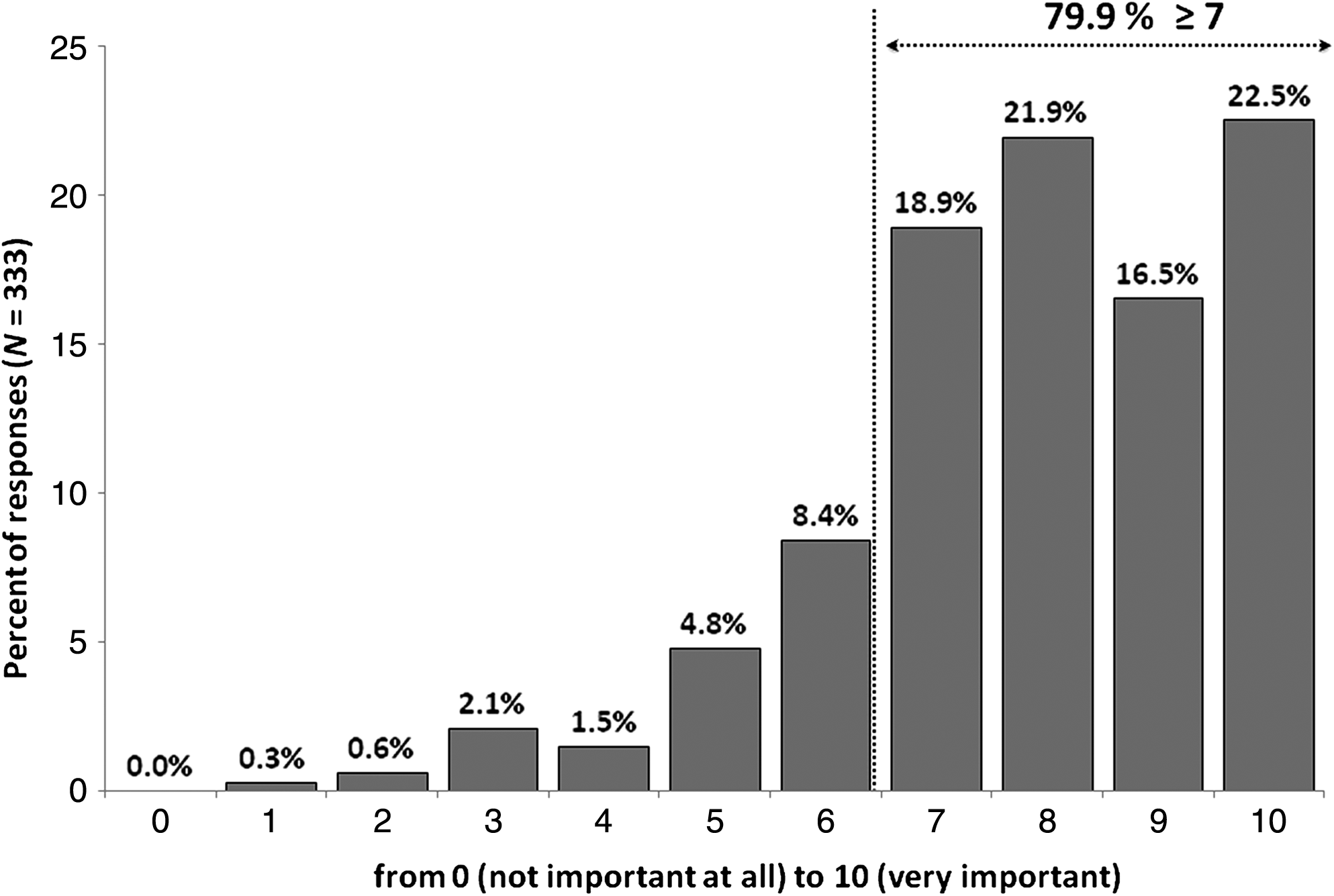
The distribution of responses to the first question as a function of the participants (N=333) perceived level of Facebook importance to the Tunisian revolution.
Text corpus analysis
The tag cloud. We applied the word cloud graphical technique based on the 6,640 English words from the newly translated English corpus to visually illustrate the most frequent words in participants' answers. 28 Figure 2 shows the result.

Word cloud graph based on a text corpus of 6,640 English words (original text corpus is composed of 7,794 French words). The word display font size is correlated with word frequency (number of occurrences in the text corpus). To create this graph, we used the online algorithm Wordle developed by J. Feinberg (
Cluster analysis
We conducted a cluster analysis, based on the following 17 most frequent words in the text corpus: Facebook (count ti=279), information (ti=129), people (ti=67), videos (ti=58), media (ti=47), Tunisia (ti=37), events (ti=35), role (ti=33), important (ti=32), Tunisian (ti=28), Tunisians (ti=25), helped (ti=25), transmission (ti=24), played (ti=23), allowed (ti=21), means (ti=20), communication (ti=19). This analysis was on the Euclidean distance matrix between these 17 words (see Table 1). The results reveal three main clusters that we interpret as follows: cluster 1: Facebook political function; cluster 2: Facebook informational function; and cluster 3: Facebook media platform function (see Fig. 3).

Cluster dendrogram based on the Euclidean distance matrix between the 17 most frequent words in the text corpus. The analysis revealed three main clusters: cluster 1 indicates the Facebook political function; cluster 2 indicates the Facebook informational function; and cluster 3 indicates the Facebook media platform function.
By assuming that word frequency in the corpus is a continuous variable, then Euclidean distance is the suitable criterion. 25 This measure is the length of the line segment between two words in a metric space. The method applied is the agglomerative clustering that has the advantage to start with a small groups and then these groups will be merged into larger groups and so on. 26 The results of hierarchical clustering are usually presented in a tree diagram referred to as dendrogram which is a visual representation of the distance at which clusters are combined. Cluster analysis was carried out with R statistical software (R Development Core Team, 2005). 27 The procedure is threefold: (a) determining the statistic that quantifies similarity or distance between two words, (b) choosing the appropriate method for forming the clusters, and (c) deciding the number of clusters that represent the dataset the best. In the present study we chose the Euclidean distance to measure how far apart two words were.
Clusters' interpretation
We provided in Table 2 a detailed description of the resulting three clusters from the hierarchical cluster analysis that we illustrated with some examples from the answers of the participants.
The original French text corpus contained 7,794 words. (a) We first opted for the unmatched strength of Google Translate for French to English translation as shown by Shen in 2010. 29 (b) Then two English-native speakers made sure that all translated sentences were grammatically correct and matched the original French sentences. (c) One key step prior to the quantitative text analysis is the filtering out of all stop words (mainly function words, articles, and prepositions) to provide the program with only chunks of text. At this point, the outcome of the word cloud is not affected by the text language. Note that the word cloud technique is aimed to highlight metadata about an item (i.e., frequency in a corpus) regardless of the structure of individual sentences. (d) After trimming the French corpus, the two judges had to separately check any discrepancies between French and English text chunks. When we failed to reach 100 percent of agreement both judges had to disentangle from the original context which decision to be taken. Only three critical discrepancies were discussed and it concerns the following words: “Tunisian,” if it refers to the adjective or the citizen, “Information,” in French the word can be either singular or plural and the word “mean,” if it refers to the notion of average or tool.
To interpret the results provided by the quantitative step of analysis we approximately followed the procedure suggested by Mayring 30 for qualitative content analysis to find a match between our clusters and the so-called deductive categories. The label for each category was immediately derived from words forming the cluster and each label was used as a working hypothesis. This qualitative step required a coarse coding of each category that can be easily checked with text corpus passages to validate the labels of the categories.
Discussion
In the present study we examined the perception of Tunisian Internet users regarding Facebook's contribution to the Tunisian revolution. The results provided specific descriptions of the perceived characteristics for the primary roles played by the Facebook social network in the Tunisian revolution.
Facebook was perceived as a “catalyst” that accelerated the Tunisian revolution. Without this social networking platform, the revolution would certainly have evolved more slowly. The present findings disentangle some of the main aspects that explain the acceleration mechanisms of this social movement. It is likely that the three described clusters (political, information, and media platform functions) reflect the dynamic of the Tunisian cyberspace during the uprising. Indeed, each Tunisian Facebook user had developed a certain knowledge about either acquiring or sharing information related to the uprising. By being involved in the field and filming live action related to the unrest, “citizen media and journalism” were crucial in shaping people collective consciousness. The latter will help individuals to filter the huge amount of miscellaneous information on Facebook to locate what is relevant to the communication processes within the network. Over time, Facebook users gain responsibility about information encoding and sharing, thus the achievement of the cyberspace goal becomes efficient. Ousting the regime was this goal and Facebook was the platform that helped the collective political awareness of the people thrive and ultimately their responsibility toward this goal (see Fig. 4).

A descriptive tentative model based on the cluster analysis of the social network dynamics toward the revolutionary goal.
In the same vein, the hierarchical structure of the dendrogram in Figure 3 shows more proximity between cluster 1 and 2. Hence, it is not excluded that the political awareness coming from different media is more powerful when efficiently shared by different users. In other words, users progressively tend to filter and purposefully orient media toward one specific goal and the cumulative amount of information will ultimately become domain-specific to the revolutionary cause.
Our tentative model may explain the likelihood of this leaderless revolution, since the described mechanisms operate in a bottom-up fashion. A rule-based or a top-down approach typically associated with the presence of a leader (party or a person) would have arranged the pieces differently. 31 Accordingly, each Tunisian Facebook user involved in the revolutionary process formed an entity that interacted at different levels of complexity with other entities until an emergent property appears from the global behavior. 32 This entity can be assimilated to the political awareness of the large group, which will ultimately evolve to the status of a “drive” for the whole revolutionary process.
Conclusion
The present study examined the key reasons that explain Facebook's contribution to the Tunisian revolution as perceived by Tunisian Internet users. The results revealed three main dimensions that we interpreted as follows: 1: Facebook political function, 2: Facebook informational function, and 3: Facebook media platform function. Tunisian revolution is marked by the absence of a leader; the possibility of a leaderless revolution is likely to be explained only by the spontaneity, the homogeneity, and the synchronicity of the Tunisian Facebook cyberactivism network action as we illustrated above. This explanation can be supported by an interpretation in terms of “collective consciousness” that refers to an internal knowledge shared by a plurality of persons.33–35 Coupled with “citizen media” activism, this knowledge emerges as a new form of consciousness via communication tools (see also for comparable interpretations, Žižek, 36 who likewise used the concept of “collective mind” and more recently Boguta 37 who used “new collective consciousness” to describe the computational history of the Internet shutdown during the Egyptian revolution). Accordingly, this form of “collective cyberconsciousness” was revealed to be timely, acute, rapid, domain-specific, and purpose-oriented, which are potential “qualities” of such successful movement.
It must be noted also that our sample showed a massive proportion of Facebook users, hence it is not excluded that a positively biased opinion toward Facebook's role was affecting participants' answers. Although this limit is not contrary to the main aim of the study which is uncovering the perception by Tunisian Facebook users of its usefulness in the whole revolutionary process, it is also important to examine, in follow-up studies, if such positive perception can also be found in general population.
It was a ripple effect during the 5 weeks following the events. The Tunisian revolution set off waves of protests in many countries including Algeria, Egypt, Jordan, Bahrain, Libya, Morocco, Djibouti, Iran, Yemen, and Syria. Note that a similar Facebook phenomenon was reported during the Egyptian revolution.38,39 Such efficient and successful use of communication makes Facebook a potentially modern revolutionary arm of freedom and dignity.
Dedication
The authors would like to dedicate this work to the memory of all men and women who died bravely in this revolution. We are forever indebted for their indescribable sacrifice and for showing how priceless freedom is.
Footnotes
Acknowledgments
The authors thank Neil Van Leeuwen and three anonymous reviewers for their very helpful comments and also Mohammed Idriss Slimane for his help in gathering data.
Disclosure Statement
No competing financial interests exist.
Endnotes
a(a) Trusted identity and visibly defined networks: Contrary to earlier social networking platforms, explicitly shared common interests or activities is inherent to Facebook's design. This trusted identity makes users progressively gain interest in building up their networks instead of feeling them to be diluted by strangers. (b) Exclusiveness: At its early stage, Facebook was very limited to some highly ranked schools in the United States. This exclusiveness massively attracted Internet users' interest, giving Facebook a prestige benefit before it ultimately became a worldwide platform. (c) News feeds: The visible summary of friends' activity, updates including: new connections, photos, videos, etc., is the core feature that keeps users coming back to the platform and keeps Facebook sustaining its traffic and longevity.
bEconomist Intelligence Unit provided for 167 countries in 2008 and 2010 a weighted average based on gathered data using a 60-item questionnaire filled up by experts in political assessment and also from surveys about public opinion and attitudes conducted in each country. This weighted average referred to as the Democracy Index (DI) and it captures 5 scores each referring to one category or democracy indicator. The five categories are (a) Freedom and fairness of national elections, (b) Security on voting, (c) Influence of foreign powers on government, and (d) Capability of the civil servants to implement policies. The classification of countries is as follows: DI below 4 defines authoritarian regimes, DI lying between 4 and 5.9 defines hybrid regimes, between 6 and 7.9 flawed democracy, and between 8 and 10 full democracy.
c
d
eImmediately after Ben Ali's ouster, counter-revolutionary hidden forces that were still loyal to the former president were deployed in the whole country trying to foment violence and looting the nation. Given the speed with which events unfold, many Tunisians were in disarray and in fear of chaos. Therefore, we were aware of the attitude of distrust that many of our respondents may adopt which is completely understandable under these circumstances. For that reason, the best strategy was the snowball sampling technique that we launched by inviting for participation some acquaintances of being in touch with some Facebook pages and blog administrators while we preserved their anonymity.