




Abstract
Abstract
Emoticons (ASCII-based character strings) and smilies (pictograms) are widely used in computer-mediated communication as substitutes to compensate for the absence of nonverbal cues. Although their usage has been investigated in numerous studies, it remains open whether they provoke differential effects and whether they lead to person perception patterns similar to what is known from face-to-face interactions. Based on findings from research about person perception and nonverbal communication, we investigated the differential effects of smilies and emoticons with regard to recipients' mood, message evaluation, and person perception in an experimental online study (n=127) with a 2(smiley/emoticon) by 2(positive/negative) between-subjects design (with an additional control condition). Results generally support earlier findings, indicating that the valence of the cue (smiley or emoticon) affects the corresponding impression formation. Further, findings concerning the differential influence of both forms of cues show that there are no differences with regard to message interpretation, whereas smiling smilies have a stronger impact on personal mood than smiling emoticons. The perception of a writer's commitment was only altered by smilies, suggesting that they elicit a stronger impact than emoticons.
Introduction
According to the Social Information Processing Theory,4,5 people actively compensate for technological shortcomings and minimize ambiguity by creating surrogates for missing social cues. Indeed, various studies demonstrated that over time, users adapt to the technology and communicate more effectively.5–9 As one aspect of the adaptation to the Internet and its alleged communicative restrictions, emoticons and smilies can be considered examples of how people have created surrogates for nonverbal cues. 10 Fittingly, emoticons have been defined as “visual cues formed from ordinary typographical symbols that when read sideways represent feelings or emotions”. 11 (p. 1) Originally introduced to enable humorous textual messages to be distinguished from serious ones, the ASCII-based emoticons first appeared in the 1980s and are formed from a character string resembling a smiling face :-). Ever since that time, numerous emoticons have been created representing a variety of human facial expressions.6,12 With technical progress, emoticons have often come to be replaced by graphic and even animated versions, so-called smilies. 6 The smiley is a colored pictogram that, unlike the emoticon, is not rotated by 90°. As smilies 13 and emoticons 10 tend to be used more often in socio-emotional rather than in task-oriented contexts, both can be seen as means to convey emotional information. 14 Although both forms are present on the Internet nowadays and are equally popular, 15 previous studies have largely focused on the formerly more established form of the emoticon while smilies have been widely ignored so far.
Empirical studies on the effects of emoticons suggest that they are similarly interpreted and fulfill similar functions to nonverbal behavior in face-to-face situations as they, for example, positively influence the users' mood.12,16 Further, misinterpretations of the message can be prevented by the use of emoticons: a smiling emoticon may, for example, reduce the ambiguity of a message. 10 By contrast, if the direction of the text's meaning and the meaning of the emoticon are opposed to each other, ambiguity may be caused.10,12 With regard to person perception of emoticon-users, the few findings available so far showed that the presence of emoticons in chat messages resulted in a positive evaluation of the person.6,17
To our knowledge, a systematic analysis of similarities and differences between both cues is lacking. Hence, the question whether smilies fulfill similar functions as emoticons in cmc still needs to be answered. When contrasting both forms of cues, four major differences have to be considered that might affect perception processes: (a) smilies are not rotated by 90°, (b) smilies potentially include more facial cues (e.g., eyebrows), (c) smilies are colored (mostly yellow but varying with the emotion depicted), and (d) smilies do not merely consist of facial features, but the head/face is symbolized by a circle. Consequently, a smiley might therefore first be more noticeable (e.g., because of the color), and second, it more closely resembles a human face.
The present study examined and contrasted the effects of smiling (=positive) and frowning (=negative) smilies and emoticons. Referring to earlier results, we assume that the valence of the cue determines perception of a written message (H1),10,12 personality of the writer (H2) 17 and the recipient's personal mood (H3).
Our major objective was to fill a gap in previous research by addressing the research questions: Do smilies have a different impact on message evaluation (RQ1), person perception (RQ2), and recipient's mood (RQ3) than emoticons (based on differences between both cues reported earlier)?
Methods
Sample and experimental design
One hundred thirty people completed the IRB-approved online questionnaire set up on
Independent variables
The material presented to the participants was a written dialogue between two fictional chat partners (Fig. 1). Within the dialogue, two messages were supplemented with visual cues depending on the respective condition. Participants were asked to evaluate the first of the two messages.
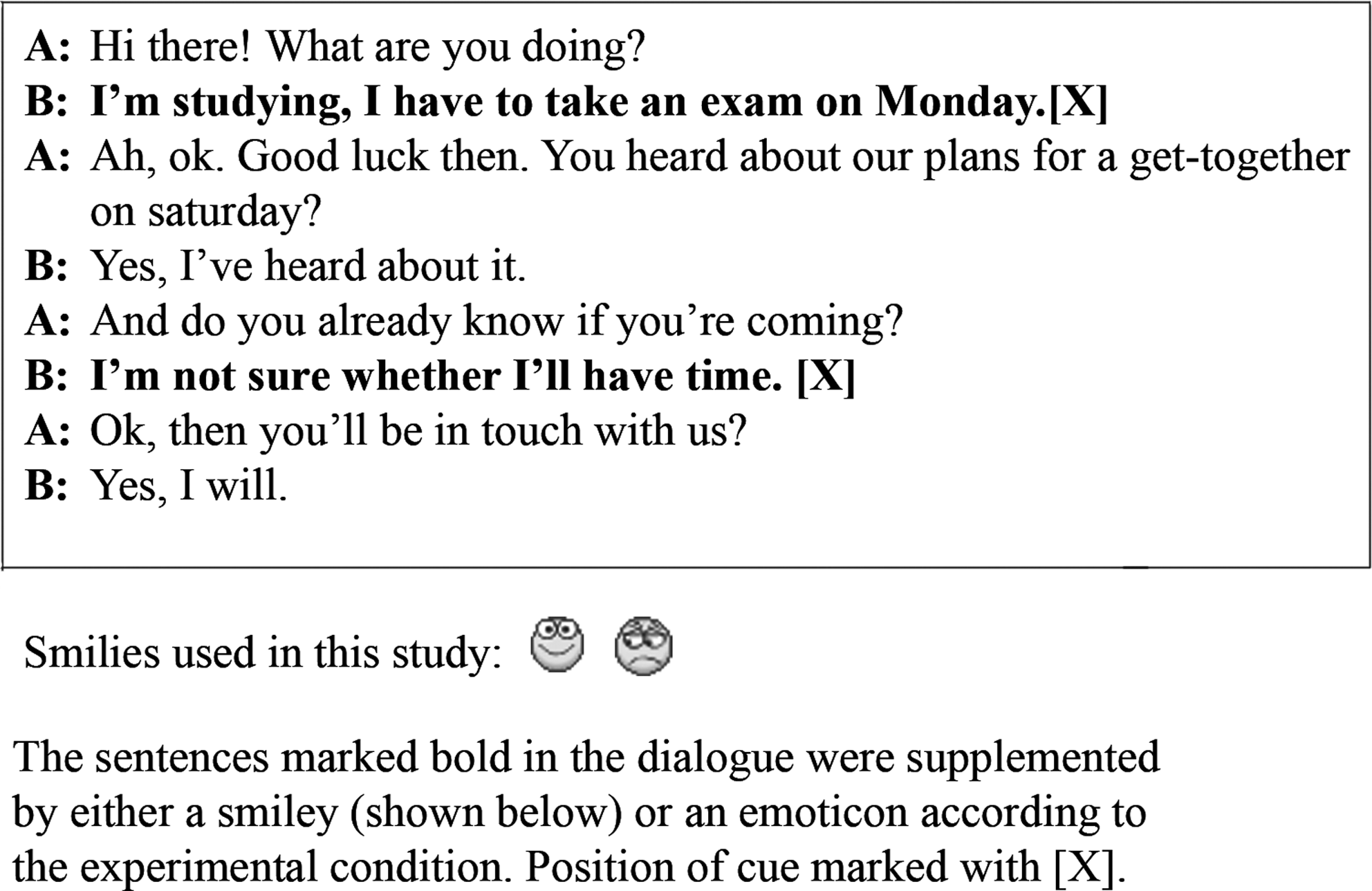
Stimulus material.
Dependent variables
With reference to questionnaires used by Walther and D'Addario 12 and Derks, 10 two items (“positive” and “humorous”) were used to evaluate message interpretation, rated on a 5-point Likert scale (1=not at all; 5=very much). The evaluation of the person using the cue was assessed using 11 self-constructed items (Table 2), rated on a 5-point Likert scale (1=not at all; 5=very much). By means of factor analysis (principal components analysis with varimax rotation), the items were reduced to three factors, explaining 60.89 percent of the total variance. These factors were labeled “commitment” (23.32 percent; M=2.93; SD=0.203; α=0.752), “extraversion” (21.92 percent; M=2.63; SD=0.170, α=0.705), and “sociality” (15.62 percent; M=3.33; SD=0.210; α=0.464).
Factor loadings<0.3 are suppressed.
Further, participants were asked to rate their mood (1 item) on a 5-point Likert scale (1=negative; 5=positive). 11
Results
Results of Levene's test for homogeneity on all dependent variables indicated that variances were equal across conditions.
Effects of valence
To test H1–H3, the factor of valence (including the control condition as neutral valence) was entered into a multivariate analysis of variance (MANOVA) with a post-hoc Bonferroni test on all dependent variables (items/factors for message interpretation, person perception, and mood). Wilk's statistics (λ=0.45, F(18, 334)=6.131, p<0.001) indicate a significant overall effect of valence. With regard to message interpretation, between-group effects show that the verbal message was differently perceived between conditions with regard to perceived positivity (F(1, 126)=24.98, p<0.001, ηp2=0.287) and perceived humor (F(1, 126)=32.87, p<0.001, ηp2=0.346). In detail, it was evaluated less positively when containing a negative cue in contrast to a positive cue (p<0.001; SE=0.188) or no cue (p=0.001; SE=0.201). Further, the message carried more humor when supplemented with a positive cue in contrast to a negative cue (p<0.001; SE=0.176) or no cue (p<0.001; SE=0.185) (Tables 3 and 4). These results support H1.
p<0.001; **p<0.005.
Regarding the writer's personality, a between-group effect was found for the factor “extraversion” (F(1, 126)=15.22, p<0.001, ηp2=0.197). The writer was perceived as significantly more extrovert when he/she used a positive cue than when he/she used a negative cue (p<0.001; SE=0.186) or no cue (p<0.001; SE=0.214). No significant main effects were found for sociality (F(1,126)=0.983, ns) or commitment (F(1,126)=2.917, ns), see Tables 5 and 6. Hence, H2 was supported for extraversion.
p<0.001.
Between-group effects further show an impact of cue valence on personal mood (F(1, 126)=7.73, p=0.001, ηp2=0.111). The recipient evaluated his/her mood significantly less positively when the dialogue contained a negative cue in contrast to a positive cue (p=0.001; SE=0.181) or no cue (p<0.05; SE=0.198) (Tables 7 and 8), supporting H3.
p<0.001; **p<0.005.
Differential effect of smilies and emoticons
To address the proposed research questions on the differential impact of both cues, both factors (valence, form) were entered into a two-factorial MANOVA with all dependent variables. Wilk's statistics (λ=0.89, F(6, 87)=1.84, ns) do not suggest an overall interaction effect of both factors. In detail, no effects were found on positivity (F(1, 95)=0.213, ns) and humor (F(1, 95)=0.085, ns) of the message (RQ1).
However, with regard to person perception (RQ2), a significant interaction effect arose on “commitment” (F(1, 95)=7.129, p<0.01, ηp2=0.073) (see Table 5). Additional separate one-factorial ANOVAs for smilies and emoticons on “commitment” showed that only smilies exerted an impact (F(1, 47)=5.415, p<0.05, ηp2=0.105), but not emoticons (F(1, 47)=0.04, ns). Thus, the employment of smilies more strongly influenced the perception of commitment compared with emoticons. No interaction effects were found for extraversion (F(1, 95)=0.050, ns) or sociality (F(1, 95)=0.192, ns).
Regarding the recipient's mood (RQ3), another significant interaction effect arose (F(1, 95)=4.346; p<0.05; ηp2=0.045), indicating a stronger impact of smilies in contrast to emoticons regarding both valences (see Table 7). Additional one-factorial ANOVA separately conducted for each form of cue on mood showed a significant difference between positive smilies and emoticons (F(1, 41)=7.516; p<0.01; ηp2=0.158) but not between the respective negative cues (F(1, 41)=0.145, ns).
Discussion
This study is designed to fill a gap in research and contribute to the scarcely covered aspect of the differential impact of smilies and emoticons on perception processes within cmc. Consequently, the differential influence of smiling and frowning smilies and emoticons with regard to the recipient's mood, message evaluation, and person perception was investigated.
Consistent with earlier research6,10,12 and our hypotheses results illustrate that nonverbal cues generally influence message interpretation and person perception. Further, the reader's personal mood was altered in accordance with the cue. Also, results regarding our research questions on the differential impact of smilies and emoticons show that smilies exerted a stronger influence on perceivers' personal mood and the perception of the writer's commitment. With regard to message interpretation, no differences between smilies and emoticons were found.
Based on our observation of the different appearances of smilies and emoticons in the introduction, we suggest that the effects found might result from smilies more closely resembling actual human faces. Thus, they might be reacted to in a more immediate way. These considerations offer a potential explanation why the observed effects were not found on all dependent variables. The immediacy of a perceiver's reaction may depend on whether the evaluation concerns cognitive or affective dimensions. Based on the finding that smilies exert a stronger influence on personal mood than emoticons, we suggest smilies to have a stronger effect on affective dimensions. However, further studies including, for example, subliminal measures or (brain) physiological data, would be needed to verify this explanation.
Future studies also need to address some methodological issues of the present study, such as pretesting the perceived valence of the verbal material. Another aspect to be considered is using a more sophisticated measure for personal mood and to adapt the measure for person perception as reliability for the sociality-factor was rather low. Also, the question of whether the observed effect resulted from the visual characteristics of the specific smiley used or whether all kinds of smilies would yield the same pattern of results should be addressed. What also remains to be answered is the role of specific context factors that may influence the way in which smilies and emoticons are interpreted. As in face-to-face communication, their use in a socio-emotional context may be differently evaluated than in a task-oriented context, resulting from specific behavioral expectations regarding the display of emotions depending on the context.19,20
Footnotes
Disclosure Statement
No competing financial interests exist.
Page L, Perceived values of male and female smiling vs. non-smiling, unpublished manuscript, 1980.