




Abstract
Abstract
The current study was designed to extend the interpersonal deviance literature into the online domain by examining the incidence and impact of supervisor cyber incivility and neuroticism on employee outcomes at work. Conservation of Resources (COR) theory was used as the guiding framework because cyber incivility is thought to deplete energetic resources in much the same way that other stressors do, ultimately leading to negative outcomes like burnout. Results indicate that supervisor cyber incivility is positively related to burnout, absenteeism, and turnover intentions. Support was also found for the role of neuroticism as a moderator of the relationship between supervisor cyber incivility and outcomes. In general, the relations between cyber incivility and outcomes were stronger for those individuals reporting higher levels of neuroticism. Results are discussed in terms of COR theory, and possible mechanisms for the role of neuroticism in the stressor-strain relationship are discussed. The current study highlights the importance of understanding workplace online behavior and its impact on employee health and organizational well-being. Future research directions examining online interpersonal deviance are suggested.
Introduction
Much of the extant research on incivility has examined its face-to-face form,5–7 but with the increasing use of the Internet and e-mail communication at work, uncivil behaviors are spilling into online activities. 8 Reviews of the incivility literature have called for an examination of the impact of cyber incivility, 9 which we define as rude/discourteous behaviors occurring through Information and Communication Technologies (ICTs) such as e-mail or text messages.10,11 Therefore, the current study begins to examine this online behavior and addresses two questions: (1) how is supervisor cyber incivility related to burnout and withdrawal behaviors? and (2) to what extent do these relationships depend upon subordinate neuroticism? As the literature on cyber incivility is relatively new, the introductory sections will draw upon the traditional incivility literature to provide insight into the definition, incidence, and impact of these behaviors.
The age of cyber incivility
With the rising rate of Internet use at work, 12 the ease with which individuals can intentionally or unintentionally engage in incivility has likely increased. 9 Certain features of the Internet and other ICTs make it easier for individuals to misinterpret the meaning behind messages and engage in deviant behavior. Specifically, online communications differ from face-to-face communications because they are mostly text-based, can be addressed to multiple people, and can be redistributed very easily. 13 Because ICTs lack many of the cues present in face-to-face communication (like pitch, tone, rate of speech, and body language), it can be much more difficult to understand a message, and the potential for misinterpretation is elevated. 14 Even if a message is not intended to be harmful, it may still be perceived as an act of cyber incivility if it is interpreted as harmful.
Additionally, many forms of ICTs have a key feature that differs from face-to-face communications–perceived anonymity. 11 In many ways, ICTs provide the perfect venue in which deviant individuals might act, since they are physically removed from the target, the consequences are less apparent and immediate, and there is an assumption of anonymity in some contexts (e.g., posts to online forums). Thus, engaging in cyber incivility may be easier than engaging in face-to-face incivility, likely increasing the prevalence of such behaviors.
Theoretical background
Conservation of Resources (COR) theory states that stress results from the threat or actual loss of resources. 15 Both a lack of resources at work (e.g., social support) and a high level of demands (e.g., interpersonal conflict) may deplete an individual's resources. This resource depletion may lead to negative outcomes such as burnout and desire to quit. Recent work by Sliter et al. has linked face-to-face incivility with this theory by finding that experiencing incivility saps mental and emotional resources. 6 Thus, COR theory may also be useful for understanding the impact of workplace cyber incivility.
Impact of cyber incivility
Whereas there is a dearth of research on cyber incivility, face-to-face incivility has been linked with several work outcomes, including psychological burnout. Burnout is a multidimensional construct comprised of emotional exhaustion, physical fatigue, and mental tiredness, 16 which results from exposure to chronic stressors, including interpersonal conflict. 17 From a COR theory perspective, these interpersonal demands deplete resources, and over time, result in psychological burnout. Several studies have linked face-to-face incivility with greater levels of burnout.7,18,19 However, to the authors' knowledge, this relationship has not been examined in an online context.
Other outcomes of stress at work might include workplace withdrawal behaviors, such as absenteeism and turnover intentions. 20 Absenteeism reflects the failure to report for scheduled work, and turnover intentions reflect an individuals' willful desire to leave an organization. 21 Whereas others have suggested that these outcomes may be used to appeal perceived injustice or express job dissatisfaction, 22 COR theory suggests that absence may reflect a coping strategy to regenerate one's resources and recover from stressful workplace events, 23 as the experience of cyber incivility may expend resources, thereby leading to greater stress and the subsequent development of physical/psychological illness. 24 Further, turnover intentions may be a more extreme coping mechanism than absenteeism. COR theory would predict that experiencing cyber incivility on a daily basis may deplete employees' resources so much that they can no longer cope with the job, leading to the desire to quit and find a job that depletes fewer resources. Several studies have noted that face-to-face incivility is linked with greater levels of absenteeism and turnover intentions.3,25,26 In an online context, a recent study found a significant positive correlation between cyber incivility and turnover intentions in a sample of finance employees in Singapore. 8 However, the relationships among cyber incivility and withdrawal have yet to be studied among employees from the United States.
Many authors have noted that the relationships between interpersonal stressors and job strain outcomes depend on an individual's level of neuroticism. 27 Individuals high on this trait typically have difficulty dealing with problems and heightened negative reactions to stressful events.28,29 There are many possible mechanisms through which neuroticism may affect the relation between stressors and job strain. 30 One such explanation is that highly neurotic individuals may more readily feel job strain as the result of experiencing stress than individuals low in this trait. The current study will test this “hyper-responsivity” mechanism by exploring the moderating role of neuroticism. This mechanism has received some support in the literature,5,31 including a recent study that found a moderating role for neuroticism in the relation between ostracism and burnout within the context of COR theory. 32 Neuroticism may be especially important to examine in an online communication context because e-mail communication is often ambiguous, and neurotic individuals may more readily perceive ambiguous stimuli to be stressful. 28
Current research
The current research extends the incivility literature by examining the impact of cyber incivility on outcomes across two samples of working adults in the United States. Portions of this research (e.g., the format of the incivility measure and the choice of outcome variables) were designed to parallel previous work in the face-to-face incivility literature.1,9
Method
Participants and procedure
Participation in an online survey was solicited via e-mail from two different samples. Sample 1 comprised 407 staff members from a large southeastern university. Sample 2 comprised 207 alumni from a large southeastern business school. Demographic characteristics for these samples are summarized in Table 1.
Percent of sample that declared that their race was White.
Percent of sample that indicated their gender was female.
Mean age of sample.
Percent of sample that had a Bachelor's degree or higher.
Average number of years of experience working in their current position.
Average number of hours worked per week.
Measures
A brief overview of each measure is provided below. Table 2 presents the number of items, scale information, scale reliabilities, and sample items, and Table 3 presents descriptive statistics and intercorrelations among the measures. Following the recommendation of Cortina et al., in an effort to reduce the likelihood of response bias, scales measuring the effects of cyber incivility were presented before the measure of cyber incivility so that uncivil experiences would not bias ratings of burnout. 1 For all measures, scale means were used to represent each construct.
S1, sample 1; S2, sample 2.
Gender was coded 1=male, 2=female.
Small but significant mean differences were found between the two samples on the stress in general and neuroticism measures (t=2.36, p<0.05; t=−3.27, p<0.05, respectively). No significant mean differences were found on the supervisor cyber incivility scale (t=1.25, p>0.05).
p<0.05.
The survey for sample 1 contained measures of burnout, neuroticism, stress in general, and supervisor cyber incivility. The survey for sample 2 contained the same measures of neuroticism, stress in general, and supervisor cyber incivility, as well as measures of absenteeism and turnover intentions.
Burnout
Burnout was assessed with the Shirom-Melamed Burnout Measure. 33 This measure was chosen due to its theoretical linkage with COR theory. 16 Participants indicated how often they felt 14 different feelings and cognitions in the past 30 workdays.
Absenteeism and turnover intentions
Absenteeism and turnover intentions were each assessed by a single item (see Table 2).
Neuroticism
Neuroticism was measured using the neuroticism scale from the Big Five Inventory. 34 Participants were asked to select the extent to which they agreed with each of eight statements.
General job stress
The Stress in General (SIG) scale was included to determine whether cyber incivility explains additional variance while controlling for general job stress. 35 The SIG measure indexes how stressful a job is by asking participants to indicate the extent to which their job is described by seven stressful adjectives.
Supervisor cyber incivility
The Workplace Incivility Scale 1 was modified to measure supervisor cyber incivility by adding “online” to the end of each question. Participants identified how frequently they experienced eight behaviors from their supervisors in the past six months.
Results
Cyber incivility levels differed by gender in sample 1 (d=0.30); therefore, gender was included as a control variable in addition to general job stress. The moderating role of gender was also examined, but gender did not significantly moderate any cyber incivility-outcome relationship. Supervisor cyber incivility was experienced by over one-quarter of the participants (i.e., 26 percent of sample 1 and 35 percent of sample 2). Further, there was a significant positive relation between burnout and supervisor cyber incivility (r=0.25, p<0.01, see Table 3). Burnout was also positively related to neuroticism (r=0.47, p<0.01); however, the bivariate relation between neuroticism and supervisor cyber incivility was nonsignificant in sample 1, but significant in sample 2 (r=0.32, p<0.05). Neuroticism was also positively correlated with gender in sample 2, suggesting the presence of a moderator. Therefore, the gender by neuroticism interaction term was included in sample 2 analyses (absenteeism and turnover intentions).
To test the main hypotheses of the study, a series of hierarchical linear regressions were conducted, with the control variables (gender and stress in general) in step 1, the main effects in step 2, and the interaction term in step 3. Table 4 presents the results of hypothesis 1. Cyber incivility and neuroticism incrementally added to the prediction of burnout, explaining an additional 22 percent of the variance in burnout beyond gender and general job stress (ΔR2=0.22). Further, the addition of the interaction term significantly improved the model (ΔR2=0.01, p<0.05). Simple slopes were calculated using regression coefficients at high (+1 SD) and low (−1 SD) values of supervisor cyber incivility. 36 The slopes were significant at low (t=2.75, p<0.05), moderate (t=5.84, p<0.01), and high (t=5.23, p<0.01) values of neuroticism. More specifically, the relation between supervisor cyber incivility and burnout was strongest for individuals reporting higher levels of neuroticism (see Fig. 1).

A graphical representation of the interaction between neuroticism and supervisor cyber incivility predicting burnout.
p<0.05.
B, regression coefficient; SE B, standard error of regression coefficient.
Table 5 presents the results of hypothesis 2 with absenteeism as the outcome variable. This analysis was conducted using Poisson regression, since absenteeism was negatively skewed (i.e., with mostly 0 or 1 day absent, and few reporting more days), and data are presented in terms of the number of predicted days absent, in accordance with Gardner, Mulvey, and Shaw. 37 As can be seen in Table 5, cyber incivility and neuroticism significantly predicted absenteeism over and above gender and general job stress (Δχ2=5.02), and while the neuroticism by gender interaction was nonsignificant (Δχ2=0.15), the neuroticism by cyber incivility interaction term added significant prediction to the model (Δχ2=4.11). To understand the form of the interaction, simple slopes were calculated as described above (see Fig. 2). These results indicate that the relation between supervisor cyber incivility and absenteeism was strongest for highly neurotic individuals.
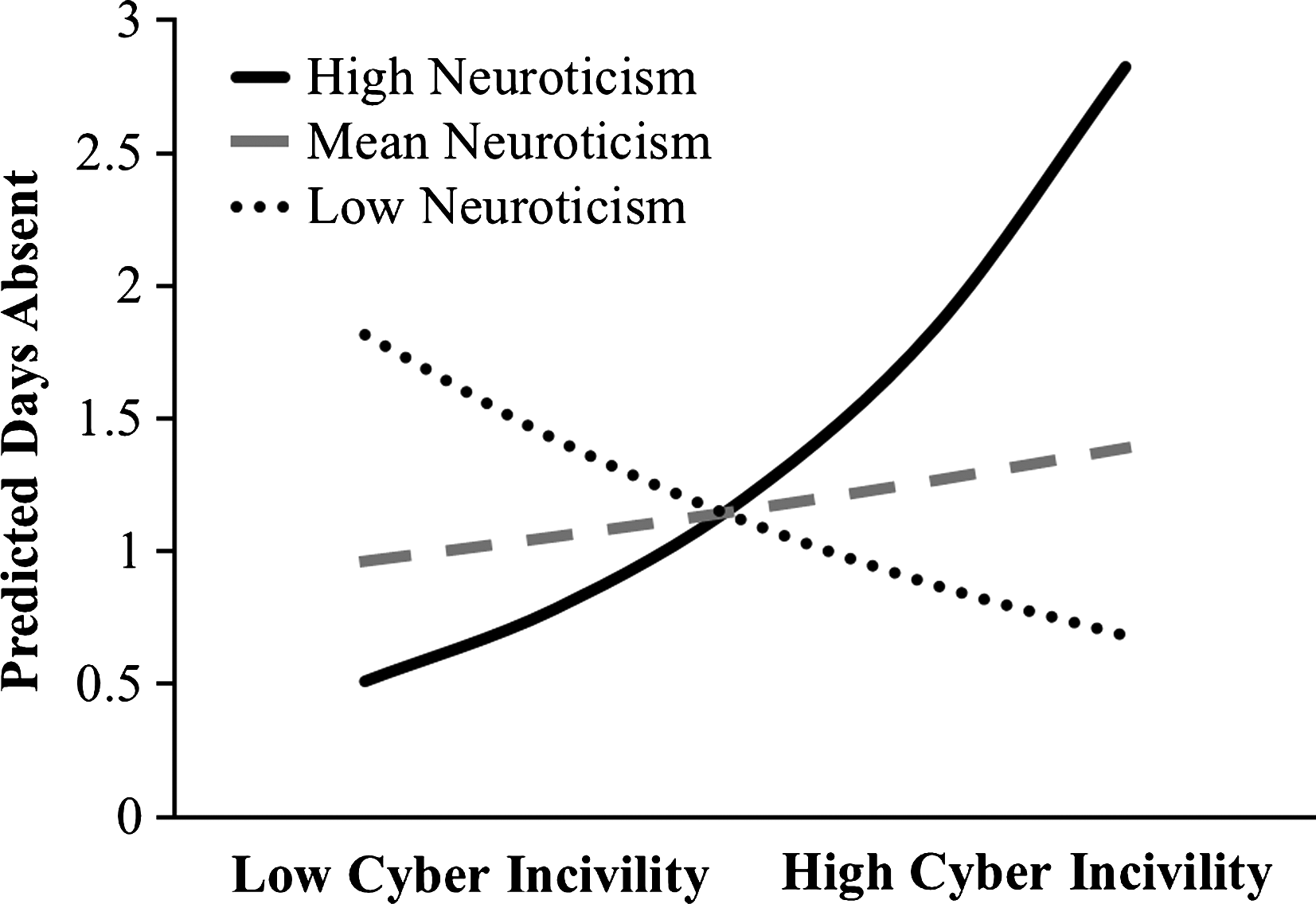
A graphical representation of the interaction between neuroticism and supervisor cyber incivility predicting absenteeism. Note that absenteeism is in the form of predicted days absent, obtained from the Poisson regression model.
Note: *p<0.05, Model χ2=12.62, df=6, n=192, R2 L =0.51. Initial −2 Log Likelihood (−2LL)=422.2, Model −2 LL=408.9.
Table 6 presents the results for turnover intentions. Neuroticism and supervisor cyber incivility incrementally predicted turnover intentions over gender and stress in general (ΔR2=0.15). The neuroticism by gender interaction term was nonsignificant, but adding the neuroticism by supervisor cyber incivility interaction significantly improved the model (ΔR2=0.06). A test of the simple slopes showed a strong positive relationship (B=1.05, SE=0.19) between supervisor cyber incivility and turnover intentions when neuroticism was high, t=5.35, p<0.05 (see Fig. 3).

A graphical representation of the interaction between neuroticism and supervisor cyber incivility predicting turnover intentions.
p<0.05.
Discussion
Taken together, these results support the hypotheses of the current study. Namely, supervisor cyber incivility predicted burnout, absenteeism, and turnover intentions, suggesting that individuals who report higher levels of cyber incivility from their supervisors are also likely to report higher levels of burnout, miss work more frequently, and think about quitting their jobs more often than individuals experiencing lower levels of cyber incivility. In addition, burnout and two withdrawal measures were predicted by the interaction term between supervisor cyber incivility and neuroticism. The nature of the interaction was such that reports of burnout, absenteeism, and turnover intentions were higher when individuals reported higher levels of neuroticism and supervisor cyber incivility. These results indicate that some individuals may be more likely to report or experience supervisor cyber incivility and negative outcomes that may be of interest to organizations.
The current study extends interpersonal mistreatment research by examining the incidence of a new form of mistreatment—cyber incivility—thus providing a more complete picture of the 21st century world of work. In addition, this form of online interpersonal deviance was more commonly reported by females than males, which is consistent with studies finding that female employees experience a greater amount of face-to-face incivility than males.3,38 These rude or discourteous online behaviors are not specifically sexist in nature, and thus are not typically thought of as illegal sexual harassment. 1 However, our findings suggest that workers may be targeted with (or more likely to report) different levels of cyber incivility based on their gender, creating the potential for disparate treatment lawsuits arising from this differential treatment.
Another noteworthy finding is the moderating role played by neuroticism in the job stress process. The results provide support for the “hyper-responsivity” mechanism proposed by Spector et al., indicating that individuals high in trait neuroticism may be more responsive to the environment and thus have a more intense response to stressors. 30
Practical implications
The findings of the current research indicate that the social interactions of supervisors may impact emotional outcomes of subordinates. This finding has potential implications in many fields, including education and personnel management. For example, if a professor treats his/her students poorly through e-mail, they may be more likely to skip class or drop the course. To avoid these issues, organizations should consider implementing online etiquette policies to raise awareness about the potential for miscommunication online.
Additionally, employees should pay special attention to their online communications and rephrase any instances that could be misperceived as being rude. Technology providers have already started to implement tools that can help users to refrain from sending uncivil communications. For example, users of Google's e-mail application, Gmail, can take advantage of a tool called “Undo Send” that allows users to stop messages from being sent up to 30 seconds after a user hits send. Such a feature may allow senders to reread the message before it is sent and cancel the message from being sent within a 30-second time window if the message is perceived to be uncivil. This is an interesting present-day practical example that illustrates how changes in technology may help individuals refrain from being uncivil online.
Limitations and directions for future research
The results of the current study should be interpreted within the context of several limitations. The primary limitations deal with study design. Specifically, this study utilized a survey design where data were gathered at one time point, and no variables were manipulated. Additionally, other potentially important variables that could be related to the outcome variables were not measured (including job satisfaction). The primary mechanism underlying the current study is that cyber incivility depletes resources, which, over time, leads to burnout, absenteeism, and turnover. However, the nonexperimental study design precludes inferences regarding causation or directionality. Namely, it could just as easily be the case that the study outcomes influence engagement in cyber incivility and one's neurotic tendencies. Despite these limitations, the approach used in this study can be useful when studying new constructs and attempting to determine their relations with other constructs, as it provides support for the existence of relationships among these constructs.
An interesting avenue for future research would be to compare the incidence of cyber incivility with face-to-face incivility. Theoretical work on the incivility construct suggests that such behaviors can spiral into other forms of aggression. 10 This work could be extended to an online context to determine whether cyber incivility escalates to face-to-face incivility, aggression, or physical violence. The current study examined rude/discourteous behaviors from the supervisor, but it would also be interesting to examine other unreasonable behaviors, such as corruption or sexual harassment. Additionally, future research should explore other moderators of these relationships, such as gender and race. These questions and more await the careful eye of occupational health researchers as we plunge forward into the technology-driven 21st century world of work.
Footnotes
Disclosure Statement
No competing financial interests exist.