




Abstract
Abstract
In the great expansion of the social networking activity, young people are the main users whose choices have vast influence. This study uses the flow theory to gauge the impact of Facebook usage on Tunisian students' achievements, with the presumption that the high usage level might reduce students' scholar achievements. The research design suggests that this impact would vary among students with different interests for the university and multitasking capabilities. Facebook usage would develop students' satisfaction with friends and family, which could enhance their academic performance. Analyses from 161 Tunisian students show that Facebook usage does not affect significantly students' academic performance and their satisfaction with the family, whereas it decreases their actual satisfaction with friends. Yet, a high level of satisfaction of the student with his family continues to enhance his academic performance. Overall, though, Facebook usage appears to do not have a significant effect on undergraduate students' academic performance. However, this interdependency is significantly moderated by the student's interest for the university and his multitasking capabilities. Students with multitasking skills and students with initial interest for the university might experience a positive effect of Facebook usage on their studies, as they keep control over their activity and make it a beneficial leisure activity. However, students who do not have these characteristics tend to not have any significant effect. Results help to understand the psychological attitude and consequent behavior of the youths on this platform. Implications, limitations, and further research directions are offered.
Introduction
For instance, earlier studies addressed the impact of video-gaming on students' academic performance.3,6–8 Results showed inconsistent conclusions about the immersion of the students on these online and offline games and their output. However, effect appears to depend mainly on the nature of content offered by these games, their design, and the extent of usage made by youths. While some video games provide educational content that develops reading comprehension3,9 and build up individuals' thinking and cognitive aptitude, more other video games have got aggressive content10,11 that negatively affected youths' behavior. It also depends on the time spent on game playing and on personality characters' of users. 3 Teenagers that get addicted can be mentally hustled toward aggressive and violent reactions. However, other games would develop cognitive capabilities of youth whose reflection develops and matures with games intended for educational purpose. These games develop the spatial view and awareness of the adolescents,12–14 their attention,14–16 and concentration or also their thinking.14,17 Oriented to active concentration, reflection, and reasoning for its users, video gaming, in this case, would enhance their cognitive abilities.
These days, because many students spend their free time surfing social Web sites, they express their selves, gain greater integration with their peers, easy access to new friends, and a continuous exchange of information and knowledge with their off-online friends. Social networking sites are now used mainly as an extension of the offline relationships already set.18–20 Such usage is mainly focused on extending or re-enforcing old ties with friends 21 rather than employed for educational purpose. Yet, unlimited exposure to Facebook, for example, may have an overall negative effect on students' performance, as tasks offered on this platform are exempted from educational content, and it has rather an extended recreational use. 22 Furthermore, a quick review of the pages of popular social networking sites reveals that many students express ongoing concerns about their inability to concentrate on their academic work when they are distracted by Facebook. This was illustrated, for example, by Karpinski and Duberstein's 5 study, as students using Facebook score lower grades than students who do not have access to such online communities. Their time spent studying also declines to 1–5 hours a week compared with 11 hours for nonusers of Facebook. This distinction likely reflects inappropriate direction of students' attention and distraction resulting from their simultaneous, multitasking performance.23–25
Despite this evidence, 79 percent of students Facebook users claimed that spending time on the social network does not interfere with their studies. 5 Yet, the number of active young users has been steadily increasing, which connotes the increase of percentage of students who might be at risk of using intensively Facebook. Thus, students appear rightfully concerned about discerning the actual effect of their keen interest in these technological offerings and how best to react to this new leaning.
In this study, main objectives are to propose a testable research model that enables us to increase overall understanding of Facebook usage. Empirically, we test its effect on student achievement within a specific context, where young generation seems to have an overwhelming presence on this platform.
We investigate whether students' absorption in Facebook is so intensive that it overwhelms the need to perform any other required task (e.g., homework preparation). Thus, we analyze how Facebook usage affects students' performance based on the flow theory (FT) and hedonic system usage. These approaches align the absorption on the task performed in a hedonic context and distribution of cognitive resources for individual who performs this task in the due time of another main task.
Following, we outline the conceptual framework of the study. Afterward, we define our hypotheses, and we provide the research model and describe the adopted methodology for empirical study. Further, we analyze and discuss the results. Finally, we draw the conclusions, present the implications and recommendations, and present the study limitations and further research directions.
Theoretical Background
FT and cognitive absorption
Originally founded in psychology, FT was applied to various contexts such as interaction on software, online applications, and resolution of mathematical problems. 26 Csikszentmihalyi 27 presents the theory as “the state in which people are so involved in an activity that nothing else seems to matter.” It reposes on the presumption that while immersed on the task performed, the user will lose track of the time spent on this task (designated by the temporal disassociation), and his attention at any other demand/task is disregarded (focused immersion). He will experience a high level of enjoyment in interacting on this task (heightened enjoyment), feels in control of the interaction as he would feel being in complete command of what he is doing (control), and finally, this task would raise his curiosity as it pushes him over and over to discover what he can offer/get beyond the interaction. 26 In these conditions, absorbed on an online task, for example, such as surfing and interacting on Facebook would shrink students' effort that should be deployed in homework preparation whether this should happen on electronic- or paper-based documents. Access to Facebook is now possible through different means: desktop computer at home or in the labs at the university, personal laptops with Internet Wi-Fi accessible everywhere, or also iPad and cell phones both in class and in breaks, in the library, and at home as well.
Facebook usage and student's achievements
Social networking Web sites refer to a common concept, which is the worldwide instantaneous communication through networks 28 such as Facebook. Other tools used for social exchange, such as e-mail, intranet, blogs, videoconferencing, photo sharing, wikis, and virtual worlds, are called Social Media 29 ; however, we here focus on one specific social media, that is, social networking Web sites, and more precisely one of these networking platforms, that is, Facebook. This system entails the use of online practices that employ technology to enable people to share content, opinions, experiences, insights, and technologies by themselves. Currently, Facebook is the top-ranked social network in the globe in terms of traffic. 30
Individual usage of systems such as Facebook applied earlier to various contexts and is, to some extent, similar to usage of other kind of computer-based system. Indeed, we assume that online social technologies, although basically designated for hedonic usage, can be used for utilitarian motives. Therefore, this usage can be of pure hedonic motives, or it also can impact positively individual's work life.31,32 While students use the Facebook platform merely for leisure purposes and have free access to this network from different devices along the day, students' time appears contracted between social occupations and classroom duties, which submerge their cognitive load and inhibits them to further concentrate and deploy mental effort and focus on their academic tasks.
Considering these conditions where students seem to be completely immersed and cognitively absorbed on this online social activity and in order to measure the actual impact of Facebook usage on students' performance, we test the following hypothesis:
Moderating effect of polychronicity and student interest for the university
Polychronicity
Monochronicity involves performing a single task at a time and scheduling tasks to run sequentially, while polychronicity (Pol) pairs at least two tasks at once.33–36 Integration of technology into people's daily lives made easier to acquire the monotasking skill, but Pol constitutes mainly a cultural characteristic that varies across countries. 37 Yet, oppositely to monochronic people, polychronic people have the ability and would be able to handle many tasks simultaneously. 38 For them, this occurs a great involvement with people, as relationships are put on priority rather than time and job. 39
Therefore, we predict that students with multitasking ability can better manage their time allocation and effort along with their interaction on the social network and preparing their homework.
Student interest for the university
Self-engagement in learning process involves a willingness to fulfill the daily requirements for learning, such as attending classes and preparing homework. It entails initiation and involvement in studies, relates to inner pleasure derived from membership in a group of learners, and incites studying to meet requirements for classes. 40 Thus, the higher is his interest for the university, the less the student would experience the detrimental effect of Facebook usage on his academic results. In contrast, a student who does not express a willingness to learn would score lower grades and would be more vulnerable to such declining effect. Thus, we test the following hypothesis:
Role of satisfaction with the family and satisfaction with friends
Students who express comfort with their lifestyle tend to earn higher grades.41,42 Pleasant life circumstances encourage more focus on schoolwork, and students who are more satisfied with their life enjoy learning and devote more time and energy to related tasks.41–43 Students who express happiness with their family, neighborhood, friends, school, and themselves dedicate more efforts to studies, their academic performance improves, and they attain better achievements. 44
We presume that the use of Internet, especially in terms of social networking, offers a reasonable way to enhance life satisfaction. Earlier study showed that the number of friends a Facebooker has on his profile and his positive self-presentation on this networking platform enhance his subjective well-being.45,46 Focusing on the student's direct interaction made on Facebook, we posit that interacting on this social network enhances his satisfaction with family and friends, as it facilitates his interactions and extends his relation with them. In turn, this satisfaction would enhance his academic accomplishment, as pleasant life circumstances encourage more focus on schoolwork. Thereby, we test the following hypothesis:
Our research model (Fig. 1) summarizes the predefined hypotheses to the test.
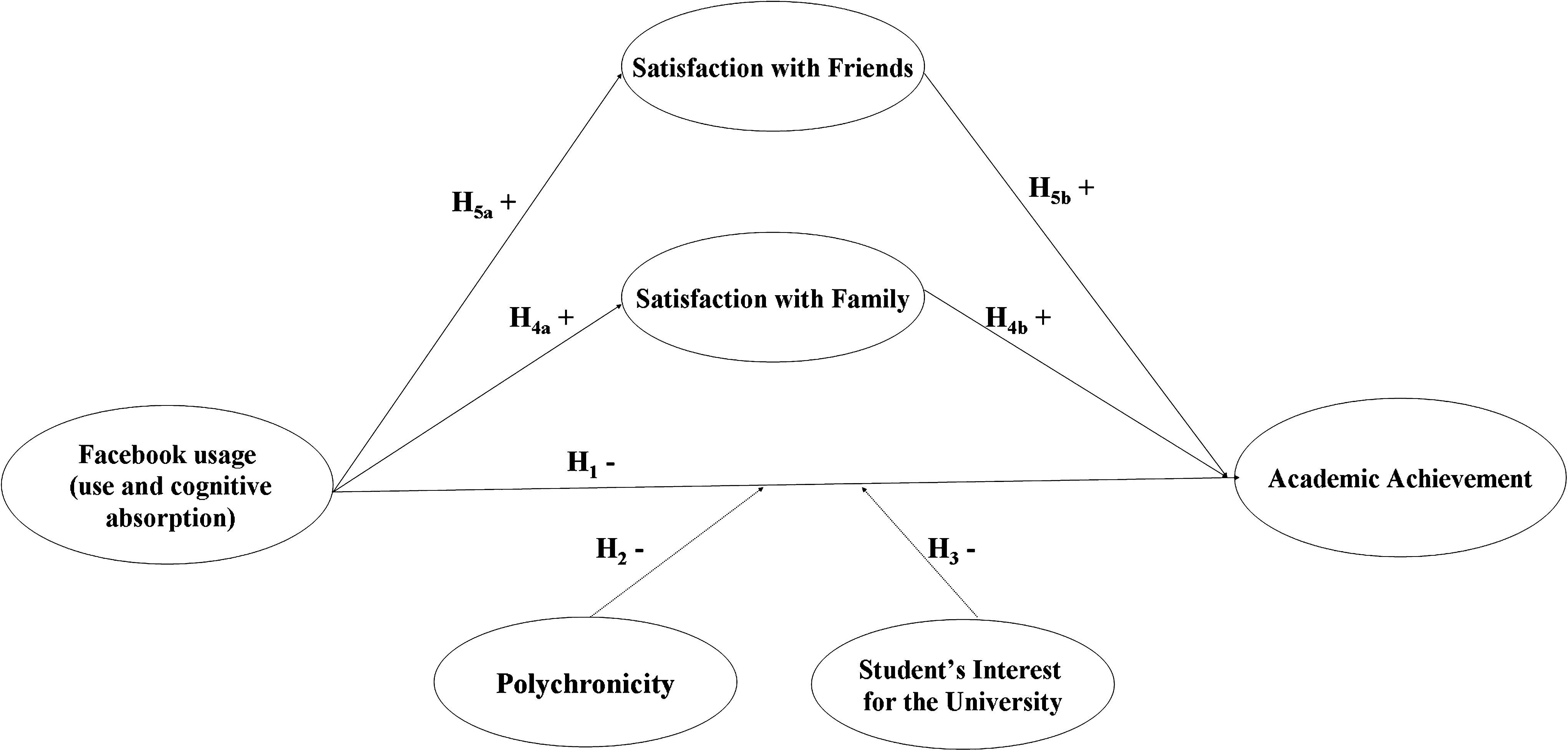
Research model.
Methods
Participants
A paper-and-pencil survey was distributed to 203 undergraduate students from the High Institute of e-Commerce in Tunisia. This number represented the population of the students physically present in classes during fall 2010 and that accepted to answer the survey. One hundred sixty-one answers were complete and useful for the statistic analysis, which represented a high response rate of 79 percent.
Measures
We used measures from previous studies in social and educational sciences, with proven reliability and validity, and adapted their wording to the study context. We present examples of the measures in Table 1.
Results
We used SPSS and SmartPLS software to analyze the collected data. First, we performed an exploratory factor analysis with SPSS of the constructs and subconstructs with reflective measures. SmartPLS package (version 2.0, M3) was used to test both measurement and structural models.
Measurement model
In Table 2, we provide psychometric properties of the constructs with reflective measures, along with their corresponding cross-loadings and convergent validity criteria. Convergent validity requires three conditions that were confirmed: cross-loadings are <0.7 and at least equal to 0.5 47 ; reliability (Cronbach's alpha) exceeds 0.7; and average variance extracted (AVE) is at least equal to 0.5. 47 Therefore, we find support for convergent validity of the constructs in our model. Yet, although these low boundaries are accepted, the rule of thumb implies that the boundary of 0.5 for AVE, 0.7 for Cronbach's alpha, and 0.5 for cross-loadings represents the strict minimum limit and that the higher the statistic metrics are, the better the items measure their respective constructs.
α, Cronbach's alpha; AVE, average variance extracted.
Loadings and their respective significant I-values are shown in bold.
Discriminant validity (Table 3) indicates that the items actually measure their theoretical corresponding construct, not any other constructs. 48 We find support for discriminant validity, as the square root of the AVE value for each construct is higher than its correlation with other constructs. This is again confirmed through the observation of the cross-loadings, where items load significantly higher with their respective constructs than with the rest of constructs in the model.
Square root of AVE are shown in bold.
Facebook usage was measured with formative dimensions (system use and cognitive absorption), and we applied a partial aggregation, so these two dimensions are used as representative items for the main construct (Facebook usage). This is justified by the high correlation between the items of each dimension. Student achievement had a single measure that measured grade changes.
Structural model
In Figure 2, the path analysis using SmartPLS displays the effects of different constructs according to the interdependencies stated in our assumptions and along with their corresponding levels of significance (T-values). Bootstrapping resampling served to test the level of significance of the path coefficients (pc).

Path analyses results.
Discussion
In Table 4, we summarize the hypotheses test results.
Path analyses show that Facebook usage has a nonsignificant negative effect (pc=0.05; T=0.79) on student achievement. However, the dual moderating effects of SIU and Pol are statistically significant and confirm that the impact of Facebook usage on academic performance is moderated by these two variables. Effect-size measures (Table 5) of the interaction models on the main model confirm this significance. Although considered separately SIU and Pol have low effect, still important, their joint effect is medium according to Cohen's 49 categorization in small, medium, and large effect.
F2=[R2 (interaction effect model) −R2 (main effect model)]/[1−R2 (main effect model)].
Significant values of the effect size are shown in bold.
Facebook usage significantly decreases students' satisfaction with their friends (pc=−0.24; T=3.53), but does not affect significantly their satisfaction with the family (pc=−0.06; T=0.71). The decrease in students' satisfaction with friends drops off, in turn, their academic achievement, which can be explained by the chief role of satisfaction with friends in students' life. However, results confirm the positive impact of the students' satisfaction with the family on their academic performance.
Testing the overall model, total effects show that although significantly determined by the use (time, frequency, and extent) and cognitive absorption, Facebook usage does not prominently decline students' academic outcomes.
Explained variance
In Figure 2, the R2 values reflect the percentages of explained variance for the dependent constructs. Our proposed research model explained 21 percent of the student achievement, which accounts for a high and important percentage of this complex construct only explained in the present study by Facebook usage, satisfaction with family and satisfaction with friends with the consideration of the moderating effects of SIU and his multitasking skills.
Besides, Facebook usage explains about 6 percent of the attenuation of the student's satisfaction with his friends, which might be a concern that students need to be aware of its probable consequences.
Conclusion
Preliminary exploratory studies tried to analyze the resulting outcomes of extensive presence on the Facebook platform for student achievement. Nevertheless, no precedent study, at our knowledge, focused on the cognitive absorption approach. Taking into account this unexplored area, we attempted to explain the impact of Facebook usage on student outcomes. High temporal disassociation and disconnection from the performance of academic tasks produces lower grades. Students who already express lower interest for school and then deploy low mental effort to learn will attain poor results, even if they are not present on Facebook. Effects also depend on students' multitasking capabilities, as students with Pol skills will manage their concentration and priorities better.
Implications for Theory and Practice
Our research model integrates interdependencies that have been justified and tested separately in prior literature. Additionally, it incorporates the multitasking skills in relation to the educational context. First, results from this study show that both cognitive absorption and the time spent on this networking platform do not affect significantly students' academic achievements. However, this effect is significantly moderated by students' multitasking abilities and their initial interest for the university. These results represent the first theoretical explanation for nonnecessary restriction to use Facebook, whether this would be home or at the university. At our knowledge, no previous academic study justified the position undertaken by some universities to interdict the access to Facebook at university or to explain to students, their parents, and authorities if there is a risk at interacting via this platform.
Limitations
Our results are subject to some limitations. We cannot offer general conclusions about the impact of extensive Facebook usage on students; yet, through this study we intended to test the proposed research model in this particular context. Young people in Tunisia (18–24 years old) represent 50 percent of the young generation in the country (15–25 years old), 50 and 38.5 percent of Facebook users in Tunisia are from this group of people, 51 which explains the importance of the investigation of the impact of Facebook usage on the individuals' performance. Yet, the sample was limited to students from one institution in a specific field. Students at this institution belong to a shared, lively culture and tend to be outgoing and sociable. The institution, the only university offering an e-commerce program in Tunisia, is characterized by a culture that entails students to be attracted by new technologies and that like to be exposed to Internet.
Future Directions
Decision to interdict or limit students' usage of Facebook both at university and home requires reconsidering if further studies demonstrate that such decisions are subject simultaneously to particular personality characters (as demonstrated in earlier studies4,5,52–54) and a specific cultural context. It also needs to consider predictors that incite this extensive resort to online socialization and use of this networking Web site (such as self-identity, belongingness, 55 collective self-esteem, group identity45,54,56 and gratifications, and online emotional openness 57 ).
Increasing the sample size would provide more solid test of the model. Conclusions will be more concrete about the impact of presence on Facebook on academic achievement and the evidence regarding the moderating effect of Pol and SIU. Another suggestion would be to test if the behavior on a networking platform varies among students with different personality traits in diverse cultural contexts and would then impact differently their academic performance.
Footnotes
Disclosure Statement
No competing financial interests exist.