




Abstract
Abstract
This article addresses nonprofessional users' expressions of everyday creativity on YouTube, adopting the idea that making entails connecting on different levels. By combining different materials and ideas into a video and sharing it within the social context of the platform, uploaders can connect with its enormous audience. In our first study, we explore patterns in the elements that are used when creating a video. We also question whether these pattern combinations are aimed at different types of viewers. Our results show that videos with self-made content that display various skills are mainly targeted at viewers situated close to the uploader (e.g., family, friends). However, videos that incorporate instances of popular culture, either as a whole (e.g., a pop concert recording) or in part (e.g., remixed with other content), are directed at a much broader audience. In our second study, we question whether these self-made videos convey a message about uploaders' personality traits commonly linked to creative behavior. We found that independent observers are able to accurately predict the uploaders' actual openness to experience, a trait marked as the substrate of creativity. Next, we discuss our results in light of a pessimistic view of today's democratized culture. We show that uploaders appear to have a tacit knowledge of what kind of videos are interesting for what type of viewers. We conclude that, despite the lowered barriers to the production and dissemination of video, YouTube viewers are still able to identify variations in the personality trait most commonly associated to creativity.
Introduction
Creativity as combining elements
As just argued, making something is interpreted as a process of actively linking different kinds of materials and ideas into a novel product. Although in practice these elements vary to a great extent, we propose a twofold distinction.
At the primary level, we identify a video's narrative content through which creativity is displayed. These expressions can range from conveying an idea or opinion (e.g., vlogs) to displaying a skill (e.g., playing an musical instrument, practicing sports). Creative communication can also extend beyond direct means, as indirect displays are possible through identification with others' creative behavior. For example, by disclosing footage of attendance at a show and displaying fandom, an uploader can bask in reflected glory. Incorporating a creative performance into his or her own work signals the openness toward and the ability to identify genuine creativity while it amplifies the appeal of one's own creations. This also applies to incorporating references to other existing cultural products by adopting and/or adapting them. More specifically, remix videos “take cultural artifacts and combine and manipulate them into new kinds of creative blends.”7(p.22) Sounds and images of popular culture are selected and adapted into new videos, which, in their turn, get spoofed or responded to by other videos. 8
This phenomenon is linked with what we consider the secondary level of creativity, namely the video's aesthetics. Although it is perfectly possible to disclose raw footage, this is only rarely done. Nowadays, entry-level video editing software is standard in most computer operating systems, providing the necessary tools to deliver (semi-) professional looking results. In fact, Müller 9 notices the importance attributed to attractive editing in various YouTube tutorials, while results from Lange's 10 ethnographic research indicate quality as one of the factors in judging other users' videos.
In short, numerous elements are at hand when making a video. However, not all videos use the same elements, or combine them in a similar fashion. This leads to our first research question:
Social connection through creativity
As noted by Gauntlett,
6
the process of creating is gratifying in itself. However, at some point, YouTube users decide to upload their videos and share them with a larger group of people, thus using their creations to connect socially. In fact, previous research has indicated that uploading frequency is partially explained by a strong social orientation and the desire to engage in social interaction.11,12 However, only a small minority of professional content obtains considerable viewer attention, while the large majority of user-generated videos receives hardly any views.13,14 Recent studies15,16 have shown that videos are uploaded mainly for people users know (identified offline public; e.g., friends and family) or for unfamiliar people with whom users share a common interest, opinion, or preferred activity (identified online public). On the other hand, uploaders keep in mind that the remainder of the YouTube community (unidentified online public) is much bigger, and that in theory, every Web surfer is a potential viewer. Still, research on teenage uploaders' public expectancies and the actual feedback received over time has shown that they are fairly capable of estimating how their video will perform in terms of on-platform feedback (number of views, rates, and comments).
15
This suggests a tacit knowledge of what kind of content attracts what kind of viewership. For instance, a video with raw live footage of a pop concert is more likely to attract viewers than a video demonstrating one's amateur guitar skills, which, in turn, tops a carefully crafted audiovisual family collage. However, this should not be a problem if the latter two are aimed at socially connecting with a smaller (informal) set of viewers.
16
Hence, we presume that different configurations of creative elements evoke different types of viewer expectancies. Therefore, we put forward a second research question:
Communicating creativity
YouTube offers a forum for everyone to publish his or her creative activities. Although we can hardly doubt that making a video entails a certain degree of creativity, we do not know whether viewers, based on the shared result, draw accurate conclusions regarding the creative personality of the uploader.
In the field of personality psychology, the broad domain of openness has been repeatedly marked as the substrate of creativity,17,18 as it is situated “in areas of fantasy, aesthetics, feelings, actions, ideas and values.”18,(p.1259) However, in some studies, higher extraversion and lower conscientiousness have also been identified as predictors for creative behavior.
19
For example, it was found that, next to openness, extraversion also positively predicts scores on the creative personality scale, while conscientiousness is a negative predictor for independent raters' scores of a creative writing task.
20
Hence, we consider compiling a video to share on YouTube as a display of creativity and put forward the following question:
Study One
Method
Sample
YouTube uploaders who had recently posted a video were selected from the platform's “most recent” Really Simple Syndication (RSS) feed. By a comment underneath their latest video, they were invited to fill out an online questionnaire about themselves and that specific video. The ∼2,000 sent invites led to 219 valid responses (71 percent male, Mage=31.12, SDage=12.74). In addition, all featured videos and their metadata were locally stored for further research.
Measures
Video properties were assessed with questions asking the video uploaders to indicate whether the video involved (a) self-produced images, (b) self-produced sound, (c) self-editing, and (d) a depiction of the uploader.
Viewer types were assessed with an eight-item instrument from previous research.15,16 By means of five-point Likert scales (strongly disagree—strongly agree), it measured the extent to which uploaders expect specific subtypes of YouTube's networked public to watch their video. These subtypes are (a) the identified offline public (family, friends, and acquaintances; three items, α=0.79), (b) the identified online public (unfamiliar people with whom an interest, activity, or opinion is shared; three items, α=0.87), and (c) the unidentified online public (unfamiliar people with whom one has nothing in common and people who accidentally end up watching the video; two items, α=0.81).
Results
Content analysis
Apart from the video information disclosed by the uploaders, a quantitative content analysis was performed to assess video characteristics. A concise coding scheme was devised, comprising dichotomous indicators of primary and secondary levels of creative elements, as discussed earlier in the article (Table 1). Although two researchers independently coded all videos, their initial agreement was very high with significant Kramer's V values ranging from 0.85 to 0.92 (p<0.001). Afterward, divergent assessments were jointly discussed until an absolute agreement was reached for all variables.
In the questionnaire, we asked whether the uploader is present in the video clip. We used this information during the coding procedure to ascertain whether the behavior in the video was posed by the uploader himself or herself.
Patterns of creative elements
To answer the first research question, a latent class analysis 21 was executed on the coded creative elements from the content analysis and the video properties as disclosed by the uploaders. The most parsimonious model to yield a sufficient model fit comprises three classes (L2(184)=172.91, p=0.71). Figure 1 summarizes the probabilities of video characteristics per latent class.
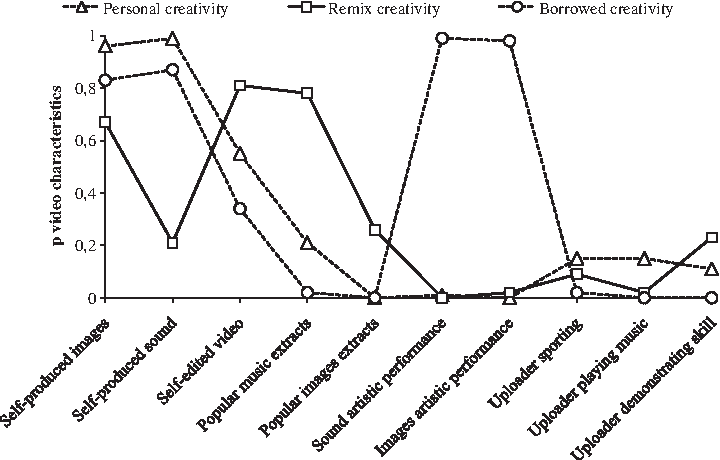
Latent class analysis of creative building block configurations. Indicator Wald statistics and R2 values are included in the Appendix section.
The results show that each class has a rather clearly delineated profile. We labeled the videos in the first class (46 percent) as “personal creativity,” because they shared high chances of containing self-made sound and images. In addition, these videos were more likely to display creative performances such as playing music or practicing a sport. The second class, labeled as “remix creativity” (32 percent), contained videos with much lower chances of containing self-made footage, while they had the highest probabilities of drawing upon excerpts from popular culture products. The third class (22 percent) was labeled as “borrowed creativity,” as it consisted almost uniquely of third-party artistic performances that were only rarely edited. Figure 2 contains several representative examples per latent class.
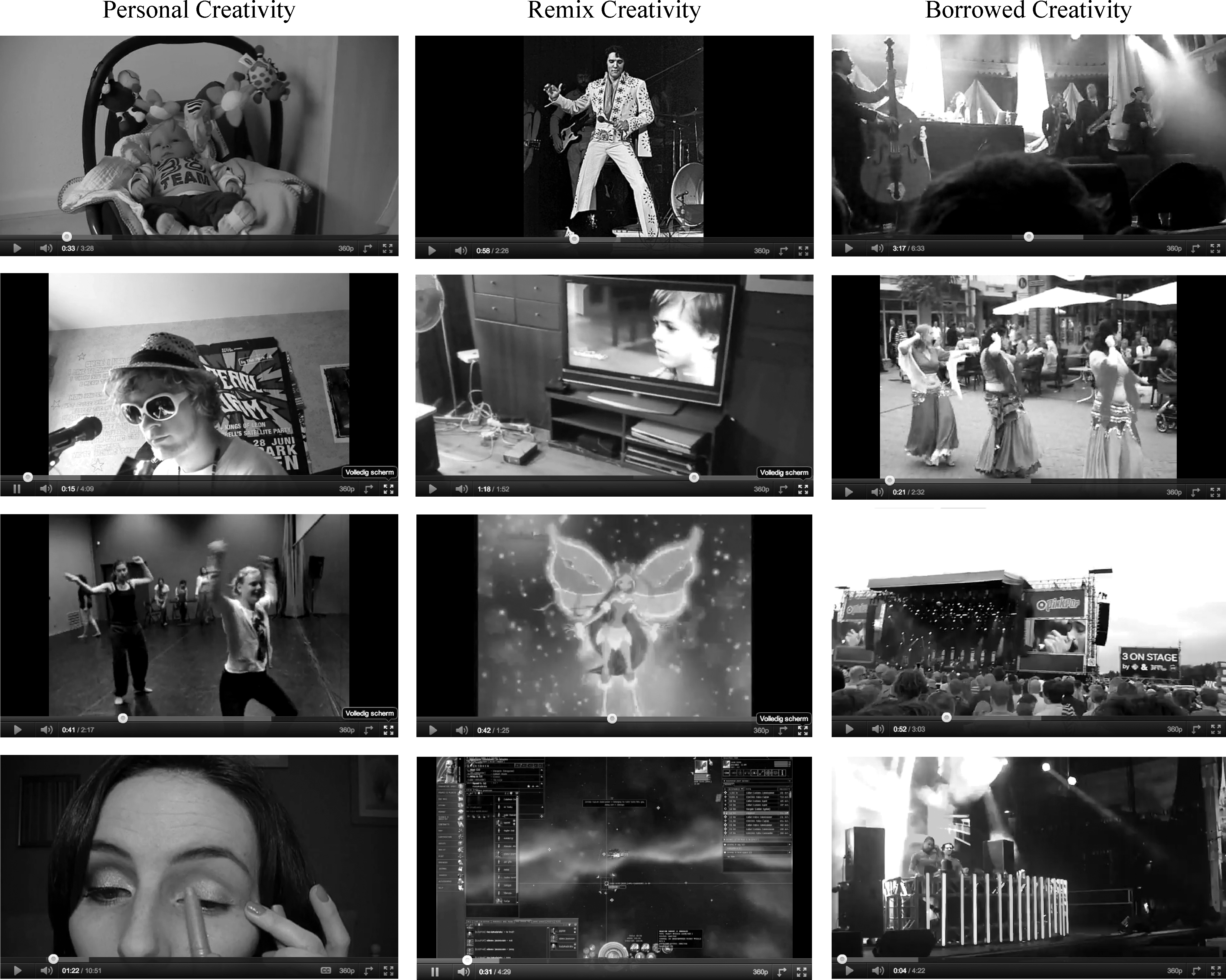
Screenshot examples of videos per latent class.
Differences in viewership aspirations
The second research question was addressed by means of a mixed model analysis of variance. The three measured subtypes of YouTube's networked public were combined as a within-subjects factor, while the video classes were entered as a between-subjects factor. A main effect was found for the within-subjects networked public factor (F(2, 432)=5.23, p<0.05). More specifically, a linear trend was found (F(1, 216)=8.59, p<0.05), indicating that the smaller and more socially connected the networked public subtype (e.g., friends, acquaintances, and family), the higher the perceived likelihood was of their watching the video. Next, a significant interaction effect was found between the networked public and the between-subjects video class factor (F(4, 432)=4.44, p<0.05). The marginal means histograms in Figure 3 reveal that videos reflecting personal creativity are directed mainly toward people known from offline life (offline identified public) and less toward people situated only online. Videos representing remix creativity are aimed mostly at unfamiliar people with whom uploaders share a common interest, opinion, or activity (online identified public), and less at people closer to them, or the remaining YouTube viewership. Finally, videos reflecting borrowed creativity seem to be used to catch the YouTube community as a whole, as all subtypes are equally expected.

Marginal means histograms of the mixed model analysis of variance.
Study Two
Method
For the second study, we followed a methodology adopted from previous research on the communication of personality through personal homepages 22 and social network profiles. 23 In these studies, external raters estimated the Big Five personality traits of zero-acquaintances on the basis of the information communicated on their homepage or profile pages. The average estimates were then related to Web site and profile page owners' measures of actual and ideal self. More specifically, a regression function was calculated, entering both target measures as independent variables and the averaged rater estimates as a dependent variable. Ideal self was entered into this equation to control for impression management. As a result, it becomes possible to filter out possible inaccuracies that result from the targets' controlled and perhaps biased online self-presentations and to capture the raters' true estimations of the targets' real selves.
First, a random subsample of 70 videos and their respective uploaders was drawn from study one's larger sample. The online questionnaire used in the former study also contained Dutch Big Five Inventory 24 self-report measures of both the uploaders' actual and ideal openness to experience (O), conscientiousness (C), and extraversion (E). Next, a team of 24 raters, aged 19 to 29, was recruited. Each rater was asked to assess the O, C, and E traits of up to fifteen randomly assigned uploaders, on the basis of their videos as shared on YouTube. We used a dedicated Web page for each video, containing the video hosted on our channel, its original metadata, and the rating form. As such, five independent assessments were gathered per video.
Results
Three criteria need to be met for a satisfactory external assessment of personality traits. Such ratings should be internally consistent, demonstrate a substantial agreement among raters, and be fairly accurate. 22 The α coefficients, summarized in Table 2, exceed the aspired-for criterion of 0.70, indicating an acceptable internal consistency. Furthermore, significant intra-class correlations are found between the assessments of all three traits, indicating a substantial agreement among raters (Table 2). However, we should acknowledge that the magnitude of the coefficient for extraversion is minimal. Finally, the accuracy of the external assessments was calculated. This was done by computing three regression functions in which self-reports of both ideal self and actual self serve as independent variables, whereas the averaged external assessment functions as a dependent variable. As in previous studies,22,23 ideal self is entered into the equation in order to control for impression management, that is, uploaders' overly positive self-presentations in highly controllable settings such as a video. 22 The analysis reveals that the raters in the study are able to significantly predict the actual openness of a video's uploader. However, for extraversion and conscientiousness, we find no significant linear association between the raters' assessments and the uploaders' ideal or actual self (Table 2).
Instrument prefixes: a“I see myself as someone who …”.
“If I could choose the way I was in real life, ideally I would like to be someone who …”.
“On the basis of this video clip, what kind of person do you think has uploaded this?”.
p<0.05; ***p<0.001.
C, conscientiousness; O, openness; E, extraversion.
Discussion
As mentioned in the introduction, Web 2.0 has lowered the barriers for ordinary users to share content on a large scale. Although the dominant discourse on participation on Web 2.0 platforms is predominantly positive, 25 various criticisms have reached the surface. For instance, Keen 26 is strongly opposed to what he refers to as “the cult of the amateur,” which implies a demise of cultural product quality, heralding a reign of mediocrity. Since, in theory, everyone has almost equal access to producing and online broadcasting facilities, the amount of (poorly made) content is steeply increasing, making it hard to see the wood for the trees. He sees the blurring of the line between authors and audience, creators and consumers, and experts and amateurs as especially troublesome.
Still, our research mitigates this harsh claim by clearly indicating that not all uploaders aspire to a large viewership. This is especially true for what could be considered unattractive, “low quality” content, such as the well-known family and pet videos or episodes from someone's amateur sporting career. Hence, not every uploader strives for his or her five minutes of glory. On the contrary, these kinds of videos are targeted at narrow, yet highly socially embedded subtypes of the networked public, ranging from family and friends to people who think and act alike. The videos that do aim at a larger audience have significantly distinct features. They mainly draw on sounds and images of artistic performances, which from our experience mostly boil down to raw images of concerts and professional events. These videos contain at least some edited extracts from products of popular culture. They are published for people with similar interests (e.g., other fans) or even the YouTube viewership as a whole. In such cases, the uploaders actually serve as a pass-trough for popular or obscure yet highly demanded content, transforming YouTube into a social filter. 13 Hence, this kind of sharing has a democratizing nature, as it broadens dissemination and could actually be beneficial for what is deemed high-quality content, rendering content sharing on YouTube at least a double-edged sword. Generally, these results are in support of the earlier suggestion of uploaders' tacit knowledge of what kind of videos attract what kind of audience.
Moreover, our second study also provides input for the discussion regarding the demise of quality and true creativity. It is argued that because of the ease of producing and sharing, resulting in an overwhelming amount of all kinds of videos, it becomes increasingly hard to differentiate few uploaders who are actually skilled from those who are not. 26 We found that in a random sample of videos, independent observers are able to correctly assess the uploaders' actual openness to experiences, on the basis of his or her latest video. As an important predictor of creativity, this result suggests that on the basis of a single video, users are still capable of identifying variability in openness to experience.
In sum, this article fills a gap in existing literature by offering a better understanding of how ordinary users are oriented toward sharing their different types of creative products. Since such products are one of the driving forces in today's Web environment, it is especially beneficial to gather insight into what is shared and for whom, and what the audience perceptions of these efforts are. In doing so, we draw on different methods and data sources, ranging from system data and self-reports to external ratings, both by the researchers and audience members. Still, our study has several limitations. First of all, we limited ourselves to the YouTube platform, ignoring other platforms, such as Vimeo or Dailymotion, that also harbor creative products. Although YouTube is by far the largest and most well known, it is also one of the most restrictive (e.g., deletion of copyrighted and/or pornographic materials), so the results need to be approached with a certain caution. Second, our analysis is exclusively quantitative. This enables the finding of valuable rudimentary patterns; however, it remains insensitive to the semantics of all kinds of creative blends, such as, for instance, a subtle parody of a cultural meme. For that reason, we would like to encourage and recommend various supplementary types of research into online creativity (e.g., ethnographic research and qualitative content analysis).
Footnotes
Disclosure Statement
No competing financial interests exist.
Appendix
| Personal creativity | Remix creativity | Borrowed creativity | Wald | R 2 | |
|---|---|---|---|---|---|
| Self-produced images | 0.96 | 0.67 | 0.83 | 15.13 *** | 0.12 |
| Self-produced sound | 0.99 | 0.21 | 0.87 | 31.73 *** | 0.60 |
| Self-edited video | 0.55 | 0.81 | 0.34 | 22.1 *** | 0.12 |
| Contains popular music | 0.21 | 0.78 | 0.02 | 47.88 *** | 0.40 |
| Contains popular images | 0.00 | 0.26 | 0.00 | 2.13 | 0.19 |
| Contains sound of artistic performance | 0.01 | 0.00 | 0.99 | 19.75 *** | 0.95 |
| Contains images of artistic performance | 0.00 | 0.02 | 0.98 | 25.49 *** | 0.95 |
| Uploader practicing sports | 0.15 | 0.09 | 0.02 | 13.57 * | 0.08 |
| Uploader playing music | 0.15 | 0.02 | 0.00 | ||
| Uploader demonstrating skill | 0.11 | 0.23 | 0.00 |
p<0.05; ***p<0.001.