




Abstract
Abstract
Based on Social Penetration theory, this study explores the topics that bloggers disclose on their blogs, and in the real world. A total of 1,027 Taiwanese bloggers participated in this online survey, which revealed that bloggers self-disclosed nine topics (attitude, body, money, work, feelings, personal, interests, experiences, and unclassified). Further, we examined the depth and width of what bloggers self-disclosed to three target audiences (online audience, best friend, and parents), confirming that their disclosure is significantly different for each of these target audiences. Bloggers seemingly express themselves to their best friends the most, followed by parents and online audiences, both in depth and in width. The “wedge model,” proposed by Altman and Taylor (1973), has been extended to online relationships in this study. In comparison to male bloggers, female bloggers seemed to disclose more to their best friends and parents in their daily lives; however, no significant difference was observed in their disclosure to online audiences. Younger bloggers (<20 years old) seemed to disclose a wider range of topics; however, there was no significant difference in the depth of their disclosure on their blogs. Discussions of these results are also presented.
Introduction
Prior research has contributed to the understanding of the identity of bloggers,4,5 their motivations to blog,1,3,6–9 the reasons for frequent postings, 10 the structure of blogs,11,12 and the self-disclosure of the bloggers.13,14
Although various studies have investigated the social interactions of bloggers, further investigation is required regarding the topics that these bloggers disclose on their blogs, and the extent to which bloggers express themselves to their real-life best friends, parents, and online audiences. The purpose of this study is to explore and clarify these issues.
Self-disclosure in real life and in cyberspace
In the past, people communicated with friends face-to-face and via phones, and gradually through personal Websites, forums, and bulletin board systems. Presently, millions of bloggers write and post photos to share their thoughts, feelings, and experiences. 3 People are motivated to keep personal blogs to document their lives, express thoughts and opinions, for catharsis, and community.1,7 Regardless of their reasons for posting, bloggers may share their personal opinions and feelings on the Internet to online audiences, who may read and comment on their blogs. That is, bloggers may self-disclose and communicate with unknown audiences, based on trust, 15 anonymity, 16 or both. 17
Self-disclosure refers to the information that individuals voluntarily and intentionally reveal about themselves to others, including their thoughts, feelings, and experiences,18–20 and is important for interpersonal relationships.21,22 Regarding Internet technology advancements, self-disclosure may be redefined as the communication of personal thoughts, feelings, and experiences to people online or offline, either anonymously or through the use of real names.
Social penetration theory
Social penetration theory plays a central role in social psychology. The theory states, “people assess interpersonal rewards and costs, satisfaction and dissatisfaction, gained from interaction with others, and that the advancement of the relationship is heavily dependent on the amount and nature of the rewards and costs.”21,23 The rewards may be presented in the form of reciprocal disclosures from others and being “liked” by others, while costs may take the form of increased vulnerability and risks related to others.
Individuals have many layers that collectively form the total personality of the individual. The outer or peripheral layers are visible information concerning the individual, which can be assessed relatively easily by others without significant probing. The deeper layers contain information regarding the increasing vulnerability and/or social desirability of the individual. The deeper the characteristics, the more they reflect the total personality of the individual. These deeper layers are reached as relationships progress, and act as “a continuously widening and deepening “wedge” … proceeding to more intimate layers of exchange but also expanding at prior levels of interaction.”21,23
People do not automatically disclose important information about themselves. Individuals maintain protective outer layers that surround a central core that represents the true self. Such distal layers are impediments in the self-disclosure process, and are not shed all at once. Rather, the outer layers must first be exposed, experienced, and successively shed before the inner and intimate layers are revealed. This gradual escalation of the revealing process is termed social penetration. As individuals disclose more information regarding themselves (i.e., amount) to other members, it is likely that the disclosures reach the more central and intimate cores (i.e., depth) during the progression of the relationships.21,23
In recent years, social penetration theory has been the focus of many online studies,13,14,16,17,24–27 and has been applied to, or adapted, in the context of online relationship studies, such as sexual self-disclosure,
13
online friendships,
14
and online social networks.
28
However, little is known of how bloggers self-disclose online and in their real lives. The following research questions have been addressed:
Methods
Subjects
We initially recruited 50 bloggers (ranging from 13 to 42 years old in age; 56 percent female) for scale development. In the formal sample, 1,038 participants were recruited from an online questionnaire (checked for e-mail duplicates, IP duplicates, blog permanent links, incomplete responses from 1,554 responses; 11 subjects older than 40 may have deceased parents, or may be married with children and were removed for further analysis, making the valid sample 1,027). The demographics of these participants are as follows: male 37.7 percent; 60.9 percent of subjects were students, 5.7 percent were from educational profession, 5 percent from IT profession and 8 percent unemployed; 78.2 percent were aged from 20 to 29 years old, 37.7 percent are from Taipei, 11.6 percent from Taichung, 9.1 percent from Tainan, and 9.6 percent from Kaohsiung. The detailed demographics of the subjects were displayed in Table 1.
Some subjects older than 40 were deleted for further analysis because their parents did not exist anymore.
Measurements
The Bloggers Self-Disclosure Scale (BSDS) was developed based on Thurstone's type scale, 29 and was utilized by Yang and Huang 30 and Chiou and Wan. 13 Based on related literature16,19,31–33 and various blogs in Taiwan for content analysis, the initial BSDS consisted of 108 items, categorized into nine subtopics: attitude, body, career, feelings, personals, hobbies, money, experiences, and unclassified. According to the rationale of the Thurstone's type scale, the intimacy value (depth of self-disclosure) of the item was determined first. The initial edition was an 11-point scale, ranging from 0 percent to 100 percent. When proceeding with the test, the 50 pretest bloggers were asked to rate “their willingness to self-disclose with the percentage” regarding a certain topic. The subjects selected from a range of 0 percent to 100 percent, and obtained inverse scores ranging from 10 to 0. For example, if a participant was unwilling to self-disclose personal financial information on his/her blog, he/she would choose 0 percent and obtain 10 points for this topic, which means that the intimacy value of this item is the highest. By contrast, if a participant was willing to self-disclose personal hobbies on his/her blog, he/she would select 100 percent and obtain 0 points of intimacy value (lowest intimacy value), which means that there is no private aspect to this topic. The participants were required to fill out the same scale for the three targets: online audiences, parents, and best friends. The purpose of this design is to probe the extent to which these bloggers are willing to disclose to online audiences and to real life parents and friends. The scorings for other percentages of self-disclosure followed the same logic.
The next step was to compute the median (Md) and the quartile deviation (Q) of each item. According to the scale development of the Thurstone's type scale, the formal items of the BSDS were selected based on their Mds to cover the continuum of intimacy. As Q is a measure of variation, and a larger Q represents inconsistency of judgment, the topic with a smaller Q is chosen when there are two or more items with approximate Mds. The initial BSDS were checked for inter-item reliability (Cronbach α from 0.62 to 0.95) and validity (Kaiser-Meyer-Olkin measure, or KMO values from 0.76 to 0.89) in each topic; and the final version of the BSDS consisted of nine subtopics, with six items in each. The 54 items had various intimacy values, ranging from the lowest (25 percent Md) to the highest (75 percent Md). To increase response rate, the final version of the BSDS were measured on a 5-point Likert scale, with each item having an intimacy value. A typical question would be: “I shall comment on politics/political figures” to my best friend, parents, or on blogs. Participants select from 1 (totally disagree) to 5 (totally agree) concerning the three targets. The depth of self-disclosure on a topic was measured by the average of six intimacy values; the width on a topic was measured by the accumulated percentage (counted 4 “agree” and 5 “totally agree”) of all six items. We chose 50 percent as the reference point, implying that half the participants disclosed this issue; and for the items exceeding 50 percent, the wider the range of topics they disclosed.
Results
The BSDS
The BSDS consisted of nine subtopics: attitude, body, money, career, feelings, personal, interests, experiences, and unclassified, as shown in Table 2. Each subtopic included six items. The validity of this scale was also checked by factor analysis; and all topics with one factor extracted with eigenvalues larger than 1. All nine topics had KMO values larger than 0.76, indicating a valid construct. All topics were also checked with Cronbach's alpha, and all were higher than 0.9, except for the feelings dimension, which was 0.62, indicating that most of the dimensions were reliable.
Dimensions of BSDS
BSDS, in comparison to previous self-disclosure questionnaires,19,30 shares five topics with Jourard and Lasakow: attitude, body, money, work, and interests. These topics are widely self-expressed by bloggers. For the sake of clarity, only the depth and width of self-disclosure were measured, whereas the other dimensions such as duration, honesty, and positive/negative were not discussed. 31
What are they blogging about?
As shown in Figure 1 and Figure 2, bloggers self-disclose on a wide range of topics. However, most of them seem to express their interests and experiences more often than private information, such as financial matters. Generally, bloggers express more (both in depth and width) to best friends rather than to parents and online audiences.

The depth of self-disclosure of bloggers to best friends, parents, and online audiences.
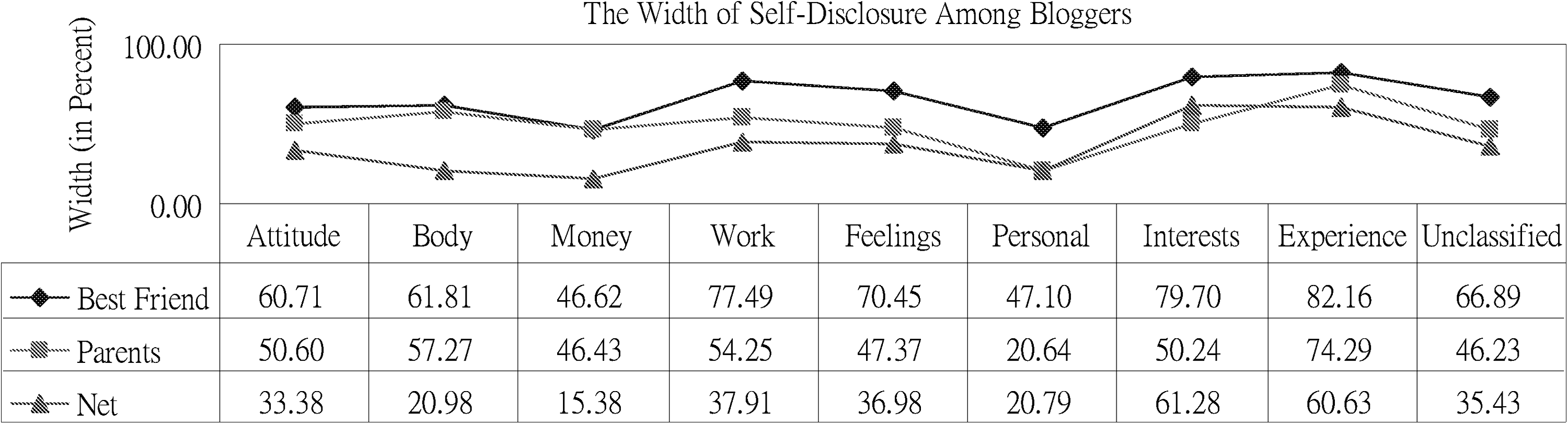
The width of self-disclosure of bloggers to best friends, parents, and online audiences.
The depth of self-disclosure as a function of topics and targets
A multivariate analysis of variance (MANOVA) was conducted to test the disclosure of bloggers to the three targets (online friends, parents, and best friends), with differences in the depth of disclosure on nine topics (measured by averaged intimacy values; the higher value in intimacy, the lower in depth). As shown in Table 3, the depth of disclosure was significantly different for each topic. The Games-Howell method for post hoc comparison was selected because Box's Variance Homogeneity test was significant. As shown in Table 3 and Figure 1, bloggers disclosed more to their best friends, followed by their parents, and online audiences. However, significant differences in the disclosure of money topics exist between best friends and parents; yet, bloggers seem cautious with expressing money matters to online audiences and best friends. On personal topics, bloggers seem to disclose with more depth to their best friends, rather than their parents and online audiences. For interest topics, bloggers disclose with more depth to online audiences rather than parents, implying that bloggers might express themselves to attract likeminded friends online.
Box's homogeneity <0.01;Wilk λ: 0.50* (Sig. <0.01).
N, Net friends; P, parents; B, best friends.
Depth of self-disclosure
The width of self-disclosure as a function of topics and targets
On the width of self-disclosure, we computed the accumulated percentage of bloggers who are willing to disclose on a topic, and chose the accumulated percentage larger than 50 percent for further analysis (implying that half of the participants are willing to talk about in this topic). For example, the most frequently disclosed items on blogs are in Table 4. Life experiences, such as shopping, traveling, and gourmet experiences, and personal interests, such as favorite movies and TV programs, are at the top of the list.
On the width of self-disclosure, bloggers express the widest to their best friends (40 items higher than 50 percent), followed by parents (28 items), and online audiences (14 items).
Bloggers seem to widely express on all topics, which is similar to the findings in the depth of self-disclosure. As shown in Figure 2, bloggers seem to disclose personal interests, experiences, work, and feelings more often, and personal and financial matters less often (over 60 percent of the items will be disclosed in interests and experiences, but only 15 percent in money topics).
We used a nonparametric statistics (Friedman's two-factor rank ANOVA) to determine whether the bloggers self-express differently in width to different targets. As shown in Table 5, the self-disclosure of bloggers is significantly different among the three targets, and further post hoc comparison reveals that bloggers express wider to best friends rather than parents and online audiences; however, the difference between parents and online audience is unnoticeable in the width of self-disclosure.
p<0.05.
Demographic variables
Certain demographics, such as gender and age, have been suggested as an important factor in self-disclosure,18,19 blogging,10,13 and online chatting. 25 Therefore, we conducted a series of MANOVA on gender and age to ascertain their impact on self-disclosure. No gender difference exists on self-disclosure in blogging; however, female bloggers disclosed deeper than males to their parents and best friends, in real life, which is consistent to prior studies.18,19 The younger bloggers (<20 years old) seemed to disclose wider, but showed no significant difference in depth (>30 years old) on their blogs.
Discussion
Online activities, for example, on social networking sites such as Facebook, Twitter, and Myspace, have become extremely popular in recent years. 14 However, the topics of disclosure of online users about themselves on the Internet are unclear. Social penetration theory was applied to the context of blogging, and revealed that bloggers disclose their thoughts, feelings, and experiences to their best friends in the real world the deepest and widest, rather than to their parents and online audiences. Bloggers seem to express their personal interests and experiences in a wide range of topics online to document their lives or to maintain their online social networks. Social penetration theory was appropriately examined in our study; and it seems that the “wedge model” of interpersonal relationships could be extended to online relationships. Similar to prior findings,17,34–36 bloggers seem to be aware of the risks of extensive disclosure on their blogs, and are more willing to disclose their interests and experiences rather than personal and money matters.
Prior research has stressed that the Internet has invoked a high level of self-disclosure regarding online interpersonal relationships. For example, a study found that people report of disclosing significantly more in their Internet relationships, compared to in their real life relationships. 37 Another study argued that participation in online newsgroups provides people with the benefit of “disclosing a long secret part of one's self.” 38 Our findings, however, challenged these ideas, in that bloggers are more willing to disclose to their real-life best friends deeply and widely, rather than on their blogs. The interpersonal relationships in the real world seem irreplaceable.
Several issues should be discussed in future studies, such as the interplay between online friends and friends in real world, the reasons that bloggers disclose more to best friends rather than their parents, and whether a blog can serve as a method of self-healing.
Research restrictions
Although the sample size of the survey was large, the subjects were volunteers, and from Taiwan only; therefore, the findings could not be generalized for bloggers worldwide. The self-reported survey may also be subject to honesty or social desirability issues, and culture may also be a potential variable for self-disclosure.
Footnotes
Acknowledgments
The authors would like to thank National Science Foundation in Taiwan for generous grant support (NSF 98-2410-H-141-002). A previous version of this manuscript was presented at the 2009 IADIS International Conference on Web Based Communities, Algarve, Portugal.
Disclosure Statement
No competing financial interests exist.