




Abstract
Abstract
The purpose of this study was to examine the effects of social cues in self-presentations and the congruence of other-generated comments with the self-presentation in people's evaluations of a profile owner. A 2 (level of social cues: high vs. low)×2 (congruent vs. incongruent)×2 (order)×2 (multiple messages) mixed-subject experiment was conducted with 104 college students. The results showed that a profile owner was perceived less socially attractive when other-generated comments were incongruent with the profile owner's self-presentation. No matter how people package themselves with extravagant self-presentations, it cannot be very successful without validation from others. Interestingly, an interaction effect between congruence and the level of social cues suggested that perceived popularity was low in the incongruent condition regardless of level of social cue. Theoretical and practical implications were also discussed.
Introduction
What people see on SNSs are articulated pieces of information intended to generate certain impressions. Although people are aware of this, because everyone is involved in some form of impression management (IM), observers are still interested in how others present themselves. In this study, we explore how self-presentations in profile pictures along with information provided by others about a user affect perceptions.
Literature Review
Goffman 3 introduced the concept of IM, explaining how people make a good impression on others by controlling the exchange of information. Based on Goffman's work, Jones and Pittman 4 developed an initial taxonomy of IM behaviors (i.e., self-promotion, ingratiation, exemplification, intimidation, and supplication). Goffman 3 explicated IM in conjunction with self-presentation in that self-presentation refers to tactics to convey one's impression by controlling disclosure of a person's information. Self-presentation is defined as a goal to influence perceptions of one's image. 5 These early scholars originally explicated IM and self-presentation in face-to-face interactions, but current studies have explained users' IM and self-presentation on SNSs.6–9
Self-presentation is practiced on SNSs when individuals create their online profiles. Specifically, individuals carry out self-presentation through their profiles by displaying networks and crafting profile lists. In a similar vein, Boyd and Heer 6 believed that individuals portray their identities on their SNS profiles by explicitly espousing social information such as relationships and testimonials.
Donath and Boyd 8 argued that SNSs reflect a more reliable self-presentation, because individuals use their real names and show their relationships with others, thus ensuring honest identities. Self-presentation is also achieved by controlling information about their background and interests, 10 as people intentionally control information to create a particular effect.
According to Ledbetter, 11 self-presentation is critical in Facebook since users expect beneficial relational outcomes such as meaningful relationships or social skills. Communicators use online technological characteristics for their messages to manage impressions toward others and shape their relationships with them. 12 Sometimes, profile owners display idealized characteristics that do not reflect their actual personalities. 13 Hancock and Dunham 14 state that people formed impressions or exaggerated personal identities of other users to create positive images of themselves in computer-mediated communication environments.
Social cues
Self-presentation involves social cues that shape impressions by individuating a person. 15 They reduce ambiguity and help shape positive perceptions: The more social cues available, the less ambiguous and the more positive impressions become. 15 Thus, face-to-face interactions, by providing more social cues, are considered more effective than computer-mediated communication. 15 However, Walther's social information processing theory argued that social cues lead to positive impression online, since people have more chances to transmit social cues. 12 Thus, SNSs provide a growing arena for the study of social cues.15–17 Carlson and colleagues 16 identified the following types of cues: verbal, nonverbal (or those that accompany the delivery of verbal or textual content), contextual, and metacues (or the interaction between cues). These cues are also present and at work in computer-mediated communication. For instance, Bolliger 18 argued that the use of visual cues, like emoticons, in communication that occurs on online teaching contributed to clear expressions of meaning and motion, thus helping improve e-learning and training. Thus, the study of the effects of social cues in relationships and impression formation has become more salient in the age of computer-mediated communication.15,16
The information people upload, consciously or not, in their personal pages and those of their friends, become social cues. Gosling, Ko, Mannarelli, and Morris 19 identified two personality claims expressed in SNSs: identity claims, which are the symbolic declarations that individuals make to themselves or others in an attempt to convey how they would like to be seen, and behavioral residue, which refers to the inadvertent clues left by one's behavior. People make personality judgment of target based on elements in the place where targets have more or less control. 19 Identity claims are also regarded as the example of utilized cues that can be easily found in materials of Facebook profiles. 20 Tanis and Postmes 15 also studied the effects of profile pictures and biographical entries as social cues. They confirmed that more social cues led to less ambiguous and more positive impressions. 15 Milyavskaya and colleagues 21 also treated the profile picture as a social cue and found that a person portrayed as socially connected in a profile picture yielded a different impression than when the person was represented alone. Thus, the concept of social cues is explicated as the additional information upon which an impression can be made. Tong and colleagues 22 found that the number of Facebook friends, another social cue, had a positive relationship with social perception, as having many friends could be judged as an indicator of social attractiveness. This integration of the literature leads us to the following hypotheses:
Warranting principle
Perceptions are shaped not exclusively by what profile users disclose about themselves. Self-presentations and the social cues that come with them are not the only sources of impression. For instance, a study found that a profile owner's perceived attractiveness was affected by their friends' attractiveness in wall posts. 17 Other studies also showed that contributed content—for instance, what other friends say on a profile user's wall—also influence perceptions about the profile user.23,24 Thus, it is important to study the combined effect of self-presentation and information from other people, especially when these are contradictory.
People judge attractiveness not only based on one's profile photograph but also based on others' comments on Facebook. 20 Information provided by others affects observed evaluations in Facebook. 24 This has been regarded in the literature as the warranting principle.20,24,25 Initially, Walther and Parks used the concept to refer to the consistency that observers perceive between someone's online presentation and offline self, 25 but Walther and colleagues 24 have also used the same concept to argue how other-generated descriptions are perceived as more truthful by observers than claims generated by the profile owner. One's own disclosures are easier to manipulate than those volunteered by others. 20 Thus, the warranting principle also emphasized that judgment from other-generated information is more influential than judgment from self-generated information. 24 Having positive statements on one's Facebook wall also generated higher scores on perceived qualification, task attractiveness, and social attractiveness than when participants saw negative statements.20,24
Self-presentations are generally positive; it is unthinkable in most instances for someone to create a negative self-presentation. A congruent condition is when other-generated information is also positive, consistent with the object's self-presentation. Thus,
Method
This study used a 2 (social cue: high vs. low)×2 (congruence: congruent vs. incongruent)×2 (order)×2 (messages) mixed-design experiment. Social cue and message were manipulated within subjects, whereas congruence and order were manipulated between subjects.
Predictor variables
Social cue
This was operationalized as the amount of personal and social information that can be perceived from the profile pictures. It is dichotomized into two levels: high and low. High social cue refers to the presence of an additional identifying element (e.g., a school jersey and a violin) in a profile picture that provides additional evidence in judging the person shown. Low social cue refers to the absence of any additional identifying element with which a person depicted in a photo can be judged.
Congruence
This was operationalized as the relationship of other-generated information (wall comments) to the target's self-presentation (profile picture). A congruent relationship is when other-generated comments are positive, which is consistent with a positive self-presentation of the target.
Pretest
A pretest was conducted with a student sample to determine which profile pictures to use in the main test. Participants rated each of the 12 profile pictures of varying social cue and gender by indicating their agreement with these questions: “How much does the picture say about the person's social information?” and “How much does the picture say about the background of the person?” in a 7-point scale. Pictures that scored low were considered having a low social cue, whereas those that rated high were considered to have a high social cue. Participants also rated physical attractiveness to enable the researchers to control possible confounding effects. The two pairs of pictures that showed no difference in physical attractiveness were chosen for the main experiment.
Main test
A total of 104 students were recruited from a Midwestern University. This sample size was determined from an a priori power analysis using the following parameters: four conditions, effect size (d)=0.2, type I error=0.05, and power=0.80. The experiment took place in a computer laboratory where the participants were randomly assigned to one of four conditions.
Demographic
A greater number of participants were females (66 percent, n=70). Participants' age ranged from 19 to 30, with an average age of 21 (SD=1.34). The majority of participants identified themselves as Caucasian/White (62.3 percent, n=66).
Control variable
Physical attractiveness
Physical attractiveness was measured using five items. 26 We asked participants to rate if the profile owner looked “classy/not classy,” “beautiful/ugly,” “sexy/not sexy,” “elegant/plain,” and “attractive/unattractive.” The measure was reliable (α=0.73).
Dependent variables
Social attractiveness
Social attractiveness was measured based on the intention to have the profile owner as a Facebook friend based on responses to two items: “I would like to add him/her as my friend in Facebook,” and “I will accept his/her friend request on Facebook” on a 7-point Likert scale (α=0.84).
Popularity
Popularity was operationalized as the perceived number of friends, since Zywica and Danowski 27 argued that individuals with many Facebook friends are perceived as more popular. The participants guessed the number of friends: 102, 302, 502, 702, or 902.24,28
Results
Manipulation check
Congruence was defined as the level of agreement of respondents that “the information from the profile picture and the information from the comments from the wall are the same.” 29 There was a significant difference between the congruent condition (MCongruence=5.29, SD=1.37) and incongruent condition (MIncongruence=2.25, SD=1.56), t(210)=15.04, p<0.01.
Hypotheses testing
Repeated-measures analysis of variance (ANOVA) and one-way ANOVA were conducted to test the hypotheses.
Hypotheses 1a and 2a predicted that the profile owner would be perceived more socially attractive when there were more social cues available (H1a) and when the wall comments were congruent with the profile picture (H2a). The main effect of social cues yielded an F ratio of F(1, 210)=4.62, p<0.05, ηp2=0.02. The main effect of the congruence of wall comments with a profile picture was also significant, F(1, 420)=29.79, p<0.01, ηp2=0.06. This result shows that the profile owner was perceived more socially attractive when the wall comments were consistent with the profile picture (M=4.25, SD=2.29) than when the comments were inconsistent (M=3.23, SD=1.67). Thus, H1a and H2a were supported.
Hypotheses 1b and 2b predicted that the profile owner would be perceived more popular when there were more social cues available (H1b) and when the wall comments were congruent with the profile picture (H2b). There was a significant main effect for social cues, F(1, 210)=89.71, p<0.01, ηp2=0.31. The main effect of the congruence of wall comments with a profile picture was also significant (F(1, 420)=9.01, p<0.01, ηp2=0.02). The main effect of the congruence of wall comments with a profile picture was also significant (F(1, 420)=9.01, p<0.01, ηp2=0.02), indicating that the profile owner was perceived more popular when the wall comments were consistent with the profile picture (M=5.06, SD=1.59) than when the comments were inconsistent (M=4.57, SD=1.86). Therefore, both H1b and H2b were supported.
A research question explored the effect of the interaction between the level of social cue and congruence. The interaction between social cue and congruence was significant for popularity, (F(1, 210)=5.77, p<0.01, ηp2=0.07). Participants in an incongruent condition gave almost similar scores for the popularity of the profile owner regardless of social cue available (see Fig. 1). However, those who were in a congruent condition gave very low ratings for the popularity of the profile owner when there were few social cues available than when there were more social cues.

Interaction between Social Cue and Congruency on Perceived Popularity.
Additional analysis
Although the current study conducted a pretest to rule out the effect of physical attractiveness, we found in the main test that the perceived physical attractiveness of those in the profiles used differed in the low social cue condition (F(1, 210)=92.774, p<0.01, ηp2=0.31). Physical attractiveness refers to how good-looking a target person is, and is therefore a matter of perception, and in several studies, it has been measured by asking respondents, usually students, to rate how attractive a target person in a photograph is.24,30–32 With respect to this line of research, it is logical to assume that physical attractiveness of a profile owner influences a range of social media users' perceptions. Therefore, to obtain a more precise analysis, we additionally conducted MANCOVA with physical attractiveness as a covariate. The result revealed that the main effect of level of social cue was significant for social media users' perception (Wilks Λ=0.89, F(3, 417)=16.88, p<0.01, ηp2=0.11), and the main effect of congruency was significant for all dependent variables (Wilks Λ=0.89, F(3, 417)=17.47, p<0.01, ηp2=0.11). Hence, our findings provide meaningful internal validity as shown by our consistent results.
Discussion
The current study found that having more social cues in one's profile pictures positively influenced perceived popularity and social attractiveness. This is consistent with previous findings that having more social cues, especially in one's profile pictures, yields more positive impressions because of the perceived reliability of the self-presentation.15,20 One practical implication is for users seeking positive impressions to provide social cues consistent with the desired image.
Our findings also reveal that congruence of other-generated comments with one's self-presentation leads observers to perceive the profile owner as more popular and socially attractive than when there is incongruence. If the wall comments are negative, participants evaluate profile owners as less socially attractive and assume that the profile owners have few Facebook friends. Consistent with the warranting principle, our data affirm previous findings that observers base their impressions not only on self-presentations but also on other people's feedback about a profile owner.22,24,25
The main contribution of this study is the interaction between congruence and the level of social cue in the perception of popularity. It appears that the effects of congruence override the effects of social cues. When other-generated comments are incongruent with the self-presentation, participants were less likely to perceive the profile owner to be more popular than when there is congruence regardless of the amount of social cues present in the profile. This is consistent with previous research showing that people rely more on other-generated information than self-generated information when forming impressions.24,25,30 In other words, opinions of other people matter more than the target person's own self-presentation. Thus, for social networking users concerned about forming a desired impression, being aware of other-generated information about oneself is paramount in the goal of achieving a positive self-presentation.
Although Walther and colleagues 24 found gender and race effects in their experiment on Facebook profiles, our current study managed to shield our findings from these possible confounds by using photos of only Asian women selected from the pretest (see Figs. 2 and 3).
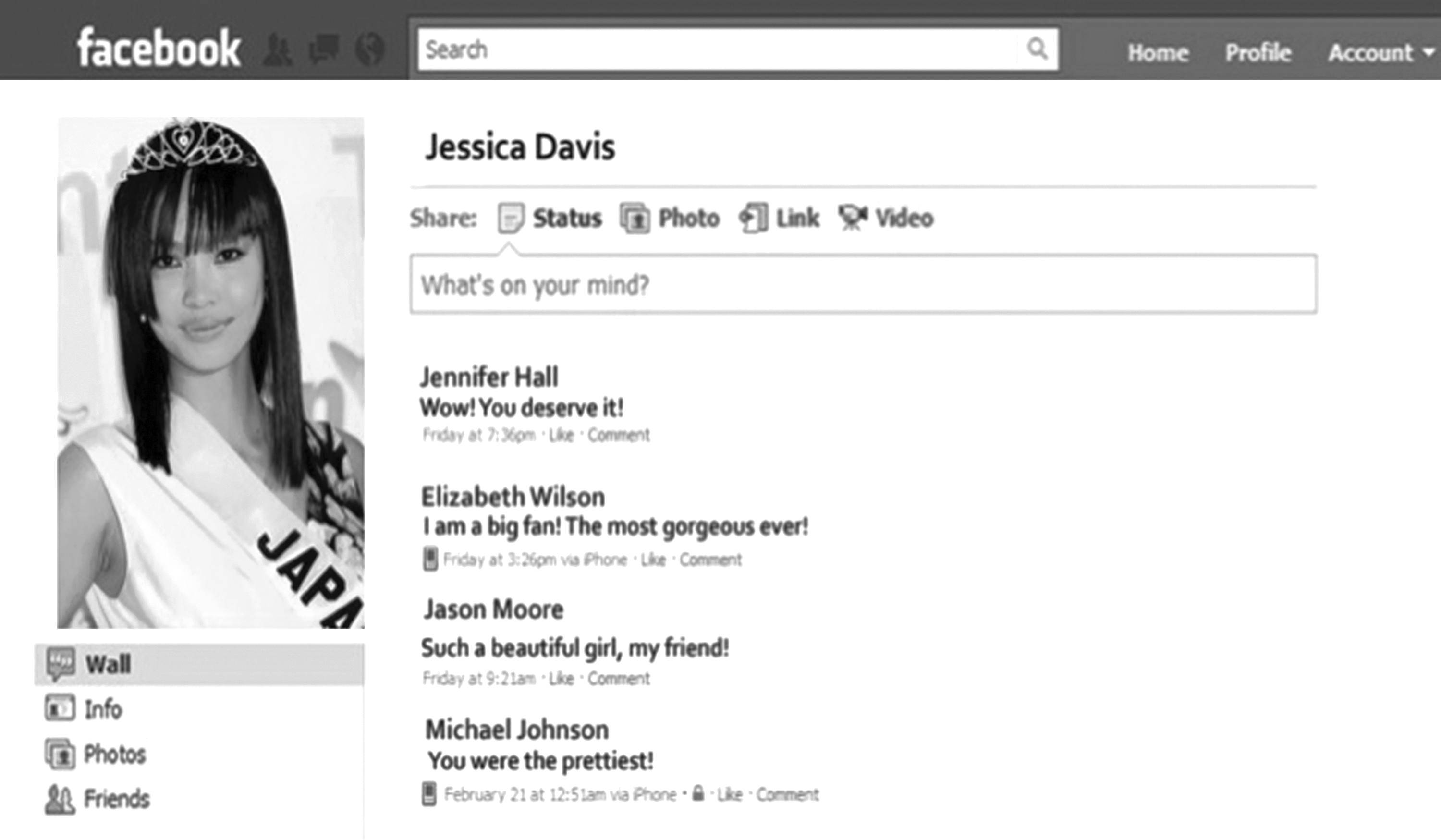
Congruent High Social Cue.
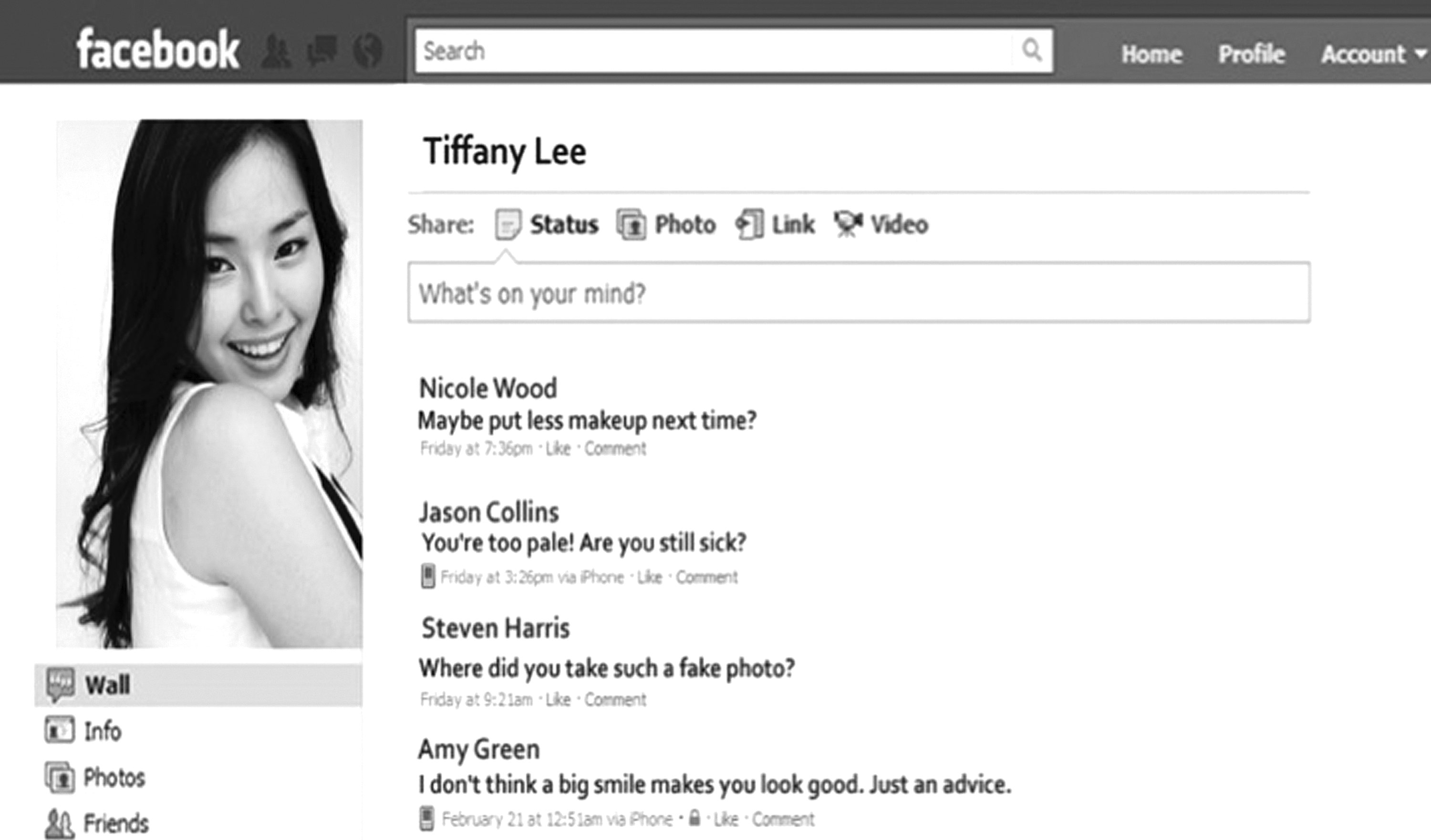
Incongruent Low Social Cue.
Our study suffers from a limitation that can be addressed in subsequent studies of this stream of research. Our operationalization of an incongruent condition was limited to negative other-generated comments, consistent with our argument that self-presentations are usually positive. As what Karl and colleagues 33 emphasized, some young Facebook users also strive for not-so-positive images, like being wild, which leads them to upload problematic information. Therefore, there will be instances when negative comments would be consistent with a problematic self-presentation. This particular situation would provide an interesting context for future research.
Conclusion
This investigation not only addresses the theoretical significance of social cues in self-presentations but also illustrates the important role of other-generated comments in generating impressions. We have shown that having higher social cues and having congruent other-generated content on one's Facebook profile lead to more positive evaluations. The findings apparently indicate SNS users' awareness of how easy it is to manipulate self-presentations online that they rely heavily on other-generated content that are deemed more difficult to manipulate. It is possible that observers also consider, if not value, other-generated content as another form of social cue that is beyond the control of the profile owner. This is something that future studies can explore to further illuminate the interaction between self-presentation and other-generated content.
Footnotes
Author Disclosure Statement
This research was not funded by any grant or organization, and hence no possible conflicts of interest would arise on the part of any of the authors. An earlier version of this article was presented as a poster at the 2011 Association for Education in Journalism and Mass Communication Conference in St. Louis.