




Abstract
Abstract
This article presents the results of a study concerning the use of online profile pages by adolescents to know more about “offline” friends and acquaintances. Previous research has indicated that social networking sites (SNSs) are used to gather information on new online contacts. However, several studies have demonstrated a substantial overlap between offline and online social networks. Hence, we question whether online connections are meaningful in gathering information on offline friends and acquaintances. First, the results indicate that a combination of passive uncertainty reduction (monitoring a target's profile) and interactive uncertainty reduction (communication through the target's profile) explains a considerable amount of variance in the level of uncertainty about both friends and acquaintances. More specifically, adolescents generally get to know much more about their acquaintances. Second, the results of online uncertainty reduction positively affect the degree of self-disclosure, which is imperative in building a solid friend relation. Further, we find that uncertainty reduction strategies positively mediate the effect of social anxiety on the level of certainty about friends. This implies that socially anxious teenagers benefit from SNSs by getting the conditions right to build a more solid relation with their friends. Hence, we conclude that SNSs play a substantial role in today's adolescents' everyday interpersonal communication.
Introduction
Yet, several studies have demonstrated a substantial overlap between offline and online social networks.9,10 This observation raises questions about the degree to which SNSs are used to acquire information on relations nested within the offline network. In this article, we question whether adolescents get to know their offline social relations better through their profile pages. Our central thesis is that adolescents successfully acquire additional information on both their friends and acquaintances through their respective social network profiles. It is hypothesized that this information has positive effects on the relationship formation process because a higher level of certainty ensures more self-disclosure, leading to a comfortable context of mutual information sharing. We expect that these effects are stronger for acquaintances than for close friends. This would imply that SNSs are beneficial in expanding and strengthening existing social networks. However, we propose that adolescents who experience social anxiety, and hence experience more difficulties in engaging in face-to-face contact, tend to benefit more from SNSs to get closer with their friends.
Relations in adolescence
Choosing adolescents as subjects in this study has a twofold reason. First of all, SNSs are anchored to the youth culture. The young population actively uses SNSs for self-representation and regular communication. 11 Second, the formation of intimate, dyadic, and clique relationships with peers is a fundamental developmental task in adolescence. Friendships offer valuable emotional and social support, comprise important sources of peer influence, and provide a socialization context to acquire essential social skills. 12 Still, peer influence is not limited to friends. Crowds, which are mainly deemed large, weakly linked, and reputational and stereotypical collections of peers, also play an important role. 13 Crowds can channel and structure social interactions and can foster opportunities to extend beyond one's immediate circle and to form new social associations. 14 Both the centrality of SNSs in adolescents' lives and the importance of forming successful peer relations render the population of adolescents especially interesting.
Acquiring information
Having information about others is a prerequisite in forming and maintaining a relationship. 15 An influential perspective on interpersonal information acquisition is the uncertainty reduction theory (URT) originally proposed by Berger and Calabrese. 16 It postulates that people are concerned with reducing uncertainty about others to predict their behavior. To do so, three strategies are used: (a) passive strategies, such as nonintrusive observation of the target; (b) active strategies, such as inquiring from others about the target person; and (c) interactive strategies, which involve direct communication with the target.
Previous research has indicated that young people are prone to employ online channels (including SNSs) to gather information on a variety of relatively close relations, such as classmates, friends, and best friends. 17 Recently, however, URT has been directly tested in the context of SNSs. 8 Findings show that in contrast to active strategies, passive and interactive strategies are quite frequently used to gather information on new online acquaintances. Moreover, both strategies appear to be substantially correlated. In a further analysis, Antheunis et al. 8 computed a path model that shows how interactive strategies mildly explain the level of uncertainty of the target, which in part affects social attraction to the target. Yet, the question remains whether the profile pages of offline friends and acquaintances also make gathering new information possible. Because of adolescents' wide use of these sites and the considerable amount of information they accumulate, we hypothesize that they actually do. In our research, we focus on both passive and interactive uncertainty reduction strategies (URSs) because both have a direct link with the target's profile. The former involves gathering information by browsing the profile, checking status updates, looking at pictures, and so on. On the other hand, the latter involves the use of communication tools or features that are usually available in profile pages (e.g., public, private, and instant messaging). Because active uncertainty reduction involves a third party, extends beyond the dyadic relationship, and, most importantly, does not necessarily involve the target's profile page, it is not included in the present study. Therefore, from now on, we refer to passive and interactive URSs as “online uncertainty reduction.” This leads to the first hypothesis.
Still, as mentioned, friend relations are by definition more intense than relations with acquaintances. It is therefore very unlikely that online information on SNSs will provide the same kind of novel information. Hence, we expand the first hypothesis.
Relation intimacy
An interpersonal relationship, especially between friends, is fueled by a substantial amount of intimacy. 18 This is usually described as a feeling of closeness and openness in sharing cognitions and emotions. 19 Meta-analytic evidence points out that disclosure by another is associated with an increased liking of the discloser. 20 On the other hand, relations—especially with friends—require an imperative degree of reciprocity. 21 In other words, the more someone allows us to know about him or her, the more reliable our appraisal of that person will be. This in turn encourages us to disclose some information about ourselves. As previously argued, we presume that SNSs serve as information sources for social relations. Consequently, we propose the second hypothesis.
Social anxiety
As revealed by previous research, not all adolescents share the same competence when it comes to forming and maintaining relations in an everyday face-to-face setting. In fact, social anxiety, which refers to the anxiety about social situations and fear of negative peer evaluation and embarrassment, has been associated with impaired social functioning, isolation, and lack of support. 22 Adolescents with social anxiety find it difficult to get to know someone, disclose information, and form a solid relationship. However, this problem may be partially overcome by using SNSs because these sites offer easily accessible social information and simultaneously provide means of less intrusive computer-mediated communication. In fact, the latter issue has been subjected to extensive research. For example, evidence was found to support the social compensation hypothesis, indicating that introverted adolescents, who lack social skills in an offline setting, consider online platforms as valuable means of compensation.23,24 Still, adolescents low in social anxiety also benefit from online platforms by expanding their social networks. 25 Therefore, we put forward the following hypotheses.
Methodology
Sampling procedure
Our study took place in Flanders, the northern region of Belgium. A sample of 352 adolescents took part in our study (Mage=16.44 and SD=1.39; 30 percent men and 70 percent women). This gender imbalance was corrected with a post hoc weighting procedure (50 percent men and 50 percent women). More specifically, to avoid gender bias, male cases were relatively toned up and female cases were toned down before generating the covariance matrix used to perform the analyses. To gather the sample, three schools agreed to participate in our study. These schools were carefully selected to ensure an equal spread of education types. In these schools, randomly chosen class groups filled out paper-and-pencil questionnaires. As such, a self-selection bias was avoided. Four respondents who do not use any SNSs were excluded from this study.
Measures
Online uncertainty reduction assessed the use of passive and interactive URSs to gather information on friends and acquaintances. It was measured with a seven-item instrument, adopted from a previous research (the full scale is listed in Appendix Table A1), that taps into the kind of information that is sought. 8 For each URS, separate measurements were obtained for friends and acquaintances. The respondents were asked to rate whether they (a) “monitor their friends' [or acquaintances'] profiles …” and (b) “engage in conversation on SNS with friends [or acquaintances] through chat and public/private messages …” to get to know more about a target's character, hobbies, personal affairs, opinions, feelings, family situation, and current occupation. Each item was rated on a seven-point scale ranging from “does not apply” to “strongly applies.” All four measurements yield satisfactory α-values ranging from 0.87 to 0.99.
The level of certainty was measured for both friends (α=0.76) and acquaintances (α=0.77). A five-item measurement was drawn from Clatterbuck. 26 Sample items are “I understand these persons well” and “I can predict how these persons will behave.” The items were rated on a seven-point Likert scale ranging from “totally disagree” to “totally agree.”
Self-disclosure to friends (α=0.75) and acquaintances (α=0.73) was measured by a five-item measurement obtained from Parks and Floyd. 27 Sample items are “I usually tell these persons how I feel” and “I tell these persons things about myself they cannot get from any other source.” The items were rated on a seven-point Likert scale ranging from “totally disagree” to “totally agree.”
Social anxiety was measured with the Social Interaction Anxiety Scale (SIAS, α=0.89). 28 Sample items are “I have difficulty talking with other people” and “I am nervous mixing with people I don't know well.” The 18 items are scored on a five-point Likert scale ranging from “not at all” to “extremely.”
Before performing the analyses, the Harman single-factor test, 29 which tests for the common bias method, was performed. More specifically, all mentioned measurements were subjected to a principal component analysis constrained to a single component. The results indicate that these measurements only share 36 percent of variance, which is below the arbitrary 50 percent cutoff. Hence, no excessive shared variance between measurements could point to the use of a common method.
Results
To test for the proposed hypotheses, the outlined paths were specified in a structural equation model ran on the weighted covariance matrix with an equal gender distribution (Fig. 1). This model simultaneously incorporates measures of acquaintances and friends. Cross-effects were implicitly modeled to correct for the methodological pitfall of autocorrelation (see dotted lines in Fig. 1). Moreover, parallel measures' error terms were allowed to correlate because mutual factors could very likely explain additional variance. The model yields an acceptable goodness-of-fit [χ2(11)=25.11, p<0.05, TLI=0.96, CFI=0.99, RMSEA=0.06 CI90 0.03, 0.09, pclose=0.26].
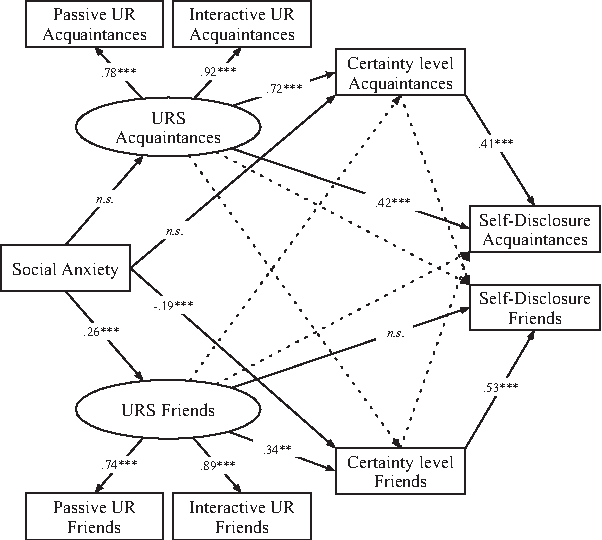
Specified structural equation model with hypothesized paths as solid lines and autocorrelation corrections as dotted lines. **p<0.005, ***p<0.001. The model's variables' correlation matrix is included in Appendix Table A2. URSs, uncertainty reduction strategies; n.s., not significant.
The results support hypothesis 1's first part (H1a) as the paths from URS on acquaintances and from URS on friends demonstrate significant, positive direct effects on the respective measures of the certainty level. To test for H1b, these two paths were constrained to equality in an additional model. Therefore, it becomes possible to directly compare the estimates' magnitudes. As the additional model fits significantly worse than the initial unconstrained model [Δχ2(1)=7.51, p<0.05], we conclude that the effect of URS on acquaintances on the respective certainty level (β=0.34, p<0.001) is significantly smaller than the effect of URS used in the context of friends on the certainty level of those same friends (β=0.72, p<0.001). This indicates that the effect of URS in the case of acquaintances is significantly stronger than that in the case of friends, thus confirming H1b.
The second hypothesis (H2) predicts that URS indirectly affects self-disclosure through an increased level of certainty. Hence, both for friends and acquaintances, we test the certainty level as a mediator for the effect of URS on self-disclosure. For friends, we indeed encounter full mediation, whereas for acquaintances, this mediation is only partial, given both significant direct and indirect effects. Hence, the second hypothesis is partially supported.
Further, we test H3a, proposing that for friends, social anxiety is positively associated with the use of URS, while the latter mediates the effect of social anxiety on the level of certainty (see bottom half of Fig. 1). The results indeed reveal a positive effect of social anxiety on the use of URS on friends. Moreover, URS on friends appears to be a positive mediator of the negative relation between social anxiety and the certainty level of friends. Finally, we investigate the last hypothesis (H3b), predicting that social anxiety is negatively associated with the use of URS on acquaintances, which would mediate the effect of social anxiety on the level of certainty (see top half of Fig. 1). The results, however, show no significant association between social anxiety and URS on acquaintances and its respective certainty level. Hence, H3b is disconfirmed.
The hypotheses and their corresponding evidence are enumerated in Table 1.
SNSs, social networking sites; URSs, uncertainty reduction strategies.
Discussion
The results indicate that SNSs are valuable sources of information for offline relations. By drawing upon their contents, adolescents get to know more about their many distant acquaintances and even their much closer friends with whom they meet on a regular basis. This emphasizes the important position these sites have established in adolescents' everyday lives. The results confirm how the Internet nowadays enhances one's ability to communicate by sustaining strong ties (close friends) and weak ties (acquaintances) 30 and by allowing one to exchange information and provide social support in relationships. In his seminal work, Bowling Alone, Putnam 31 anticipated the inherent ability of the Internet to enhance the transmission of social information, strengthening both relatively weak ties and strong ties. To connect with more distant acquaintances, referred to as bridging, adolescents are enticed to engage with heterogeneous social networks (e.g., crowds), to participate in wide patterns of interaction, and to form broader identities. At the same time, through bonding, connections with homogeneous groups (e.g., cliques) are further validated. 31 Our results support the interpretation of using SNSs in these terms of bridging and bonding. SNSs play a valuable role at the onset of establishing new or even reinforcing solid friend relations. That is, they help to reduce entropy in mutual interactions, providing a more suitable context to engage in self-disclosure and hence to invest in relationships.
Not surprisingly, the amount of novel information on friends obtained from SNSs is much lower than that on acquaintances. This may be explained by the low investment it requires to engage in uncertainty reduction on acquaintances by means of technology, which does not require much emotional investment and profound reciprocity. This could point to a growing disengagement. 32 Still, when it comes to the discussion whether SNSs bring about a deterioration of social contact, we must take into account our findings regarding social anxiety. Apparently, SNSs could serve a very important function. As expected, we found a negative direct effect of anxiety on the level of certainty about friends. Teenagers characterized by a high degree of social anxiety often experience problems in interacting with others, impairing their ability to gain rich information directly from the source. It is, therefore, remarkable that there is a positive mediation of the aforementioned effect by URSs on SNSs. Still, we must take into account that the level of certainty is a perception and perhaps does not reflect an actual profound knowledge of a person. Nevertheless, SNS applications do seem to serve as a bypass and aid to create a more comfortable context to engage in self-disclosure, which is the cornerstone of successful social interaction. This kind of investment, which is especially difficult for the socially anxious, in turn offers a better position to deepen and strengthen friend relations. In other words, it offers something to talk about. Still, we found no effects of social anxiety for acquaintances, indicating that there is no link between social anxiety and the use of SNSs for uncertainty reduction on acquaintances, which means that regardless of one's position on social interaction, adolescents equally engage in this type of uncertainty reduction.
Conclusion
In conclusion, this study expands on earlier findings that focused on gathering information on new online contacts. 8 It sheds light on the dynamics of SNSs and their consequences for everyday communication. It also demonstrates how it becomes increasingly difficult to rigidly dichotomize the online and the offline. What happens online has implications offline and vice versa. However, this study needs further verification by other studies to further demonstrate the validity of its results. Therefore, we encourage replications and extensions. We recommend seeking a more in-depth understanding of what kind of information is exactly obtained from SNSs and how this information is used in social interactions.
Footnotes
Disclosure Statement
No competing financial interests exist.
Appendix
| 1 | 2 | 3 | 4 | 5 | 6 | 7 | 8 | 9 | |
|---|---|---|---|---|---|---|---|---|---|
| 1. Passive UR friends | — | ||||||||
| 2. Interactive UR friends | 0.67 | — | |||||||
| 3. Self-disclosure friends | 0.12 | 0.18 | — | ||||||
| 4. Certainty level friends | 0.18 | 0.26 | 0.53 | — | |||||
| 5. Passive UR acquaintances | 0.59 | 0.55 | 0.10 | 0.20 | — | ||||
| 6. Interactive UR acquaintances | 0.49 | 0.46 | 0.08 | 0.10 | 0.70 | — | |||
| 7. Self-disclosure acquaintances | 0.13 | 0.15 | −0.06 | −0.13 | 0.30 | 0.44 | — | ||
| 8. Certainty level acquaintances | 0.17 | 0.15 | −0.01 | 0.12 | 0.36 | 0.43 | 0.55 | — | |
| 9. Social anxiety | 0.26 | 0.22 | −0.12 | −0.10 | 0.15 | 0.17 | −0.02 | −0.07 | — |
| M | 3.35 | 3.50 | 5.34 | 5.08 | 2.98 | 2.67 | 3.09 | 3.22 | 65.45 |
| SD | 1.33 | 1.41 | 1.04 | 0.97 | 1.36 | 1.26 | 1.10 | 1.12 | 15.96 |
All correlations with p>0.05 are set in italics.