




Abstract
Abstract
The current study explored the motivations of online social network use among a sample of the general population in Taiwan (N=4,346). It investigated how seven different motivations to use Facebook predicted the intensity of Facebook use and content-generation behaviors on Facebook. Results showed that the motivation to use Facebook for posting and viewing status updates was the strongest predictor of Facebook intensity, while the motivation to view and share photographs was the strongest predictor of content-generation behavior on the site. Results are discussed in terms of expanding motivations to use Facebook to the study of social networking sites and other new and social media.
Introduction
Despite the fact that the majority of Facebook users come from countries other than the United States, the extreme majority of Facebook research is U.S. centric. Therefore, it becomes important to explore this social phenomenon in other countries and cultures. The current study surveyed a sample of Taiwanese Facebook users (N=4,346) to explore the site's motivations and uses. More specifically, the study investigated the relationships among motivations to use Facebook, Facebook intensity, and self-reported content-generation behavior on the site.
Defining SNSs
While Facebook creators define it as a “social utility that helps people communicate more efficiently with their friends, family and coworkers,” 1 boyd and Ellison 6 (p211) define SNSs as web-based services that allow individuals to (a) construct a public or semipublic profile within a bounded system, (b) articulate a list of other users with whom they share a connection, and (c) traverse their list of connections and those made by others within the system.
Beer 7 critiques this definition by stating that it is far too broad and aggregates web applications that might be structurally different into one category. This argument reflects the difficulty in coming up with conceptual definitions of social phenomena that are tied to ever-changing technologies. Looking specifically at Facebook, the Web site is constantly updating its design, adding new features, and creating new applications.1,8,9
Facebook's growing popularity is matched with the site's plight for constant change and updating. Past research indicated that Facebook users are motivated by the need to maintain their offline relationships with friends, family, and acquaintances in an online setting.10–16 This begs the question as to whether changes in the site's design and function mirror changing motivations to use Facebook. The current study explored whether the motivations to use Facebook, different uses of the site, and the relationships between motivations and uses are different in other countries; in this case, Taiwan. To understand such relationships, the following section reviews the uses and gratifications (U&G) approach as the theoretical framework for the current study.
U&G of SNSs
U&G redefined the way researchers evaluate how and why people use media. Unlike previous theories of direct and powerful media effects that regarded media users as passive, U&G posits that audience members are active and goal-oriented consumers of media. They are active in terms of selecting media channels and messages based on their motivation to satisfy different needs.17,18 This has been criticized with arguments that audiences differ in terms of both their needs and the means by which they are gratified, as well as the challenge of assuming that the active nature of the audience is not subjected to distinction based on media features.19–24 The Internet, and what it provides for acquiring and sharing information, arguably reconciled this argument. Researchers contended that computer-mediated communication makes it impossible for users to be passive.23,25–28
Raacke and Bonds-Raacke 15 applied the U&G approach to studying Facebook use. They described Facebook from a friend-networking perspective, and argued that since users have considerable control in making decisions regarding whom to involve, follow, and communicate with in their network of Facebook friends, then U&G is applicable, especially with shifting focus from the message and channel to the user.
Recent studies attempting to explore the motivations to use SNSs applied measures of Internet-use motivations.15,29–33 While these studies illustrated that motivations of information, entertainment, diversion, surveillance, social utility, narcissism, self-expression, media drenching, and aesthetic experience, among others, are applicable to the study of SNSs, we argue that using SNSs is a qualitatively different experience from the generic use of the Internet; thus, a different set of motivations specific to these new media is needed. For example, past research found that Facebook users are primarily motivated to use the site to maintain offline relationships.10,15 The current study considered seven different motivations for using Facebook: social connection, shared identities (creating/joining groups and events), photographs (viewing/sharing), content (applications, games, etc.), social investigation, social network surfing, and status updates. 34
The major premise of U&G deals with the assumption that motivations to use media are good predictors of an individual's media-use behavior, including the choice of medium and amount of time spent using it.17–24 Sheldon found that motivations to use Facebook (i.e., relationship maintenance, passing time, participation in a virtual community, entertainment, coolness, and companionship) predicted a participant's use of the site.29,30 The current study focused on two patterns of Facebook use: Facebook intensity and content-generation behavior. The intensity to use Facebook combines use measures alongside affective and cognitive attitudes toward the site. 35 Alhabash and colleagues 36 found that five motivations to use Facebook (social connection, status updates, social investigation, photographs, and content) significantly and positively predicted Facebook intensity. With limited research using a Taiwanese sample, we proposed the following research questions.
The second type of Facebook use is specific to content-generation behavior, considering the fact that users share over 30 billion pieces of content (status updates, links, videos, and pictures) every month. 1 The current study explored how different motivations to use Facebook predicted participants' content-generation behavior on the site. Therefore, we asked the following questions.
Method
Survey design, sampling, and participants
The current study utilized a survey of Taiwanese Internet users that was administered between November 9 and 20, 2010, through a Taiwan-based online survey system owned by InsightXplorer, a marketing firm in Taipei, Taiwan. The survey was designed in English and administered in Mandarin after several rounds of translation and back-translation. A total of 7,964 respondents from the online panel of 8,000 participants took part in the study (99.6 percent response rate). However, the sample size included in the analyses was dropped to 4,346 responses due to the following reasons: 654 respondents reported not having a Facebook account and were discarded, 1,086 respondents were discarded for having missing values on more than one variable, and 878 respondents were removed as a result of a multivariate outlier analysis using Mahalanobis distance for each measure.
Participants (N=4,346) were Taiwanese nationals with a mean age of about 30 years old (SD=9.71). The majority of the sample was women (58.7 percent). Nearly one-third of the sample (30.1 percent) reported being married. The majority of participants (67 percent) reported having a college degree.
Measures
The current study used a 27-item scale to measure the seven different motivations for using Facebook: social connection, shared identities, photographs, contents, social investigation, social network surfing, and status updates (see Table 1). 34 The intensity to use Facebook was measured using two categorical questions (number of friends and daily time spent on Facebook) and five affective and cognitive statements (see Table 2). 35 The other use measure dealt with content-generation behavior. We developed 12 items to measure content-generation behavior on Facebook. All scale items were rated on a seven-point scale anchored by “strongly disagree” and “strongly agree.”
Results
Descriptive results
The majority of the sample (74.6 percent) reported having 150 or less friends on Facebook, leaving only a quarter of the sample (25.4 percent) with more than 150 Facebook friends. Nearly two-thirds of the sample (78.4 percent) reported spending less than one hour daily on Facebook (see Fig. 1). The majority of the sample (63.7 percent) estimated that 30 percent or less of their Facebook friends are people whom they are in daily contact with (see Fig. 2). Finally, the majority of participants (89.4 percent) reported that they use Facebook for personal reasons, as opposed to using it for business purposes only (1.7 percent) and for both personal and business purposes (8.9 percent; see Fig. 3). Results also showed that the highest rated motivation to use Facebook was to maintain social connection (M=4.46, SD=1.42), followed by the motivation to use Facebook to update one's status and view other people's status updates (M=4.17, SD=1.49), and using Facebook for the content it provides (M=3.91, SD=1.48). All of the other four motivations were above the rating scale's mid-point and were somewhat similar (see Fig. 4).
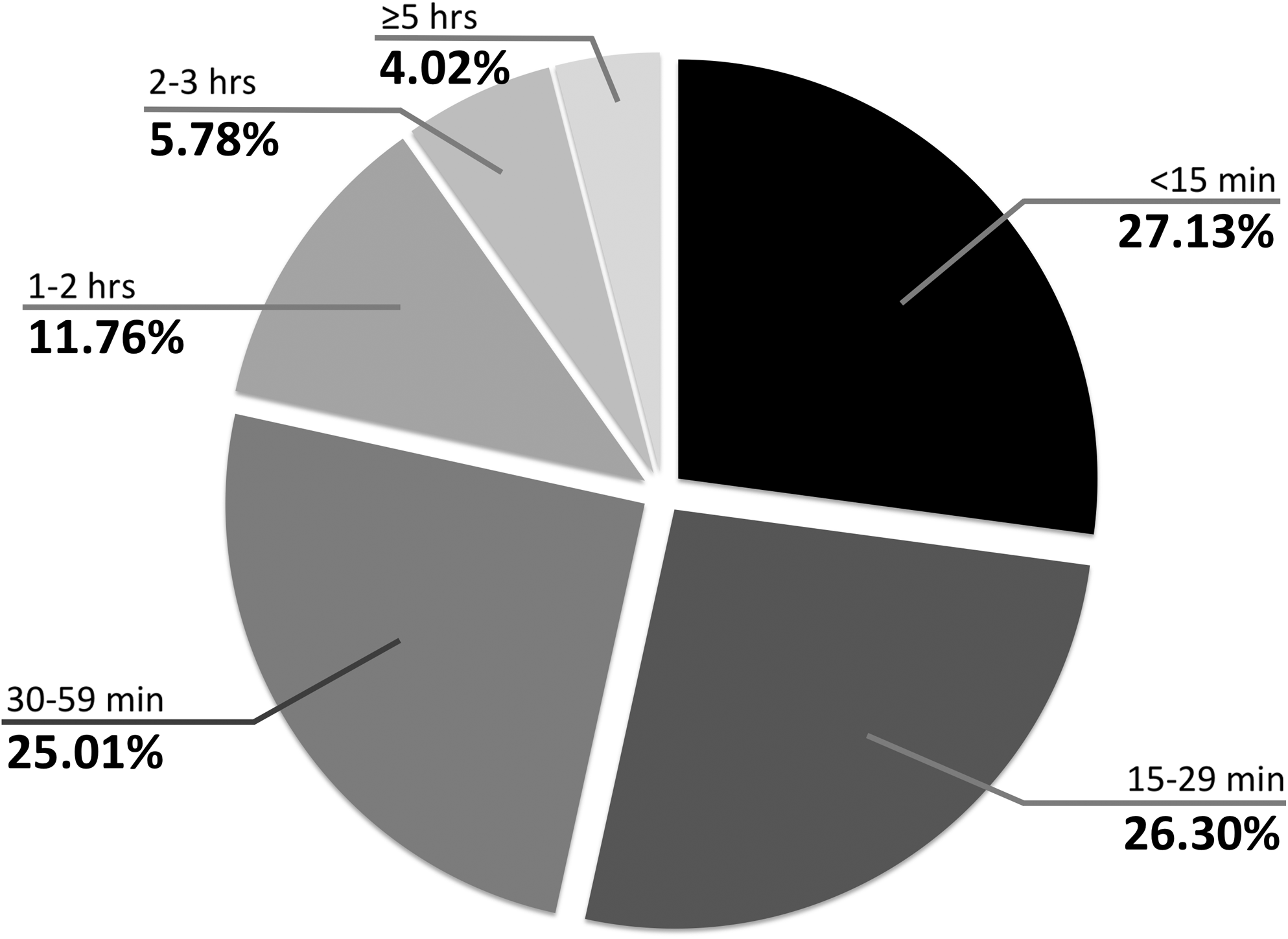
Self-reported time spent on Facebook.
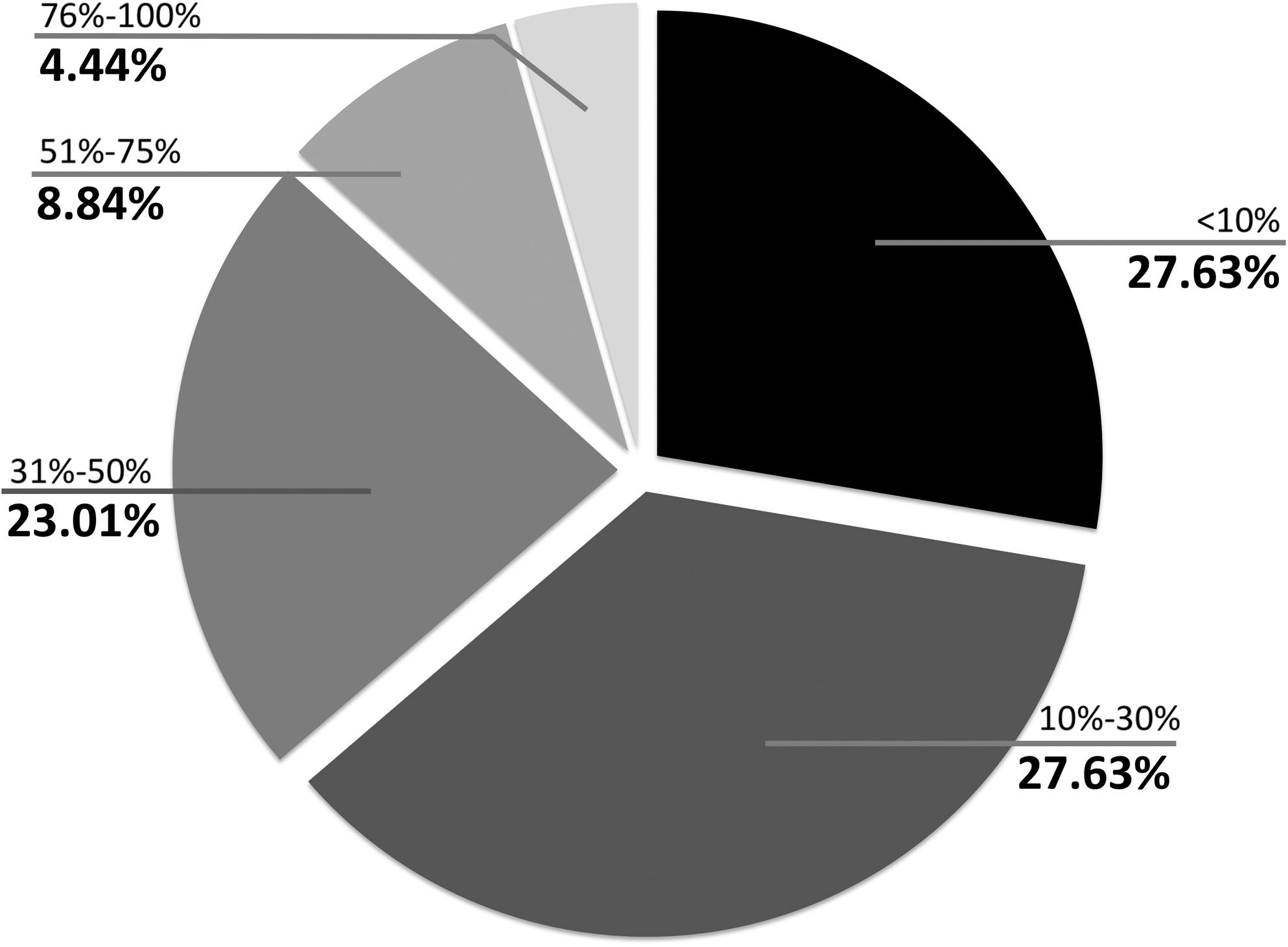
Estimated percentage of Facebook friends they daily interact with offline.

Primary uses of Facebook.
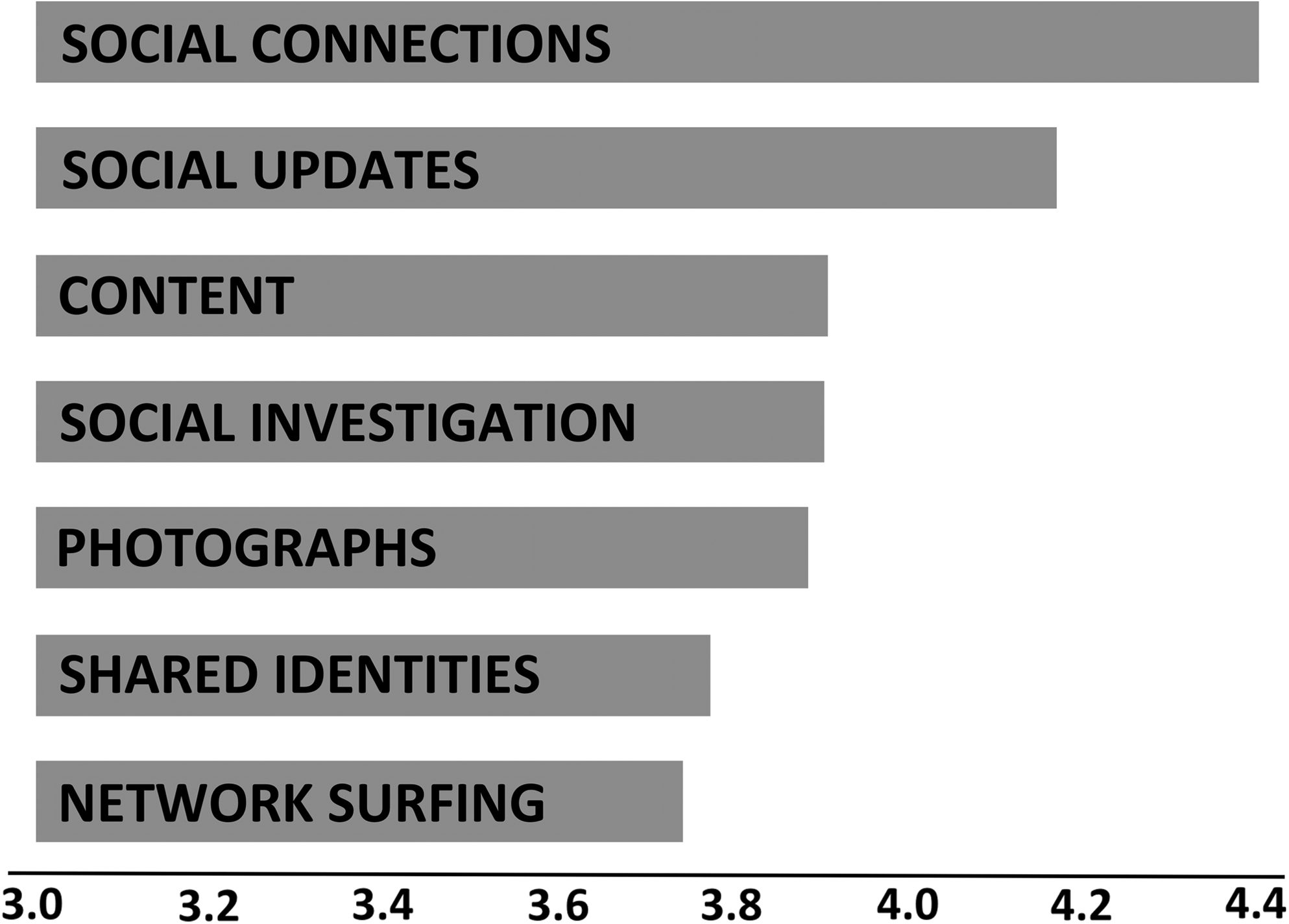
Mean scores for seven motivations to use Facebook.
Motivations predicting intensity of Facebook use
Two 7-predictor multiple linear models were proposed to explain the intensity of Facebook use and content generation on Facebook. The seven motivations to use Facebook served as independent variables in the model. Prior to testing the proposed models, Pearson's bivariate correlations among the independent and dependent variables were examined to justify the use of regression analysis. Facebook-use intensity and content generation were significantly correlated with all of the motivation variables, and the coefficients ranged from 0.63 to 0.86 (see Table 3). There were also significant correlations among the seven motivations. Accordingly, a stepwise regression method was employed to determine the best set of predictors for the Facebook usage variables. The risk of multicollinearity was also assessed using the tolerance and the Variance Inflation Factor (VIF) in the following regression analyses.
**p<0.01.
A stepwise regression analysis was conducted to explore which of the motivations to use Facebook are the strongest, most significant predictors of Facebook-use intensity (RQ1.1) as well as how the other motivations predict the intensity to use Facebook (RQ1.2). At each step of stepwise regression, the most significant predictor is added to the model until none of the independent variables left out of the model would have a significant contribution if they had entered into the model. 37 As a result of the regression analysis, social investigation and social network surfing were dropped from the model, and five predictors were found to be significant at the critical level of 0.05 (see Table 4).
ST, status updates; SC, social connection; SID, shared identities; CT, content; PHT, photographs.
The first predictor to be entered into the model was status updates, accounting for 54 percent (R 2 ) of the variance. At the second step, social connection significantly added 6.0 percent to the explained variance. Shared identities, content, and photos were subsequently added to the model, increasing slightly but significantly the amount of the variance explained (2.2 percent, 1.0 percent, and 0.4 percent, respectively). The final regression model with these five predictors yielded an F-ratio of 1498.46 (p<0.001) and explained 63.3 percent of the variance in the intensity of Facebook use. In this model, social connection (β=0.27) appeared to be the strongest predictor for Facebook intensity, followed by status updates (β=0.22) and shared identities (β=0.15) (see Table 5). Subsequently, the posting or viewing of photographs (β=0.13) appeared to positively influence Facebook intensity. The lowest coefficient was relevant to Facebook content (β=0.11). The collinearity statistics showed that none of the five predictors had a tolerance value smaller than 0.10 and VIF greater than 10, suggesting no serious multicollinearity in the model.
SE, Standard Error; VIF, variance inflation factor.
Motivations predicting Facebook content generation
Another regression analysis was performed to examine which Facebook motivation would be the strongest predictor of Facebook content-generation behavior (RQ2.1) as well as the relationships between the motivations to use Facebook and the generation of Facebook content (RQ2.2). Based on the stepwise method used, all motivation variables except for social connection appeared to be significant predictors for content generation on Facebook (see Table 6). The motivation to post or view photographs made the highest degree of contribution in explaining content generation (R 2 =0.62), and it was added first to the model. Social investigation was subsequently entered into the model with an R 2 increment of 6.8 percent. Shared identities made the third highest contribution (1.8 percent) followed by status updates and content, which significantly added 1.5 percent and 0.3 percent, respectively, to the explained variance. Social network surfing was entered last to the model, increasing the explained variance by 0.1 percent.
SI, social investigation; SN, social network surfing.
The final model accounted for 72.0 percent of the variance in content generation [F(6, 4339)=1860.94, p<0.001]. As in the stepwise procedures, the photograph variable (β=0.24) was found to be the most significant predictor in explaining content-generation behaviors of Facebook users (see Table 7). Subsequently, status updates (β=0.22), shared identities (β=0.20), and social investigation (β=0.15) appeared to positively influence content generation on Facebook. The use of Facebook content (β=0.09) and social network surfing (β=0.05) had relatively small influences but appeared to be significant, positive predictors of content generation in the model.
Discussion
The current study utilized the U&G approach to explore the motivations and uses of Facebook among a large sample from Taiwan. A set of interesting findings is reflected in the descriptive results of the current sample. First, compared with student samples from the United States,10,35,36 the Taiwanese sample reported a lower number of Facebook friends. This might be influenced by the fact that we recruited a sample of the general population, as well as due to plausible cultural differences with regards to the size of individuals' online networks of friends. In addition, contradictory to previous studies in the United States arguing that Facebook is primarily used to maintain offline relationship in an online setting,10–16 the majority of respondents estimated that less than a third of their Facebook friends are people they interact with in the offline world.
The second set of findings deals with the relationship between Facebook motivations and Facebook intensity. In line with previous theorizing on SNSs and their unique advantage of facilitating social connectivity,38,39 our findings show that the highest rated motivation to use Facebook was social connection. This serves to illustrate the universal utility of SNSs and how they evolve within different cultures. However, it was the motivation to use Facebook for status updates that was the strongest predictor of Facebook intensity, a trend that is different from what was found in studies of American college students. 36 Whereas past studies of American college student samples showed that the motivations to use Facebook for shared identities and content features did not significantly predict Facebook intensity, 36 our findings show otherwise.
The third set of findings deals with the relationship between the motivations to use Facebook and participants' content-generation behavior on the site. The most intriguing finding is that the motivations to use Facebook predict content-generation behavior in a different way compared to predicting Facebook intensity. The strongest predictor of content generation was the motivation to view and share photographs, whereas status updates was the strongest predictor of Facebook intensity. In addition, while the motivation to use Facebook for social connectivity was the second strongest predictor of Facebook intensity, it was the weakest predictor of content-generation behavior on the site. This illustrates that different aspects of using Facebook serve to gratify a different set of needs for the site's users.
In general, the study's findings call for the need to reevaluate the ways scholars think about new media. The way the technology has advanced in the past two decades should drive researchers to think beyond the widely accepted, yet not so relevant, theoretical boxes. While the U&G approach guided our study, we argue that a reassessment of the operationalization of both the motivations and uses of SNSs is needed, especially considering our results that the motivations to use Facebook predicted two types of the site's usage differently. This is of great importance to the study of online social networking behavior, as it calls for the need to dissect the different functions of SNSs. Moreover, our findings suggest differences among Facebook users that might be reflective of the culture to which they belong. This is prevalent in the qualitative comparison between the motivations and uses of Facebook among Taiwanese and American respondents. With the growth of academic scholarship on SNSs, there is a need to address cross-cultural differences in how and why individuals use SNSs. These findings contribute to expanding approaches like U&G globally, therefore, empirically testing the universality of this theoretical approach as a means to advancing the field of research on SNSs.
Limitations and Future Research
The current study has a few limitations that are worth noting. First, our sample, although providing a large cross-section of the Taiwanese general population, is part of a panel for a marketing firm, thus limiting the generalizability of our results to the whole population. Second, since all measures were developed in a Western cultural context, it is possible that certain contextual interpretations on the participants' end were different from what we have intended to measure. Third, the current study was limited to Taiwan; thus, generalizing to the larger Asian population and comparison with the Unites States and other countries may not be possible. Future studies should explore Facebook motivations and uses using a random sample of the population, guard against culture-specific interpretations, extend the research to other Asian countries, and explore motivations and uses of different SNSs (i.e., Twitter, Plurk, etc.).
Conclusions
The current study explored how motivations to use Facebook predicted use intensity and content-generation behavior using a large sample from Taiwan. Using new operationalizations of media U&G, the study illustrated that different patterns of use are predicted by a different set of motivations to use Facebook. The study advances the U&G approach to the specificity of online social networking behavior.
Footnotes
Disclosure Statement
No competing financial interests exist.