




Abstract
Abstract
The use of online video games as an advertising channel has become an integrated part of branding for many marketers in an increasingly fractured media environment. The primary question motivating this research is whether the use of an animated spokes-character embedded in online game affects the persuasiveness of advertising. Specifically, this study looks at how product types moderate the magnitude of such effects. The results show a significant interaction effect between character presence and product type on both brand attitude and purchase intention. The effects of an animated spokes-character on brand evaluation and purchase intention were more pronounced for utilitarian products than for hedonic products.
Introduction
Considering the unique nature of Advergames, the presence of these animated spokes-characters is one possible factor that may influence their effectiveness, as suggested by previous studies.5,6 Although considerable research has been conducted in the traditional broadcast and print media, little empirical research has addressed the role of animated spokes-characters in the context of Advergames. Thus, the primary purpose of this study is to examine whether the use of such a spokes-character embedded in Advergames influences the effectiveness of advertising in terms of brand evaluation and purchase intention. Specifically, the study delves into how product types promoted in Advergames moderate the magnitude of such effects.
Spokes-Characters' Effects in Advertising
Spokes-characters are “animate beings or animated objects that are used to promote a product, a service, or an idea.” 7 Many attempts have been made in broadcast and print media to examine the relationship between their use in advertising and measures of advertising effectiveness.5,6,8 The rationale for using spokes-characters stems from the belief that the positive affect they induce will be transferred to the brands they endorse. Further, they help marketers establish an emotional link between the consumer and the brand. 5
In cyberspace, animated spokes-characters “appear on the screen as embodied characters and exhibit various types of life-like behaviors, such as speech, emotions, gestures, and eye, head, and body movements.” 9 Many online marketers currently use an animated spokes-character in Advergames because it can be perceived as making the Advergames more interesting and entertaining. However, spokes-characters in Advergames can be perceived as more interruptive and annoying than those in traditional media due to the interactive nature of the medium. While the potential benefits of using spokes-characters are evident, it remains unclear whether their presence enhances the effectiveness of Advergames for various kinds of products.
Moderating Role of Product Type
Some researchers suggest that certain types of products can induce quite different responses than others. One way to categorize products is by their hedonic and utilitarian aspects. 10 Consumers purchase utilitarian products, such as toilet paper, to fulfill functional and practical needs. Such consumption is often made to achieve certain goals and tasks. On the other hand, hedonic products, such as perfume, are consumed primarily for fulfilling experiential needs such as sensory pleasure, fun, and excitement. 11
Here it is predicted that the effect of using spokes-characters in Advergames is likely to be higher when advertising hedonic rather than utilitarian products. The consumers of utilitarian products, which are usually used in a goal-directed and systematic manner, are likely to be more annoyed by the presence of spokes-characters than their hedonic-buying counterparts. Users may feel that a spokes-character distracts them from performing games or learning product information from an advertisement. 9 On the other hand, because consumers tend to use hedonic products in an experiential and heuristic manner, the presence of spokes-character may enhance the entertainment value of the game experience. Therefore, the interruptive nature of spokes-characters is less of a problem than for utilitarian product consumers. Accordingly, the following hypotheses are posited.
Methods
Design
The study was a 2×2 (product type: utilitarian vs. hedonic×character presence: presence vs. absence) between-subject design. Attitudes toward the game and game engagement were controlled as covariates.
Materials
A custom-made concentration game was used as a stimulus. The task was to match card pairs by flipping face-down cards and eliminating them from the field (see Fig. 1). Various pictures of the products appeared in the hidden sides so that players were aware of what kind of products they were dealing with. The text-based logos of the products, with fictitious brand names, appeared on the back side of the face-down cards.

An Advergame without the game character.
In the character presence condition, standing in the background was the animated game character shown in Figure 2, programmed to respond to the participants' task performance with corresponding facial expressions (e.g., eye blinks, raised eyebrows, smiles), bodily motions (e.g., nodding, raising his arm), and verbal encouragement (e.g., “good job,” “nice” for successful matching, “try again,” “that's not it” for failed trials). These characters' visual and audio effects did not appear in the absence condition.

The game character within an Advergame.
Based on the literature, tissue and coffee were selected for utilitarian and hedonic products, respectively.10,12,13 In a pretest, 45 subjects were asked to rate how each product was perceived on a single hedonic scale of 0 (not at all hedonic) to 6 (extremely hedonic) and a single utilitarian scale of 0 (not at all utilitarian) to 6 (extremely utilitarian). The result showed that coffee (M=4.60) had a higher hedonic value [t(75)=−9.80, p<0.001] than tissue (M=1.60), while tissue (M=5.29) had a higher utilitarian value [t(81)=7.61, p<0.001] than coffee (M=3.40). Therefore, the selection of products was deemed to be acceptable.
Procedure
One hundred and thirty undergraduate students at a large private university in a northeastern state participated in the study for course credit. The assignment of subjects to treatment conditions was almost equivalent. Average age was 20.45 (SD=1.87).
The experiment was conducted in a computer laboratory. On entering the laboratory, participants were welcomed and were randomly assigned to one of the four experiment conditions. On the monitor, they read a brief product description followed by visual instructions on how to play the concentration game. Once they finished the game, they answered the questionnaire items based on their game experience.
Measures
Brand attitude was measured using five semantic differential items: hateful/loving, sad/delightful, annoyed/happy, tense/calm, angry/relaxed (α=0.87). 14 Purchase intention was measured using two bipolar items: unlikely/likely, improbable/probable (α=0.86). 15 For covariate measures, attitude toward the game was measured using five semantic differential scales: negative/positive, bad/good, awful/nice, sad/happy, unpleasant/pleasant (α=0.93). 16 Game engagement was measured using four Likert items (1=strongly disagree, 7=strongly agree): “I paid a lot of attention to this game,” “I was extremely focused on this game,” “I found myself responding strongly to this game,” and “I got involved with the goal of this game” (α=0.90). 17
Results
Brand attitude
The ANOVA analysis revealed a significant two-way interaction: [F(1, 124)=9.49, p<0.005], as shown in Figure 3. Attitude toward the game had a significant effect on brand attitude as a covariance [F(1, 126)=22.52, p<0.001]. Planned contrasts revealed that for a utilitarian product, the game without the spokes-character (Mabsence=4.57) yielded higher brand attitude [t(55)=−1.99, p<0.05] than the game with the character (Mpresence=4.19). However, for a hedonic product, there was no significant difference between the condition with the character and the one without it.

Product×character interaction on brand attitude.
Purchase intention
A significant two-way interaction was detected [F(1, 124)=4.77, p<0.05], as shown in Figure 4. Game engagement had a significant effect on purchase intention as a covariance [F(1, 124)=5.46, p<0.05]. Planned contrasts revealed that in a utilitarian product, the game without the character (Mabsence=4.56) yielded higher purchase intention [t(58)=− 2.15, p<0.05] than the game with the character (Mpresence=4.02). However, in a hedonic product, there was no significant difference between the condition with the character and the one without it.
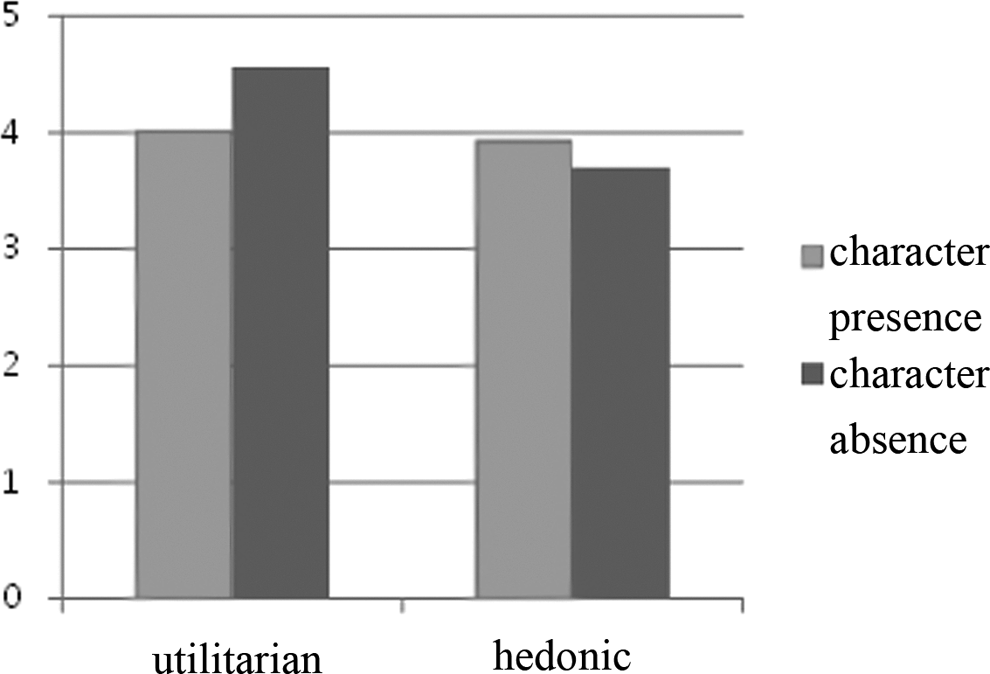
Product×character interaction on purchase intention.
Discussion
This study examines how the presence of spokes-characters influences the effectiveness of Advergames in terms of brand evaluation and purchase intention. Specifically, it looks at how product types used in Advergames moderate the magnitude of such effects. The findings indicate that the process of integrating spokes-characters with indifferent product types can substantially undermine the effectiveness of Advergames. Specifically, the results demonstrate that marketers might experience a disadvantage with the use of a spokes-character when advertising utilitarian products. However, the negative effect was found to be diminished when the hedonic product was advertised. Although no statistically significant difference in brand evaluation and purchase intention was detected for hedonic product condition, it is worth noting that not using a spokes-character did not turn out to be more persuasive than using one.
This pattern of results makes sense from the stance of the literature on hedonic and utilitarian consumption, which suggests that the advertising effect does not manifest itself in the same way under varying kinds of products. 11 According to this study, participants might be more annoyed and distracted by the presence of a spokes-character in Advergames promoting a utilitarian product than with a hedonic product counterpart because of the goal-oriented nature. As a result, negative affects induced by spokes-characters attenuate the persuasiveness of Advergames. However, the interruptive nature of spokes-characters is less of a problem for hedonic products than for their utilitarian counterparts because of their experiential nature. 10 It may be that the use of spokes-characters in Advergames is most beneficial for experiential product categories that tend to utilize heuristic processing and that otherwise would possess little novelty or information.
The implication for advertisers is that it seems to be more detrimental to utilize a spokes-character within an Advergame when utilitarian products rather than hedonic goods are promoted. The problem for advertisers would be to determine how to efficiently identify various types of products in that they clearly seem to be more vulnerable to the spokes-character effect, and then incorporate this information into advertising designing processes to maximize the effectiveness of Advergames. In this regard, finding an appropriate fit between a product and a game will be an important issue. For example, offering more instrumental benefits (e.g., incentives and coupons) rather than showing eye-catching avatars may be more attractive to consumers who are looking for utilitarian product values.
This study had several limitations. The first is the use of only two product categories in manipulating hedonic and utilitarian products. Although considerable caution was given to selecting the categories, it would be hard to dismiss the possibility that idiosyncrasies residing in a product category might, to some extent, operate as a noise for the observed treatment effects. The second was the use of a fictitious brand. Although this might be effective in reducing within-group variation, thereby resulting in greater statistical power, external validity would be sacrificed to some extent. Future research with actual brands is needed to corroborate the findings of this study. 18 Finally, it would be worthwhile to replicate this study with more various types of subjects (e.g., age, race, and different level of game proficiency) to verify the possible effects of user characteristics on the effectiveness of Advergaming.
Footnotes
Acknowledgment
This research was funded by a grant from the National Research Foundation of Korea (NRF-013-2008-1-B00124) to the first author.
Author Disclosure Statement
No competing financial interests exist.