




Abstract
Abstract
Prior research suggests that video game features that appear natural or that otherwise allow players to identify with their in-game experience will promote enjoyment. Using a 2×2 experiment, this study demonstrates the positive effects of a steering-wheel controller and the opportunity to customize the driven vehicle on enjoyment of a console driving game, as mediated by transportation and challenge–skill balance. The role of presence is also probed, with results suggesting no direct link to enjoyment.
Introduction
Although games serve a variety of functions, most mainstream titles primarily attract and retain players because they are fun and entertaining. 1 Thus, research on this topic offers insights into the practical question of how to attract players and to key theoretical questions about the meaning and antecedents of video game enjoyment, drawing upon several relevant theories. In this study, we employ an experimental design to explore how both controller type and customization influence enjoyment through three key aspects of engagement: transportation, flow, and presence.
Literature Review and Proposed Theoretical Model
Although potentially popular for many reasons, motion controls are thought to contribute to enjoyment by providing natural mapping. 2 Although commonly conceptualized as a dimension of interactivity, natural mapping generally refers to “the ability of a system to map its controls to changes in the mediated environment in a natural and predictable manner.” 3 (p86) In recent years, video game companies have increasingly incorporated more advanced motion control schemes to accompany their game consoles—many of these devices offer a naturally mapped experience, although that may not be the only appealing or meaningful feature of motion controls.
Tamborini and Skalski 4 theorized that naturally mapped controllers should be easier to use, because they invite game players to draw on their previous life experiences to interact with a game. Research has shown that more naturally mapped control schemes often lead to greater feelings of presence, realism, and enjoyment among game players when compared to less naturally mapped control schemes.2,5
That said, some research suggests that motion controls do not necessarily lead to greater enjoyment. 6 In some cases, players may perceive less natural mapping from a motion-controlled game than a more traditional controller. 7 If players are used to standard controllers or if motion-controlled devices fail to adequately mirror real-world movements, natural mapping will likely not be experienced, though motion controls could still be appealing for reasons of novelty or excitation transfer. Thus, in the current study, we not only manipulated controller type, comparing a steering wheel and a traditional console controller, but also measured perceived natural mapping to confirm its expected influence on enjoyment.
While natural mapping extends the game experience outward into the physical space, customization extends player preferences into the game world. The ability to customize one's self-representation within the game has been linked with identification, immersion, and ultimately enjoyment.8,9 Games implement customization in many ways; within this study, participants were able to adjust the appearance of their car, which could generate identification through both the involved process of modifying the car's appearance and the resulting perception of the car as a representation of one's self- (or desired self-) image.
As with natural mapping, the direct game feature is less critical than the subsequent psychological state, in this case identification, and again, we not only manipulate game elements, but also measure the expected outcome. Identification can be defined as a process of adopting the identity and perspective of a media character. 10 It is important to consider, however, that identification in an interactive game context may be fundamentally different from identification as experienced in a noninteractive medium. For example, playing a video game may involve acting as a projection of oneself in the virtual environment, or what may be termed “embodiment,” rather than identifying with an outside entity.8,11 Klimmt and colleagues have similarly theorized that video game identification may be better understood as a shift in self-perception or self-experience.12,13 Recent studies have investigated the process of identification with video game characters, the related process of wishful identification and its effect on outcome variables such as aggression and self-perception.14–16 Also, at least two studies have directly connected identification and enjoyment of a video game.12,17 Identification with one's game character may lead to enjoyment by facilitating experiences of immersion into video games. Perceptions of natural control may further facilitate experiences of identification by increasing the ease with which one perceives oneself to be projected into the game world. We do not expect that natural control or identification will themselves automatically and directly create enjoyment, however. Players who find a game customizable and controllable, but who do not actually experience involvement are unlikely to have fun.
The above discussion suggests that both motion controls and customization could facilitate enjoyment to the extent they provide natural mapping and prompt identification. To fully understand how this occurs, we further consider three related variables that potentially serve as mediating factors. We note that one reason for considering all three simultaneously is to address some ambiguity in the existing literature regarding each; by testing presence, transportation, and flow together, we can help parse out their distinct effects.
The term presence generally refers to a user's perception of nonmediation with regard to a particular user interface, virtual world, or environment.18,19 With regard to video games and virtual worlds, presence has often been identified as a central concept in explaining game player experiences.4,20 Although this concept is posited to have multiple dimensions, we focus on spatial presence (the sense of being physically located in a virtual environment), which some suggest also partly encompasses the notion of self-presence.4,18,21(p75) Recent research has linked game-playing experiences to presence and subsequent game player enjoyment.2,20
We expect presence could serve as a mediator for both natural mapping and identification. By giving players a sense that their physical actions and actual selves map onto the virtual world, games can enhance presence and ultimately increase enjoyment. Prior research suggests that identification can encourage the users to accept the medium as their “primary egocentric reference frame,” 22 (p505) and Bailey et al. 8 found that avatar customization led directly to experiences of subjective presence. Research on natural mapping demonstrated a connection between perceived naturalness and spatial presence, although only one or two studies showed a connection between presence and enjoyment. 2
While presence, in the context of this study, focuses on spatial perceptions, transportation is generally understood as reflecting affective, cognitive, and mental imagery involvement in a mediated experience; prior research in noninteractive contexts demonstrates a close link between transportation and enjoyment. 23 Transported individuals experience heightened responses to media content as a consequence of their increased involvement. Thus far, little research has been reported that investigates the application of the transportation concept to interactive media. While the literature suggests that the link between identification with story characters and transportation is complex and possibly bidirectional, 24 we expect that in a single episode of play, individuals who identify with their in-game avatar will feel more transported. In addition, similar to the expectations for presence, individuals should accept the environment as their primary reference frame when experiencing natural controls, amplifying transportation as well. 22
While both transportation and presence involve individuals becoming more immersed in spaces and stories, as they experience them as more engaging or real, the flow theory suggests that immersed individuals lose track of their actual surroundings and plunge instead into the activity at hand. 25 Sherry 1 suggests that the enjoyment of video games can be explained in part as a consequence of people experiencing this psychological state while playing. In particular, he suggests that games can succeed at causing flow to the extent they foster a balance of challenge and skill, consistent with theoretical definitions of flow in other contexts.
Unlike the variables of presence and transportation, we do not expect that challenge–skill balance is fostered by identification. Rather, this experience is more directly linked to how well the players operate the game, rather than how intensely they experience the world of the game. However, experiencing the game controls as natural and intuitive should help players achieve that balance, fostering enjoyment. Prior research confirms that the control scheme can be linked to the experience of other components of flow, 6 and here, we focus on whether this is also true for this central experience.
In summary, we test two common features of modern games: innovative natural control schemes and avatar customization. The former, operationalized as the use of a steering-wheel controller, is expected to foster a sense of natural mapping, which could also enhance the connection felt with the in-game avatar, a vehicle. Meanwhile, the ability to modify the look of that vehicle should also amplify identification. Ultimately, we believe that both experiences will translate into enjoyment. Believing that the controls are natural and intuitive should increase a sense of challenge–skill balance and also create immersion through presence and transportation. Identifying with one's avatar is unlikely to affect the sense of skill, but should prompt immersion. All three measures of engagement are theoretically and empirically linked with enjoyment and are expected to play a similar role here. Our hypothesized model is illustrated in Figure 1.
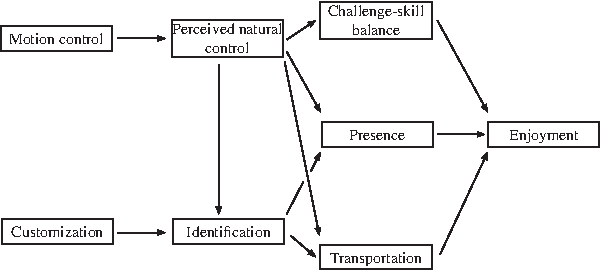
Theoretical model linking game features, psychological experiences, and game enjoyment.
Methods
To evaluate this model, we conducted a 2×2 experiment, with random assignment to the controller type and the customization level. Study participants were undergraduate students offered extra credit (n=96). Participants were primarily female (77.1 percent), white (87.4 percent), and young (M age=20.1).
Participants played Need for Speed: Pro Street on the Xbox 360, which features a variety of options for modifying the vehicle appearance and relatively accessible controls that include the option of a steering-wheel device (available separately). For participants in the customization condition (n=50), they were provided with a brief tutorial on how to customize the appearance of their car, such as applying stickers or changing paint colors. Participants in this condition then spent no more than 10 minutes customizing the look of their car; adjustments did not affect vehicle performance. Participants in the noncustomization condition (n=46) instead viewed a video of customized vehicles and provided a numerical rating for each vehicle; this video was ∼8 minutes long.
All participants were then given a brief explanation of the control scheme to which they were assigned, allowed to complete a practice lap on the selected track, and then asked to complete a four-lap race against computer-controlled vehicles on this same track. To operationalize the control scheme, participants used either a steering-wheel controller (including two foot pedals serving as accelerator and brake) designed for use with Xbox 360 racing games (n=48) or a traditional Xbox 360 controller (n=48). After completion, participants filled out a questionnaire containing the dependent measures.
All dependent variables were measures on seven-point Likert scales, with anchors of 1 (strongly disagree) and 7 (strongly agree).
Perception of natural control was an index of four items (M=4.20, SD=1.43, Cronbach's α=0.84). Questions included, “The game controller functioned realistically,” and “The way I controlled my car in the game was similar to driving a car in real life.”
Identification was an index of six items (M=2.41, SD=1.19, Cronbach's α=0.95). Questions included, “This game fits my image,” and “I was able to transform this game into something I'd like to call my own.”
Presence was an index of six items based upon the existing literature on presence, but customized for the particular aspects of this study (M=3.82, SD=1.37, Cronbach's α=0.87). Questions included, “I felt as if I were actually driving a car” and “I felt as if objects on the screen, such as other cars, were real.”
Challenge–skill balance was a three-item index based upon the Jackson and Marsh 26 flow scale, specifically the items used to measure challenge–skill balance, modified to apply to game experience (M=4.78, SD=1.21, Cronbach's α=0.81). An example item is, “My abilities matched the challenge of the situation.”
Transportation was a seven-item index based upon the Green and Brock 27 scale (M=3.64, SD=1.11, Cronbach's α=0.81). The original scale contained 11 items, but one was omitted because it did not fit the constraints of the study, and three (items 2, 9, and 10 in the original study) adversely affected scale reliability. An example of a remaining item, modified for the gaming context, is, “I was mentally involved in the game while playing it.”
Enjoyment was measured using a seven-question scale adapted for the video game use from research on sport and self-determination 6 using the same seven-point scale (M=4.95, SD=1.25, Cronbach's α=0.94).
Results
Preliminary analysis of the correlations among variables suggests that the expected relationships among variables are present (see Table 1). Analysis of variance results testing the simultaneous effects of both manipulations confirm that the control scheme was significantly related to the perceived natural control, F(1, 92)=26.29, ηp2=0.22, p<0.001, with higher scores in the wheel (M=4.88) than in the traditional controller condition (M=3.54). Similarly, identification was significantly affected by the customization manipulation, F(1, 92)=10.88, ηp2=0.11, p=0.001, with higher scores in the customization (M=2.77) than in the control condition (M=2.01). No interactions were found. A stronger test of the proposed model is provided through the use of path modeling with AMOS, which allows us to show the unique contribution of each variable and to quantify the indirect effects of our manipulations. These results, which include all participants, are presented below.
Values shown are Pearson's r correlation coefficients. Motion control reflects whether participation used the steering-wheel (1) or traditional controller (0). Customization reflects whether participants were allowed to modify the appearance of their vehicle (1) or played with a default appearance (0).
p<0.05.
p<0.01.
Initially, we tested the model illustrated in Figure 1. However, this model suffered from a relatively low fit, because it did not specify a correlation between presence and transportation. Given that the literature suggests that presence and transportation are similar concepts, both rooted in a sense of immersion within the world of the game, including this correlation was theoretically sound. Figure 2 presents the final model, which otherwise mirrors our original expectations. Model fit was acceptable [χ2 (16)=19.62, p=0.24; standardized root mean of the residual=0.07; non-normed fit index=0.98; comparative fit index=0.99; root-mean-squared error of approximation=0.05]. All hypothesized paths, but one, were in the expected direction and significant; the exception is the path from presence to enjoyment, which was positive, but not significant. In brief, both manipulations acted as expected upon the key psychological variables of perception of natural control and identification. The former had a direct influence on all three potential mediators—transportation, presence, and challenge–skill balance—as well as an indirect influence by its effect on identification. This variable in turn also contributed to presence and transportation. Both flow, in the form of challenge–skill balance, and transportation led to feelings of enjoyment, as expected.
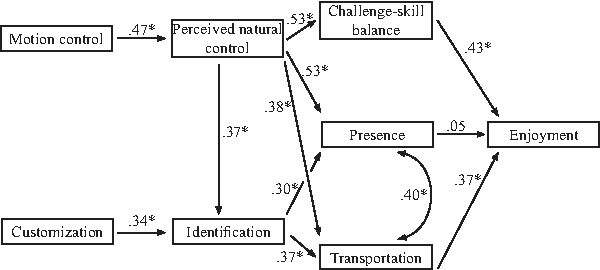
Final path model linking game features, psychological experiences, and game enjoyment. Results are standardized coefficients from path model run using AMOS. Motion control reflects whether participation used the steering-wheel (1) or traditional controller (0). Customization reflects whether participants were allowed to modify the appearance of their vehicle (1) or played with a default appearance (0). *p<0.01.
A further benefit of this approach to analysis is that it allows us to quantify the indirect effects of the experimental manipulations, using the bootstrap analysis with bias correction (1,000 iterations) to estimate the confidence intervals. Both the controller (B=0.21, p<0.01) and customization (B=0.05, p<0.01) conditions had significant, positive indirect effects on enjoyment; that is, while the direct correlation of these variables with enjoyment was not significant, the analysis shows evidence that by acting through the proposed psychological mechanisms, both can shape enjoyment.
Discussion
This study confirms the potential of both controller type and avatar customization to generate enjoyment of a video game. As expected, individuals using a steering-wheel controller reported a greater perception that the control was natural, reflecting the natural mapping such a controller provides. In turn, this perception was linked to increases in identification, transportation, presence, and challenge–skill balance, of which transportation and challenge–skill balance proved to be key predictors of enjoyment. Similarly, allowing players to customize their car increased identification, which amplified both transportation and presence. In general, the results suggest that allowing greater and more realistic interaction with a game can amplify immersion and enjoyment. They confirm the relationship between natural mapping and enjoyment, as well as research linking identification and enjoyment. They also illustrate how perceived naturalness can also act indirectly through identification, connecting these two lines of research. The study demonstrates the influence of objective game features on enjoyment, but also shows the greater importance of psychological perceptions. What ultimately mattered was how much players felt transported into the game and the extent to which they achieved a flow-like state, balancing challenge and skill.
A few caveats are in order. First, the zero-order relationship between customization and enjoyment, although not significant, was in fact negative. While the effect of this manipulation on identification clearly increased enjoyment, it appears that this feature also had some unintended, and unmeasured, effect on other psychological responses to the game that undercut its ability to generate fun. Second, as with any study that relies on path modeling of this sort, the specific direction of relationships not involving experimental manipulations cannot be known for certain. While the theory suggests the paths represented here, alternative explanations are possible. For example, individuals who were having more fun may have become more transported as a result.
Third, the unexpected failure of presence to relate to enjoyment cannot be fully explained—although the finding is consistent with the weak link between presence and enjoyment found by Skalski et al. 2 . It could be that the correlation between presence and transportation actually reflects a causal influence of presence on transportation, meaning presence does contribute to enjoyment, but does so by amplifying other aspects of immersion. It may also be that the measure of transportation better captured some of the same psychological responses as the measure of presence, and therefore served as a better predicted of enjoyment. Differently worded measures might produce different results, but this would suggest a strong overlap between the two concepts. Fourth, different game types could produce different results. This is especially true with regard to avatar customization and identification. To some degree, identifying with an on-screen vehicle where you cannot see the driver is not the same as connecting with either the unseen hero of a first-person shooter or a clearly visible avatar in a third-person game. Finally, of course, the use of a student sample with limited prior experience with this game leaves open the possibility that more experienced players would respond differently. For example, players who play for longer periods of time and who earned the money to purchase a vehicle in-game may feel greater identification and be more compelled to customize the look of the car. Players who were already familiar with a traditional controller might be less comfortable using a novel steering wheel, although additional analyses considering the limited number of individuals who had played racing games previously showed no clear evidence of this. In addition, the student participants were racially and culturally homogenous; other groups may respond differently. They were also largely female. While we found no evidence that gender moderated the direct effects of the manipulations, there was some indication that the subsequent paths were stronger for women than men. Future research could better address gender differences in the psychological mechanisms that produce enjoyment.
In general, though, these results verify several strands of research on the role game features, and immersion plays in shaping game enjoyment. They show the potential value of novel control schemes if those schemes provide natural mapping. They also confirm that finding ways for players to better identify with their on-screen tools and representations can help provide immersion and enjoyment as well. Finally, they illustrate the importance of variables such as challenge–skill balance and transportation as aspects of media enjoyment, with the latter in particular being notable as a variable not often applied to interactive entertainment.
Footnotes
Author Disclosure Statement
No competing financial interests exist.