




Abstract
Abstract
This study elucidates why and how e-return services (e-RS) fail, representing a preliminary attempt to explain the critical role of psychological contract violation (PCV) and explore its antecedents and outcomes in e-RS research. Based on marketing, psychology, and information systems-related studies, a theoretical framework is developed to correlate perceived fairness (PF), causal attribution (CA), and magnitude of negative outcome (MNO) with customers' PCV. Additionally, based on trust (TR), exactly how PCV further influences customers' stickiness intention (SI) is examined as well. Analysis results indicate that PF, CA, and MNO influence customers during both the evaluation stage and the customer receipt of e-RS, subsequently deriving PCV. These factors contribute to the subsequent success of e-RS, especially, customers' TR and SI. Furthermore, recommendations are made on how firms should evaluate PCV and its influencing factors to prevent e-RS failure.
Introduction
Assurance signals in the form of e-return services (e-RS) truly help to overcome consumer fears and delays regarding online shopping, soften negative responses, and result in positive interactions between consumers and manufacturers.2,3,5–8 However, to most consumers, the use of e-RS means that they still must wait to receive products, 3 and this often leads to dissatisfaction with the product when it turns out to be different from consumer expectations before purchase. 4 Namely, whether intentional or not, while possessing an informational advantage, 2 e-retailers provide e-RS to relax this situation. Such a contradictory situation leads customers to feel that their expectations have not been met, also known as service failure, or result in other negative emotions, which will influence customer evaluations about service recovery efforts.9,10 At this moment, if the customers perceive themselves to be on the receiving end of unfair responses and a significant loss that should be imputed to e-firms, they would sense psychological contract violation (PCV). 10
Still worse, PCV can induce a decline in trust (TR) and affect subsequent e-customer responses, both drawing e-RS failure/double deviation.10–12 Stickiness intention (SI) is an important predictor of customer response, which has attracted increasing attention in numerous empirical information system/technology studies, owing to its ability to substitute customer satisfaction or actual behavior.1,13–15
Our focus is on exploring why and how e-RS fails by discussing the interaction effects among customer evaluations of e-RS, PCV, TR, and SI. First, we review relevant literature. Next, a conceptual framework and the derived hypotheses are presented along with our research methodology and results. Finally, we clarify our findings, discuss their implications and limitations, and suggest directions for further research.
Conceptual Background
Customer evaluations of e-RS
Many studies have attempted to explain customer evaluations of service failure/recovery or their encounters with the handling of complaints, and provided conceptual influencing factors, including perceived fairness (PF)/justice, causal attributions (CA), and service failure severity/negative outcomes16–23 :
Perceived fairness
In considering the difficulty of customers to evaluate intangible benefits before or after the purchase of a service, a fairness/justice theory has become increasingly salient.24,25 “Justice” refers to the fair dealings of a firm, while “fairness” indicates customer perceptions of the degree of justice in the firm's efforts.24,25 Relative studies focus customers PF to firms' responses on three factors— (a) distributive justice (DI): the PF of the tangible outcome or decision (e.g., the amount of refund), (b) procedural justice (PR): the PF of the procedures used in arriving at that outcome (e.g., the rationality and flexibility of the retailer's return policy), (c) interactional justice (IN): the PF of the manner in which customers were treated throughout the conflict resolution process (e.g., the courtesy and attention of the retailer in handling return process).17,18,26 Accordingly, we believe that customer PF toward e-RS is subjective by outcome, procedure used, and the manner of implementation.
Causal attribution
Attribution theory is useful in explaining customer reactions to the redress of firms by considering that when customers are confronted with product/service failure, they will infer reasons as to the why product/service failed through a rational information handling process, which thereby influences how they respond. 27 Folkes 27 has cited Weiner's 28 categorization to classify causal property into the following dimensions: (a) stability: the cause is temporary or permanent (the problem can be solved at once or may happen consistently), (b) locus (LO): the cause resulting in the problem belongs to customer or seller, (c) controllability (CO): the cause can be controlled or not. This study analyzed how causes of returned purchase can be attributed. The scope is restricted to a particular returned purchase and is a temporary attribution. Studies on temporary attribution are similar to studies concerning attribution of service failure and are different from Weiner's 28 long-term investigation on attribution of human motivation; customers who face these failures frequently practice temporary attribution only on particular events. Thus, the results of relative empirical studies do not support the effect of stability on subsequent consumer responses.29,30 Accordingly, we believe that CA is influenced by whether customers consider that the causes resulting in e-RS are in a manner that is internal and controllable by firms.
Magnitude of negative outcome
Magnitude of negative outcome (MNO) means the severity or intensity with which the customer perceives the service failure, problem, loss, or harm.18,19,22 We include this construct in our model, and believe that MNO depends on the severity of the problems that lead customers to ask for e-RS.
Psychological contract violation
PCV occurs when a buyer's expectations are unmet, or when the consumer perceives him or herself as having been treated wrongly regarding the terms of an exchange agreement with an individual seller.10,11 Pavlou and Gefen 11 have made a major initial contribution in exploring the antecedents and consequences of PCV. Goles et al. 10 further verified the central importance of PCV in online buyer–seller relationships.
Undeniably, PCV is appropriate for depicting buyer–seller relationships in the e-shopping realm, especially for describing the feelings of consumers when their expectations are not met when accepting e-RS. Therefore, in addition to including PCV in our research structure (Fig. 1), we also discuss three characteristics that affect the evaluation of customers on e-RS/PCV. We believe that the fairer the customers' perceptions on the e-RS of sellers, the lower the perceived level of PCV. Additionally, if the sellers must be responsible for the reason for the returned purchase, and if the customers recognize they experience a high level of MNO when accepting e-RS, the perceived level of PCV increases. Accordingly, we establish hypothesis 1–3:
H1: PF is negatively correlated to PCV. H2: CA is positively correlated to PCV. H3: MNO is positively correlated to PCV.

Conceptual framework.
Trust
Because great uncertainty exists in the online environment, TR is vital in studies related to transactions and guaranties.15,31–35 TR in Internet trading is generated based on the perception of consumers, and can affect the subsequent behavior of consumers.
36
Goles et al.
10
found that the maintenance of psychological contracts is critical to sustaining TR, and that PCV negatively affects buyer intention/word of mouth/transaction behavior by directly impacting TR. Moreover, in a study of community-based auction Web sites, Pavlou and Gefen
11
indicated that if a buyer experiences PCV in a community, the buyer's TR toward the community would be lowered. In summary, we propose Hypothesis 4 regarding the negative relationship between the PCV and TR of customers in accepting e-RS:
H4: PCV is negatively correlated to TR.
Stickiness intention
SI can be defined as individual intention to repeatedly, routinely, and continuously visit and use a preferred Web site.1,37 In the online business to customer environment, TR is a vital impact factor on behavioral responses, such as the willingness, intention, stickiness, and word of mouth of consumers.1,10,11,15,35,38–43 Accordingly, this study incorporates SI in the conceptual framework and introduces hypothesis 5 as follows:
H5: TR is positively correlated to SI.
Research Methodology
Measurement
All research constructs were assessed using a seven-point Likert scale (1=strongly disagree, 7=strongly agree). Minor modifications were made to fit the specific context of e-RS. Among which, the three dimensions of PF, DI, PR, and IN were based on a scale comprehensively integrated from studies by Smith et al. 18 and Weun et al., 22 and was applied in empirical studies; therefore, the scale could appropriately depict our concept. The two dimensions of CA, LO, and CO, were developed based on studies such as those of Maxham and Netemeyer 20 and Hess. 23 MNO was measured by referring to studies by Maxham and Netemeyer 20 and Weun et al. 22 PCV was measured by referring to an integrated study conducted by Pavlou and Gefen, 11 and was applied to issues of the online environment. The six questions regarding TR were formulated by combining the scales proposed by Morgan and Hunt, 44 Yilmaz and Hunt, 45 and Li et al. 1 Furthermore, we use Li et al.'s 1 SI scale (Table 1).
The items deleted.
The α of the secondary dimension of PF.
The α of the 12 questions of PF.
The α of the three indicators of PF.
All item loadings were significant at p<0.00, two-tailed.
e-RS, e-return services; PCV, psychological contract violation; PF, perceived fairness; CA, causal attribution; MNO, magnitude of negative outcome; TR, trust; SI, stickiness intention; DI, distributive justice; PR, procedural justice; IN, interactional justice; AVE, average extracted variance; CR, composite scale reliability.
Data collection
Following a 2-month survey period, two samples were accumulated for this study, in which both of the samples underwent a 2-month survey period. Effectiveness of the measurement model was evaluated using Sample 1, while the structural model was examined using Sample 2. Sample 1 was collected from among undergraduate and graduate students of several universities. Sixteen research assistants distributed the questionnaires. Respondents were provided with a self-administered questionnaire, offered a reward incentive, and instructed to evaluate their overall e-RS experiences during the previous 6 months. The respondents were instructed to stop answering the questionnaire if they lacked experience with e-RS within the previous 6 months; otherwise, the respondents were asked to complete the questionnaire. With a refusal rate of 52.1%, Sample 1 contained 323 questionnaires. 56.9% of the participants were female, ranging from 18 to 40 years old.
For Sample 2, 20 research assistants employed an intercept method in busy public locations, including densely populated urban locations, shopping centers/malls, and train/subway stations. Respondents were randomly selected based on a sampling schedule. Sample schedules were generated based on peak/off peak hours during weekdays and weekends. Time frames, locations, and respondents were randomly chosen. The sampling schedule for on-site interviews used various time frames to increase randomness. The answering requirements were the same as for Sample 1. The final sample contained 553 usable responses, with a refusal rate of 89.6%. Participants were 69.6% female, and ranged in age from 16 to 69.
Before further analyzing, we conducted a descriptive statistical analysis. The analytical outcome indicates that the mean and median scores for each question were very close; all skewness values were lower than 2 and kurtosis values were smaller than 5 (Table 2). This result shows that the responses to these questions were well distributed.
The items deleted.
Results
We first performed a principal component factor analysis with varimax rotation on the second-order scales of PF and CA, employing a factor weighting of 0.50 as the minimum threshold value. As a result, DI2, CO1, and CO2 were removed. The remaining 12 PF questions were simplified into three indicators: DI, PR, and IN. The total eigen value is 6.97. The index values were acquired by simple averaging of the corresponding questions. All CO dimensions of CA were deleted to form a single-dimensional table of three questions regarding LO. The total eigen value is 1.93 (Table 3).
Bold values indicate factor loadings significant and over 0.50, loadings of less than 0.20 are not shown to improve readability.
The items deleted.
Measurement model results
The proposed measurement model was assessed using LISREL VIII. 46 The model estimation utilized a 6-variable 22-indicator CFA model. In the CFA, the Goodness of Fit Index (GFI), Adjusted Goodness of Fit Index (AGFI), Normed Fit Index (NFI), and Comparative Fit Index (CFI) values were 0.93, 0.90, 0.97, and 0.99, respectively. A value higher than 0.80 is desired for AGFI, 47 while a value higher than 0.85 is desired for other indices. 48 Notably, the Root Mean Square Error of Approximation (RMSEA) was 0.040. Browne and Cudeck 49 suggest that the RMSEA value lower than 0.05 implies a close fit. Correspondingly, the model's suitability was deemed satisfactory in this study. Although the χ2 test of the hypothetical model was significant (χ2=286.00, df=188, p<0.00), according to Carmines and McIver, 50 a χ2 value twice to three times larger than the degree of freedom is acceptable (χ2/df=1.52).
The values for Chronbach's coefficient alpha and composite scale reliability (CR) all exceeded the acceptable level of 0.70,51–53 implying good internal consistency (Table 1).
Construct validity was examined by using several methods to assess the convergent and discriminant validity of the measurement model. First, all factor loadings in the CFA model were at the p<0.00 level of significance. 47 Next, the average extracted variances for all observed variables exceeded 0.50, 51 with both indicating convergent validity (Table 1). Additionally, discriminant validity was confirmed using the procedure recommended by Anderson and Gerbing. 47 Each pair of six variables was compared using a χ2 test between allowing phi (Φ) to vary and constraining Φ correlation to unity. In this case, our results indicated that the χ2 value for the unconstrained model is significantly lower than the constrained model, thus supporting discriminant validity. Next, whether the correlation for each pair of six variables was significantly less than one was tested 54 by examining the confidence interval of each correlation estimate. The exclusion of the value one in the confidence interval for each pairwise correlation estimate (±2 standard errors) indicates support for discriminant validity.
Structural model results
Figure 2 schematically depicts the estimated initial model, which consists of both a structural equation model based on latent variables corresponding to the theoretical model (Fig. 1), and measurement models for the latent variables. Those results suggest an overall acceptable fit (χ2=440.65, df=195, p<0.00, χ2/df=2.26, RMSEA=0.048, GFI=0.93, AGFI=0.91, NFI=0.98, CFI=0.99). Additionally, Figure 2 and Table 4 indicate that all relationships hypothesized were significant and in the anticipated direction. Above results demonstrate the hypothesized negative path between PF with PCV (H1), while the positive path between CA and MNO with PCV (H2-H3) are supported (γ11=−0.72, t=−16.30, p<0.00; γ12=0.14, t=3.94, p<0.00; γ13=0.10, t=3.06, p<0.00). Customers' PCV was also assumed to adversely influence their TR in hypothesis H4. The analysis results in which β21 was −0.76 (t=−17.08 and p<0.00), support H4. Additionally, the sample yielded results that demonstrate H5, where the TR is assumed to improve SI. The analysis results of the two constructs support H5 (β32=0.62, t=14.61, p<0.00). Furthermore, the Squared Multiple Correlation (SMC) of PCV, TR, and SI were 66%, 58%, and 38%, respectively.
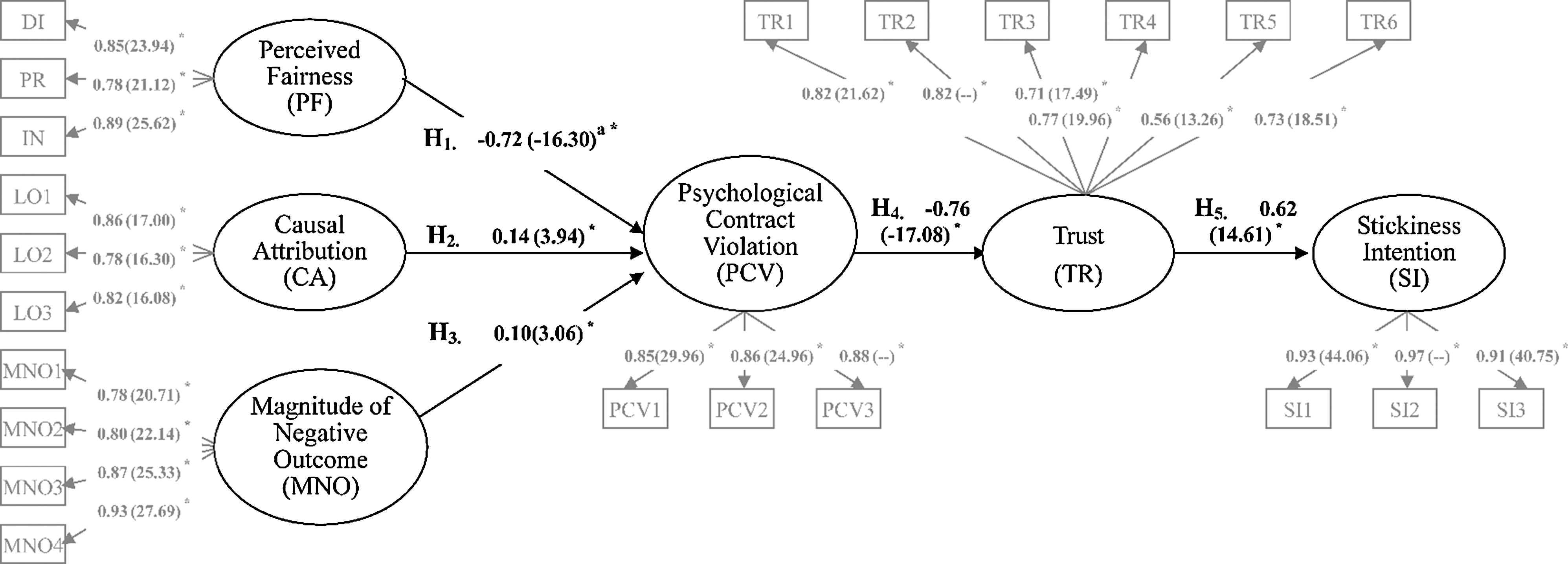
Estimated Model. aCompletely standardized coefficient, t-value appear in brackets. *p<0.00, two-tailed.
p<0.00, two-tailed.
Discussion
Implications
PCV is an important yet obstructed concept, and is seldom incorporated in empirical models when analyzing and predicting the behavior of e-consumers. 11 This study incorporates PCV in the proposed model to describe the accompanying perceptions of the unfulfilled expectations of consumers when accepting e-RS. Three characteristics of PF, CA, and MON are also discussed how they influence PCV, to further describe how the consumer evaluation model may lead e-RS failure.
In addition to considering the uncertainties and risks of an Internet environment, the proposed model includes TR after integrating the above description of the major axis forming the model of this study. Especially, when confronted with e-RS, the perceptions of uncertainty and risk may arise again, reflecting the necessity of emphasizing the importance of TR. As is widely recognized, SI is an appropriate predictor that can accurately predict the behavior of e-consumers, explaining why the proposed model includes SI.
Through empirical processes, we verify that a significant relationship exists among PCV, TR, and SI as a customer uses e-RS (H4-H5 are supported). However, based on the results of SMC, the model in this study can explain more than half of the variance in PCV and TR, but less than half of that of SI. Thus, our study model can better explain the evaluation and TR of customers in the process of using e-RS, whereas SI is very similar to the behavior of customers in reality; therefore, it is affected by factors other than e-RS.
Results of this study further demonstrate that customers perceive a strong PCV if they perceive outcomes as unfair, if they endure serious negative consequences, or if the seller must take responsibility for the e-return (H1-H3 are supported). Among the impacts of PF, CA, and MNO on PCV, PF has the most apparent one. This finding may be owing to uncertainties in the e-environment result in most online purchases being general ones, as compared with more specialized and expensive purchasing behavior. In this way, customers can avoid serious MNO when purchase returns occur. Therefore, the respondents' answers on MNO were centralized at the lower end, with the analysis results indicating a relatively obscure trend. Furthermore, customers are less willing to spend too much time and effort in evaluating general purchases; explaining why CA has become less critical.
In summary, we believe that sellers should strive to make customers feel that they are treated fairly, correctly, and deservedly when providing e-RS. Clearly, e-RS should be characterized by prompt, flexible, courteous, and friendly services. Timely sincere apologies and cordial concern would allow customers to experience quality services. Additionally, pleasant communications between buyers and sellers would ensure reasonable expectations of consumers for the products/services, and this is fundamental to reducing the return of products and PCV. Therefore, firms should emphasize defining the transaction contract, clarifying promises, and providing accurate and timely information. Furthermore, other customers or communities, such as feedback on message boards, may affect customer perceptions, and should be effectively managed.
Several questions have evolved concerning the interpretation of the CA scale. According to the previous literature, CA includes three subdimensions: stability, LO, and CO. However, because stability involves long-term attributions for events on the part of people, it does not conform to the property of e-RS; therefore, stability was eliminated. This has also been confirmed in related research. Additionally, CO was also excluded from this study during the process of exploratory factor analysis, and only LO was retained because LO involves customer evaluations concerning whether manufactures must assume responsibility for a given problem, whereas CO is the level of control manufactures have over a problem as judged by customers after they confirm that manufactures must take responsibility for the problem. Although both LO and CO involve manufacturer responsibility, LO entails the direct cognition of responsibilities, whereas CO involves whether the responsible party deserves sympathy. The previous section demonstrates that samples used in this study are mostly cases of general purchase, and customers are unlikely to expend much effort when contending with e-RS for general purchases. Therefore, direct cognition of responsibilities (LO) may exist, but further derivation of sympathy (CO) is too tedious and would not occur in reality.
Limitations and future research
This study has several limitations. First, within the context of e-RS, this study is an early effort in applying PCV and its characteristics to the TR-SI model and performing empirical research. However, our research results were obtained from a single study. Thus, caution must be exercised when generalizing the findings. Second, scholars have reported that customer experiences in conducting transactions with manufacturers, such as the satisfaction level and performance, affect the customers' PCV. 11 Therefore, in addition to judgment on e-RS (PF, CA, MNO), additional factors can influence the formation of PCV; these variables may be included in future studies to reflect real situations more accurately. Third, there are many other relationships among constructs, such as the moderating role of MNO, 10 which could be explored to provide further insight.
Moreover, though our scale has compiled from those of relevant studies, previous studies on PCV and its influences have focused on general transactions, but not on the reactions of customers in the face of e-RS. Therefore, we have completed the necessary modifications to sentences, and consulted experts from academia and industry to acquire the scale. Though a positive result has been obtained throughout the entire empirical process, the input of further empirical studies is anticipated in the future. Finally, in this study, sampling was conducted on customers who had experienced e-RS within the previous 6 months. These samples are difficult to obtain, and the collected samples mostly represent the general purchasing behavior. Consequently, we were unable to examine the purchasing behavior regarding expensive or specialty items; the collection and comparison of more samples in this regard is to be conducted in the future.
About the Author
Pei-Ling Hsieh holds a Ph.D. from the National Taiwan University of Science and Technology, Taiwan. She is an associate professor at the Takming University of Science and Technology, where she teaches consumer behavior and services marketing. Her research interest is consumer reaction in e-service encounters. Pei-Ling Hsieh can be contacted at plhsieh@takming.edu.tw.
Footnotes
Author Disclosure Statement
No competing financial interests exist