




Abstract
Abstract
This study adopts a global theoretical framework to predict adolescents' disclosure of personal information in exchange for incentives offered by commercial Websites. The study postulates and tests the validity of a model based on the theory of planned behavior (TPB), including antecedent factors of attitude and perceived behavioral control (PBC). A survey was conducted among 1,042 respondents. Results from SEM analyses show that the hypothesized model fits the empirical data well. The model accounts for 61.9 percent of the variance in adolescents' intention to disclose and 43.7 percent of the variance in self-reported disclosure. Perceived social pressure exerted by significant others (subjective norm) is the most important TPB factor in predicting intention to disclose personal information in exchange for incentives. This finding suggests that in discussions of adolescents' information privacy, the importance of social factors outweighs the individually oriented TPB factors of attitude and PBC. Moreover, privacy concern and trust propensity are significant predictors of respondents' attitudes toward online disclosure in exchange for commercial incentives, whereas the frequency of Internet use significantly affects their level of PBC.
Introduction
The extensive data requests toward teenagers, combined with the ease with which data are acquired and disseminated for marketing purposes, has yielded increasing concerns about minors' disclosure to e-service providers.8–10 In this context, the concept of information privacy emerges. Westin defines information privacy as “the claim of individuals, groups, or institutions to determine for themselves when, how, and to what extent information about themselves is communicated to others.” 11 In addition to the possibilities that users have for applying privacy settings to control the extent to which disclosed personal information is made public (e.g., on social network sites [SNS]), information privacy in the online context refers also to the decisions of individual users regarding whether to divulge personal information when a commercial Website makes a request to do so.
As observed by some scholars, most studies focusing on the online privacy of adolescents adopt a predominantly empirical perspective.8,12 Several authors, however, have tried to explain the ways in which teenagers deal with information privacy from a more theoretical viewpoint. For example, Youn 10 demonstrates the applicability of Rogers' protection motivation theory to adolescents' adoption of privacy-protective behaviors. One study, involving an online survey, applies the theory of planned behavior (TPB) to predict the adoption of privacy protection strategies by college students. 12 The three TPB constructs accounted for 21 percent of variance in intention and 23 percent of variance in the adoption of privacy-protective strategies.
The present study aims to verify whether the TPB applies to the disclosure aspect of information privacy. According to the TPB, behavior is directly determined by behavioral intentions. Intention is subsequently determined by attitude (a positive or negative evaluation of the behavior 13 ), subjective norm (SN) (perceived social pressure to perform the behavior 13 ), and perceived behavioral control (PBC) (the perceived ease or difficulty that the individual addresses to perform the behavior 13 ). Literature focusing on these TPB components typically reports relationships in which more favorable attitudes and subjective norms toward a specific behavior and greater PBC are associated with stronger motivation to perform this behavior. 13 In this study, we test the applicability of this TPB-model to disclosure of information by teenagers in response to online data requests that offer incentives.
Hypotheses
We derive eight hypotheses from the literature (see Fig. 1). In the following section, we elaborate on how we inferred the hypotheses for the present study.
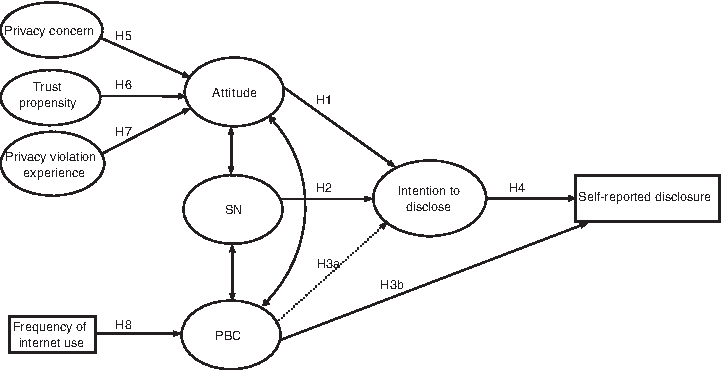
Proposed model of theory of planned behavior (TPB) applied to adolescents' self-reported disclosure in exchange for commercial incentives.
TPB factors
Attitude
Previous research on the attitudes of adolescents regarding online privacy threats has revealed that they are more positive than adults are toward data-processing activities, when commercial incentives are offered.
7
Similarly, a study
14
examining adolescents' disclosure reports that older adolescents are more willing to provide their personal information if they assess the perceived benefits as exceeding the perceived costs related to disclosure. Individuals who view invasions of information privacy online as adverse are less inclined to carry out acts that pose threats in this regard.
15
Another study reports a positive relation between respondents' attitudes toward protecting their information privacy and their actual intention to do this.
16
Based on these findings, we hypothesize the following:
Subjective norm
People develop perceptions of the normative framework within a society through significant referents in their lives
17
(e.g., family members, friends, and educators).
18
Research has demonstrated that adolescents coordinate their behaviors, both online and offline, in such a way that they achieve congruence with the social pressure exerted by significant others. For example, Livingstone
19
states that teenagers' activities on social network sites are influenced by peer norms. Lewis et al.
20
found that students were more likely to restrict access to their profile pages if the profiles of peers were closed as well. They conclude that the online privacy behavior is an upshot of both social influences and positive incentives. In the present study, we therefore expect the following:
Perceived behavioral control
The PBC concept has two dimensions
21
of control: internal (abilities, skills, and confidence) and external (resources, barriers, and dependence on others). With regard to internal control, many studies applying the TPB report that individuals who have high confidence in their ability to perform a behavior are more motivated to carry out the behavior. When, however, respondents feel that they have complete internal control over the behavior, the influence of PBC is likely to decline.
13
The focal behavior of this study—disclosing personal information in exchange for commercial incentives—should pose few, if any, difficulties for adolescents because of their skills in using information and communication technologies. As noted by Ajzen,
13
PBC is compatible with Bandura's notion of self-efficacy, which is defined as “judgments of how well one can execute courses of action required to deal with prospective situations.”
22
In the context of online privacy, LaRose and Riffon
16
found no direct relationship between Internet users' privacy self-efficacy and their intention to disclose personal information. The following is predicted in the present study:
With regard to external control, PBC is also posited to predict behavior, because the degree of success with which this behaviour is carried out is partially dependent on the presence of nonmotivational factors.
13
Disclosing personal information in exchange for a commercial incentive is a behavior that only can be performed when individuals have the opportunity to do this (e.g., Internet access; exposure to commercial data requests online). Moreover, research
23
revealed a direct positive relationship between PBC and respondents' adoption of privacy-protective behaviors. Therefore, we expect the following:
Intention
Previous research has established an association between intention to use and actual usage of new technology.24,25 Except with regard to behaviors that are largely out of an individual's behavioral control, the intention to perform a particular behavior is the strongest predictor of its actual performance.
13
We expect the following:
Antecedents of attitude
Privacy concern
Privacy concern can be defined as the “Internet customer's concern for controlling the acquisition and subsequent use of the information that is generated on him or acquired on the Internet.”
26
Several studies have revealed a negative relationship between privacy concern and the intentions of both adolescents14,27 and adults28,29 to disclose personal data to online marketers. No direct relationship, however, between privacy concern and intention is expected in our study, as the TPB proposes that additional factors can only indirectly influence behavior, because their influence is mediated by attitude, subjective norm, or PBC.
30
In this study, we predict the following:
Trust propensity
Personal information disclosure for commercial purposes is conducted within a context of temporal and spatial separation between Internet users and commercial organizations. Situations can arise in which Internet users are unsure about what commercial Websites will do with their personal information. 5 Bearing this in mind, Youn 10 suggests that it might be interesting for future research models to include consumer traits such as trust propensity. Mayer et al. 31 define this construct as a general willingness to trust others.
In this study, we expect the following:
Privacy violation experience
Recent research found that 9 percent of European youth reported a misuse of their personal information on the Internet during the last 12 months. 32 Strater and Lipford 33 report that respondents reporting events about intrusive contacts made on SNS were more likely to give thorough consideration to their online disclosure and the level of access allowed to profile data. Such negative experiences could influence young people's attitudes toward disclosing personal information online.
We expect the following:
Antecedent of PBC
Frequency of Internet use
Some studies report a positive relationship between online experience and privacy concern. 34 Other studies have shown that Internet users with more experience demonstrated a greater desire to control personal information.35,36 Lewis et al. 20 report that more intensive Internet users are more likely to have private profile pages on SNS. There are additional reasons to expect that the frequency of Internet use will influence PBC. In a study on SNS self-disclosure, Trepte and Reinecke 37 report that frequent SNS users were more willing to disclose personal information. Within online commercial contexts, frequent Internet users could thus be more readily inclined to disclose personal data, as they are more frequently confronted with data requests from online marketers offering possible rewards for entrusting personal details.
We therefore expect the following:
Method
Participants
Self-administered anonymous questionnaires, containing all variables involved in the research model of the present study, were completed by 1,042 respondents (519 male respondents and 523 female respondents) in January 2010. From an exhaustive list of schools obtained from the Flemish Ministry of Education, we selected 6 schools from each Flemish province, resulting in a total selection of 30 schools. We used the schooling type as an additional sample criterion, to guarantee the equal representation of students from all three levels of education in Flanders. Within each school, one class in each of the three grades was selected to participate in the study to guarantee the equal representation of students in various age categories. All pupils from a selected class were asked for their permission to participate in the survey study. Participants' ages ranged between 12 and 18 years (Mage=15.35; SD=1.75).
Instruments
We developed a questionnaire containing scales that have been validated in previous research testing the TPB. We applied these measures to examine adolescents' disclosure of personal information. All TPB items were assessed using 6-point Likert-scales with item responses ranging from 1 (strongly disagree) to 6 (strongly agree), with the exception of attitude as described in Table 1.
PBC, perceived behavioral control; SN, subjective norm.
Privacy concern
A scale developed by Smith, Milberg, and Burke 38 was adopted to measure privacy concern using six items measured on a 6-point Likert-scale (e.g., I am concerned about organizations using my personal data; totally disagree–totally agree). High scores correspond to high levels of privacy concern. The scale was reliable (α=0.85).
Privacy violation experience
This construct was measured using two items rated along a dichotomous scale (e.g., I have already experienced a misuse of personal data; yes–no). Low scores on these items suggest that the respondent has already experienced a certain degree of privacy violation.
Trust propensity
The measurement of trust propensity was based on the 6-item adaptation 39 of Rotter's 25-item trust propensity scale measured on six points (e.g., I'm inclined to trust others, even if I don't know them; totally disagree–totally agree). High scores indicate that respondents are more inclined to trust others in general. The scale showed internal consistency (α=0.85).
Data analysis
To investigate the hypothesized relationships among the TPB constructs, structural equation modeling was applied to the collected data using Mplus 6. 40
Results
Four out of 10 respondents (41.1 percent; n=430) indicate that they never disclose personal information in exchange for commercial incentives. One out of three teenagers (35.3 percent; n=370) report that they seldom disclose information. About one in five (17.5 percent; n=183) disclose sometimes, while about one out of 20 respondents divulges on a somewhat regular basis (5.4 percent; 3.5 percent [n=37] of respondents disclose regularly, 1.1 percent [n=11] often, and 0.7 percent [n=7] very often).
Measurement model
The measurement model provides a good fit for the data (see Fig. 2). All variables were treated as latent constructs, with exception of the single-item measures. Table 2 displays the correlations between the latent constructs. All factor loadings are significant and above 0.499 (see Table 3).
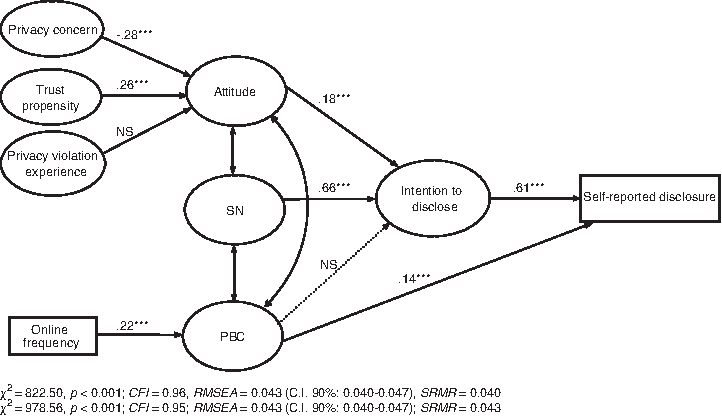
Model of the TPB applied to adolescents' self reported disclosure in exchange for commerical incentives. ***p<0.001.
n=1,042.
Structural model
Figure 2 presents the model, including the standardized regression coefficients yielded by the SEM analyses. All fit indices indicate a good fit for the model, except for χ2 due to its sample size sensitivity. Our analyses reveal that the three TPB factors explain 61.9 percent of the variance in adolescents' intention to disclose personal information in exchange for commercial incentives. Moreover, intention and PBC jointly account for 43.7 percent of the variance in self-reported disclosure behavior.
As shown in Table 3, our analyses reveal that the most important predictor of adolescents' disclosure in exchange for commercial incentives is behavioral intention (β=0.61, p<0.001) (H4). Furthermore, PBC with regard to disclosing personal information is a significant predictor of self-reported disclosure (β=0.14, p<0.001) (H3b). According to our analyses, an individual's intent to disclose is influenced primarily by a subjective norm (β=0.66, p<0.001) (H2) and subsequently by attitude (β=0.18, p<0.001) (H1), although no significant path is found between PBC and intention (β=0.04, p=0.142) (H3a). Our analyses further indicate a negative association between privacy concern and adolescents' attitude toward disclosure (β=−0.28, p<0.001) (H5). As predicted by H6, respondents' trust propensity is positively related with attitude (β=0.26, p<0.001). Contrary to expectations, no significant relation (β=−0.03, p=0.502) is found between privacy violation experience and attitude, thereby rejecting H7. Finally, we find a positive relationship (β=0.22, p<0.001) between online frequency and adolescents' PBC with regard to disclosing information (H8).
Discussion
By offering a global theoretical framework for explaining the ways in which adolescents deal with personal information disclosure in online commercial settings, the outcomes of this study could be especially fruitful for consumer educators and policymakers seeking to design privacy educational initiatives to foster online privacy awareness among teenagers. The present study reveals that subjective norm is the most important predictor of teenagers' intention to disclose personal information on commercial Websites. This finding suggests that the importance of social factors outweighs individually oriented attitudinal factors. Instead of following their own subjective evaluations in coping with information privacy, teenagers are more strongly influenced by the social pressure they anticipate from significant others (e.g., peers, siblings, parents, teachers, and relatives). Our results suggest that policymakers interested in protecting teenagers' online personal information should focus their attention to subjective norm as a primary target of intervention. The important role of subjective norm aligns with literature. Ling and Ytrri 41 suggest that young people are more susceptible to external and interpersonal influences, because they are at an age stage in which their social development and learning are more dynamic than in adulthood. Adolescence is also the life stage in which young people start to spend more time outside the family context, which increases the exposure to the opinions and the pressure exerted by others, not only peers but also adults. 42
As expected, we found no significant relationship between PBC and intention to disclose personal information. One possible explanation is that, as suggested earlier in this article, young people may feel such high levels of internal control, that this does not increase their motivation to disclose personal information in exchange for incentives. A direct positive relationship however was found between PBC and disclosure. This indicates that adolescents' information disclosure is partially dependent on the available opportunities to perform this behavior.
Footnotes
Author Disclosure Statement
No competing financial interests exist.