




Abstract
Abstract
In recent years, the phenomenon of cyberbullying has been gaining scholars' growing interest under various aspects, including its overlap with face-to-face bullying. Nevertheless, its relationships with cognitive and affective empathy, proactive and reactive aggression, and moral disengagement, constructs that proved to be crucial in distinguishing aggressive subjects from their targets and nonaggressive peers in traditional bullying, still represent, to some extent, an unexplored domain. The main purpose of the present exploratory study was to investigate the associations between cyberbullying and the mentioned constructs among Italian adolescents. 819 high-school students (mean age 16.08) were administered a battery of standardized tools, along with Cyberties, a new instrument created to assess the prevalence of (and the type of involvement in) different forms of electronic assaults. Analyses of variance were conducted to compare four roles (“pure” bullies, “pure” victims, bully victims, and noninvolved subjects). Participants who identified themselves as cyberbullies or cyberbully victims showed significantly higher levels of overall moral disengagement and of both types of aggression. Cyberbullies also displayed a lack of affective empathy. Our findings are in line with the ones in extant literature about correlates of traditional and electronic forms of bullying. Implications for prevention strategies are discussed.
Introduction
The present cross-sectional study was designed to preliminarily investigate, in a sample of Italian adolescents, some constructs that proved to play crucial roles in face-to-face bullying and whose relations to youth's involvement in cyberassaults still represent a partially explored domain. Our research was carried out within an established approach that parallels the equally recognized “participant role” one 10 and is corroborated by a large body of empirical evidence supporting the assumption that different roles in bullying relate to different psychological profiles (for a recent meta-analysis, see 11 ). Children and adolescents (self-)characterized as bullies, victims, or bully victims significantly diverge with reference to various dimensions, including the ones our investigation focused on: moral disengagement (MD) and subtypes of empathy and aggression.
MD was conceptualized by Bandura12,13 as a set of eight cognitive mechanisms that allow individuals to endorse behaviors conflicting with their system of moral values without feeling guilty. Three mechanisms aim at restructuring the harmful behaviour: Moral justification allows a viewing of the detrimental conduct as a means to serve socially valued purposes; euphemistic labeling refers to a process that confers respectability on reprehensible behaviors through sanitized language; advantageous comparison contrasts reprehensible activities with more unacceptable ones. Displacement of responsibility and diffusion of responsibility operate by weakening individuals' sense of personal agency: The former makes people view their actions as stemming from others' pressure, while the latter enables individuals to feel less responsible when acting as a part of a group. Distortion of consequences minimizes the negative outcomes of a person's transgressions. Dehumanization of the victim allows to endorse immoral behaviours by viewing the recipient of them as a subhuman creature that does not deserve to be considered within the frame of a conventional moral codex, while the attribution of blame to the victim legitimizes maltreatment by construing it as an admissible reaction to a provocation.
Among the studies investigating the relations between MD and traditional bullying in adolescence, Hymel et al. 14 showed that 38 percent of the variance in reported bullying was explained by participants' endorsement of MD mechanisms (see also 15 ). Almeida, Correia, and Marinho 16 found a positive association between high levels of MD and positive attitudes toward the bully role, opposed to low levels of MD as predictors of positive attitudes toward the defender role. According to Obermann, 17 Danish adolescent pure bullies and bully victims displayed higher levels of MD than outsiders. In a longitudinal research, 18 MD mediated the association between early risk factors (such as rejecting parenting and a deprived socioeconomic background) and antisocial behaviour in adolescence. A recent Australian study 19 showed that high scores in MD were predictors of frequent peer aggression over time, and reinforced the association between individuals' low levels of efficacy beliefs in the possibility to act cooperatively (students and teachers) against aggressive conducts and high frequency of peer aggression.
Among the few researchers who explored the relationships between MD and cyberbullying, Pornari and Wood 20 found that overall MD and moral justification were positive predictors of cyberaggression.
Cohen and Strayer's definition of empathy as “the ability to understand and share in another's emotional state or context” 21 (p988) encompasses the two widely agreed dimensions of empathic responsiveness: the cognitive one, that is the ability to take another's emotional perspective; and the affective one, which represents the ability to experience vicariously another's emotions, with an awareness of the emotional repercussions of one's behaviors on other individuals. 22
Empathic skills, globally considered, generally inhibit aggressive conducts, as some meta-analyses23,24 have confirmed; a review about affective empathy 25 highlighted its significant negative relationship with aggression in adolescents.
Each of the two dimensions of empathy can specifically predict involvement in aggressive conducts, as academics have shown with reference to face-to-face bullying. Results from a recent inquiry 26 suggested that low affective empathy was independently related to bullying among boys when controlling for individual and social background variables (such as socioeconomic status, parental supervision, and impulsivity). Caravita et al. 27 found that male children and preadolescents were characterized by a negative relation between affective empathy and the bully role, and demonstrated a positive relation between the latter and cognitive empathy, regardless of gender.
Very few scholars investigated the associations between empathy and cyberbullying. Steffgen et al. 28 demonstrated that lower levels of empathic responsiveness, measured globally, regardless to its two dimensions, significantly distinguished cyberbullies from peers who identified themselves as victims, bully victims or nonaggressive in the cyberspace. In a study 29 involving Singaporean adolescents, participants of both genders displaying low levels of affective empathy, but scoring high on the cognitive dimension, were less aggressive in cyberspace than peers who were low in both dimensions; a different pattern of interactions emerged about individuals who were high in affective empathy: Low cognitive empathy was associated with more of boys' aggressiveness, while girls acted cyberassaults, regardless of their levels of cognitive empathy.
Reactive aggression originates from the tendency to attribute hostile intentions to social stimuli and to react consistently, while proactive aggression is preplanned and driven by the anticipation of a benefit30–33 ). The different contribution of the two subtypes to youth's involvement in face-to-face bullying is a widely investigated topic. A Norwegian study 34 demonstrated that, in a sample of 14-year-old subjects, a strong relation emerged between proactive aggression and being a bully, while reactive aggression was only weakly related to the bully role; no significant relation emerged between being a victim and both subtypes of aggression. In a research (based on both peers' and teachers' nominations) by Salmivalli and Nieminen, 35 among 10- to 12 year-old subjects, bullies were considered more proactively and reactively aggressive than controls (nonaggressive subjects) and victims; victims scored higher than controls, but lower than bullies and bully victims, in reactive aggression; victims showed no proactive aggression (this finding was confirmed by Camodeca et al. 36 and by Camodeca and Goossens 37 ); and bully victims scored higher than all other roles in both subtypes.
Only a few studies explored the associations of proactive and reactive aggression to electronic bullying. A cross-cultural research 38 (participants were adolescents from the United States and Singapore) indicated that the contribution of proactive aggression to cyberbullying, controlling for reactive aggression, was statistically significant, while the contribution of reactive aggression, controlling for the proactive subtype, was not. Similarly, results by Calvete et al. 39 showed that cyberbullying was significantly associated with the use of proactive aggression.
The overviewed findings inspired the formulation of our set of hypotheses. First, we expected that authors of cyberassaults would be significantly more morally disengaged than victims and uninvolved subjects. With regard to empathy, we expected individuals who perform aggressive acts in cyberspace (respondents categorized as bullies and bully victims) to score significantly lower than “pure” victims and noninvolved participants in affective empathy. We also hypothesized that levels of cognitive empathy would not distinguish aggressive roles from nonaggressive ones. Finally, with regard to aggression, we hypothesized that perpetrators of cyberbullying would show higher levels of the proactive subtype than both groups of nonaggressive participants.
Materials and Methods
Participants
Our sample comprised 819 adolescents—547 girls (66.79 percent), 272 boys (33.21 percent), mean age 16.08, SD 1.42—attending state high schools located in middle-class urban communities, in three medium-sized northern Italian towns; 225 participants were first graders in secondary education; 185, 181, 136, and 92 were in second, third, fourth, and fifth grade, respectively.
Measures
Cyberties
We created this self-report survey to explore various aspects of adolescents' use of electronic communication devices. Its first part (to be completed by all participants) provides a definition of cyberbullying (see below) and investigates lifetime involvement in the phenomenon without specification of cyberaggression modalities. The second part is to be filled in only by respondents who previously declared having been involved in cyberbullying; it explores the occurrence of six suffered/inflicted modalities of cyberassaults (see Table 1) during the past 3 months. Frequencies are measured on a seven-point scale ranging from never to several times a day.
N= 20; bN= 19.
Basic empathy scale 40 (Italian validated version 41 )
This instrument consists of 11 items assessing affective empathy—for example, “After being with a friend who is sad about something, I usually feel sad”—and of nine items measuring cognitive empathy—for example, “I can often understand how people are feeling even before they tell me.” Each item is rated on a five-point scale ranging from one (strongly disagree) to five (strongly agree). Alpha coefficients for the present study were 0.85 and 0.76 for the affective and the cognitive subscale, respectively.
Reactive-proactive aggression questionnaire, 42
Italian validated version. 43 This questionnaire includes 11 items measuring reactive aggression (e.g., “How often have you reacted angrily when provoked by others?”) and 12 items measuring proactive aggression (e.g., “How often have you hurt others to win a game?”); each item is rated as 0 (never), 1 (sometimes), 2 (often). In the present study, alpha coefficients were 0.77 for the proactive subscale and 0.76 for the reactive one.
Scala di disimpegno morale [MD scale] 44
This 24-item tool is specifically designed to measure levels of MD, with three items measuring each of the eight mechanisms described by Bandura (e.g., dehumanization of the victim: “Some people deserve to be treated like animals”; moral justification: “It is alright to beat someone who bad-mouths your family”). It also provides an overall MD score. Participants are asked to express their agreement with the statements the items contain on a scale whose three points correspond to never true, sometimes true, and always true. In this study, α was 0.80.
Procedure
Several principles were contacted in order to obtain permission for some classgroups in their schools to take part in our research; once the principals' authorizations were obtained, a passive parental consent procedure was put in place. Researchers administered the instruments just described during school hours, in one encounter for each classgroup. Students were told they were going to answer anonymous questions about adolescents' daily life and the use of electronic communication devices. It was explicitly stated that participation was voluntary and that data would be used only for scientific purposes. Before the administration, the following broad definition of cyberbullying reported on the front page of the Cyberties survey was discussed with the classgroups in order to ensure a shared understanding of the phenomenon: “Cyberbullying occurs when an individual or a group, motivated by the intent to hurt someone, repeatedly uses electronic means like cell phones and computers in order to perform harmful conducts such as insulting, threatening, spreading rumours, spreading embarrassing pictures and/or videos, posting mean comments in blogs etc.”
Results
Descriptive analyses
Role and gender distributions, prevalence of cyberbullying, occurrence of the various modalities
Roles were assigned with reference to how participants answered two questions in the first part of Cyberties: “Have you ever been a cyberbully?” and “Have you ever been a cybervictim?” Subjects who answered “no” to both questions were categorized as noninvolved; those who answered “yes” to both questions were considered cyberbully victims; “pure” cyberbullies included those who answered only the first question affirmatively, while “pure” cybervictims comprised subjects who answered only the second question affirmatively.
454 out of 547 (83 percent) girls and 232 out of 272 (85.3 percent) boys fell into the noninvolved group; 54 (9.87 percent) girls and 10 (3.67 percent) boys were cybervictims only; 21 (3.83 percent) girls and 21 (7.73 percent) boys self-reported being “pure” cyberbullies; and the group of cyberbully victims consisted of 18 girls (3.30 percent) and 9 boys (3.30 percent).
Of the 133 involved participants, 68 completed the second part of Cyberties. Table 1 shows the occurrence of the various cyberbullying modalities during the last 3 months; frequency steps were never, sometimes (this option clusters the following original answers: “once or twice overall” and “twice or three times a month”), often (“about once a week,” “several times a week”), and usually (“once a day,” “several times a day”).
Analyses of variance
The one-way analysis of variance (ANOVA) between groups (roles in cyberbullying) we conducted showed that individuals who reported an “active” involvement in cyberbullying conducts (cyberbullies and cyberbully victims), compared with their nonaggressive peers (victims and noninvolved subjects), were characterized by statistically different (higher in the cases of MD and aggression) mean scores. Details referring to each investigated construct are illustrated below.
The significance level was set at p<0.05; all results relate to the global sample, as no significant gender differences emerged.
Moral disengagement
The ANOVA showed that overall MD levels significantly differentiated roles in cyberbullying [F(3, 819)=21.270, p=0.001]; Tukey post hoc tests confirmed that perpetrators—cyberbullies and cyberbully victims—scored significantly higher than both “pure” cybervictims and noninvolved participants (Fig. 1), while no statistically significant discrepancies emerged within similar categories (aggressive/nonaggressive participants).
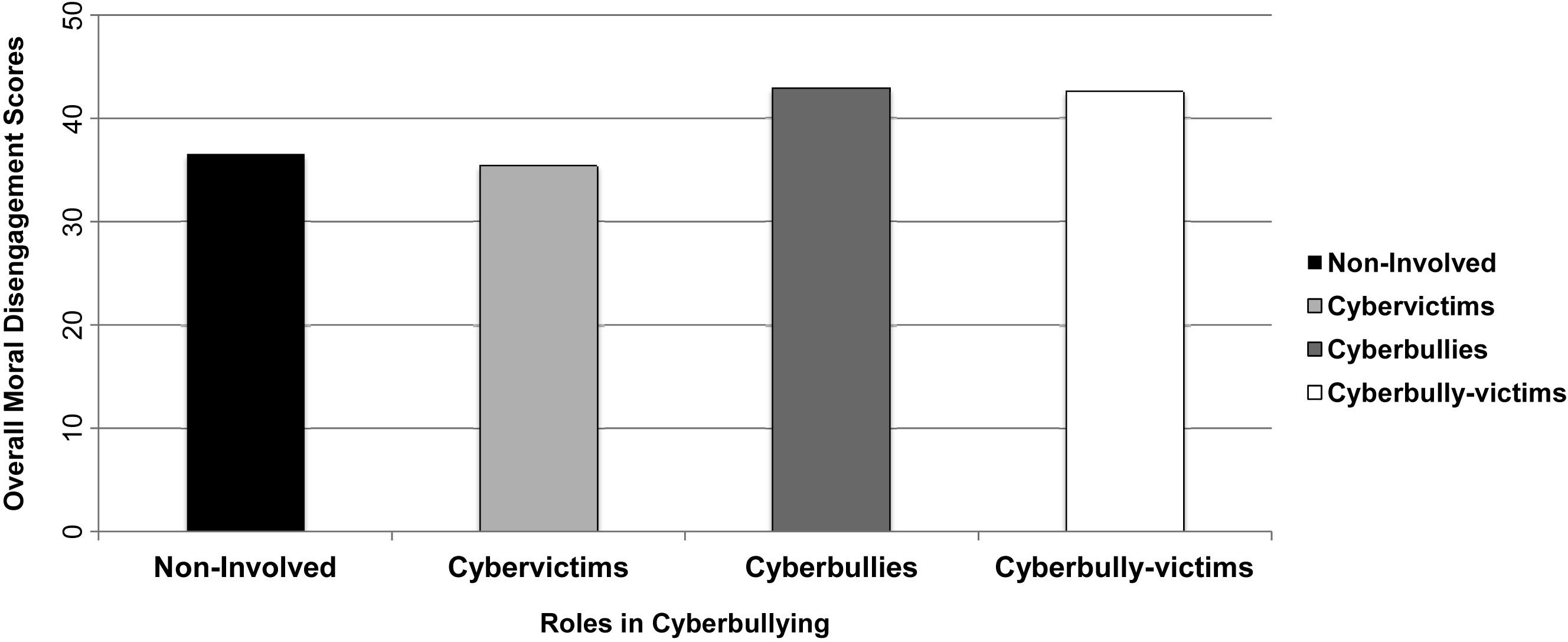
Average group scores in overall moral disengagement.
At the single mechanisms level, comparable results were obtained for moral justification: F(3, 819)=16.889, p=0.001, euphemistic labeling: F(3, 819)=12.144, p=0.001, and advantageous comparison: F(3, 819)=19.898, p=0.001; similarly to what has been highlighted about overall MD, in these three cases, statistically significant differences emerged between the two categories of cyberaggressive adolescents and both cybervictims and noninvolved subjects, and once again, the scores did not significantly differentiate respondents within the aggressive and the nonaggressive groups.
As for diffusion of responsibility [F(3, 819)=6.494, p=0.001], differences were significant only between cyberbully victims and both nonaggressive roles.
Distortion of consequences [F(3, 819)=8.361, p=0.001] was characterized by statistically significant discrepancies between cyberbullies and both groups of nonaggressive subjects, and also between cyberbully victims and cybervictims; a similar pattern of findings emerged in the case of dehumanization of the victim [F(3, 819)=9.417, p=0.001], but with reference to cyberbullies only, while cyberbully victims significantly differed from noninvolved participants.
Levels of attribution of blame to the victim [F(3, 819)=5.508, p=0.001] significantly differentiated between cyberbully victims and noninvolved subjects.
The only MD mechanism with regard to which no significant differences were found was displacement of responsibility.
Empathy
Affective empathy [F(3, 819)=3.902; p=0.009] differentiated cyberbullies from both cybervictims and noninvolved participants; cyberbullies also scored lower than cyberbully victims, but not significantly; moreover, the latter did not display a significantly lower level than nonaggressive subjects, as Tukey post hoc procedures confirmed. With regard to cognitive empathy, no significant differences between the roles emerged (Fig. 2).
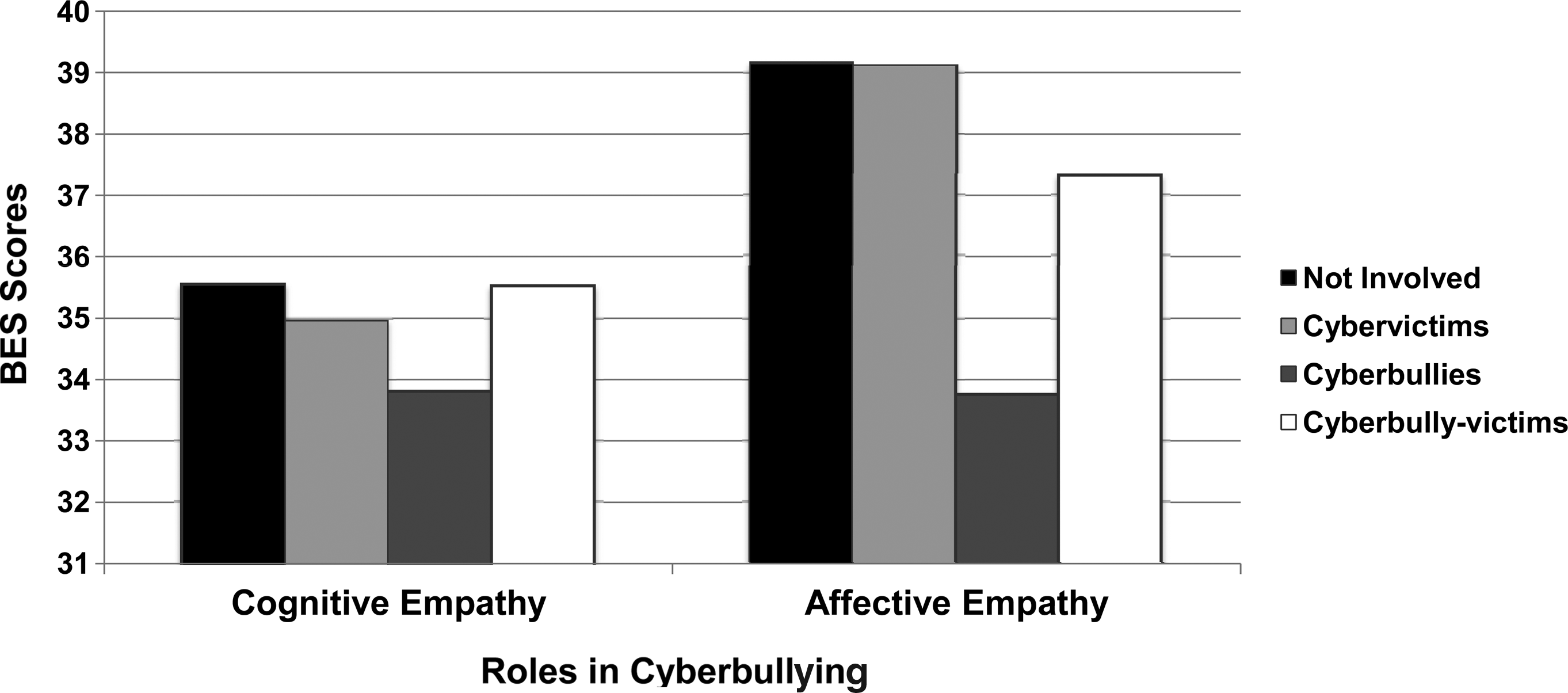
Average group scores in cognitive and affective empathy. BES, basic empathy scale.
Proactive and reactive aggression
Analogous patterns of findings emerged about reactive [F(3, 819)=21.245, p=0.001] and proactive [F(3, 819)=31.727, p=0.001] aggression: In both cases, Tukey post hoc comparisons confirmed that adolescents who identified themselves as perpetrators of cyberbullying (cyberbullies and cyberbully victims) were characterized by significantly higher scores than cybervictims and noninvolved participants (Fig. 3); no statistically significant discrepancies emerged within similar groups (aggressive/nonaggressive participants).
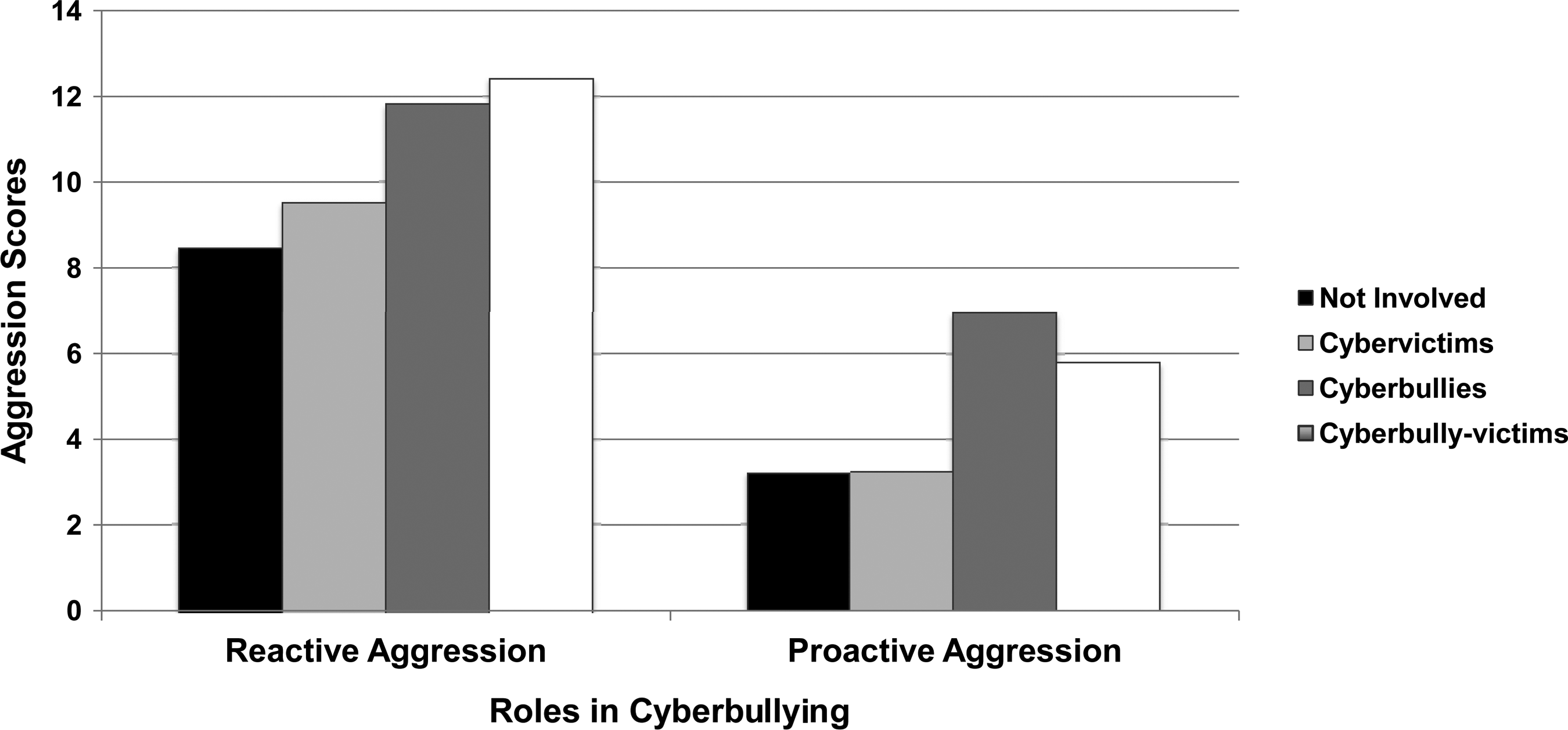
Average group scores in reactive and proactive aggression.
Discussion
The main purpose of the present study was to explore the associations between adolescents' cyberbullying and some constructs that a large body of research has indicated as relevant correlates of traditional bullying; in particular, we expected that individuals who perpetrate antisocial behaviors in cyberspace could be distinguished from their targets and/or from their peers who report no involvement in cyberbullying episodes by considering: (a) their level of endorsement of guilt-relieving strategies (i.e., mechanisms of MD); (b) their lack of ability in vicariously experiencing others' negative emotional states (i.e., affective empathy); and (c) their propensity to preplan detrimental conducts (i.e., proactive aggression). The data analyses we conducted confirmed our hypotheses. With regard to MD and both subtypes of aggression, patterns emerged that distinguished aggressive from nonaggressive groups. As for empathic skills, the four roles were not characterized by significant discrepancies in levels of cognitive empathy (thus reinforcing the conceptualization of bullies as good readers of others' minds—see 27 ), while statistically relevant differences emerged in relation to the affective dimension. It should be pointed out that only cyberbullies displayed a significantly lower level of affective empathy, while cyberbully victims did not. It might be argued that being victims themselves could have enhanced the latter group's emotional proximity to others' distress, but the cross-sectional, exploratory nature of our study did not enable us to interpret causal effects. Consequently, only further research with different experimental designs will lead to a better understanding of what represents, in the present investigation at least, a unique pattern in which the two aggressive roles diverge.
In sum, these results are in line with the ones provided by extant literature on cyberbullying, but the fact that we chose to focus solely on this phenomenon raises some questions about their interpretation. Unlike other researchers who carried out parallel investigations, we did not assess our subjects' involvement in traditional forms of bullying, which can be considered a major limitation with reference to the debate about the comparison between cyber and face-to-face aggressors' profiles. Such a comparison is still at its beginnings, but some interesting data are already available. In Pornari and Wood's study 20 (inspired by the same Bandurian conceptualization we adopted), cyberaggressors proved to be less morally disengaged than their traditional counterparts, as if a lower level of endorsement of MD mechanisms was required to engage in media-based bullying. Pornari and Wood hypothesized that such a discrepancy could be due (a) either to the fact that cyberbullying conducts might be perceived as less serious than behaviors pertaining to face-to-face bullying because of anonymity and distance from the victim (conditions that entail a reduced need to rationalize and justify), (b) or to a general perception of online activities as being mainly recreational.
By contrast, in an investigation conducted on Italian adolescents, Menesini and colleagues 45 did not find such a difference between traditional bullies and cyberbullies in the domain of morality, with regard to which both categories of aggressive subjects displayed similar deficiencies; but it should be observed that the instrument they used to measure the involvement in immoral behaviors was not developed within the framework of Bandura's theory.
In any case, research seems to indicate that cyberbullying, similar to its face-to-face counterpart, can be rightfully considered a morality-sensitive topic.
Moreover, the dissimilarity between traditional and cyber aggression also with reference to the two subtypes of aggression deserves deeper attention, as a few scholars have already demonstrated. Comparing psychosocial characteristics of traditional and cyber aggressors and victims, Sontag et al. 46 showed that perpetrators of cyberbullying were characterized by lower levels of reactive aggression compared with traditional and combined (face-to-face and cyber) aggressors; both individuals who were victimized in cyberspace only and combined victims were more reactively aggressive than traditional-only targets.
Another relevant question to be addressed refers to the different modalities of cyberbullying. The small number of subjects who accepted to complete the second part of our survey did not enable us to carry out a proper investigation on how the specific methods of media-based aggression can reflect different levels of the constructs we took into consideration, which is potentially a topic of interest. For example, a recent study 47 on the motivations underlying cyberbullying in a sample of 733 Canadian adolescents showed that reactive aggression significantly predicted conducts such as sending aggressive messages online, posting embarrassing pictures, and/or making mean comments on them, while proactive aggression was a predictor of hostile Website development. Larger samples of involved subjects could make it possible for us to perform analogous regression analyses also on MD and on the two categories of empathic responsiveness as independent variables.
Some other limitations to our research are worth noting. First, data were derived only from self-report measures: anonymity should have lowered the risk of socially desirable answers, but adolescents might have under-reported their involvement in cyberaggression. Second, although its overall size was relatively large, ours is a convenience sample: Our battery was administered only in the schools whose principals agreed to participate, and a major consequence of the not-randomized nature of our sample is that girls largely outnumbered boys, because of the numerical gender imbalance that characterized most of the respondents' classgroups. Hence, it would be hasty to generalize our results to the whole Italian adolescent population. Further longitudinal research is needed to corroborate our findings; still, they can contribute to a deeper understanding of some crucial psychological correlates of the engagement in electronic forms of aggression. Furthermore, this study provides some indications for the planning and implementation of preventive strategies. For example, interventions that proved to be effective in reducing levels of MD related to noncyber behaviours might be adopted (and adapted) in order to tackle cyberbullying too. Among these interventions, an Italian classroom-based, administered by trained teachers program named The Bullies' Alphabet, 48 consisting of a series of discussions of moral dilemmas exploring daily school-life conflictual situations, significantly reduced preadolescents' tendency toward self-justification (see also 49 ). The discussion of dilemmas that focus on cyber conducts might lead to similar positive outcomes.
Footnotes
Acknowledgment
The authors are grateful to all the students who agreed to participate in their research.
Author Disclosure Statement
No competing financial interests exist.