




Abstract
Abstract
This study examined how creating a human presence in organizational online communication affects organization–public relationships and publics' favorable behavioral intentions to engage in word-of-mouth (WOM) and dialogic communications. Four hypotheses were tested in the context of Twitter through a 2×2 (presence: human vs. organizational×organization type: nonprofit vs. for-profit) within-subjects design. The results revealed that conversational human voice was perceived to be higher for Twitter pages of organizations with a human presence than for those with an organizational presence. Providing a human presence on social media through the use of social media managers' avatars and names appeared to promote favorable organization–public relationships and positive WOM communication. However, dialogic communication intentions did not significantly differ between organizations incorporating a human presence versus an organizational presence into their Twitter pages. The proposed dynamic role of human presence versus organizational presence adds a new perspective as to how organizations can take better advantage of interpersonal aspects of social media.
Introduction
Twitter has been one of the fastest-growing social media sites over the past few years. 7 This social networking tool fosters information sharing and instant interactions among individual users and organizations, allowing them to post short real-time messages, or tweets. Twitter also has been used most frequently by Fortune 500 companies to communicate with their publics, followed by Facebook and YouTube. 8 For this reason, this study used Twitter as the experimental setting for examining the effect of presence on public responses to an organization.
Social presence theory and conversational human voice
Regarding relationship building via social media that relies on real-time interactions and active conversations, it is prudent for organizations to communicate like humans and incorporate a conversational human voice.4,5 Conversational human voice illustrates “an engaging and natural style of organizational communication as perceived by an organization's publics based on interactions between individuals in the organization and individuals in publics.”4(p177) Simply put, having publics perceive that they are conversing with an actual person rather than a lifeless organization is the core of conversational human voice. Previous studies on online public relations have shown that an organization's human voice can play an important role in developing and nurturing organization-public relationships online,4–6,9 as well as increasing positive attitudes toward an organization and intentions to engage in WOM communications. 10
The concept of conversational human voice is integrally related to social presence theory, which was proposed by Short et al. 11 This theory complements and embraces two earlier perspectives to telecommunication, efficiency and nonverbal theories, which explain differences between media and predict the outcomes of communication based on the efficiency of a communication channel in obtaining intended outcomes (e.g., conflict resolution) and the amount of verbal and nonverbal information that a medium provides, respectively. 11 As these earlier theories were unable to fully explain and predict communication outcomes by media type, social presence theory was developed as a more sophisticated approach to researching media effects in mediated communication. From this perspective, a critical aspect of a communication channel is the degree to which the counterparty is perceived as being real in a mediated communication environment. 11 In other words, each media channel differs in the amount of acoustic, visual, and physical contact it allows between two communication parties. 11
Social presence theory was initially developed to explain the degree of being there with another that someone feels among audio and closed-circuit television encounters, but it is now popularly used to explain communication behaviors in computer-mediated communications. 12 Since people are social beings, they strive to inculcate a sense of social presence to gain satisfying and productive access to others and share the thoughts, emotions, and presence of real and virtual humans.13,14 Without face-to-face conversations, greater perceptions of social presence may emerge in communication that conveys feelings of being with other people rather than in interactions devoid of human presence.15,16 This is because media with higher levels of social presence are considered to be more sociable, more sensitive, more personal, and warmer. 11
Several scholars have pointed out that the concept of social presence can be hard to explicate due to the broad and vague nature of its definition; however, some researchers suggest that one way to overcome this is to identify the properties of representations in mediated environments that elicit perceptions of social presence from the users–viewers. 13 In other words, discovering how to better trigger social cues that one is together with another should be a design outcome of social presence theory. This is especially imperative in the current social media-dominated environment, because different social media platforms, such as blogs, YouTube, and Facebook, can be classified based on degrees of social presence that may emerge within a channel; for example, blogs and wikis have lower social presence than do social networking sites, which are in turn lower in social presence than virtual social worlds such as Second Life. 17 More importantly, social presence can even vary within the same communication channel depending on contextual factors, such as the size of the other party's pictures provided to a communicator. 11 It is important to identify methods for improving social presence in a mediated communication context, because greater perceptions of social presence lead to higher levels of satisfaction toward the communication experience,16,17 and more favorable attitudes toward a Website, 18 and more trusting relationships with a company or brand. 15 To this end, this study focused on explicating social presence by creating two different stimuli that vary in the degree of interpersonal and conversational cues available in the social media channel.
Higher levels of social presence can be achieved by making the communication counterparty highly visible and the conversation real-time. 19 This study adapted the concept of social presence to define human presence and organizational presence in social media from a public relations perspective. A human presence reflects a situation in which social presence is perceived to be high, with cues showing that communicators are actual human beings, whereas an organizational presence resides within a mediated communication context that is missing such cues. Thus, this study demonstrated a human presence by making the communication counterparty highly visible through providing social media managers' avatars with their personal names on an organization's social media site. The human element in organizational communication makes the communication appear to be more interpersonal and conversational, thereby increasing positive effect on perceptions of conversational human voice. 5 Thus, H1 posited the following:
Organization-public relationships
With the friending functions of social networking sites, relationships between an organization and its publics have become closer to interpersonal relationships. 1 This phenomenon underscores the importance of understanding how to manage relationships with publics, which has been one of the predominant topics in public relations over the past few decades.20–22 An organization–public relationship is defined as “the state which exists between an organization and its key publics in which the actions of either entity impact the economic, social, political, and/or cultural well-being of the other entity.”23(p62)
This study conceptualizes organization–public relationships as consisting of four important constructs: trust, control mutuality, satisfaction, and commitment. Trust represents a belief that another party in a relationship will fulfill one's future needs. 24 Another relational outcome is control mutuality, which refers to “the degree to which parties agree on who has the rightful power to influence one another.”20(p3) Control mutuality depends on power differences in the social context, and a certain level of control mutuality should be achieved to maintain good organization–public relationships. 25 Satisfaction is the degree of positive feelings that one has about another. 20 If parties in a relationship meet each other's expectations and provide sufficient benefits to each other, both parties feel satisfied with the relationship. 26 Commitment refers to the degree to which both parties invest their resources in maintaining a relationship.20,27 As the degree of commitment to a partner in a relationship increases, the desire to end the relationship decreases. 28
Previous research on organizational blogs suggests that these key relational outcomes may be influenced by conversational human voice in a computer-mediated context. 5 From a social presence perspective, Gefen and Straub 15 argue that relational trust is built through ongoing interactions with a high social presence, driven by the perception that there is actual human contact in the communication context. In Sweetser and Metzgar's 9 study, the use of conversational human voice, as well as responsiveness, appeared to be the core factors in improving relationships through an organizational blog during a crisis situation. Therefore, H2 predicted the following:
Dialogic communication and WOM intentions
Dialogic communication is defined as “any negotiated exchange of ideas and opinions.”29(p325) While perceptions of good relationships lead publics to engage in dialogic communication, 30 constant interactions and dialogue are conversely fundamental to relationship building in the long term. 3 Since social networking has its essence in interpersonal interactions,15,31 organizations can seek to continue dialogue with their publics by facilitating interpersonal communication via social networking sites. In this respect, organizational social networking pages should let visitors know that “it is no longer some faceless public relations department or corporate entity communicating with the publics but an actual person”31(p339) that is engaged in the online communication process. If an organization's social networking page conveys a sense of actual human contact occurring, visitors to the page are more likely to express their thoughts and opinions about the organization and its products and services. Thus, H3 predicted the following:
Word-of-mouth (WOM) refers to “informal communications directed at other consumers about the ownership, usage, or characteristics of particular goods and services and/or their sellers.”32(p261) Many scholars have found that WOM intentions and actual WOM behaviors are positively correlated with favorable relationships.33–36 For example, noting that positive WOM is one of the significant outcomes of satisfaction, Luo and Homburg 36 argue that WOM, as free advertising, contributes to the efficiency of future promotion and advertising investments for organizations. Based on previous literature, this study posited that there is likely to be a spillover effect from perceptions of relationships onto WOM intentions. Therefore, H4 predicted the following:
Methods
This study used a 2×2 (presence: human vs. organizational×organization type: nonprofit vs. for-profit) within-subjects experimental design. The type of presence was operationally defined based on whether or not an organization's social networking page included a list of individuals in charge of the page and exhibited a personal approach through the use of those individuals' names in postings. In both human presence and organizational presence conditions, the Twitter pages contained messages about the organizations' recent events, such as promotions or updates in services and products, as well as comments from other Twitter users. It was only in the human presence condition, however, that social media managers' avatars, along with their names, were embedded on the left side of the Twitter page, and these managers used their names in responding back to users' questions or comments (see Fig. 1). Except for these attributes, the stimuli were identical in the content and visual layout. The total number of and the type of tweets were also identical between the two conditions, and the tweets were a combination of negative, positive, and neutral tones across both experimental conditions. Based on pretest results, we chose two companies (Continental Airlines and Southwest Airlines) from the Fortune 500 list 37 and two nonprofit organizations (Teach For America and Junior Achievement) from the NonProfit Times Top 100 Nonprofits list. 38 Two organizations were chosen for each type to create message variance, because the independent variables were within-subjects factors. 39 The selected organizations were similar in reputation and familiarity, and each organization had an official Twitter page.
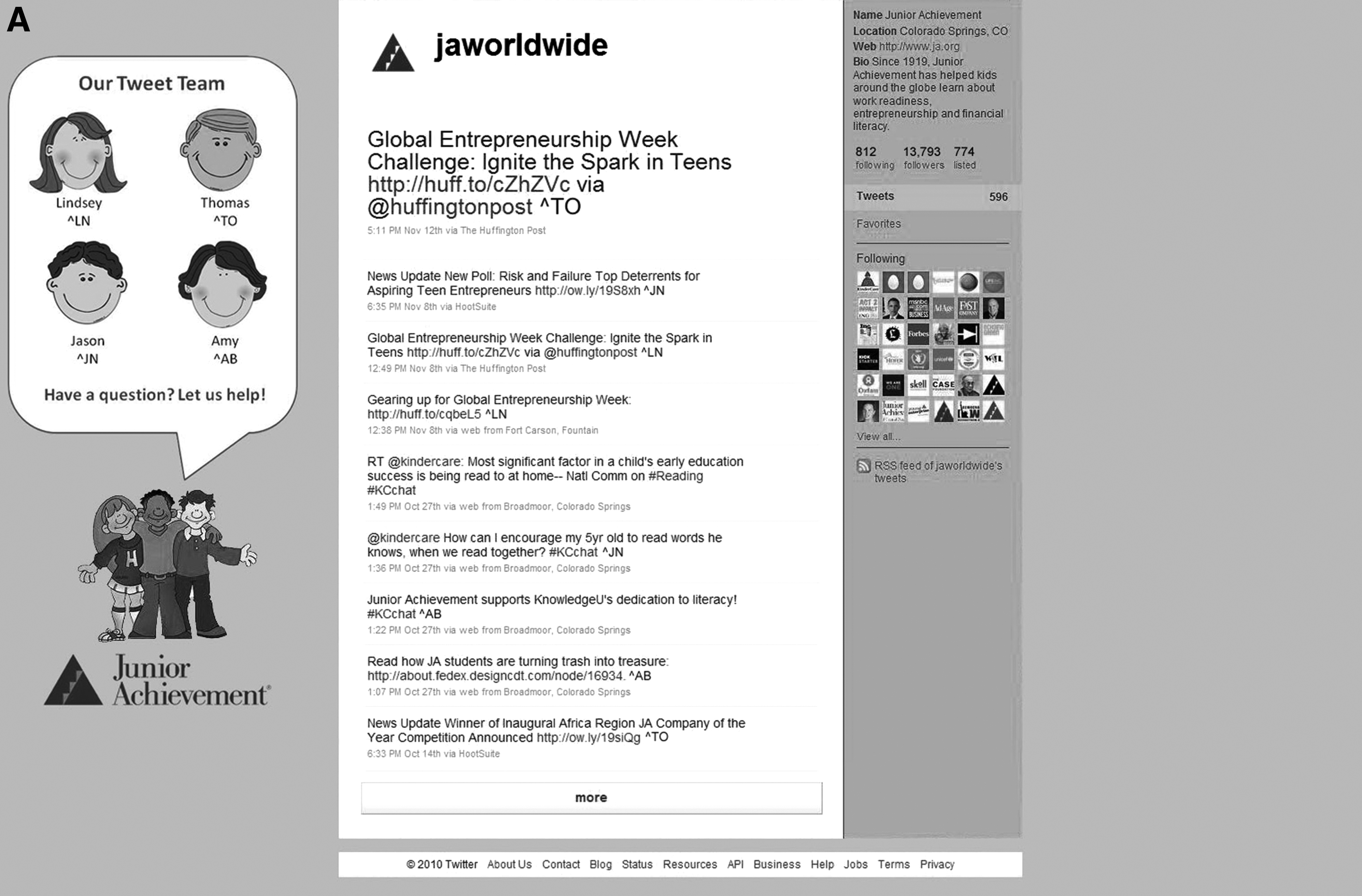
Screen shots of Twitter pages for the human presence and the organizational presence conditions.
Dependent variables were (a) conversational human voice, (b) relational outcomes (trust, control mutuality, commitment, and satisfaction), (c) dialogic communication intentions, and (d) WOM intentions. Participants' perceptions of conversational human voice on the organization's Twitter account were measured using 11 items developed by Kelleher and Miller, 5 such as “This organization invites people to conversation” and “This organization tries to communicate in a human voice” (α=0.87). Relational outcomes were measured, each by four items, using Hon and Grunig's 20 relationship scale: trust (α=0.92), control mutuality (α=0.78), commitment (α=0.83), and satisfaction (α=0.88). Examples of the items are “This organization treats people like me fairly and justly” (trust); “This organization really listens to what people like me have to say” (control mutuality); “I can see that this organization wants to maintain a relationship with people like me” (commitment); and “I am happy with this organization” (satisfaction). Dialogic communication intentions were assessed by Bettencourt's 40 six-item scale, which includes “I let this organization know of ways that they can better serve my needs” and “I make constructive suggestions to this organization on how to improve its service” (α=0.95). WOM communication intentions were assessed by four items adopted from Brown et al. 41 (α=0.86). All of these items were measured on a 7-point Likert-type scale ranging from 1 (strongly disagree) to 7 (strongly agree).
The participants for this study were 40 college students (31 women and 9 men) recruited from journalism classes at a Midwestern university. Their ages ranged from 20 to 22, with an average age of 20.55. The experiment took place in a campus computer laboratory. After reading and signing the consent form, each participant was randomly assigned to one of four conditions, which resulted from a cross combination of the two within-subjects factors and two sampled organizations for each type. Since this study used a counterbalanced design to control for stimulus order effects, four different stimuli in each condition were arranged in 24 random orders. Participants viewed a stimulus Twitter page and then responded to questions measuring dependent variables. They repeated the same procedure of viewing a Twitter page and answering the questions for each of the three remaining stimuli. The experiment lasted for 30 minutes.
Results
To test the proposed hypotheses, a 2×2 (presence: human vs. organizational×organization type: nonprofit vs. for-profit) repeated-measures analysis of variance (ANOVA) or multivariate analysis of variance (MANOVA) was conducted for each dependent variable. Regarding the effect of presence on perceptions of conversational human voice (H1), ANOVA results indicated that participants reported greater perceptions of conversational human voice in the human presence condition (M=5.11) than in the organizational presence condition (M=4.69), F(1, 39)=5.30, p<0.05, ηp2=0.12. The effect of organization type was also significant on conversational human voice (Mfor-profit=5.18 vs. Mnonprofit=4.63), F(1, 39)=13.17, p<0.01, ηp2=0.25. However, the two-way interaction between the presence type and organization type was not significant, F(1, 39)=1.08, p=0.31. Thus, H1 was supported.
The effect of presence on relational outcomes (H2) was tested using a repeated-measures MANOVA. This doubly multivariate design is commonly used when multiple dependent variables are measured at two or more different times, and it may provide some protection against the inflation of type I errors caused by conducting multiple repeated-measures ANOVAs independently.42,43 Our experimental design included the four dimensions of relationship as a set of dependent variables and two within-subjects factors (presence type and organization type) with two levels.
The effect of presence was significant on the relational outcomes, Wilks Λ=0.73, F(4, 36)=3.26, p<0.05, ηp2=0.27. The use of human presence versus organizational presence was more likely to foster trust (Mhuman=5.54 vs. Morg.=5.08), commitment (Mhuman=4.95 vs. Morg.=4.53), satisfaction (Mhuman=5.31 vs. Morg.=4.97), and control mutuality (Mhuman=4.91 vs. Morg.=4.76). Neither the effect of the type of organization nor the interaction between the two factors was significant on the relational outcomes, Wilks Λ=0.83, F(4, 36)=3.26, p=0.13, and Wilks Λ=0.91, F(4, 36)=0.94, p=0.45, respectively. Therefore, H2 was supported.
A 2×2 repeated-measures ANOVA was conducted to test H3 and H4. Participants had similar intentions to participate in dialogic communication for both the human and the organizational presence conditions (Mhuman=4.81 vs. Morg.=4.65), F(1, 39)=0.77, p=0.39. The effect of organization type and the interaction between the two factors was also not statistically significant, F(1, 39)=0.09, p=0.76, and F(1, 39)=0.23, p=0.63, respectively. Thus, H3 was not supported.
Regarding WOM intentions (H4), participants reported higher WOM intentions in the human presence condition (M=5.28) compared to the organizational presence condition (M=4.84), F(1, 39)=0.54, p<0.05, ηp2=0.12. Neither the type of organization nor the two-way interaction achieved statistical significance, F(1, 39)=0.12, p=0.73, and F(1, 39)=0.00, p=0.96, respectively. Thus, H4 was supported.
Discussion
This study showed that conversational human voice was perceived to be greater for organizations' social networking pages with a human presence than for those with an organizational presence. Thus, creating a human presence through visual cues can be a viable and effective tactic for dialogic communication by “conveying some sense of human attributes existing behind an organizational façade.”5(p409) Accordingly, if social media managers want users to perceive more of a conversational human voice from their organizations' social networking pages, they should try to identify who they are, respond to users' questions or concerns with their actual names, and use visual representations of themselves, such as avatars, when engaging in online communication.
Another interesting finding is that the for-profit organizations' pages were more likely to be perceived as using a conversational human voice than were the nonprofit organizations' pages. Although the effect of organization type was not the focus of this study, this finding is noteworthy, because it suggests another fruitful avenue for research on online communication—the question of which strategies and tactics are most appropriate for different types of organizations. For-profits and nonprofits may be viewed differently in the minds of publics, and thus the stereotypes that people have regarding different organization types may be reflected in their evaluations of organizations' Twitter pages. 44
The findings also point to the value of using a human voice as an important factor in developing good relationships with publics. Participants' perceptions of relationships with an organization were significantly more favorable when its Twitter page had a human presence rather than an organizational presence. This result underscores the notion that online communication efforts should be transparent to foster relationship growth.1,2 Berman et al. 45 consider the provision of practitioners in charge of organizational social media pages, which was manipulated as a human presence in this study, to be one of the core elements representing organizational full disclosure in online communication. Therefore, a human element in communication may create perceptions of transparency, as well as feelings of interacting with a person rather than an organization, which in turn contribute to cultivating quality relationships between an organization and its publics.
Dialogic communication intentions did not significantly differ between the human presence and the organizational presence conditions. A possible explanation for this unexpected result may be found in the essence of social media, which lies in engagement and participation. Rather than passive recipients of one-way information, social media users have the desire to actively engage and to become both producers and consumers of information. 17 By the same token, participants in this study may have wanted to engage in conversations with organizations as they do with other humans. Alternatively, the fact that dialogic communication intentions for the human presence condition were not high (M=4.81) despite positive relational outcomes may be due to the use of Twitter as the stimuli. Participants may have thought that the limitation of 140 characters is not enough to express their concerns or give suggestions to an organization. These thoughts may reduce their desire to provide feedback to and engage in dialogue with an organization.
It is worth noting that providing a human presence on social media may promote positive WOM communication and thereby attract viral attention. Positive WOM communication can serve as free advertising and thus reduce promotion and advertising costs for organizations. 36 Moreover, the development of online communication tools has made WOM easier and more influential due to their speed of spreading information and their ability to reach many people simultaneously. 46 On Twitter, in particular, people share information through a process called retweeting, and the spread of information can be squarely accelerated by its following-follower mechanism. 47
The overall findings of this study suggest that creating a sense of personal and sociable human contact on social media promotes favorable organization–public relationships and supportive behavioral intentions toward an organization. Applying social presence theory to organizational communication via social media, 11 this study extends previous studies on conversational human voice by showing that perceptions of online communication can differ even within the same medium depending on the visual cues of human presence, not only between the different types. 5 The dynamic role of human presence versus organizational presence proposed in this study adds a new perspective, as to how organizations can take more advantage of interpersonal aspects of social media.
Despite its important findings and implications, this study had limitations. Although college students compose a large part of the population using social media, the sampled students may not be representative of key publics with whom the sampled organizations deal. The sample was also heavily female. The selection of organizations for stimuli posed another limitation to this study. Perceptions that participants held about the organizations before exposure to the stimuli may have affected relational outcomes and behavioral intentions. Thus, future studies should consider using hypothetical organizations or companies with different standings in business and selecting samples from various groups.
Footnotes
Author Disclosure Statement
No competing financial interests exist.