




Abstract
Abstract
The assessment of body image in adolescence plays a key role in investigating self-esteem development and social adjustment. In particular, these days, adolescents use more and more online tools to communicate with other people, and virtual body image represents a critical aspect for understanding the avatar development. This study aims at investigating the virtual body representation by using the “Drawing Me” graphical test with a group of Italian adolescents. Specifically, we compared body image representation in real (drawings) and virtual (avatar) life by taking gender differences into consideration. Results show that virtual body representation is more characterized by the sexual features related to body, face, and clothes and by a major number of context elements than real body representation. Gender differences confirm that girls tend to represent themselves in greater detail than boys and their avatars are rich with sexual characters. To conclude, our study illustrates that the Drawing Me test is an effective tool that analyzes the virtual body representation in an unobtrusive way, and intervention implications are discussed.
Introduction
Body image is a complex construct, including several aspects such as body perception, body satisfaction, and body representation. This complexity is also evident in psychological assessment measures that typically include anthropometric features and specific questionnaires. In particular, a specific test is used to investigate body representation, the Drawing Me, originally created by Witkin et al. 5 for adults and then modified and rearranged for adolescents. 6
Many studies have investigated the roles of social, cultural, interpersonal, and individual factors that influence the body image. Gender emerges as one of the most important variables to be taken into consideration: girls are more vulnerable than boys to physical changes, and this vulnerability tends to turn into a greater body and weight dissatisfaction, reflecting in low self-esteem.7,8
Body image is important in adolescence, but what happens when adolescents use online tools and what is the relationship between body image representation and avatar development? The answer to this question is critical today both for pubertal development implications and because more and more, the Internet has become a widely used communication medium, and adolescents use the Internet for interpersonal communication and real-time online communication.9–12
In virtual worlds, the body becomes the avatar. The term “avatar” comes from Sanskrit and refers to “the manifestation of a deity, notably Vishnu, in human, superhuman or animal form.” 13 In computer science and related disciplines, “avatar” is defined as “general graphic representations that are personified by means of computer technology,” 14 and includes both a static picture and a dynamic cartoonish character observed on a computer screen.15,16
Until now, the area of virtual body image has been investigated from different perspectives. Most of the studies have been carried out with adults and focused on the analysis of the association between avatar-player similarity and identification with the avatar and its effect on the enjoyment experience in videogames. 17 Vasalou and Joinson 18 compared the nature of different online environments—blogging, dating, or gaming—and found that avatars were perceived by their owners as being highly similar to themselves. With a focus on group dynamics, Midha and Nandedkar 19 recently found that avatars that are similar to the users enhance the identifiability of users within the virtual teams. The interest toward the influence of gender, personality, and self-esteem on virtual representation has been examined by Dunn and Guadagno, 20 who found that the avatar representation tends to represent an ideal body, in particular for introvert men and women. Other studies have used virtual reality to improve body image even in patients with eating disorders.21–23
Only a few studies have focused on avatar construction in adolescence. Jin 24 analyzed the effects of priming the actual self versus the ideal self on users' perceived interactivity and immersion in avatar-based exergame playing with undergraduate students, showing that game players who created an avatar reflecting the ideal self reported greater perceived interactivity than those who created a replica avatar mirroring the actual self.
In light of what we have demonstrated about the paucity of studies related to avatar representation in adolescence, the goal of this study is to explore the virtual body representation of adolescents. To achieve this goal, we focused on avatar construction, intended not just as the interface players use in order to control the game, but conceivably the representation of the players' own identity.18,25–28 Specifically, we decided to carry out a between-subjects design by comparing body image representation in real and virtual life. Furthermore, according to the studies highlighting gender differences in body representation,29–31 we were interested in verifying this difference also in the virtual world.
Materials and Methods
Participants
A sample of 41 early adolescents (21 men and 20 women, age: M=13.6, SD=0.8, range=11–15 years) were participants in this study. All participants had an Italian background and were recruited from the upper middle class. Before completing the Drawing Me test, a written informed consent was signed by parents, and they were thoroughly briefed about the aims of this study. Conformity to the Italian ethical standards for research was granted by the ethical board of the university.
Measure and procedure
Adolescents filled out the “Drawing Me” graphical test in a group setting, at school, while the avatar was completed in an individual setting, at school, outside the class.
The Drawing Me test, originally created by Witkin et al. 5 for assessing body image perception of adults then modified and rearranged for adolescents, 6 aims at identifying, through a graphic representation (a self-made draw), what adolescents think about their body: perceptions, attributions, satisfaction, or self-perceived integration of body districts. Three blinded independent examiners, not aware about the purpose of the study, rate every drawing and accordance between judges measured by the Choen coefficient, which is K=0.80. 6
Subjects are given the following instructions: “I asked you to try to depict yourself as you would do to introduce yourself to someone who is interested in you but doesn't know you. You are free to represent yourself in the most appropriate way. Try to communicate to the other person about who you are and your characteristics.”
The drawing is evaluated through three scales; each scale is structured in three different subscales, scored from 1 to 3 (1=low level; 2=medium level; 3=high level) (see Table 1).
Beyond the three scales and subscales, there are seven sociocultural categories based on nominal scale: clothes style, brand, symbolic elements, contexts, objects, figure action, and face expression.
The avatar was completed by using the free Internet program Yahoo (
The similarity of the virtual avatar with the graphical test allowed us to include “details” and “sexual characterization level” scales and sociocultural categories of the original “Drawing Me” test within the study. The formal level was not assessed, because adolescents could not modify the body shape and proportion during avatar development.
Results
Data analyses
Group analyses were carried out to explore the differences between Drawing Me versus avatar and the gender differences within each group (men vs. women related to Drawing Me; men vs. women related to avatar). Results are discussed in two different paragraphs.
A one-way analysis of variance was carried out with Drawing Me scales. The level of significance was set to a p-value <0.05. Statistical analysis was performed using SPSS 17.0 package (SPSS, Inc. Store, 2008).
Drawing Me versus avatar
The accordance between judges for Drawing Me, measured by the Choen coefficient, was K=0.84 and for the avatar, it was K=0.89.
For each scale of the “Drawing me”, avatar scores were found to be higher than drawing scores. This difference reached a statistical significance in four subscales: clothes' details (F(1, 77)=13,250; p<0.001); body sexual characterization level (F(1, 77)=12,588; p=0.001); face sexual characterization level (F(1, 77)=39,247; p<0.001); and clothes sexual characterization level (F(1, 77)=11,560; p=0.001).
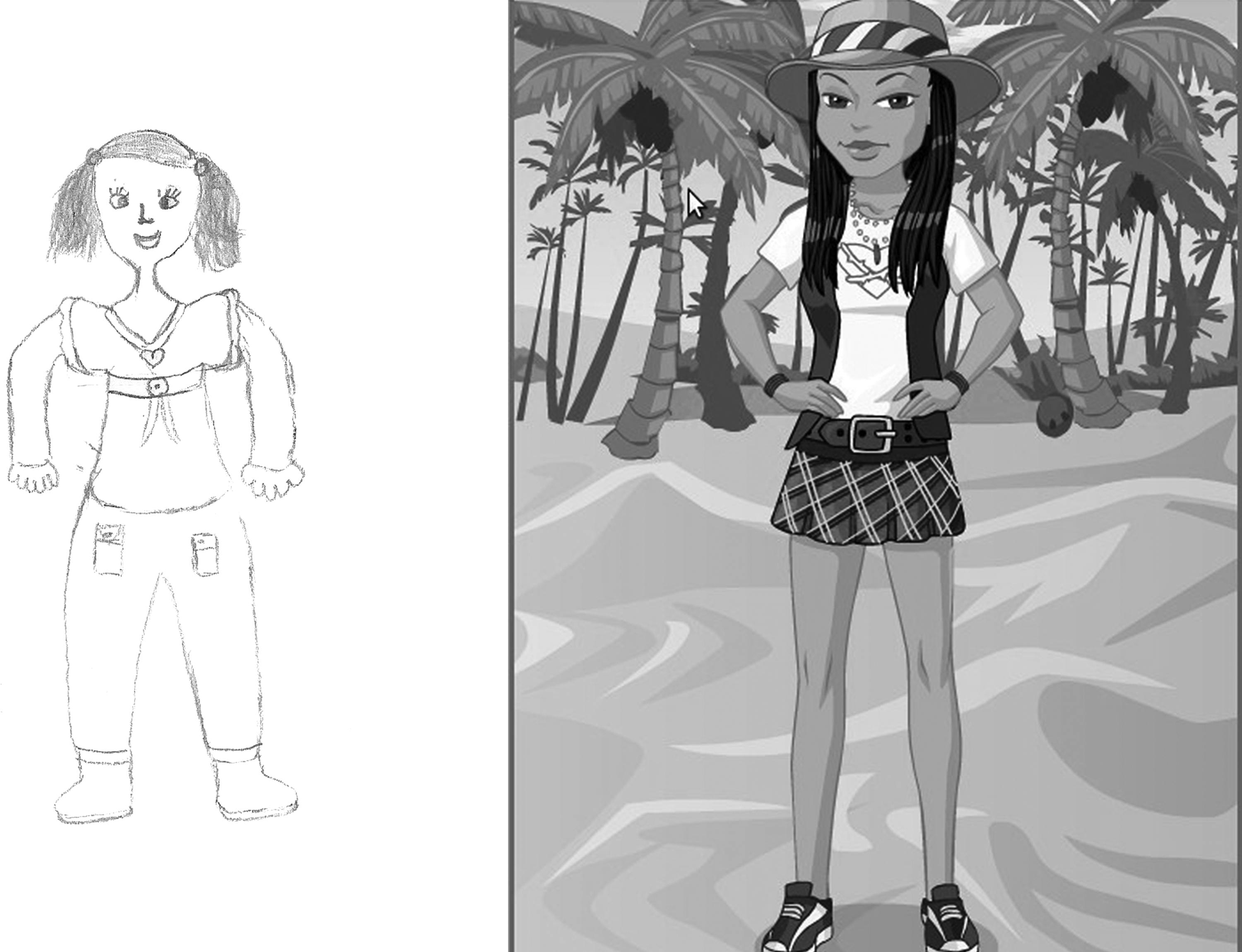
The results showed that it was easier to enrich the characteristics in a pre-existing figure. In particular, through the avatar, the adolescents marked sexual characteristics that were more hidden in drawings (see Figure 1).
Female drawing and female avatar (black and white version).
The scores of Figure 1, analyzed by using the Drawing Me test, are reported here as an example (Table 2). As stated earlier, the formal level was not assessed.
Figure 1
Sociocultural scores were analyzed by the Chi-Square Test, and differences between drawings and avatars were not so marked. The avatar was more stylish than drawings (χ2=10,877; d.f.=5; p=0.045), but the drawings were richer and of a fashion brand (Gucci, Dolce e Gabbana, Prada, Nike….) (χ2=4,064; d.f.=2; p=0.044).
Instead, the context of the avatars was more rich and complex (χ2=37,296; d.f.=4; p<0.001) with many elements of natural landscapes or family settings (school, gymnasium, and her/him bedroom).
Finally, while the Drawing Me figures appeared static, the avatar figures appeared dynamic and in move (17,529; d.f.=2; p<0.001).
Gender differences
As far as gender was concerned, a separate analysis was carried out for each group. For the Drawing Me differences, we found a tendency of significance in the subscale “face sexual characteristics” (F(1, 37)=1,741; p=0.053). Girls tended to draw more details in their drawings than boys.
For sociocultural categories, the principal differences appeared to be related to brand/fashion brand (χ2=4,447; d.f.=1; p=0.035) and to the presence of symbolic or ideological elements (χ2=4,918; d.f.=1; p=0.027), such as flags, peace symbols, and inscriptions with a message about their life. Boys preferred drawing the symbols about their team sport or being inspired by famous sporting personalities or singers.
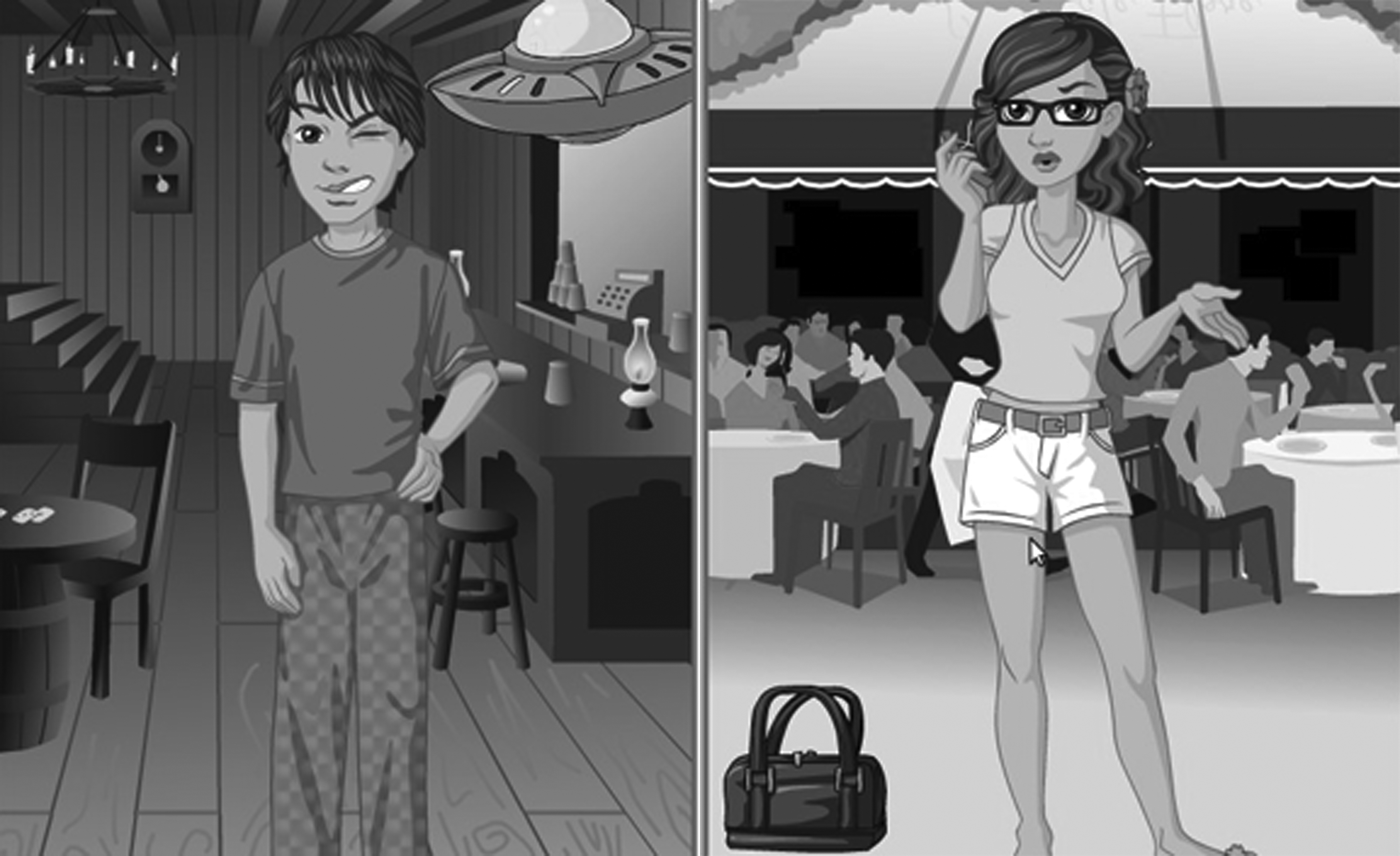
For the avatar-related differences, we found significant differences in body details subscale (F(1, 36)=6,892; p=0.013), face details (F(1, 36)=10,573; p=0.003), and body sexual characterization (F(1, 36)=9,653; p=0.014). Girls were more careful than boys (see Figure 2) in choosing both body and face parts and secondary sexual aspects.
Male and female avatar (black and white version).
Sociocultural categories confirmed the trends: girls obtained higher scores than boys related to brand (χ2=5,276; d.f.=2; p=0.022) and to the presence of objects in their figures (χ2=13,718; d.f.=6; p=0.033). The presence of a major number of objects in girls' drawings confirmed that the girls desire to embellish their figure to appear more attractive.
Discussion
Adolescence is a period of life with many important body changes determined by pubertal development. Although many studies underline the important role of gender in influencing body perception and satisfaction, only a few contributions have investigated the representation of the own body in the real and virtual world in adolescence.
According to previous studies,30,31 drawing analyses highlight some gender differences. In particular, girls are more concerned about their body; in fact, they use more body and face details, and they draw elegant clothes. On the other hand, boys pay more attention to body shape, making drawings characterized by a good proportion but with a few details, which are also related to their clothes.
Gender differences also emerge in avatar representation where girls include more sexual characteristics than boys. This result partially seems to be in contrast with Dunn's study, 20 but we have to consider that their study has been carried out on an adult population, and our study is focused on adolescents.
Significantly, the comparison between drawings and avatar supports the efficacy of the Drawing Me Test in analyzing the body representation in face to face and virtual contexts.
The principal difference found is related to the presence of more sexual features corresponding to body, face, and clothes in avatar, and we suggest two explanations. On one hand, it could be easier for adolescents to create an avatar than a drawing, because the web program gives the opportunity to choose among different features, such as context, objects, and elements from a group of fixed sets. Representing himself/herself on white and empty leaf could be more difficult, and this difficulty is caused by the pubertal development that modifies body shape, weight, and height, bringing about a great vulnerability in self and body representation. On the other hand, the avatar could be perceived more distant from the real body, leading the adolescents to feel free to add elements, in particular related to sexual characterization. The avatar represents a sort of adolescents' second body, and online, it becomes a tool to experience their self in a flexible way and create their own image. Through the avatar, the body representation seems to become even more “personalized,” and a “personalized” body is very important to reach a body identity that will be integrated into global identity at the end of adolescence. 32
The principal limitations of the study are that we did not collect anthropometrics measures as body mass index (BMI), weight, and height, which are useful to investigate the relationship between the BMI level and the accuracy of the drawings. Furthermore, the study lacks the quantitative data obtained by questionnaires measuring adolescents' body perception and personality factors such as self-esteem, which are considered important variables in body image studies.33,34
To conclude, our study illustrates that the Drawing Me test is an effective tool that analyzes the virtual body representation in an unobtrusive way. Nevertheless, if through the avatar researchers can investigate the important aspects of body representation, then it is important to consider that for adolescents, others' perceptions are critical, and this aspect could lead to modifying their virtual body and “self-presentation.”35,36
Future research could improve this explorative study by including anthropometric measures, body perception, and personality questionnaires, in order to consider the avatar from a multidimensional view.
Footnotes
Author Disclosure Statement
No competing financial interests exist.