




Abstract
Abstract
Internet addiction has been considered to be associated with poor impulse control. The aim of this study is to compare the trait impulsivity of those suffering from Internet addiction with that of individuals suffering from pathological gambling. Twenty-seven patients diagnosed with Internet addiction (age: 24.78±4.37 years), 27 patients diagnosed with pathological gambling (age: 25.67±3.97 years), and 27 healthy controls (age: 25.33±2.79 years) were enrolled in this study. All patients were men seeking treatment. Trait impulsivity and the severity of the Internet addiction and pathological gambling were measured by the Barratt Impulsiveness Scale-11, the Young's Internet Addiction Test, and the South Oaks Gambling Screen, respectively. The Beck Depression Inventory and the Beck Anxiety Inventory were also administered to all subjects. Our results show that those suffering from Internet addiction showed increased levels of trait impulsivity which were comparable to those of patients diagnosed with pathological gambling. Additionally, the severity of Internet addiction was positively correlated with the level of trait impulsivity in patients with Internet addiction. These results state that Internet addiction can be conceptualized as an impulse control disorder and that trait impulsivity is a marker for vulnerability to Internet addiction.
Introduction
Impulsivity has a range of definitions that include lack of planning or forethought, reduced perseverance, and seeking novel experiences. 10 Impulsivity is a trait that has often been related to addictive behavior. 11 Barnes et al., 12 Vitaro et al., 13 Moeller et al., 14 and De Wit 15 showed evidence that impulsivity is related to addictions to substance or behaviors (e.g., pathological gambling). Vitaro et al. 13 investigated whether the impulsivity of 12–14-year-olds could predict problem gambling in late adolescence and reported evidence in support of the DSM-IV classification of pathological gambling as an impulse control disorder. Goudriaan et al. 16 and Grant et al. 17 studied increased impulsivity in pathological gambling using neurocognitive tasks assessing impulsivity. Patients diagnosed with pathological gambling had longer reaction times on stop-signal trials in the stop-signal task, which is indicative of greater difficulties with regard to inhibiting the stop responses.16,17
With regard to impulsivity in Internet addiction, Cao et al. 18 examined the relationship between impulsivity and Internet addiction among Chinese adolescents. The authors showed that the Internet addiction group was more impulsive than the control group, as measured by both the Barratt Impulsiveness Scale 11 (BIS-11) and the Go-Stop impulsivity paradigm, supporting the classification of Internet addiction as an impulse control disorder. 18
Until now, there is no study about the impulsivity in Internet addiction by directly comparing it with that in pathological gambling. This study was performed to determine the degree to which the subjects diagnosed with Internet addiction, subjects diagnosed with pathological gambling, and healthy controls demonstrated trait impulsivity as measured by the BIS-11 and to examine the relationship between the severity of Internet addiction and the degree of impulsivity. Treatment-seeking male patients diagnosed with Internet addiction or pathological gambling were enrolled in this study.
We hypothesized that the subjects diagnosed with Internet addiction would show an increased impulsivity that was comparable to that shown by individuals diagnosed with pathological gambling.
Materials and Methods
Participants
Twenty-seven patients diagnosed with Internet addiction (age: 24.78±4.37 years), 27 patients diagnosed with pathological gambling (age: 25.67±3.97 years), and 27 healthy controls (age: 25.33±2.79 years) were enrolled in this study. All patients were treatment seeking, that is, they visited our clinics due to their suffering from Internet use or gambling-related problems; only male patients were enrolled, because the prevalence rate of excessive Internet use differs between men and women, and men are more likely to be problematic users of the Internet.19–21 We included homogeneous male subjects to control variables, affecting the impulsivity, such as gender and biological factors. 19 Patients were recruited from the outpatient clinics of the SMG-SNU Boramae Medical Center and the Kangbuk Samsung Hospital in Seoul, South Korea.
We assessed the participants using Young's Internet Addiction Test (IAT), 1 South Oaks Gambling Screen (SOGS), 22 Beck's Depression Inventory (BDI), 23 and Beck's Anxiety Inventory (BAI). 24 Young's IAT has been proposed by K.S. Young after the DSM-IV criteria for pathological gambling, and is commonly used in the world by investigators, the standardized scale in South Korea. In addition, we can assess the severity of Internet addiction using the total score of Young's IAT. SOGS is also the standardized scale in South Korea. The subjects with pathological gambling are classified by the scores of SOGS from level 1 to 3, not as a dichotomy. Therefore, we can evaluate the relationships between the impulsivity and severity of symptoms. The reasons behind the choice of BDI and BAI is to evaluate the anxiety and depressive symptoms in subjects with Internet addiction and pathological gambling to control the effect on impulsivity.
Previous studies have defined excessive Internet users as those with scores of at least 50 on the IAT.1,25 However, we included only subjects with scores of at least 70 on the IAT who also spent more than 4 hours per day and 30 hours per week using the Internet to collect the severe Internet addiction group, not the high-risk group with excessive Internet use. The mean score on the IAT obtained by patients in the Internet addiction group was 75.67±4.60. The mean number of hours of Internet use per day and per week in this group were 6.75±2.86 and 47.61±15.83, respectively. In addition, the Structured Clinical Interview for DSM-IV (SCID) 26 was used to identify the past and current psychiatric illnesses. Of the 27 patients diagnosed with Internet addiction, four fulfilled the DSM-IV criteria for depressive disorder. The main purpose of Internet use in all patients with Internet addiction was online gaming, and no patients used the Internet for online gambling. The diagnosis of pathological gambling was based on the SCID. 26 The diagnosis of pathological gambling was also defined for patients with an SOGS22,27 score ≥5. Out of the 27 patients diagnosed with pathological gambling, 15 were included in our previous report. 28 Healthy controls were recruited from the local community and had no history of any psychiatric disorder. Patients with pathological gambling and healthy controls used the Internet for less than 2 hours per day. All patients were drug naïve. The BDI 23 and the BAI 24 were administered to all subjects to measure depressed and anxious symptoms, respectively. The institutional review boards of the SMG-SNU Boramae Medical Center and the Kangbuk Samsung Medical Center approved the study protocol, and all subjects provided written informed consent before participation.
Measures
IAT
We used the Korean version of Young's IAT 29 to assess the severity of Internet addiction. Items in this test are rated on a five-point scale on which one indicates “very rarely,” and five indicates “very frequently.” Total scores were calculated according to Young's method, 1 and the possible scores for all 20 items ranged from 20 to 100.
SOGS
The SOGS consists of a 20-item questionnaire and is used to screen pathological gambling. Scores of five or more are considered indicative of pathological gambling.22,27 We used the Korean version of the SOGS. 27
BIS-11
We used the BIS-11 30 to measure impulsivity. The BIS-11 includes three subscales: cognitive impulsiveness, motor impulsiveness, and nonplanning impulsiveness. We used the Korean version of the BIS-11. 31
Statistical analysis
All statistical analyses were conducted with SPSS 17.0. Demographic and clinical data were compared using analyses-of-variance (ANOVAs) tests with Tukey's post hoc analysis. The correlation between IAT scores and clinical variables in subjects with Internet addiction was assessed using Pearson's correlation analysis. Statistical significance was set at the level of 0.05, which was two tailed.
Results
Demographic and clinical characteristics
Table 1 presents the demographic and clinical characteristics of the subjects. No significant differences in age or education were observed among the three groups. The three groups differed significantly in terms of BDI, F(2, 78)=22.27, p<0.01, and BAI, F(2, 78)=11.36, p<0.01, scores. Both the Internet addiction and pathological gambling groups obtained higher scores in the BDI and BAI than did the healthy controls (post hoc, p<0.01). The Internet addiction group was characterized by longer illnesses than was the pathological gambling group (p<0.01).
SD, standard deviation; IAT, Internet addiction test; SOGS, South Oaks Gambling Screen; BDI, Beck Depression Inventory; BAI, Beck Anxiety Inventory; BIS-11, Barratt Impulsiveness Scale 11.
Comparison of impulsivity among the Internet addiction, pathological gambling, and healthy control groups
We found significant differences among the groups with regard to total scores on the BIS-11, F(2, 78)=16.68, p<0.01, and scores on all three subscales: cognitive impulsiveness, F(2, 78)=6.68, p<0.01, motor impulsiveness, F(2, 78)=17.12, p<0.01, and nonplanning impulsiveness, F(2, 78)=14.01, p<0.01. The post hoc analyses revealed that both the Internet addiction and pathological gambling groups obtained higher total scores and higher scores on the three subscales than did the healthy controls (p<0.01). To control the effects of depressive mood and anxiety, we reanalyzed the ANOVA treating the BDI and BAI as covariates. Significant differences were observed among three groups with regard to scores for motor impulsiveness, F(2, 78)=4.75, p=0.01. The post hoc analyses revealed that both the Internet addiction and pathological gambling groups obtained higher scores for motor impulsiveness than did the healthy control group (p=0.01 and p=0.02, respectively). Furthermore, we conducted a regression analysis to evaluate how much more likely it is to develop impulsivity in subjects with Internet addiction and pathological gambling than in healthy controls. Each of the Internet addiction and pathological gambling groups showed significantly higher impulsivity compared with the healthy control group (β=16.89, confidence interval (C.I): 12.49∼21.30, p<0.01; β=15.68, C.I: 12.49∼21.30, p<0.01, respectively).
Relationship between severity of Internet addiction and impulsivity in the Internet addiction group
We conducted Pearson's correlation analysis to examine the relationship between the severity of Internet addiction and the impulsivity in patients with Internet addiction. We found that scores on the IAT were positively correlated with total scores and scores on the three subscales. All correlations demonstrated a statistical significance (p<0.05). Figure 1 shows the relationship between the severity of Internet addiction and total scores on the BIS-11 in patients with Internet addiction.
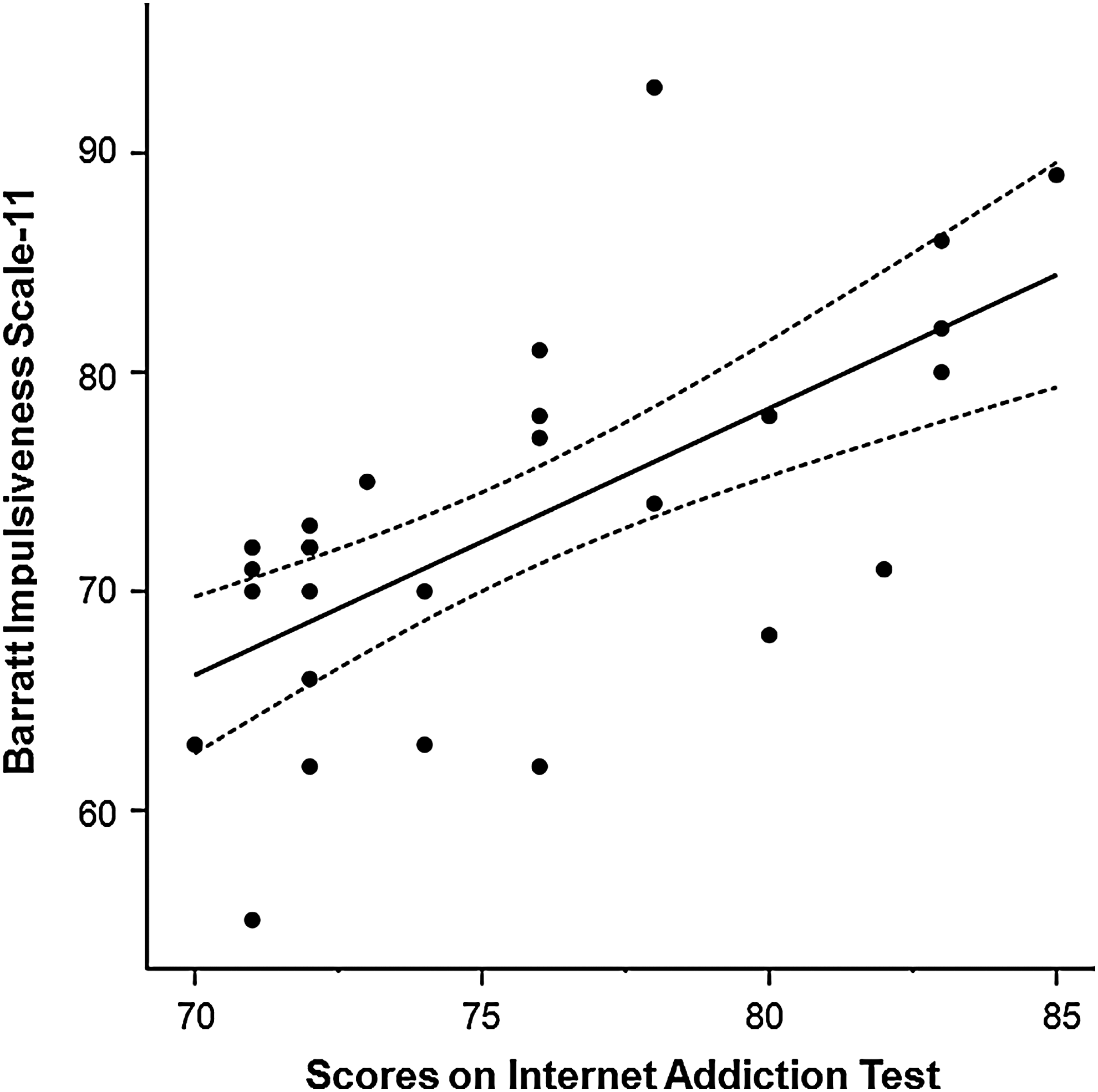
Correlation between the severity of Internet addiction and the level of impulsivity (total scores on Barratt Impulsiveness Scale-11) in the Internet addiction group (r=0.64, p<0.01). Solid line is the best fit line (r=0.64, p<0.01), and dashed line means a 95 percent confidence interval.
Discussion
The present study compared the trait impulsivity, as measured by the BIS-11, of individuals diagnosed with Internet addiction with that of individuals diagnosed with pathological gambling from the perspective of considering Internet addiction to be an impulse control disorder. We found that the Internet addiction group showed increased levels of trait impulsivity that were comparable to those observed in patients with pathological gambling. In addition, the severity of Internet addiction was positively correlated with the level of trait impulsivity in patients diagnosed with Internet addiction. To our knowledge, this is the first study that measures trait impulsivity in treatment-seeking patients with Internet addiction and compares these results with those obtained from patients with pathological gambling and healthy controls.
Impulsivity has been addressed as an endophenotype of individuals at risk for developing addictions, including substance use disorders and pathological gambling. 10 In particular, trait impulsivity, which refers to an enduring personality characteristic, has been reported to be a marker of susceptibility to pathological gambling. 32 Trait impulsivity has also been associated with Internet addiction. 18 Cao et al. 18 reported that impulsivity was positively correlated with Internet addiction, supporting the hypothesis that impulsivity is a risk factor for developing Internet addiction. Park et al. 33 reported that those who overused Internet games showed greater impulsivity than did normal users, and noted a positive correlation between the severity of the overuse and impulsivity. Those who overused Internet games had abnormal glucose metabolism in the brain regions associated with impulse control, suggesting that overuse of Internet games shares psychological and neural mechanisms with other types of impulse control disorders and addictions. 33 Based on previous reports, Internet addiction has been considered an impulse control disorder. Our current findings also indicated that patients diagnosed with Internet addiction were characterized by higher levels of trait impulsivity than were healthy controls and by levels of trait impulsivity which were comparable to those of patients diagnosed with pathological gambling. This study may be interpreted as a confirmation of the construal of Internet addiction as an impulse control disorder.
The Internet addiction and pathological gambling groups in this study showed increased depressed and anxious symptoms. Four patients with Internet addiction also had a diagnosis of depressive disorder. Indeed, depression has been reported to be associated with Internet addiction.34–38 Depressed individuals may rely on the Internet as a way of coping with their depressive state. When we controlled for the effects of depressed and anxious symptoms on Internet addiction and impulsivity, the Internet addiction group demonstrated increased impulsivity, especially motor impulsiveness on the BIS-11. The significant correlation between the severity of Internet addiction and impulsivity also remained. These findings suggest that the higher trait impulsivity in the Internet addiction group may be independent of mood state.
This study has several limitations. First, the sample size was small, and only male subjects were included; thus, the generalization of the results may be limited. Second, this study is a case-control study design that has limitations in showing the correlations between impulsivity and clinical psychiatric symptoms. However, we included drug-naive patients, and it is important to recruit a homogeneous sample to control for confounding factors such as medication and gender effects. Furthermore, we included treatment-seeking patients, and diagnoses were made by psychiatrists to accurately identify individuals with pathological Internet use or gambling. Future studies should use larger samples as well as longitudinal study design to investigate the neurobiological markers associated with impulsivity among those diagnosed with Internet addiction.
Conclusion
The present study found that treatment-seeking patients diagnosed with Internet addiction showed increased trait impulsivity as measured by the BIS-11 and that their levels of trait impulsivity were comparable to those of patients diagnosed with pathological gambling. We also found a significant positive correlation between the severity of Internet addiction and the level of impulsivity. These results provide evidence that Internet addiction can be conceptualized as an impulse control disorder and that trait impulsivity is a marker for vulnerability to develop Internet addiction.
Footnotes
Author Disclosure Statement
The authors have no conflict of interest.