




Abstract
Abstract
The use of social networking sites (SNSs) has proliferated throughout the last several years for all populations, but especially adolescents. Media reports have also identified several instances in which adolescents broadcast their suicidal behaviors via the Internet and/or SNSs. Despite the increase in the usage of SNSs, there has been little research conducted on how adolescents use SNSs to communicate these behaviors. The objective of this study was to explore the ways in which adolescents use MySpace to comment on their suicidal thoughts and intentions. Content analysis was used to identify suicidal statements from public profiles on MySpace. The original sample consisted of 1,038 comments, made by young people ages 13–24 years old. The final sample resulted in 64 comments, where Potential Suicidality was identified. Through content analysis, the following subthemes (within the Potential Suicidality theme) were found: Relationships, Mental Health, Substance Use/Abuse, Method of Suicide, and Statements without Context. Examples and discussion for each subtheme are identified. The comments referenced a significant amount of hopelessness, despair, and desperation. This study provides support that adolescents use public Web sites to display comments about their suicidal thoughts, behaviors, and possible intentions. Future research is warranted to explore the relationship between at-risk behaviors and suicidality as expressed on SNSs.
Introduction
Adolescents and social networking
Boyd and Ellison 10 define a SNS as “web-based services that allow individuals to (a) construct a public or semi-public profile within a bounded system, (b) articulate a list of other users with whom they share a connection, and (c) view and traverse their list of connections and those made by others within the system.” SNSs allow users to create and post profiles, upload pictures and videos, network and communicate with friends, and write blogs. Lenhart and Madden 7 found that 55 percent of adolescents who are online use a SNS, with girls using these sites primarily to reinforce existing friendships and boys using the sites mostly to make new friends and flirt.
While SNSs may provide ways to stay connected with a network of friends, they may also provide individuals a place to present ideas, feelings, and moods that are uncomfortable to share in-person, including self-harm or suicidal thoughts.11–13
SNSs and at-risk behaviors
Adolescents use SNSs to display at-risk behaviors, including sexual behavior, violence, and substance use. Moreno et al. 14 examined the display of at-risk behaviors on adolescent's MySpace profile pages. They found that of a total of 500 publicly available MySpace profiles for 18-year olds, 54 percent contained at least one high-risk behavior, with 24 percent referencing sexual behaviors, 41 percent referencing substance use, and 14 percent referencing violence. In their 2010 study, Moreno et al. 15 used content analysis to identify references to alcohol use. They found that 56 percent (out of 400 profiles of 17–20-year olds living in one Washington county) had references to alcohol use, more frequently made by males (54 percent) who were white (70 percent). Moreno et al. 16 conducted focus groups to explore reasons why adolescents use SNSs to display alcohol references, finding that adolescents posted these references to look cool, therefore providing some level of social gain among their peers.
The research on adolescents' use of SNSs to display at-risk behaviors is increasing; however, we know very little about their display of suicidal thoughts or intentions on these sites. The purpose of this study is to explore the content of suicidal statements available on MySpace public profiles of adolescents aged 13–24 years old. The findings from this study can be used to inform health and mental health professionals about how adolescents have used SNSs to communicate their suicidal thoughts and intentions and possibly develop interventions that use this type of technology.
Methodology
Setting
MySpace (
Institutional review board
The Institutional Review Board (IRB) at the Ohio State University was consulted on the project and whether or not the project met the exemption guidelines. Moreno et al., 17 discussion of research ethics and their application to research on SNSs was also used as a guide for conducting this research. The study met the criteria for exemption for the following reasons: (a) all data were collected from publicly available profiles on MySpace; (b) data were downloaded using an algorithm and no specific identifying data were collected (e.g., name, address, and contact information); (c) the study was observational and no participants were ever contacted; (d) no identifying data were included in the dataset; (e) any names included in the sample quotes were changed; and (f) the specific quotes were altered slightly to ensure that the commenter could not be identified using a search engine.
Data
Data were collected from publicly available profiles and their respective comments on MySpace (
To find the subjects, MySpace profile owners were selected if they:
(a) gave the US as their location (b) had a public profile (c) were not self-identified as musicians, comedians, or movie makers (d) had 2-1000 friends and, hence, were probably active normal members.
After the MySpace profile owner's profile pages were identified, all publicly available comments on their MySpace profile page were downloaded. The data were then parsed based on a set of comments that had suicidal language (see Fig. 1).
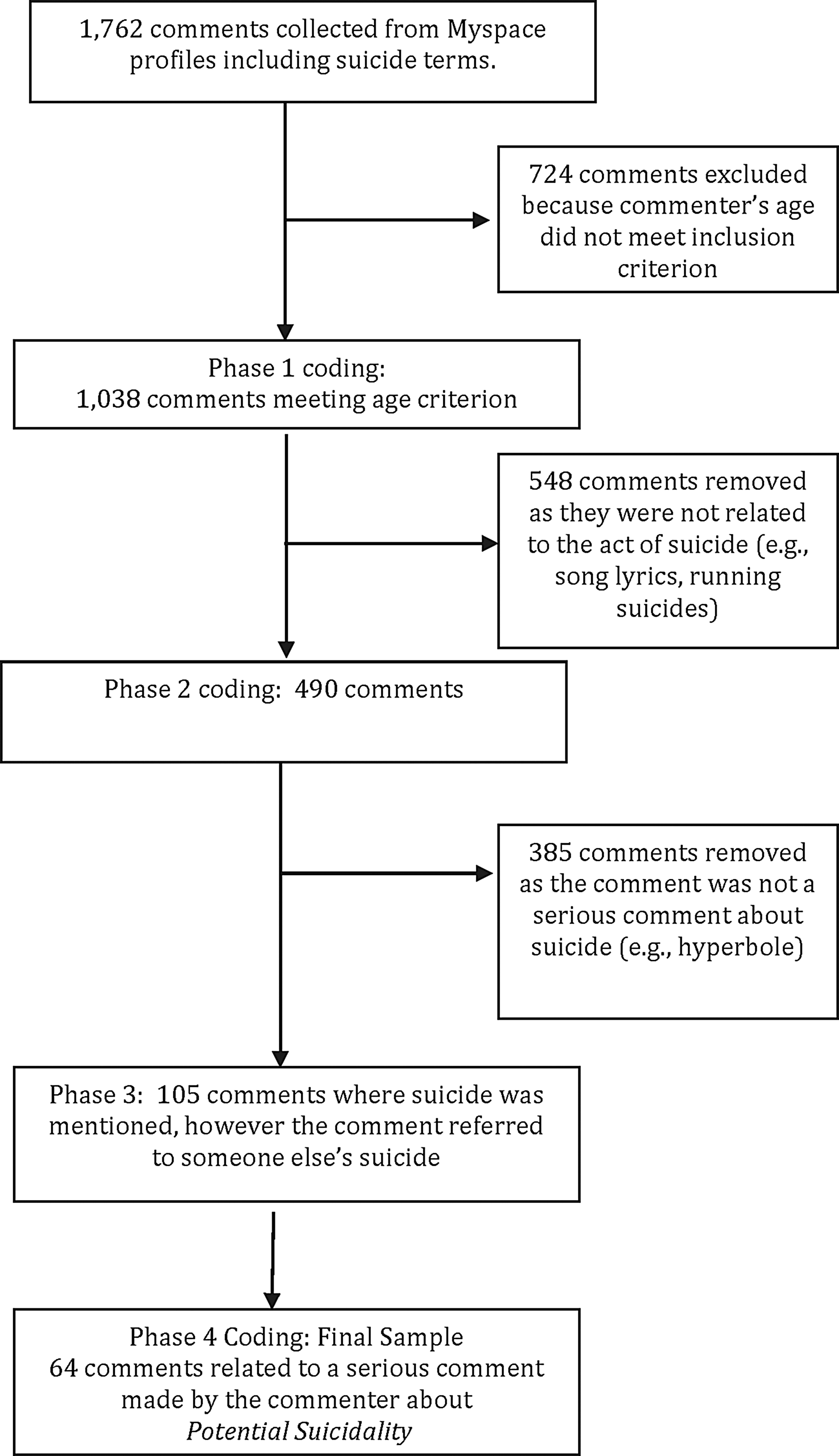
Sample selection process.
Search algorithm
The downloading of profiles was undertaken automatically using purpose-built software and the downloading of comments was achieved semiautomatically using purpose-built software. Data set 1 originated with a list of 40,000 public MySpace profile IDs from about 51,000 in steps of 5,193 representing a systematic sample of members with various joining dates up to July 3, 2006. Data from the profile page of each member was downloaded during March 3–4, 2008, and the declared country of origin extracted as well as the number of friends of each member.
Waves of data
The selected subset was downloaded again in December 2008 and a further subset of comments was selected of those who had received ≤4,000 comments and still had a public profile. For this subset, all comments received by each individual were extracted. For each MySpace profile downloaded as above, one commenter was selected at random, if any existed, that is, one person who commented to the member. All comments made to this commenting friend were then extracted as long as they
(a) had a public profile (b) did not self identify as a musicians, comedians, or movie makers (c) had received ≤4,000 comments.
Commenters failing this test were rejected and another commenter selected instead until a valid commenter was found or all commenters had been checked. Musicians, comedians, and or movie makers were excluded from the sample as their profile pages did not necessarily represent one person commenting to another person. In addition, the comments on their pages may have discussed suicide in terms of media (e.g., songs, movies, etc.) rather than actual comments about suicidal behavior. A person also had to have fewer than 4,000 comments, as we found that the profiles where there were more than 4,000 comments often represented a professional user of MySpace rather than an individual making comments to other individuals. The final raw data set used was a collection of all comments extracted by the above process.
List generation process
A list of phrases that included some reference to potential suicidal behaviors was collected from public posts on the Suicide Forum Web site (
The suicideforum.net Web site was chosen as a source to identify common phrases used to indicate potential suicidality for several reasons. First, the forum is open to the public. Second, since the forum was designed for people who are seeking information or help about suicide, the forum seemed like a logical choice and met the needs of the project. Third, collecting the phrases on the site did not violate the forum's policies on site usage. Specifically, the site, at that time, posted their policies stating that forum could not be used as a mechanism to solicit information from the individual users for research and/or educational projects. This allowed the researcher the opportunity to collect only information on suicidal language without ever having to contact the individuals directly or collect identifying information. Finally, the suicideforum.net has moderators who monitor the forums to help identify individuals who are posting statements specifically related to potential suicide intentions. Generating a suicide-specific list of phrases was necessary to create a systematic way to identify publicly available comments that included a reference to potential suicidal behavior.
Once the list of phrases was generated, the list was then used to parse the dataset for comments matching one of the phrases (see Table 1); these comments were selected for inclusion in the study.
Suicide Phrases are based on key phrases identified from
Other data extracted included the age of the commenter and the commentee, based on the age identified in the person's profile. These data were adjusted to reflect their age at the time that the comment was made, instead of the age at the time of the data download. The ages are based on the self-reported age recorded in the profile and are estimates since dates of birth were not available. Data on the commenters gender was also extracted when the profile included this information.
In total, over two million comments were extracted from MySpace to be searched for suicide-related comments. The use of four different data sets controlled for differences between MySpace members joining at different times.
Sample
The unit of analysis for this study is the individual comment level. Comments with one of the suicide phrases were selected for analysis (see Tables 1 and 2). Table 2 provides support that the list of suicide-related phrases were useful in parsing the data as there was at least some representation of all of the individual phrases in the total sample. Not surprising, the phrases that had the highest frequency were “suicide” (29.4 percent), “kill myself” (24.4 percent), and “be dead” (16.6 percent). The phrases with the lowest frequency (<0.1 percent) were “go to sleep forever,” “better off dead,” “better off without me,” “tired of living,” and “don't want to be here.”
Matching text is based on suicide phrases from
The data structure and methodology used to extract the data from MySpace limited the ability to group comments by sender. For the majority of the comments, the age of the person making the comment (commenter) and the self-declared age of the person receiving the comment (commentee) were automatically extracted from MySpace. The initial dataset included 1,762 comments with ages of the commenter and/or commentee ranging from 13–35. After applying the criterion for the commenters age (13–24-year olds), the sample size was reduced to 1,038 comments. Table 3 provides a description of the ages for the total sample.
Sample reduction process using themes
The sample was reduced in four phases, using an initial coding scheme. All 1,038 comments were coded using the themes and corresponding operational definitions (Table 4). (Note: see the Coding section for more details about coding procedures).
After Phase 1 coding, the sample was reduced to 490 comments, removing comments unrelated to suicidal behaviors (e.g., a song lyrics, running suicides; see Table 5). During Phase 2 coding, the sample was reduced to 105 comments by removing comments that did not reflect serious/potential suicidal behaviors. The criteria for including a comment that reflected a serious/potential suicidal behavior included: the comment could not be characterized as hyperbole, the comment included words that are associated with suicidal behaviors, and/or the comment did not have enough context to rule out that it was not serious. Phase 3 coding removed comments that still included potential/serious suicidal behaviors; however, these comments referred to someone else's suicidal behaviors, not the commenters. After Phase 4 coding, the sample included only serious comments about the commenter's Potential Suicidality (n=64).
Minor changes have been made to the quotes so that the commenters cannot easily be identified through search engines.
Table 6 provides the percentages for matching suicide phrases for only the Potential Suicidality sample. The percentages of matching suicide phrases were somewhat different for this subsample as compared to the total sample. For example, the phrase “kill myself” was present in 51.6 percent of the matched phrases for the Potential Suicidality sample, whereas it was only present in 24.4 percent of matched phrases in the total sample. The phrase “want to die” was identified for 15.6 percent of the Potential Suicidality sample as compared to 10.2 percent of the total sample. The phrase “suicide” was used more in the total sample (29.4 percent) as compared to the sample of Potential Suicidality comments (14.1 percent).
Matching text is based on suicide phrases from
Sample characteristics
Limited demographic data were available for the sample characteristics of the Potential Suicidality sample. Forty percent of the samples were female, 37.5 percent were male, and 21.9 percent gender were unknown. Table 7 provides a distribution of the age of the commenter for those included Potential Suicidality subsample. Approximately, half of the Potential Suicidality sample (46.9 percent) was between the ages of 13 and 17.
Analyses
Content analysis was the analytical method used to generate themes. Content analysis allows for constant comparisons between different data points with the overall goal of developing themes (to saturation) to understand meaning from text.24–26 Content analysis also provided a mechanism for providing counts and frequencies on the themes.
Coder training
Two researchers conducted the data coding process. Themes were generated until there was saturation. As new themes were identified, we created an operational definition to assist with consistency throughout the process (see Table 4 for themes and corresponding operational definition). Inter-rater reliability was assessed by having the two coders individually code the first 50 comments, and then the coders discussed the assigned code for each comment. The inter-rater reliability on the first fifty comments resulted in a 95 percent theme agreement. Disagreements on assigning the theme to a particular comment were discussed before a theme was assigned to the comment. Throughout the coding process, when either researcher was unsure about how to code a specific comment, the researchers discussed the comment and arrived at a mutually agreed upon theme. Some of the comments had aspects of several of the subthemes; when this occurred, the coders discussed the comment and decided on the primary theme in the comment. Once the initial coding was completed, one of the researchers reviewed each code to ensure the consistent coding throughout the analysis.
Results
Within Potential Suicidality, comments were coded to identify more specific themes that provide additional information on the types of comments made by users who are expressing serious and potential suicidal behaviors. All results are presented only for the Potential Suicidality sample. Samples of comments for the themes with Potential Suicidality are presented in Table 5. The presentation of these sample comments is based on a content analysis framework previously used, 15 in a study, 14 to examine statements made on profiles from MySpace.
Table 8 provides the frequencies of each subtheme within Potential Suicidality.
Unknown context
A little over half of the comments (33/64; 51.6 percent) did not include any specific reference to the context in which the persons were writing about. Within this theme, the commenter only indicated a desire to die or kill themselves. A few comments reflected a previous attempt and/or previous thoughts of suicide.
Relationships
The Relationships subtheme had the most prevalent representation (n=27; 42.2 percent) in the data. In 20 percent of the sample, the type of relationship the young person was referring to in the comment could not be determined. When the type of relationship was identified, young people were most affected by break-ups (15.6 percent). The relationship comments, in general, reflected desperation stating that they cannot live without the person or within the situation. Some comments also reflected the commenter's sense of not feeling loved.
Mental health and substance use
Four comments (6.3 percent) were coded as a mental health/substance use. The comments were revealing in terms of the commenters' acknowledgement of having a mental illness (e.g., depression, anxiety, etc.) and/or a mental health treatment facility hospitalization. One commenter also mentioned being in a drunken haze. The comments within this theme reflected a sense of worthlessness, hopelessness, and that life did not matter.
Method of suicide
Within some comments, the person indicated that he/she was thinking about suicide and they identified a particular method to commit suicide. Some comments were specific in identifying an actual plan. The three methods identified included shooting oneself with a gun (n=2) using a knife (n=1), or stepping out in front of a car and using a knife (n=1). The majority of comments did not identify a method.
Multiple themes
One comment included two themes: mental health and a relationship break-up. This person wrote that he/she was recently released from a mental hospital for cutting and suicidal thoughts and they were also going through a break-up.
Bivariate analyses
Additional analyses explored the relationship between age and theme and gender and theme. Table 9 presents the findings from a crosstab using a Fisher's Exact Test comparing age (13–18 vs. 19–24) on the type of theme. The percentage of themes without context was similar for both groups (13–18, 51.4 percent; 19–24, 51.9 percent). There were differences, within the relationship theme; however, these were not statistically significant. The 13- to 18-year olds had higher frequencies of comments regarding relationships with unknown context (24.3 percent) as compared with 19–24-year olds (14.8 percent). The 19–24-year olds identified family relationship problems in 11.1 percent of comments compared to 0 percent for 13–18-year olds.
Table 10 provides a comparison of males and females on the Potential Suicidality subthemes. A crosstab with a Fisher's Exact Test was used to test for differences. Comments made by males, on the whole, had no context (62.5 percent). The highest percent of comments made by females were 38.5 percent no context and 30.8 percent were coded as relationship, but unknown. The differences between the two groups were not statistically significant.
Discussion
The results of this preliminary study document the existence of serious suicidal comments on MySpace pages. The majority of comments had no context. Forty two percent of comments, however, had content that was related to a relationship. The suicidal statements regarding relationship problems were most prevalent for break-ups, followed by family relationship, and a few related to friendships. Interpersonal conflict or loss and family discord are common precipitants of suicidal behavior and suicide in young people.27–29 The present results suggest that adolescents may use SNSs to reach out for help and support. However, our data cannot disentangle whether comments posted on MySpace received a response, and if so, the nature or content of those responses.
Approximately, 6.3 percent of suicide statements on MySpace involved references to mental health problems (mostly depression) with one comment that included a brief mention of substance use. Mood disorders and alcohol/substance are risk factors for suicide and attempted suicide in adolescents. 30 The relatively small percentage of comments that included mental health references was not all that surprising, since we are not sure if the individuals making the comments were aware of their mental health status and/or if this is something that they are willing to disclose. Moreno et al., however, have found that SNSs, like MySpace and Facebook, provide a venue for adolescents to talk about sensitive or stigmatizing behaviors.31,32
A relatively small percentage (6.2 percent) of suicide statements on MySpace pages described specific methods of suicide within the context of other themes. Specifically, the comment included references to using a knife when a relationship theme was also identified. One person indicated that he/she would step into the road to be hit by a car or would use a knife to cut their throat. A gun was mentioned as a method of suicide within the context of a relationship break-up. Finally, one comment referenced using a gun as a method, but there was no additional context provided.
Limitations
This study has several potential limitations. First, data were collected from only one SNS, MySpace. MySpace at this time is struggling to regain its presence on the Internet. Second, the nature of the comment and whether or not it was considered serious is based on a determination made by the two coders rather than an objective measure. The number of comments that were coded as serious suicide comments was significantly large, which made it necessary to only focus on one subset of the theme, Potential Suicidality despite the fact that many other themes were represented. Finally, the lack of complete demographic data makes it difficult to accurately describe the sample and generalize the findings, and it also limits the ability to look at associations between demographic variables and suicide-related comments.
Implications
These limitations notwithstanding, the findings in the present study and media reports suggest that adolescents do use SNSs to discuss suicidal thoughts and intentions. The blending of computer science with social science may provide a unique opportunity to develop ways of identifying at-risk adolescents using computer algorithms to identify the comments and social scientists to provide context. However, as Boyd et al. 33 argue, simply using algorithms to identify self-harm or other risk behaviors is not enough; it is necessary to identify both positive and negative instances of behaviors as online communities may serve as its own risk factor or as prosocial support. Boyd et al. 33 write “in moving forward to address problematic self-harm content—and youth-generated problematic content more generally—we must begin embracing visibility, both as a source of information from which we can learn and as a potential channel through which we can engage.”
Partnerships between researchers and SNSs would require sites to allow researchers access to the profile data, which may prove controversial given concern for privacy. However, this should not stop conversations between social network sites and researchers. Alternatively, with the proliferation of Facebook, researchers and practitioners could employ creative approaches for reaching out to adolescents. One research option would be to recruit participants directly from the advertising section of Facebook, asking adolescents to participate in studies on mental health31,32. Another option is for practitioners to design advertisements that inform individuals of options for mental health or substance use assistance. 32 Moreno et al. 32 argue that “given the frequency and consequences of depression as well as the inadequacy of current help-seeking among college students, innovative methods to identify those at risk and provide them appropriate services are warranted.”
Facebook and Google have both created a mechanism to provide information on suicide support options (e.g., international hotline numbers). For example, if a person types suicide into Facebook's help field, then a list of suicide prevention hotlines are provided to the user. Google has a slightly different approach, where if a person searches on keywords related to suicide, the search results page lists as its first item a red telephone, with a phone number to the National Suicide Prevention Lifeline.
Foundations, organizations, and support groups are also trying to harness the power of SNSs to connect with people who need support. For example, Inspire Foundation USA and their counterpart,
Other suggestions include using online groups to help increase positive social support systems, while reducing the impact of negative social interactions 34 and to explore common risk factors for suicidal behaviors, substance use, sexual displays, and violence to better target individuals and interventions.33,35 It is vital that we continue to try to understand youth and the multitude of ways in which they convey their feelings and make cries for help. As we learn more, we will be able to utilize this information to reach out to them and help them in ways that make sense to them.
Footnotes
Acknowledgments
The authors would like to thank Dr. Megan Moreno for her comments and feedback on an earlier version of this manuscript.
Author Disclosure Statement
No competing financial interests exist.