




Abstract
Abstract
This study aims to propose an integrated model of smartphone adoption that incorporates social influences (SIs), perceived technicality, as well as hedonic and utilitarian attitudes into the technology acceptance model. The proposed model was empirically evaluated by using survey data collected from 239 Korean college students to investigate their perception and attitudes toward smartphone adoption intention. Our results show that users' attitudes and their adoption intention are highly influenced by SI and positive self-image. This implies that a smartphone is a symbolic product that can signal affiliation and enhance the users' status in a group. The results also indicate that hedonic enjoyment is equally important as utilitarian usefulness in predicting the adoption intention, and the two variables mediate the relationships between SI, positive self-image, perceived technicality, and the intention to use. Consequently, the results reveal that smartphones are convergent media that can be viewed as both task-oriented and entertainment-oriented devices.
Introduction
TAM has been widely used to explain the adoption and use of information and communication technologies (ICTs). The model was originally designed for task-oriented information devices at work. Therefore, it validates the adoption decision of ICTs as rationally driven rather than emotionally or socially driven. 2 However, as newly emergent ICTs have been equipped with functions and features that fulfill various dimensions of the human need for information, communication, and entertainment, the adoption and use of convergent media have been inextricably linked to both rational and emotional decision-making processes. As a result, the original TAM has been considered inadequate for identifying the adoption and use of the convergent media motivated by entertainment or social networking needs. 3
Recent studies have also attempted to reveal the cognitive process underlying convergent media adoption by analyzing the influence of either social influences (SIs) or technical features of the convergent media. Some propose that the advanced technicality embedded in new convergent media mediates the influence of TAM components on the adoption intention. 4 On the other hand, others focus more on SI and self-image that may directly or indirectly influence the adoption of the convergent media.5–7
However, despite such academic efforts, their findings are still not fully incorporated into an integrated TAM for convergent media. Therefore, from the integrated perspective, this study aims to suggest an extended TAM for convergent media by including aspects of a user's perceptions and attitudes toward smartphones. The main purpose of the study is to examine the relative extent to which hedonic enjoyment and utilitarian usefulness influence one's intention to adopt a smartphone. Particularly, this study suggests that the effect of factors, such as SI and advanced technicality, are mediated through hedonic enjoyment and utilitarian usefulness. Investigating the pathways of intention to use through hedonic enjoyment and utilitarian usefulness, this study attempts to propose an extended TAM for smartphone use.
An Extended TAM for Smartphone Use
Early TAM studies assumed that the adoption decision of ICTs is determined mostly by a cognitive cost-benefit analysis of its productivity 8 : mobile phones,9–11 mobile TV, 12 and computer software.13,14 However, with the diffusion of personal devices for social networking and entertainment, TAM needs to be extended to include hedonic aspects, such as leisure, enjoyment, aesthetics, and pleasure, as reasons for using ICT devices.3,15,16 For example, Van der Heijden 17 suggested that utilitarian usefulness can be a weaker indicator than hedonic enjoyment to predict the adoption of personal devices and services, such as video games, the Internet, and informational devices used at home. His suggestion implies that the adoption decision of these personal devices could be more driven by motivations for the senses of pleasure and relaxation.
Thus, the adoption and use of smartphones seems to be driven by dual properties of hedonic and utilitarian dimensions. In other words, it is not only a task-oriented device for productivity but also an entertainment-oriented device designed for pleasure.18–20 People tend to become emotionally driven in seeking fun, enjoyment, and sensory stimulation when using a smartphone for entertainment and pleasure, whereas they are more likely to be rationally driven to analyze cost benefits based on its functionality when using smartphones for work. In this sense, this study assumes that the differential aspects (or duality) of smartphones influence an individual's adoption intention simultaneously. This assumption leads to the first hypothesis of this study:
Perceived eases of use (PEOU) as an intrinsic property of technology has always been an important factor in the diffusion of innovation because perceived complexity has a negative impact on one's intention of adopting it. 21 Therefore, in regard to the traditional TAM-based utilitarian approach, PEOU used to be considered as a strong indicator of perceived usefulness and the user's adoption intention of task-oriented devices.10,11,19,22 However, with the emergence of many information and entertainment devices based on highly advanced technology, various technological attributes, such as instant responsiveness, user controllability, and ubiquitous connectivity, are now becoming important in determining a user's attitude and the intention to use. 4 Thus, along with PEOU, the high technicality of convergent media, such as perceived responsiveness and ubiquitous connectivity, should be regarded as being associated with utilitarian attitudes toward adoption and use.
The enhanced functionality of smartphones (i.e., ease of use, responsiveness, and ubiquity) can presumably extend the scope to use from utilitarian purposes to hedonic enjoyment. Several recent studies on multipurpose information systems have found that high technicality has a significant influence on not only usefulness but also enjoyment because using a high-tech product offers a pleasurable experience, in addition to utilitarian benefits.17,19,23 The advanced technicality of smartphones enables users to easily connect to the web and affords them more flexibility traversing across time and space for the use of content and its transmission. Such functional attributes allow users to perceive the intensive accessibility and availability of smartphones, eventually leading to positive effect of user's attitudes toward the utilitarian and hedonic values of smartphone. Thus, integrating the fragmented findings from literature, it can be assumed that there are some causal relations between perceived technicality, utilitarian usefulness, hedonic enjoyment, and the intention to adopt and use multipurpose information systems like smartphones in an integrated way.16,24 To examine how these factors have causal relations with utilitarian usefulness and hedonic enjoyment in smartphone use, we derive the following hypothesis:
Basically, SI means that the referents deemed important by individuals play a significant role in the individuals' normative control regarding behaviors. 25 If one observes that their significant others own and use a new technology, then they may be influenced by their social relations and thus develop a positive perception and attitude toward adopting the technology. 2 In another sense, SI is also assumed to indirectly and directly influence perceived enjoyment and usefulness through self-image, which is affected by the association with a reference group.2,6,26 SI and positive self-image are more likely to be strongly significant in determining the adoption decision of mobile device, because mobile devices are mainly used for maintaining social relations between close personal contacts.5,27 We therefore propose the following hypotheses:
Generally, people seek more fun, enjoyment, and sensory stimulation in using the devices and services that are hedonic in nature, whereas they seek more rational benefits in using the devices and services that are utilitarian in nature.8,15 Many market experts argue that smartphone use for leisure and pleasure is likely to gain more popularity than that for task-oriented productivity.28–30 For instance, recent findings from The Pew Research Center's Internet and American Life Project showed that smartphone users ascribed hedonic attributes to their phones, using emotional words, such as “good,” “great,” and “excellent,” rather than rational words signifying utilitarian values, such as “useful,” “convenient,” and “necessary.” 31 Therefore, smartphones as a convergent media cannot be conclusively linked to either attribute. Rather, they can be defined as task-oriented devices used for productivity as well as entertainment-oriented devices used for pleasure, thus influencing a user's adoption decision through emotional and rational reasons. Thus, we assume that hedonic enjoyment and utilitarian usefulness simultaneously mediate the associations of SI, self-image, and technicality involved in the behavioral intention to use smartphones. The assumed mediating roles of usefulness and enjoyment have been supported by literature on other personal devices and services: PEOU of a movie Web site 17 ; interactivity of Smart TV 24 ; and SI of group interaction services, Push to Talk, 26 led to utilitarian usefulness and hedonic enjoyment as mediators of the intention to use. Given the findings in prior research, we suggest the following hypothesis:
Data Collection and Measurements
To test the model, a web-based survey was conducted among undergraduate students in several universities near metropolitan areas in Korea and a total of 239 responses were gathered after excluding incomplete ones. Gender was relatively evenly distributed in the respondents, and the sample consisted of 56.1 percent (n=134) women and 43.9 percent (n=105) men. The average age was 22.65 (SD=2.156).
In this study, all the questionnaire items presented in Appendix A were measured on a seven-point Likert scale. TAM constructs, such as adoption intention, utilitarian usefulness, hedonic enjoyment, and PEOU, were borrowed from scales developed by Voss et al. and Verkasalo et al.32,33 The scales were slightly modified for smartphone adoption. To reflect the smartphone's new technical characteristics, perceived responsiveness and perceived ubiquitous connectivity were measured by combining multiple items from scales of T. Lee. 34 SI and positive self-image were measured through items included by Kwon and Chon 5 and Zhu and He. 7 The reliability tests of measurements indicated acceptable scores, with Cronbach's alpha coefficients of more than .7 (see Table 1). Structural equation modeling (SEM), part of AMOS 6.01 statistical package software, was employed to analyze respondents' perceptions and adoption intention of smartphones.
Results
Table 2 lists the correlations of the observed variables. The hypothesized model shows a very good fit in regard to the data, indicating an NFI of 0.951, CFI of 0.982, TLI of 0.943, and RMSEA of 0.047. Figure 1 presents the results with significant paths as straight lines and nonsignificant paths as dotted lines, and the standardized path coefficients between constructs.
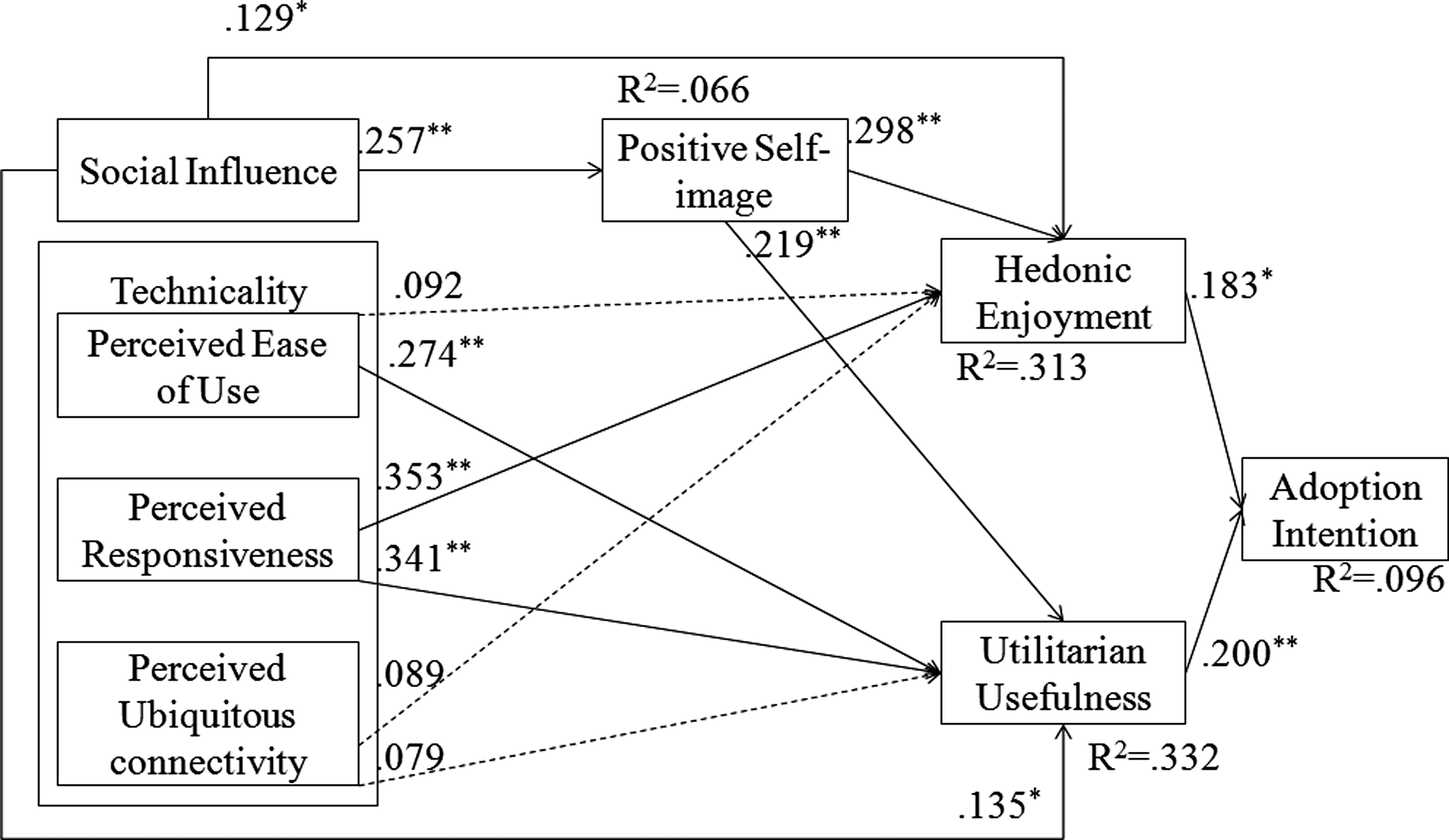
Standardized path coefficients of the model of Smartphone adoption intention; *p<0.05, **p<0.01.
p<0.05.
p=0.01.
H1 stated that hedonic enjoyment and utilitarian usefulness would directly influence the adoption intention. As expected, the results showed that utilitarian usefulness (B=0.200, p<0.01) and hedonic enjoyment (B=0.183, p<0.05) positively predicted the adoption intention. Hence, H1 was supported.
H2 stated that perceived technicality would directly influence hedonic enjoyment and utilitarian usefulness. In the results, perceived responsiveness (B=0.353, p<0.01) directly influenced smartphone's hedonic enjoyment, but PEOU (B=0.092, p=0.093) and perceived ubiquitous connectivity (B=0.089, p=0.103) were not significant in predicting its hedonic enjoyment. On the other hand, a smartphone's perceived usefulness was directly influenced by PEOU (B=0.274, p<0.01) and perceived responsiveness (B=0.341, p<0.01), but not by perceived ubiquitous connectivity (B=0.079, p=0.147). Thus, H2 was partially supported.
H3-1 stated that SI would directly influence positive self-image. As expected, the results showed that SI had a positive direct effect on positive self-image (B=0.257, p<0.01). H3-2 stated that SI would directly influence hedonic enjoyment and utilitarian usefulness. The results indicated that SI had a positive direct effect on hedonic enjoyment (B=0.129, p<0.05) and utilitarian usefulness (B=0.135, p<0.05). H3-3 stated that positive self-image would directly influence hedonic enjoyment and utilitarian usefulness. The results demonstrated that positive self-image had a positive direct impact on hedonic enjoyment (B=0.298, p<0.01) and utilitarian usefulness (B=0.219, p<0.01). Thus, H3-1, H3-2, and H3-3 were supported.
H4 stated that hedonic enjoyment and utilitarian usefulness would mediate the positive relationships between SI, positive self-image, perceived technicality, and the adoption intention. To test H4, we conducted mediating effect analyses using Sobel test35,36 and Baron and Kenny's steps. 37 As shown in Table 3, the effects of SI, positive self-image, PEOU, and perceived responsiveness on the adoption intention were completely mediated through either hedonic enjoyment or utilitarian usefulness at the p<0.01 significance level. However, the mediating effect of PEOU through enjoyment (Z=1.671, p=0.095) was not significant, indicating that PEOU influenced only the rational decision-making process of the adoption intention. The mediating effect of perceived ubiquitous connectivity was also not significant in either pathway, through hedonic enjoyment (Z=1.681, p=0.093) or utilitarian usefulness (Z=1.543, p=0.123), to the adoption intention.
As shown in Table 4, the results offered us additional information regarding the mediating effects of hedonic enjoyment and utilitarian usefulness. SI (B=0.076, p<0.01), positive self-image (B=0.098, p<0.01), and PEOU (B=0.071, p<0.01) had weak but significant indirect effects on the adoption intention, whereas perceived responsiveness (B=0.133, p<0.01) had relatively stronger indirect effect on it.
p<0.05.
p<0.01.
Conclusion and Limitations
This study aims to propose an extended framework of TAM for the convergent media by integrating SI, self-image, and perceived technicality into hedonic and utilitarian attributes inherent in the media. We primarily investigated the ways in which SI, positive self-image, and perceived technicality through hedonic and utilitarian attitudes influence the adoption intention. We also examined the association of hedonic and utilitarian attributes with the intention to use a smartphone.
With regard to hypothesis 1, our results showed that respondents' intention to use smartphones is jointly influenced by both hedonic enjoyment and utilitarian usefulness, indicating that the smartphone is positioned as a convergent media that appeals to a user's task-oriented as well as entertainment-oriented motivations. Within the proposed framework of TAM, our results demonstrated that people perceive both hedonic and utilitarian values as equally important with regard to the adoption intention of smartphones.
With regard to hypothesis 2, our results showed that PEOU, as traditional TAM suggests,10,11,19,22 is still a strong positive indicator to predict respondents' perceived usefulness of the convergent media, but does not have significant effect on their hedonic enjoyment. This means that PEOU is more associated with purposeful and practical use such as task-oriented activity than entertainment-oriented use. Compared to the other variables of technicality, perceived responsiveness is the strongest indicator of the user's perception of usefulness and hedonic enjoyment. The findings imply that people perceive a smartphone's fast feedback as important when considering its usefulness and enjoyment. On the contrary, perceived ubiquitous connectivity was not found to have a positive effect on either hedonic enjoyment or utilitarian usefulness. The results suggest that because of the relatively slower connection speeds of mobile broadband service in public spaces, perceived ubiquitous connectivity is not yet a factor that positively stimulates hedonic or utilitarian attitudes toward the intention to use.
Our results for hypothesis 3 demonstrated that SI motivates the enhancement of positive self-image in the group to which the respondents belong. Further, SI and positive self-image directly influenced hedonic enjoyment and utilitarian usefulness. The findings indicate that people perceive smartphones as a tool for identifying members and thus a symbolic product that enhances one's status within a group.
Hypothesis 4 explored the indirect effects of the indicators on the intention to use. The results imply that instead of the simple direct relations with the intention to use, the indicators had indirect positive relationships with the adoption intention through the complex causal pathways to it. Perceived responsiveness indicated a more indirect influential factor than do other indirect factors of PEOU, SI, and positive self-image. More importantly, the results revealed that the effects of SI, self-image, and perceived technicality on the adoption intention are mediated through hedonic enjoyment and utilitarian usefulness.
Overall, our results showed that smartphone is a convergent device that requires potential users to consider not only usefulness but also enjoyment while making a decision to adopt and use it. This suggests that the hedonic dimension of smartphones is likely to be as important as its utilitarian dimension. The traditional TAM was limited by its narrow perspective in the analysis of adoption behaviors regarding the convergent media. Thus, in order to fully understand one's cognitive processes in adopting a convergent medium, such as smartphones, TAM should be extended to include one's emotional evaluation of the medium's sensory pleasure and symbolic benefits as well as one's rational analysis based on the medium's productivity and functionality. Therefore, it could be concluded from the findings that the integrated model of smartphone adoption that includes hedonic and utilitarian perspectives is more effective in explaining smartphone adoption than the traditional TAM.
Despite the marginal R-squared values of our structural equation model on the adoption intention, the findings of the study make several contributions toward the application of TAM in relation to convergent media. The findings reveal that smartphone adoption is influenced by direct and indirect relationships among SI, perceived technicality, hedonic and utilitarian attitudes, and the adoption intention. Smartphone adoption among college students encourages social communication and entertainment, and tends to serve as a multipurpose medium for social and entertainment-oriented activities rather than for simple work-related activities. Gu et al. argued that there are group differences in perceiving the hedonic and utilitarian natures of information devices by one's employment status. 16 They found that employees are more likely to be greatly affected by utilitarian usefulness in using instant messaging whereas students are more likely to be significantly influenced by hedonic enjoyment. 16 However, the results of the current study suggest that smartphones, as advanced convergent mobile devices, are a more multipurpose medium unlike other information systems, and their intrinsic hedonic and utilitarian attributes are simultaneously important even among college students.
In this study, the analysis and interpretation of the results are not based on a nationwide systematic random sample, which is more conducive to the generalizability of the results. Hence, future studies should conduct national probability sampling to obtain generalizable results. Also, the effects of SI and positive self-image may be stronger in our sample because of the influence of Korea's collective culture. Therefore, future research should examine the effects of SI and positive self-image in other contexts dominated by individual culture. Given the rapid adoption and use of smartphones worldwide, we recommend that the integrated model proposed here be applied in other contexts to compare the relative degree of influential factors on the intention to use or adopt the convergent device.
Footnotes
Author Disclosure Statement
No competing financial interests exist.