




Abstract
Abstract
Having a large social network is generally beneficial to health. However, it is unclear how Internet-based social networks might influence health. Chronic stress can have negative health consequences, and some data suggest that Facebook could be a new source of psychological stress. Thus, we examined undergraduate college student perceptions of Facebook use and incidence of upper respiratory infections (URIs). We hypothesized that subjects with more diverse networks (i.e., more friends on Facebook) would have fewer URIs than their less diverse counterparts; that subjects reporting Facebook-induced stress would be more susceptible to URIs; and that subjects with more diverse networks who report Facebook-induced stress would be less susceptible to URIs than subjects with less diverse social networks who reported Facebook-induced stress. In this prospective study, healthy college students completed online questionnaires that assessed use and perceptions of Facebook and technology, and then were interviewed weekly for 10 weeks to track incidence of URI. URI episodes were defined by a symptom-based criterion. The social network size was significantly related to the rate of URI, such that, the larger the social network, the greater the incidence rate of URI. Most (85.7 percent) respondents experienced some degree of Facebook-induced stress. The effects of Facebook-induced stress on incidence of URI varied across the social network size, such that, the impact of stress on the URI incidence rate increased with the size of the social network. These results are largely in contrast to our hypotheses, but clearly suggest an association between Facebook use, psychological stress, and health.
Introduction
While it is clear that having a large social network is generally beneficial to health, it is less clear how Internet-based social networks might influence health. With the advent of social-networking Web sites, such as Facebook, individuals are becoming more and more connected through the Internet and spending significant amounts of time engaging in Internet-based social networks. 7 Estimates are that 90 percent of undergraduates and 90 percent of high school students use social media sites, such as Facebook. 8 Furthermore, research conducted in the area of emotional disclosure, 9 an intervention in which individuals write or talk about emotionally stressful material reveals beneficial effects in some, but not all participants. 10 It remains unclear if emotional disclosure will work or actually have detrimental effects in a social networking setting. Thus, understanding how social network usage might influence health is of great importance.
The few studies that have examined the influence of Facebook on health have been equivocal. For example, one study found that using Facebook affected undergraduate's perceptions of others, such that, the longer one used Facebook the more likely they were to believe that others were happier and had better lives and the less likely they were to believe that life was fair. 11 A separate study found that spending a lot of time on Facebook was associated with feelings of low self-esteem. 12 In contrast, a recent report suggested that larger social networks predicted higher levels of life satisfaction and perceived social support on Facebook. 13 In another study of undergraduates, researchers found that Facebook use resulted in users' positive affective state. 14 Interestingly, this study also found that Facebook use resulted in increased respiration and skin conductance, suggesting that Facebook use results in activation of the physiological stress response. While the long-term health effects of Facebook-induced activation of the stress response are unknown, a recent case study provides evidence that a Facebook-induced stress response can serve as a trigger for asthma attacks. 7 In addition, it remains unclear what percentage of Facebook users actually perceive their use of Facebook to be stressful.
Numerous studies indicate that exposure to chronic stress (a stress that persists for several hours a day for weeks or months) can be immunosuppressive, and hence, may be detrimental to health. 15 Given that Internet-based social networks, such as Facebook, could be a new source of psychological stress, and that chronic stress can have negative health consequences for an individual, we examined undergraduate college student perceptions regarding Facebook use and incidence of URIs using a prospective study design. Because network diversity has been associated with improved host resistance, we predicted that those with more diverse networks (i.e., more friends on Facebook) would have fewer URIs than their less diverse counterparts. We also hypothesized that people reporting Facebook-induced stress would be more susceptible to URIs than individuals not reporting Facebook-induced stress. Lastly, we predicted that people with more diverse social networks reporting Facebook-induced stress would be less susceptible to URIs than people with less diverse social networks reporting Facebook-induced stress.
Materials and Methods
Participants
Participants were college undergraduates (n=88; 11 men and 77 women) aged 18–24 years who responded to in-class recruitment solicitations during the Fall 2011 semester (see Table 1). All reported no chronic or acute illness, no regular medication regimen (with the exception of birth control), and good health before the study onset. All procedures were approved by the University Institution Review Board.
Procedures
All participants completed an informed consent, and then completed a Web-based survey adapted from the Jed Foundation/Associate Press technology and mental health poll (see Tables 2 and 3). 16 After completing the survey, participants were then instructed about the 10-week follow-up period. For 10 weeks, participants completed a weekly diary to provide information concerning URI symptoms. The majority (n=77; 87.5 percent) of participants completed and returned all weekly diaries.
Facebook use and perceptions survey
Stress can be defined as a constellation of events, consisting of a stimulus (stressor), which precipitates a reaction in the brain (stress perception), that activates physiological fight-or-flight systems in the body (stress response). 15 It is difficult to assess one's perceptions of stressors, thus, we took a multiquestion approach in an attempt to define and quantify Facebook-induced stress. Based on results from questions 2–7 described in Table 2, we rated each participant's level of Facebook-induced stress. We reasoned that questions 2–7 could be viewed as stressors for some and, therefore, questions answered that demonstrated a negative state when using Facebook (e.g., disliking receiving friend requests, feeling angry or sad about defriending someone, feeling angry or sad when defriended by someone else, feeling anxious about Facebook, delaying response to a friend request due to anxiety, feeling guilty or uncomfortable rejecting a friend request) were totaled. Participants answering 0 questions in a negative fashion were rated as having no stress, those answering 1–2 questions in a negative fashion were rated moderate stress, and those answering 3 or more questions in a negative fashion were rated high stress.
Self-reported symptoms
Weekly symptom scores were derived by summing answers to the following eight items, completed on a five-point Likert scale with ratings of zero (none) and one (mild) to four (very severe): nasal congestion, sneezing, runny nose, cough, headache, scratchy/sore throat, fever, and feeling under the weather. As previously reported,17,18 these symptoms resulted from an analysis of the self-reported symptoms that participants used to characterize their natural clinical colds after viral challenge. 19 Using a previously reported methodology,17,18 we derived a symptom-based cold incidence measure from a participant report of two of the eight symptoms at the severe level. On the basis of this criterion, 45 participants were defined to have experienced a URI. Previous research demonstrates that this method of self-reported URI symptoms correlates with verified URI by health care clinicians. 18
Data analysis
To determine if main effects were present, all analysis utilized analysis of variance (ANOVA). Alpha was set at 0.05. All figures are shown with group means and standard error bars. Consistent with the literature, 12 no differences were observed between male and females and, therefore, analysis was done on all subjects regardless of sex.
Results
Use and perceptions of Facebook and technology
Of the 88 subjects who completed the survey, the vast majority (95.9 percent) used Facebook in the 7 days before completing the survey and most users had between 200-999 friends on Facebook (Table 2; 0–199, n=20; 200–999, n=51; 1,000+, n=17). Table 2 summarizes subject's responses.
Self-reported stress and happiness
Most subjects stated they experienced high levels of stress that prevented them from completing academic assignments over the previous 3 months (Table 3). However, the great majority (85.7 percent) of subjects reported feeling at least “somewhat happy” at the time of the survey.
Self-reported URI symptoms
During the 10-week follow-up period of the participants (n=77) who completed and returned all weekly diaries, 45 (58 percent) had at least one URI defined by self-reported symptoms. Of those who reported at least one URI, the average number of infections over the 10-week period was 2.5 infections/individual.
Social network size, Facebook-induced stress and self-reported URI symptoms
The social network size was significantly related to the rate of URI (Fig. 1A, B). ANOVA revealed a main effect of the number of Facebook friends on the incidence rate of URI [Fig. 1A, F(2, 74)=3.0, p=0.05] and a trend for the average number of URI/individual (Fig. 1B, p=0.07), such that, the greater the social network (i.e., number of Facebook friends) the greater the incidence rate of URI. No relationship between hours spent using the Internet, minutes spent talking on cell phones/day, or text messages sent/day and incidence of URI was observed. Additionally, there was not a relationship between subject self-reported stress levels, or degree of happiness (Table 3), and incidence of URI.

Observed incidence rates
Of the six questions (questions 2–7, Table 2) used to assess participant's level of Facebook-induced stress, ANOVA revealed a significant relationship between those that felt angry or sad when someone else defriended them and the incidence of URI [Fig. 2A, F(1, 68)=9.1, p=0.003] (85.7 percent vs. 49 percent). Two-factor ANOVA demonstrated significant main effects of social network diversity [Fig. 2B, F(2, 64)=4.2, p=0.01) and feelings associated with being defriended [Fig. 2B, F(1, 64)=7.9, p=0.006]. These results indicate that increased social network diversity and negative feelings after being defriended are both associated with increased incidence of URI. In addition, the effects of having negative feelings following being defriended on incidence of URI varied across the social network size. Individuals with the smallest network size demonstrated a 22.7 percent increase in the URI rate when comparing individuals who reported no difference or feeling angry/sad following being defriended (27.3 percent vs. 50 percent). In comparison, individuals with the largest network size demonstrated a 50 percent increase in the URI rate when comparing individuals who reported no difference or feeling angry/sad following being defriended (50 percent vs. 100 percent). No significant differences were observed for the remaining five questions examining Facebook-induced stress and URI incidence (p>0.05 for all), although a trend (p=0.1) was observed when examining URI incidence in those who reported that Facebook made them anxious (URI incidence=73.3 percent) compared with those that reported Facebook did not make them anxious (URI incidence=54.8 percent).
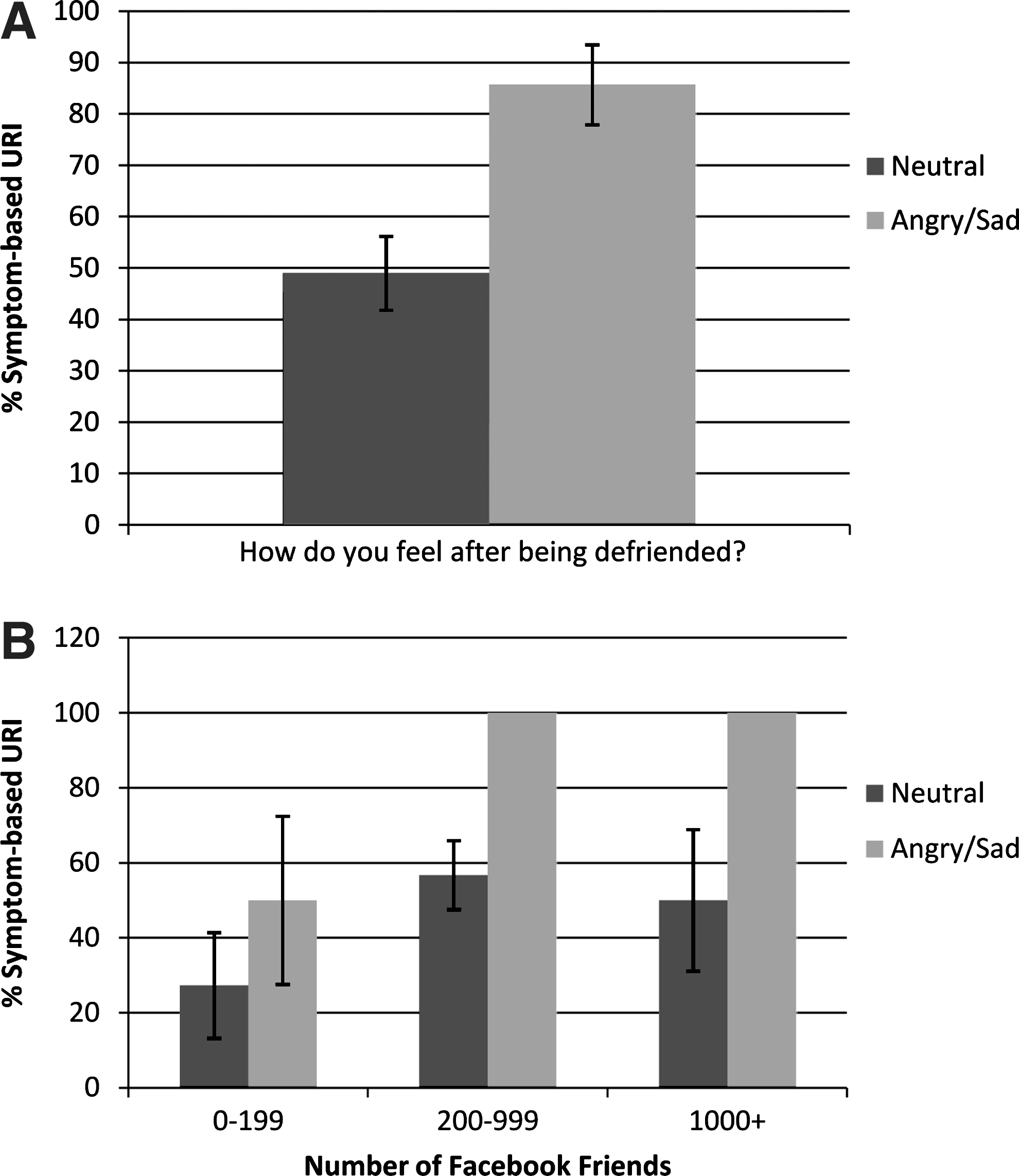
Observed incidence rates of URIs during the 10-week follow-up as a function of subjects' feelings following being defriended
The majority of respondents (53.2 percent) experienced moderate Facebook-induced stress, a sizeable group experienced no Facebook-induced stress (32.5 percent), and a significant minority (14.3 percent) experienced high Facebook-induced stress. ANOVA demonstrated no significant main effect of Facebook-induced stress on incidence of URI or the average number of URI/individual (Fig. 3A, p=0.3). Two-factor ANOVA confirmed significant main effects of social network diversity [Fig. 3B, F(2, 68)=4.4, p=0.01], but not Facebook-induced stress (Fig. 3B, p>0.05) on incidence of URI. In addition, a reliable social network diversity by Facebook-induced stress interaction was observed [Fig. 3B, F(4, 68)=2.5, p=0.04] suggesting that a greater social network diversity was associated with increased incidence of URI and the impact of Facebook-induced stress on incidence of URI varied across different sized networks. No relationship between hours spent using the Internet, minutes spent talking on cell phones/day, or text messages sent/day and incidence of Facebook-induced stress was observed.
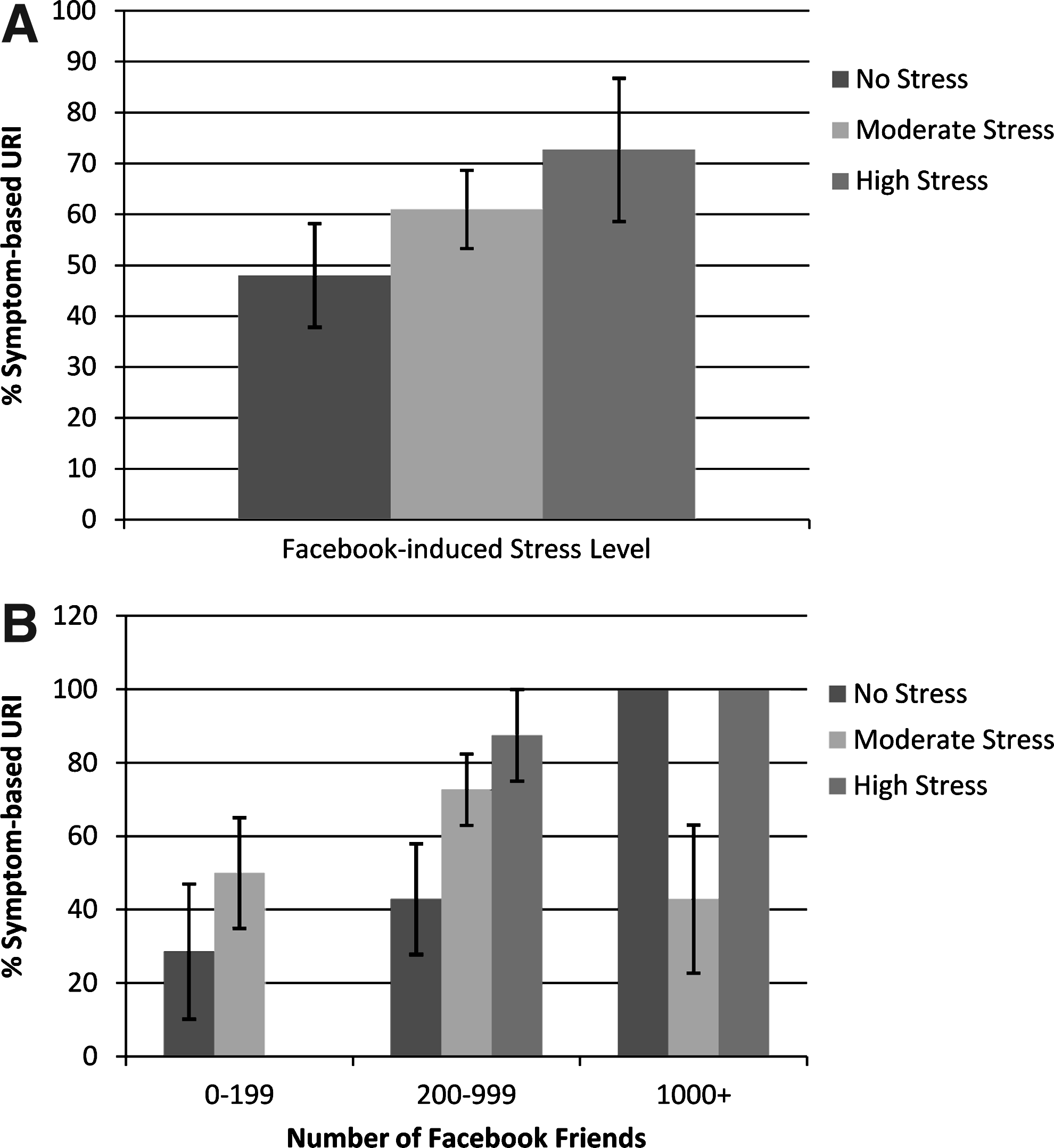
Observed incidence rates of URIs during the 10-week follow-up as a function of Facebook-induced stress experienced by subjects
Discussion
Individuals with larger social networks have been demonstrated to have physical and psychological health benefits. However, studies examining how Internet-based social networks influence psychological health have produced mixed results. To our knowledge this is the first study to examine how Internet-based social networks influence physical health (i.e., URI). Given recent estimates that approximately 8 percent of the world's population and 42.3 percent of the entire American population use Facebook, 20 this issue is of the utmost importance.
In contrast to our hypothesis and the literature examining traditional social networks,5,6 Internet-based social network size was associated with an increased rate of URI (Figs. 1–3), such that, the larger the social network (i.e., number of Facebook friends) the greater the incidence rate of URI. Although having a diverse social network is generally beneficial to health, there are studies that report increased numbers of URIs with increased exposure to others. 21 Diverse social networks are associated with a face-to-face contact with a wide range of people that could ultimately increase risk of exposure to infectious agents. Moreover, in situations, where one's host resistance is compromised, increased social contact and exposure to a larger range of infectious agents could possibly lead to a greater incidence of URI communicated through social contact. Thus, it has been suggested that the protective effect of having a diverse social network is reserved only for times when one's immune system is functioning appropriately. 18 In the current study, we had no direct measure to indicate if having more Facebook friends was associated with more face-to-face contact with those friends. However, a recent study reported a strong overlap between online and offline friends suggesting that those with more Facebook friends are likely to interact with those friends face-to-face, 22 thereby increasing the likelihood for disease transmission.
A number of factors can compromise host resistance, including age, immunosuppressive drugs, and exposure to chronic stress.23–26 The results from our study suggest that many Facebook users find use of the social networking tool to be stressful. According to our analysis, the majority of respondents (53.2 percent) experienced moderate Facebook-induced stress, and 14.3 percent experienced high Facebook-induced stress. Specifically, almost a third of respondents stated that being defriended made them angry or sad, while 9.1 percent stated defriending someone made them angry or sad, and a small number of users (4.1 percent) stated they actually disliked receiving friend requests. When asked directly if Facebook made them feel anxious, 18 percent answered in the affirmative; however, 45.9 percent of respondents stated that they delayed replying to a friend request because they felt anxious about the request and 32.7 percent stated that rejecting friend requests made them guilty or uncomfortable. Consistent with the idea that Facebook use is resulting in user stress for some individuals, 31.7 percent of respondents stated unplugging from technology would result in less stress and 43.9 percent of respondents stated that the increased use of technology has made it harder to feel close to people.
Given that chronic stress can compromise the immune system, and Facebook use results in stress for some users, users experiencing Facebook-induced stress might have compromised immune systems. Indeed, individuals who reported feeling angry or sad following being defriended had a higher URI incidence rate compared to those reporting feeling neutral following being defriended (85.7 percent vs. 49 percent; Fig. 2). Although increased social network diversity was also associated with increased incidence of URI (Fig. 1), having negative feelings following being defriended was associated with a greater incidence of URI in subjects with the largest network diversity. In addition, when examining subjects' overall level of Facebook-induced stress (no stress, moderate, high), it was found that subjects experiencing high Facebook-induced stress who had more diverse social networks were more susceptible to URIs than subjects experiencing high Facebook-induced stress who had less diverse social networks (Fig. 3). The observation that subject's self-reported levels of overall stress and happiness (Table 3) were not associated with incidence of URI lends support to the suggestion that these results were specific to Facebook-induced stress. Our data are similar to previous studies reporting that increased social contact is associated with great incidence of URI under stress.17,18,27 Importantly, the results from the current study add to this literature by demonstrating that increased virtual social contact (i.e., via Facebook) is also associated with a greater incidence of URI when subjects are under stress.
One explanation for these results is the possibility that having more Facebook friends results in more Facebook-induced stress, and this increased stress further compromises the immune system. There is evidence, for example, that the amount of time spent on Facebook correlates with the number of Facebook friends. 12 Increased time spent on Facebook, theoretically, would provide more opportunity for Facebook-induced stress. However, we did not find a relationship between the number of Facebook friends and any measure of stress in the current study (data not shown). Thus, having more Facebook friends did not necessarily result in more Facebook-induced stress. In addition, spending more time using the Internet (including using Facebook) did not result in more Facebook-induced stress or incidence of URI, suggesting increased frequency of Facebook use does not necessarily result in greater stress or incidence of URI.
In conclusion, the results of the current study indicate that the virtual social network size might influence human health, users frequently report feelings of stress associated with Facebook, and the social network size and Facebook-induced stress might interact to influence health. These data suggest that people who have more diverse social networks reporting high Facebook-induced stress are more susceptible to URIs than people with less diverse social networks reporting high Facebook-induced stress. How and why Facebook might induce the physiological stress response remains a topic of investigation. One limitation of the current study was the unequal number of male and female subjects. Additionally, the small number of subjects with 1,000+ Facebook friends makes analysis of various subgroups within this group difficult. Future studies should attempt to have a more balanced subject population. It seems clear, however, that for some individuals Facebook use and technology in general are sources of psychological stress.
Footnotes
Acknowledgment
We thank the undergraduate students at Regis University for participating in this study.
Author Disclosure Statement
No competing financial interest exists.