




Abstract
Abstract
Despite the design of various challenge levels in online games, exactly how these challenges increase customer loyalty to online games has seldom been examined. This study investigates how such challenges increase customer loyalty to online games. The study sample comprises 2,861 online gamers. Structural equation modeling is performed. Analytical results indicate that the relationship between challenge and loyalty intensifies when customers perceive that overcoming challenges takes a long time. Results of this study contribute to efforts to determine how challenges and challenge-related perceptions impact customer loyalty to online games.
Introduction
A
Online game research has focused on customer loyalty, helping game providers to nurture a competitive edge. 4 Online customer loyalty (i.e., intention to purchase goods or services repeatedly from the same provider) is vital to service providers. 5 Customer loyalty to online games has several antecedents, including flow 6 and gratification from social interactions. 7 Customer loyalty research on online games should thus address both flow and social interactions.
Flow has been conceptualized as total concentration with intrinsic enjoyment. Flow theory posits that skill and challenge predict flow. 8 Subsequent studies found that challenge can solely predict flow9,10 owing to its ability to arouse individual attention directly in order to formulate concentration and, ultimately, flow. However, to our knowledge, exactly how challenges impact customer loyalty to online games has never been addressed. By using goal-setting theory 11 as its theoretical foundation, this study develops hypotheses on how challenges impact customer loyalty. Goal-setting theory posits that an attainable and challenging goal motivates individuals to exert maximum effort to achieve the goal. Based on this theory, two potential moderators are proposed: probability of overcoming challenges and time needed to overcome challenges. Importantly, results of this study provide valuable insight into how attainable challenges induce customers to play online games continuously.
In particular, this study investigates whether challenge level is related to customer loyalty and how the probability of overcoming challenges and time needed to overcome them moderate this relationship. This investigation contributes to literature in two ways. First, this study uniquely examines how challenges directly impact loyalty. Second, this study identifies two factors that may moderate the relationship between challenge and loyalty, shedding light on how challenges impact customer loyalty.
Customer Loyalty
Customer loyalty refers to the intention to purchase and use a specific product or service repeatedly from the same provider. 12 This definition, as used in this study, is extensively adopted in literature and applied to numerous contexts, including online gaming. 13 Loyalty can be applied to online games, given their ability to provide customers with experiences that incorporate online games into daily life, including excessive play and its related problems, addiction, psychosocial impacts, loss of time, and alleviation of a negative mood. 14
In online gaming, customer loyalty has various antecedents, including flow,6,15,16 customization, 13 social interactions with other gamers, 16 achievement gratification and social interaction gratification, 7 as well as social norms. 17 Moreover, online gaming is characterized by a positive relationship with others and enhanced interactions. 18 Pertinent literature demonstrates the importance of achievement, flow, and social interactions in determining online gamer loyalty. Achievement is often attained by overcoming challenges. Goal-setting theory 11 can explain how challenges impact loyalty. Goal-setting theory 11 posits that a goal must be both attainable and challenging to motivate individuals to deploy maximum effort in order to achieve goals. An attainable goal should involve a high probability of achievement and take considerable time. Therefore, based on two novel constructs (i.e., the probability of overcoming challenges and time needed to overcome challenges), this study examines their roles in moderating the relationship between challenge and loyalty.
Moreover, a comprehensive framework can be generated by including flow and social interaction variables. Although flow is a well-defined construct, social interaction involves numerous variables. This study considered commitment to virtual community (i.e., willingness to make contributions to a virtual community) as a proper construct because online gamers form virtual communities and often commit to those virtual communities. Such commitment describes behavioral intention to contribute to those communities, explaining its important role in predicting online customer loyalty. 19 Hence, this study considers flow and commitment to a virtual community as two control variables. To avoid omitting variable biases and increase rigor, this study includes the known relationships between challenge and flow, 8 flow and loyalty, 6 and commitment and loyalty. 19 This study also develops focal hypotheses on how challenge and loyalty are related and also how probability and time needed to overcome challenges moderate this relationship.
Hypotheses Development
Goal-setting theory 11 posits that a well-defined goal motivates individuals to achieve a specific goal. Applying this theory to online gaming settings indicates that challenges motivate online gamers to exert the required efforts (e.g., upgrade their abilities). This motivation then thus induces customers to play a game repeatedly. Repeated play (use) fosters customer loyalty. 12 Thus, we hypothesize that challenge and loyalty are positively related.
Notably, this hypothesis is new to flow theory. Flow theory posits that users with high-level skills who encounter high-level challenges can experience flow, 8 subsequently increasing loyalty. 6 However, this hypothesis asserts that challenge and loyalty are directly related, indicating its contribution to flow theory.
Goal-setting theory posits that individuals who perceive that a certain goal is attainable and challenging will be strongly motivated to expend the required effort to achieve that goal. 11 If customers perceive a high probability of overcoming challenges in a certain game, the relationship between challenge and loyalty should strengthen because customers are willing to expend the required effort to pursue an attainable goal. Since repeated use is vital to customer loyalty, 12 customers who perceive a high probability of overcoming high-level challenges are likely to be loyal to that game.
Conversely, customers who believe that they have a low probability of overcoming challenges in a game are likely to give up at an early stage in the game. This tendency to give up weakens the relationship between challenge and loyalty. We thus hypothesize the following:
Customers who believe that considerable time is needed to overcome challenges perceive the goal of overcoming challenges as highly challenging. Goal-setting theory 11 posits that a highly challenging goal motivates individuals to expend the maximum effort to achieve that goal. Applying this theory to online gaming indicates that the time needed to overcome challenges contributes to the strong motivation of gamers to make the effort needed to overcome challenges. Restated, the time needed to overcome challenges further increases the extent to which challenge influences customer motivation to play a game, often increasing customer loyalty.
Conversely, customers who perceive that only a short time is needed to overcome challenges view such challenges as easy. According to the goal-setting theory,
11
an easy goal diminishes motivation, offsetting the impetus originating from challenges. Namely, even with difficult challenge, gamers still lack a strong motivation to play a game repeatedly. We thus hypothesize the following:
Flow theory
20
posits that high skill and challenge levels interact with each other to create flow. Skillful users concentrate thoroughly on challenging tasks, thus allowing them to experience intrinsic enjoyment. However, subsequent studies9,10 found that skill and challenge create flow independently, supporting inclusion of only one of them is appropriate. Challenge can increase individual attention paid to gaming activities,
21
thus increasing the concentration level, which is the definition of flow.
9
We thus hypothesize the following:
Flow encourages the repeated use of online games.
15
The underlying mechanism is the reinforcement theory,
22
which posits that positive feedback induces the intention to engage repeatedly in the same behavior. By applying this theory to this study, flow is strongly related to enjoyment,
23
which is positive feedback that triggers repeated use (i.e., loyalty). We thus hypothesize the following:
Commitment to virtual community increases individual tendency to participate in a community. 19 In an online gaming setting, participation in an online gaming community requires repeated logging in and playing the game, creating a strong intention to play it repeatedly. Restated, commitment fosters strong customer loyalty.
A study involving online venders 19 found that commitment to a virtual community is related to customer loyalty toward vendors. However, that study failed to investigate online gamers or examine gamer loyalty, indicating the novelty of this hypothesis. We thus hypothesize the following:
Figure 1 illustrates the study framework. Although H4 and H5 are common in the literature, it is necessary to include them.

Research framework.
Methods
Sample and data collection procedures
Given the widespread popularity of online gaming, as evidenced by the more than 12 million subscribers globally to World of Warcraft, 3 this study solicited online gamers willing to complete an online questionnaire during a 2-week period (from May 26 to June 8, 2012). Invitations were posted on Web sites and in online forums used by online gamers. To increase the data validity, this study used seven criteria to eliminate invalid responses. Table 1 lists these criteria and number of invalid responses determined by each criterion. In total, 3,094 participants provided 2,861 valid questionnaires, for a valid response rate of 92.5%. This high valid response rate may be because only participants submitting valid responses were eligible for a lottery for US$330 gift certificates.
Measures
Participants were instructed to respond to items in relation to their favorite game. Five items evaluating customer loyalty were obtained from the study of Zeithaml et al. 12 Six items evaluating challenge came from Novak et al. 8 Four items evaluating commitment to a virtual community came from Gupta et al. 19 Eleven items evaluating flow came from Webster et al. 24 Since these items are for four distinct dimensions, this study modeled flow as a second order construct. Moreover, by using three novel items, this study assesses the probability of overcoming challenges and three items to evaluate time needed to overcome challenges. Since confirmatory factor analysis (CFA) has demonstrated usefulness, 25 this study evaluates the reliability and validity of the measures by using CFA.
Before applying CFA, this study performs an exploratory factor analysis to verify the factor structure. Principal component analysis and varimax rotation were used. Totally, 74% of variance was explained. Factor loadings are provided in the Appendix. All constructs, except for flow, had items that correspond to the measurement theory, possibly because flow scales comprise four distinct dimensions and, thus, have a low internal consistency.
Items evaluating each construct had a Cronbach's alpha >0.73, except for items evaluating dimensions of flow. This finding may be because the four flow dimensions are distinct, subsequently reducing their internal consistency. The items evaluating control had a Cronbach's alpha of 0.24. The reason may be that one item has “no control,” which is semantically strong, reducing its correlation with the other item. However, the 11 items measuring flow as a whole had a Cronbach's alpha of 0.79, consistent with the numbers (0.72 and 0.82) in Webster et al. 24 Items evaluating each construct had a composite reliability (CR) exceeding 0.80, and average variance extracted (AVE) exceeded 0.59, except for items evaluating dimensions of flow. The imperfect internal consistency explains such a low AVE. Overall, statistics indicate that most measures of this study have adequate reliability, except for the measures of control.
All items had indicator loadings exceeding 0.50, except for two items evaluating flow. These statistical findings support the convergent validity for most items. 26 Additionally, the squared correlation for each pair of constructs was below the AVE of each construct, except for one test involving the relationship between flow and loyalty, generally satisfying the discriminant validity criterion. 27 Adequate discriminant validity indicates that the three constructs (i.e., challenge, probability of overcoming challenges, and time needed to overcome challenges) are three different constructs. Overall, the fit indices performed acceptably (χ2=12911.74, df=445, NNFI=0.95, CFI=0.96, IFI=0.96). Also, NNFI, CFI, and IFI values exceeded criteria in literature.28,29 Since the chi square and chi square/degrees of freedom values increased significantly with sample size, 30 they were not used as critical indices in this study. Table 2 lists measurement items and CFA results.
Note. λ, indicator loading; CR, composite reliability; AVE, average variance extracted. *Reversely coded item.
Table 3 lists the correlations among study variables. This study evaluated the significance of common method variance (CMV), as suggested in literature. 31 Variance of all items was also explained using a single construct—CMV. The chi square value of the model with CMV (χ2=8407.44, df=269) significantly exceeded that of the model without CMV (Δdf=9, Δχ2=643.43>χ2 [df=9, α=0.05]=16.92). Moreover, the model without CMV fit data significantly better than that with CMV, demonstrating that the problem associated with CMV is minimized.
Note. **p<0.01.
Results
Sample description
The study sample comprised 2,861 participants. The participants ranged from 11–59 years old; the average age was 21.39 years old, and the standard deviation was 5.02 years. This age range reflects a wide coverage of online gamers. In total, 64.2% of the participants had attended college or university. Furthermore, participants had played their favorite game for an average of 3.09 years, with a standard deviation of 3.10 years. Participants played their favorite game for 16.00 hours weekly on average, with a standard deviation of 17.34 hours. Table 4 summarizes the demographic data of the study population.
Hypotheses testing
This study applies LISREL 8.8 software (
Note. **p<0.01.
Formally hypothesized moderating roles were tested by using orthogonalizing procedure 32 and latent variables to model moderating effects. The interaction of challenge and probability of overcoming challenge is not related to loyalty (path coefficient (γ)=0.00, p>0.05), thus not supporting H2. However, the interaction of challenge and the time needed to overcome challenges is positively related to loyalty (path coefficient (γ)=0.02, p<0.05), thus supporting H3.
In Table 5, challenge is positively related to flow, thus supporting H4. Flow is positively related to loyalty, thus supporting H5. Commitment to virtual community is positively related to loyalty, thus supporting H6. Table 6 summarizes the results for hypotheses testing. Figure 2 illustrates the final model and the standardized coefficients. The only one indirect effect among the study constructs is the effect of challenge on loyalty, which was .70. The large magnitude indicates the robustness of flow theory, as well as the necessity of including flow in this study.
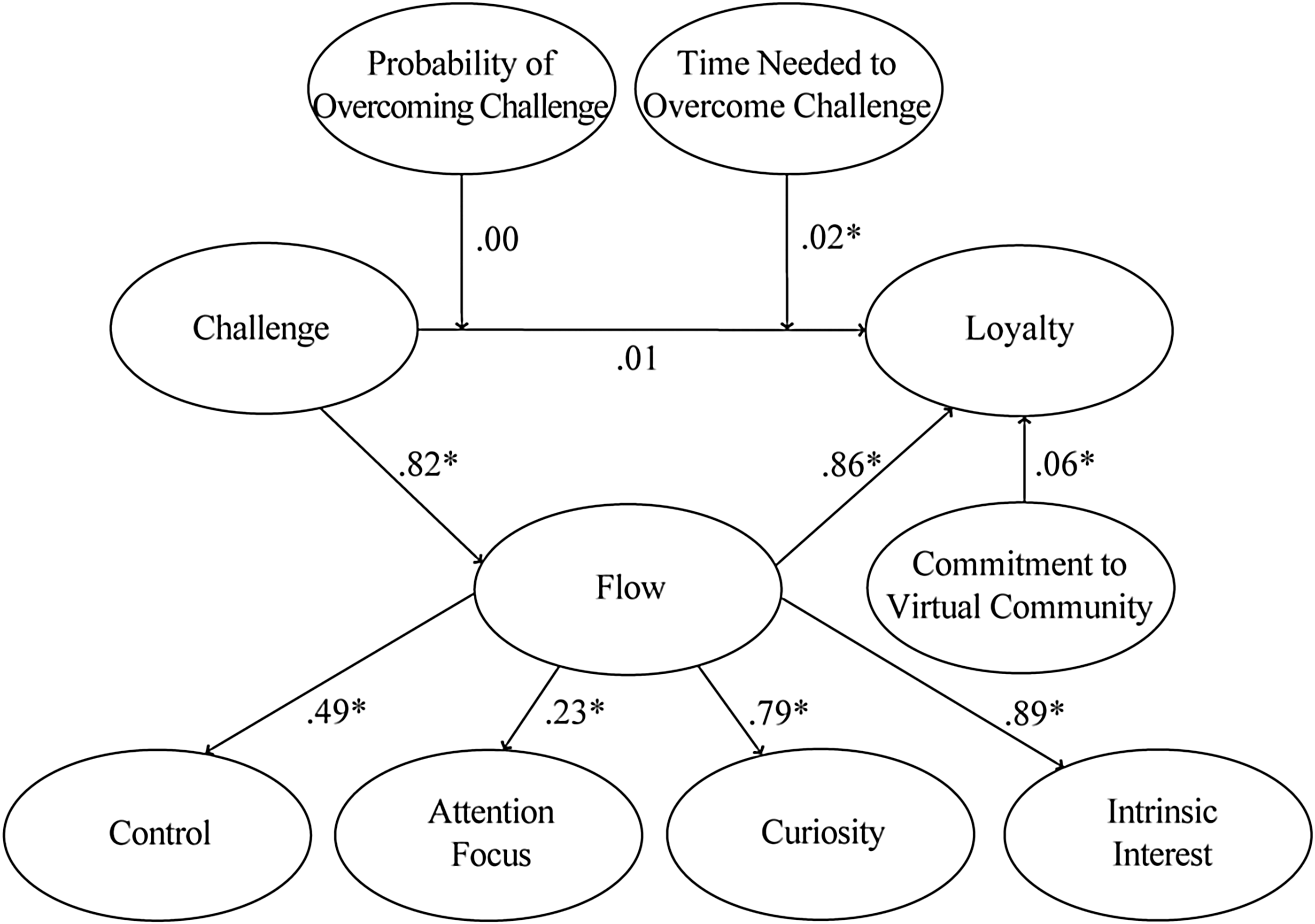
Final model and standardized coefficients. *p<0.05.
Discussion
Main findings
This study has demonstrated that the direct relationship between challenge and loyalty can be strengthened by a long time needed to overcome challenges. Such a finding reveals that the influence of challenge on loyalty is contingent on customer perceptions regarding challenges. This finding is novel in the literature. The results of this study conform to the hypotheses made based on goal-setting theory.
This study also confirmed the predictions of flow theory in which challenge is positively related to flow, which is positively related to loyalty. Moreover, commitment to a virtual community is positively related to customer loyalty. Such findings demonstrate that flow plays a critical role in the relation between challenge and loyalty. Furthermore, social factors and flow can predict customer loyalty. The above findings reflect those in the literature, thus validating the results of this study.
This study did not find evidence supporting the moderator role of probability of overcoming challenges in the relationship between challenge and customer loyalty. The reason may be that users interpret probability of overcoming challenges in various aspects. A high probability can be interpreted as worth trying but can also be interpreted as too easy to try. The multiple interpretations offset the influences of probability of overcoming challenges.
Theoretical implications
In utilizing the goal-setting theory, 11 this study uniquely incorporates challenges, probability of overcoming challenges, and time needed to overcome challenges as predictors of customer loyalty to online games. Analytical findings indicate that the relationship between challenge and loyalty can be strengthened by a long time needed to overcome challenges. The above findings demonstrate the feasibility of goal-setting theory in explaining how challenges impact customer loyalty to online games. The results of this study also contribute to goal-setting theory by further demonstrating that an increasing challenge can have a similar effect of setting a goal, thus providing a new research direction for theory development.
This study also contributes to flow theory by successfully replicating the findings of other studies using flow theory,6,8,15 indicating that challenge predicts flow and flow fuels loyalty. This successful replication provides solid support for the feasibility of applying flow theory to online games. In addition to the replication, this study further contributes to flow theory by verifying that predictors (e.g., challenge) of flow can also forecast user loyalty in certain contexts.
The literature on social interactions indicates that gratification from social interactions largely explains why customers play an online game repeatedly. 7 Moreover, positive relationship 18 and social norms motivate customers to play an online game repeatedly. 17 The results of this study also contribute to the literature by identifying commitment to virtual community as a predictor of loyalty. Although a previous study examined commitment to a virtual community in online shopping, 19 this study uniquely applies it to online gaming.
The results of this study provide valuable implications. Parents concerned with their children playing online games excessively can attempt to prevent their children from playing online games in which gaming challenges take a long time. Such games likely induce repetitive gaming behavior.
Research limitations and future research directions
Flow theory 8 posits that challenge predicts flow. The CFA results of this study demonstrate that challenge and flow are two distinct constructs. However, challenge may still be a part of flow. Future studies can examine such likelihood.
By using survey data, this study also examines the feasibility of the proposed model in predicting customer loyalty to online games. The data collection process and data sources are appropriate for answering the research questions of this study. However, survey data are limited in examining the causality of study constructs. Although this study provides valuable insight into the topic, further studies are warranted to verify that the correlations in this study originate from causality, especially when using longitudinal or experimental designs.
Online games are extremely popular and, thus, relevant to user psychology. Selecting online games as an investigation target is appropriate for research purposes. Additionally, online games include elements of challenge and achievement, indicating that they fit the objectives of this study. We recommend that future studies examine whether study findings apply to online gambling and other online activities that challenge users who derive a sense of achievement from overcoming challenges.
Self-determination theory 33 encompasses a wide array of motivations. This theory has been applied to video gaming contexts, 34 demonstrating its potential to explain online gaming behavior. Future studies can incorporate this theory to include a comprehensive set of predictors for playing online games.
Results of this study demonstrate the effectiveness of the goal-setting theory in explaining online gamers' behavior. Results of this study further demonstrate the role of flow theory in determining customer loyalty. We thus recommend that customer loyalty research consider using flow theory when the setting involves challenges to customers.
Footnotes
Acknowledgment
The author thanks Chang Gung University, Taiwan, for financial support (UARPD390181).
Author Disclosure Statement
No competing financial interests exist.
Appendix
Loadings of Exploratory Factor Analysis
| 1 | 2 | 3 | 4 | 5 | 6 | 7 | 8 | 9 | |
|---|---|---|---|---|---|---|---|---|---|
| Loyalty-1 | 0.87 | ||||||||
| Loyalty-2 | 0.80 | ||||||||
| Loyalty-3 | 0.83 | ||||||||
| Loyalty-4 | 0.91 | ||||||||
| Loyalty-5 | 0.89 | ||||||||
| Challenge-1 | 0.63 | ||||||||
| Challenge-2 | 0.88 | ||||||||
| Challenge-3 | 0.80 | ||||||||
| Challenge-4 | 0.90 | ||||||||
| Challenge-5 | 0.86 | ||||||||
| Challenge-6 | 0.77 | ||||||||
| Commitment-1 | 0.86 | ||||||||
| Commitment-2 | 0.92 | ||||||||
| Commitment-3 | 0.92 | ||||||||
| Commitment-4 | 0.88 | ||||||||
| Probability-1 | 0.87 | ||||||||
| Probability-2 | 0.92 | ||||||||
| Probability-3 | 0.80 | ||||||||
| Time-1 | 0.93 | ||||||||
| Time-2 | 0.90 | ||||||||
| Time-3 | 0.48 | −0.64 | |||||||
| Flow-Control-1 | 0.63 | ||||||||
| Flow-Control-2 | 0.75 | ||||||||
| Flow-Focus-1 | 0.85 | ||||||||
| Flow-Focus-2 | 0.84 | ||||||||
| Flow-Focus-3 | 0.41 | 0.45 | |||||||
| Flow-Curiosity-1 | 0.96 | ||||||||
| Flow-Curiosity-2 | 0.95 | ||||||||
| Flow-Curiosity-3 | 0.91 | ||||||||
| Flow-Interest-1 | 0.69 | ||||||||
| Flow-Interest-2 | |||||||||
| Flow-Interest-3 | 0.48 |
Note. Number of factors was determined when Eigenvalues were >1. Loadings >0.40 were listed.