




Abstract
Abstract
Facebook has become a widely used online self-representation and communication platform. In this research, we focus on emotional disclosure on Facebook. We conducted two studies, and results from both self-report and observer rating show that individuals are more likely to express positive relative to negative emotions and present better emotional well-being on Facebook than in real life. Our study is the first to demonstrate impression management on Facebook through emotional disclosure. We discuss important theoretical and practical implications of our study.
Introduction
Two theoretical frameworks are particularly compelling for their application to self-disclosure on Facebook. First, the enhanced self-disclosure theory suggests that computer-mediated communication (CMC) stimulates self-disclosure due to the lack of nonverbal cues (such as visual, auditory, and contextual cues).3,10–14 It may lead to communication that is more intimate than face-to-face communication.15–17 As Valkenburg and Peter 17 stated, “the finding that online communication enhances self-disclosure is one of the most consistent outcomes in CMC research.” Enhanced self-disclosure in online communication (including instant messaging and social networking) has been considered as the key that associates Internet usage with improved social well-being. 18
Second, Walther's hyperpersonal interaction model suggests that CMC does not provide the critical visual cues available in face-to-face communication, and therefore allows individuals to easily manipulate their self-presentation to create a more socially desirable self-image.19,20 Walther 19 found that participants included more verbal expressions, personalized language, and complex sentences to appear more socially desirable in text-based communication. Online SNSs seem to be an ideal platform for impression management and selective self-presentation. 21 Users have full control of how they want to present themselves. They can decide what emotions to express in status updates, which photos they should upload to convey their best image, and which part of their social lives should be disclosed. Ellison et al. 21 found that users of online dating sites intentionally present their profiles in a way that portrays their ideal self, while maintaining reasonable credibility. Facebook users have been found to selectively choose physically more attractive photos as their profile pictures,22–24 and use implicit means, such as photos with others, to create an active social image. 25 Studies also show that exposure to one's own Facebook profile enhances self-affirmation, self-esteem, and positive emotion.26,27 Longer user of Facebook is associated with impression of others having better lives and well-being. 28 These findings provide indirect evidence, suggesting that self-representations on Facebook are optimized to emphasize the positive side of oneself.
Both the enhanced self-disclosure and selective self-presentation model shed light on emotional disclosure on Facebook. According to the enhanced self-disclosure model, users may reveal emotional experiences that they would not reveal in face-to-face communication. More importantly, according to the hyperpersonal model, users would be more likely to disclose their positive emotion relative to negative emotion on Facebook to present a better social image. Thus, we hypothesize that users will present better emotional well-being on Facebook than in real-life through disclosing much more positive than negative emotional experiences.
Overview of the Current Study
We conducted two studies to test the premise that users will present better emotional well-being on Facebook than in real life. Study 1 asked participants to rate how likely they would disclose their positive and negative emotional experiences on Facebook and in real life, and we predicted that participants would be more likely to express positive relative to negative emotions on Facebook than in real life. In Study 2, we used observer rating to confirm the self-report results in Study 1. Participants were asked to rate their friends' emotional well-being in real life and on Facebook, and we predicted that participants would rate their friends to be happier and have more positive relative to negative emotional experiences on Facebook than in real life.
Study 1
Method
Participants
A sample of 185 college students (63 males, 122 females; mean age=21.10 years, standard deviation [SD]=1.67) participated in our study in exchange for course credits. All participants had been using Facebook for at least one year and had more than 50 Facebook friends.
Procedure and measures
Participants were asked how likely they would disclose positive and negative emotional experiences on Facebook, respectively, on a 7-point Likert scale (1=very unlikely, 7=very likely). The same questions were asked about emotional disclosure in real life.
Results
We conducted a 2×2 repeated measures analysis of variance with emotion (positive vs. negative) and medium (Facebook vs. real life) as two within-subject factors. There was a main effect of valence, F(1, 184)=138.40, p<0.001, η 2 =0.429, with positive (M=5.50, SD=1.01) being more likely to be disclosed than negative (M=4.35, SD=1.16) emotional experiences. There is also a main effect of medium, F(1, 184)=144.01, p<0.001, η 2 =0.439, showing that participants were more likely to disclose emotional experiences in real-life situations (M=5.66, SD=1.21) than on Facebook (M=4.19, SD=1.13). More importantly, these main effects were qualified by a valence×medium interaction, F(1, 184)=47.703, p<0.001, η 2 =0.206. As shown in Figure 1, participants were much more likely to disclose positive (M=5.07, SD=1.47) than negative emotion (M=3.30, SD=1.69) on Facebook, F(1, 184)=145.49, p<0.001, η 2 =0.44. The likelihood of disclosing positive (M=5.92, SD=1.26) relative to negative emotion (M=5.40, SD=1.61) was smaller (as revealed by the interaction) in real life, though still statistically significant, F(1, 184)=19.58, p<0.001, η 2 =0.10. These results suggest that participants were more likely to express positive relative to negative emotions on Facebook than in real life.
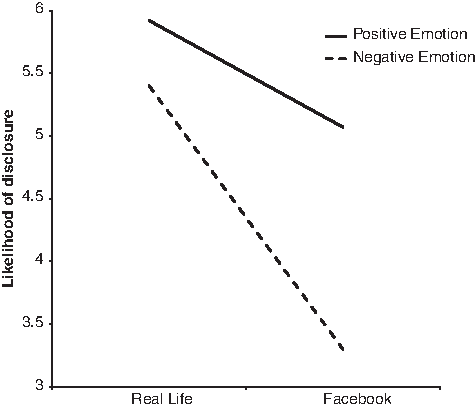
Self-reported likelihood of disclosing positive emotion versus negative emotional experiences in real life and on Facebook.
Study 2
Method
Participants
Thirty-seven college students (14 males, 23 females; mean age=22.16 years, SD=1.92) participated in our study in exchange for course credits. All participants had been using Facebook for at least one year and had more than 50 Facebook friends.
Procedure and measures
Participants were first shown a circle diagram that categorizes social relations into family members, close friends, general friends, and casual acquaintances. Then, they were asked to name three close and three general friends. Participants were asked, for each friend, how happy the friend's life is on a scale from 1 (extremely unhappy) to 7 (extremely happy), and how frequently the friend experienced positive and negative emotions, respectively, on a scale from 1 (never) to 7 (almost always).
Then, participants browsed each friend's Facebook wall page for 2 minutes. They were asked to consider each friend's life presented on Facebook and rate how happy the friend is on a scale from 1 (extremely unhappy) to 7 (extremely happy), and how frequently the friend experienced positive and negative emotions, respectively, on a scale from 1 (never) to 7 (almost always).
Results
We first examined participants' perception of their friends' overall happiness. Results show that participants considered their friend to be happier on Facebook (vs. in real life) (Mreal-life=7.25, SDreal-life=0.83; MFacebook=7.55, SDFacebook=1.11), t(36)=2.81, p=0.008, Cohen's d=0.30. We then conducted a 2 (emotions: positive vs. negative)×2 (medium: Facebook vs. real life) repeated measure on how participants evaluated their friends' emotional experiences, and found that valence, F(1, 36)=4.77, p=0.036, η 2 =0.12, and medium, F(1, 36)=89.46, p<0.001, η 2 =0.71), both have significant main effects. These main effects were qualified by an interaction between valence and medium, F(1, 36)=8.75, p=0.005, η 2 =0.20. Simple effect analysis shows that participants perceived their friends to experience more positive (M=5.40, SD=0.75) than negative (M=3.02, SD=0.93) emotions on Facebook, F(1, 36)=88.76, p<0.001, η 2 =0.71. The difference between positive (M=5.27, SD=0.71) and negative (M=3.33, SD=0.83) emotions is significant, but smaller in real life, F(1, 36)=73.40, p<0.001, η 2 =0.67. As Figure 2 shows, these results are consistent with the self-report findings from Study 1. They consistently show that users disclose more positive relative to negative emotional experiences and present a happier self-image on Facebook (vs. in real life).
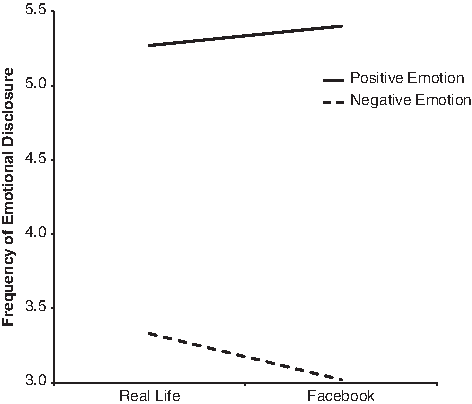
Perception of the frequency of friends' emotional disclosure in real life and on Facebook.
Discussion
Our study has important theoretical implications. We present new evidence of how users present an enhanced self-image on Facebook. Results from both self-report and observer rating consistently suggest that users are more likely to disclose positive relative to negative emotional experiences on Facebook than in real life, and lead viewers to have a better impression of their emotional well-being. While previous studies have shown that Facebook users tend to display attractive profile images, pictures with friends, and friend lists, to create a better social image,22,25 our study is the first to demonstrate impression management on Facebook through emotional disclosure.
Studies have shown that users present their true personality rather than an idealized self-image on Facebook.29,30 Viewers can predict users' personality traits, including Extraversion, Agreeableness, Conscientiousness, and Openness, but not Neuroticism. 30 Our results do not contradict these findings, as personality traits and emotional experiences are two different dimensions. One may represent their true personality, while limiting the disclosure of negative emotions. Interestingly, our result may support Back et al.'s 30 finding because neuroticism is associated with the tendency to experience negative emotions. 31 It may be because users limit the disclosure of their negative emotional experiences, and therefore make neuroticism difficult to predict.
In Study 1, we used single-item measures to assess how likely participants would express positive (vs. negative) emotions on Facebook versus real life. Participants may have responded in a socially desirable manner, and their self-reports may not reflect their actual behavior in real life and Facebook. However, in Study 2, we asked participants to provide observer-reports of their friends' emotional experiences on Facebook versus in real-life. The same pattern in Study 1 is replicated in Study 2: even as observers, participants reported that their friends (a) expressed more positive than negative emotions in general; and (b) this difference is more striking on Facebook than in real life. Given the consistent pattern of results across the two studies, we believe the single-item measures we used are valid. Importantly, Study 2 helps us rule out the effects of social desirability, because participants are reporting about their friends and not directly about themselves. Thus, not only do people report that they themselves express less negative emotion on Facebook than in real life, but they are also able to observe this discrepancy as viewers of their friends' Facebook profiles.
Our study has important practical implications. As online social networking are becoming mainstream in today's digital age, it is important to understand its social consequences and the underlying mechanism of these consequences. Our study partially explains why more use of Facebook is associated with the perception of others being happier and having better lives. 28 By informing people that presenting more positive than negative emotional experiences is a prevalent behavior on Facebook, we can help them adjust their impression of others' lives and reduce the possible negative effect of upward comparison.
Footnotes
Author Disclosure Statement
The authors declared that they had no conflicts of interest with respect to their authorship or the publication of this article.