




Abstract
Abstract
The present study investigated when and how the level of interactivity in politicians' Twitter communication affects the public's cognitive and affective reactions. In a Web-based experiment (n=264), participants viewed a high profile male politician's Twitter page, wherein he was either actively responding to his followers' questions (high interactivity) or mostly posting messages on his own (low interactivity). Exposure to the high-interactivity Twitter page induced a stronger sense of direct conversation with the candidate (social presence), but only among less affiliative individuals who usually avoid social interaction. Heightened social presence, in turn, led to more positive overall evaluations of the candidate and a stronger intention to vote for him. Although those in the high-interactivity condition generated more positive thoughts, they had fewer issue-related thoughts and exhibited poorer recognition of the issues mentioned by the candidate.
Introduction
Among several unique characteristics of Twitter, we focused on interactivity. Despite numerous conceptual and operational definitions of this elusive construct, 10 researchers seem to concur on two types of interactivity: one manifested in technological functions, such as hyperlinks and multimedia presentations, and the other materialized through textual strategies, such as the use of first-person address and personalized content.11–13 Considering that direct, reciprocal communication is at the heart of SNS communication, we conceptualized interactivity as the extent to which a politician's Twitter communication represents two-way conversations, as opposed to one-sided public addresses. By varying the degree to which a politician engages in virtual conversation with his/her followers on Twitter and examining how such a variation alters the public's cognitive and affective reactions, we aimed at elucidating when and how politicians' Twitter-based campaigns yield positive outcomes.
The benefits of interactivity in Internet-based political campaigns have been well documented, but not without qualifications. Directly germane to the present study, when the candidate responded to voters' comments on his SNS page, participants expressed more favorable attitudes toward the candidate, albeit only for the right-wing candidate. 14 However, when interactivity was operationalized in terms of the number of hierarchical layers of related links on a politician's Website, intermediate, not high, level of interactivity elicited the most favorable perceptions of and the strongest agreement with the candidate. 11 Similarly, Warnick et al. 13 examined how campaign-to-user interactivity (i.e., the ability for campaigns and users to communicate with each other) and text-based interactivity (i.e., stylistic verbal and nonverbal devices fostering a sense of interaction) affect the site visitors' cognitive engagement, and reported that each form of interactivity improved the participants' recall of the candidate's issue positions, whereas their joint presence hindered it. Taken together with the findings that the inclusion of interactive features caused greater disorientation and confusion, but elicited more positive evaluations of the news Website (i.e., interactivity paradox), 15 it seems imperative to investigate (a) under what conditions and (b) through what psychological mechanism the level of interactivity in politicians' Twitter communication affects the public's reactions.
One explanation for why heightened interactivity induces more positive reactions concerns social presence. Defined as the extent to which a person feels as if he/she were ‘with’ the communication partner, engaging in a direct, face-to-face conversation,16–18 social presence has often been examined in more technologically advanced contexts. However, presence can be vividly experienced in more traditional, even asynchronous communication contexts, such as hearing a prerecorded voice message. 19 What is more, such illusory feelings of being together with the mediated partner may go beyond participating individuals, as people “feel like co-listeners” while watching “a television character just talking to other characters on the screen” (p. 182). 20 Just as TV viewers at home feel intimate with the TV persona who casually “mingles with the studio audience in a question-and-answer exchange” (p. 218), 21 those reading the candidate's verbal exchange with other followers might find it easier to vicariously participate in the virtual interaction with the candidate than do those reading the candidate's monologic posts.
Heightened presence might, in turn, affect individuals' evaluations of and attitudes toward the target. When social presence was defined as perceived closeness and connectedness in mediated communication, intimateness was positively related to the participants' judgments of their partner's competence and trustworthiness, while perceived co-presence elicited higher ratings of trustworthiness. 22 Likewise, when interacting with a computer agent, having control over the message presentation induced a stronger presence of the agent, which prompted more positive thoughts about the agent. 18 In fact, albeit only among socially reserved individuals, the exposure to a politician's microblog page increased a sense of direct interaction, compared with a news article simply re-mediating the politician's messages, which improved both overall impressions and the vote intention. 23 Collectively, these findings indicate that social presence fosters more favorable reactions.
Such positive effects of interactivity, however, might hinge on the social perceiver's interpersonal orientation. Affiliative tendency, which refers to “generalized positive expectations in social relationships” (p. 98) 24 and taps the preference for attachments (vs. independence) and group (vs. individual) activities, might operate in two different ways. First, those high in affiliative tendency might be better at mentally reconstructing the virtual interaction with the target, regardless of how interactive the target's tweets are. Just as extraverts can decode nonverbal cues more accurately due to more social practice, 25 more affiliative individuals might be better equipped to vividly imagine the interaction with the candidates even when their messages convey little conversational flare, whereas less affiliative individuals' reactions might depend more on how dialogic their Twitter communication is. The aforementioned finding that the remediation of a politician's microblog messages lowered perceived presence only among those low in affiliative tendency 23 supports this conjecture.
Affiliative tendency might also affect the perceived valence of social presence. Given that affiliative tendency was negatively correlated with the tendency to avoid social contacts and the amount of discomfort they experience in social situations, 24 heightened social presence might not elicit positive reactions from less affiliative individuals. By contrast, highly affiliative individuals not only hold more favorable attitudes toward social interaction, but they also like others with a similar orientation (e.g., “I prefer a leader who is friendly and easy to talk to over one who is more aloof and respected by his/her followers”) (p. 98). 24 If so, increased presence is more likely to evoke positive reactions from more affiliative individuals.
When the politicians' Twitter pages highlight the conversational give and take with their followers, it might also affect individuals' message processing. On the one hand, considering that involvement is “the degree to which an audience member perceives a connection between him or herself and mass media content,” (p.112) 26 and that increased involvement facilitates message elaboration, the candidate's frequent engagement in a seemingly spontaneous interaction with voters just like themselves might help participants build a psychological connection with the content, promoting more thorough message processing. On the other hand, increased interactivity can hinder the participants' recall of the candidate's issue positions 12 and cause greater disorientation and confusion, while eliciting more positive evaluations of the Website. 15 Given these competing possibilities, the following questions were proposed.
Method
Participants
Two hundred sixty-four participants (117 men, 147 women; age M=32.95, SD=8.06) were recruited through an online survey company in South Korea. On visiting the study Website, they were asked (a) whether they were using Twitter, and if yes, (b) whether they were following any politicians on Twitter. Based on their responses, only current Twitter users who did not follow any politicians were allowed to proceed.
Procedure
After answering questions on demographic information, Twitter use, and their attitudes toward several political leaders, participants viewed a mock-up Twitter page of Simin Rhyu, a former minister of Health and Welfare and the leader of a liberal political party, who boasts the largest number of followers among politicians. Eleven tweets were created by slightly modifying his actual tweets. Four of them concerned controversial political issues, such as the sale of nonprescription medicines at convenience stores and a political rally of the Korean Teachers and Educational Workers' Union. The remaining posts pertained to his personal life, including his vacation plan, his favorite sport, and leisure activities. For the high-interactivity condition, eight messages were replies to his followers' questions or mentions (e.g., “Actually, my fourth-grade son and I are diehard soccer fans. When there is a big game, we go to Sang-Am stadium to watch it with our own eyes. Among the K-league teams, Kangwon FC and Jeju Utd are my favorites. RT@story What's your favorite sport?”). For the low-interactivity condition, only two messages were his responses to the followers (i.e., a thank-you note to the congratulatory mention on his book, an answer to the question about the college tuition issue). The information contained in the question was incorporated in the candidate's answer, and the time stamps were removed.
Measures
First, participants indicated (a) the duration of Twitter use (M=9.45 months, SD=8.40), (b) the time spent on Twitter daily (M=45.44 minutes, SD=60.04), and (c) their attitude toward the target (1=Dislike him very much, 7=Like him very much; M=3.55, SD=1.54). Immediately after viewing Rhyu's Twitter page, participants had three minutes to list the thoughts that came across their minds while reading his messages.18,27 Two independent coders analyzed listed thoughts (n=857), identifying whether they were (a) source related (i.e., feelings and thoughts about the target, e.g., “He seemed like a warm person,” “Less aggressive than I thought”: 0=No, 1=Yes), (b) issue related (i.e., thoughts concerning issues of public interest, e.g., “I wish college tuition was lower” “I oppose Teachers' Union very much”), (c) positive, and (d) negative. Inter-coder reliability was computed using Cohen's kappa, 28 and the scores were averaged between the coders (see Table 1). The proportion of source-related thoughts to the entire entry was 78.6 percent, and that of issue-related thoughts was 18.1 percent.
Cohen's κ for the number of thoughts (5–8).
p<0.05l; ** p<0.001.
For social presence, participants indicated how much they agreed with the following statements16,17: “I felt as if I were engaging in an actual conversation with him,” “I felt like I was in the same room with him,” “I felt as if he was speaking directly to me,” and “I could imagine him vividly” (1=Strongly disagree, 7=Strongly agree).
For affiliative tendency, a revised version of Mehrabian's 29 Affiliative Tendency scale adapted for Korean respondents 30 was used, which includes “I like to make as many friends as I can,” “I prefer independent work to cooperative one,” and “I would rather read a book or go to a movie than spend time with friends.” (1=Describes me very poorly, 7=Describes me very well).
For an overall evaluation of the candidate, participants rated the candidate on nine items tapping intelligence, competence, leadership, selfishness, morality, trustworthiness, honesty, likability, and attractiveness.31,32 Since a factor analysis yielded a single-factor solution (Eigen value=5.61, percent of variance accounted for=62.32 percent), scores were averaged.
To measure issue recognition, six issues of public controversy were presented for the participants to indicate whether or not the candidate had mentioned each one. Lastly, they answered how willing they were to vote for the target, if given a chance (1=Not at all willing, 11=Very much willing).
Results
To examine whether high interactivity enhances social presence especially among less affiliative individuals (H1), a moderated hierarchical regression analysis was performed. 33 First, prior attitudes toward the candidate, the duration of Twitter use, and daily amount of Twitter use were entered as control variables. Next, the level of interactivity (0=Low, 1=High) and mean-centered affiliative tendency were added, followed by their interaction term.*,† Those more favorably predisposed toward the candidate felt a stronger social presence, b=0.33, t=6.84, p<0.001, but neither of the Twitter use variables exerted significant influence. More significantly, a significant interaction emerged between interactivity and affiliative tendency, b=−0.35, t=−2.13, p=0.04. Simple slopes tests showed that high interactivity amplified perceived presence only among less affiliative individuals (−1 SD from the mean), with no corresponding effect for more affiliative individuals (+1 SD from the mean) (see Fig. 1). Alternatively, more affiliative participants perceived a stronger presence of the candidate than lows, only when viewing the low interactivity Twitter page, b=0.26, t=2.26, p=0.02. In the high-interactivity condition, affiliative tendency had no significant effect, t<1.

Interaction between interactivity and affiliative tendency on social presence.
To examine whether affiliative tendency moderates the effects of interactivity on the overall evaluation of the candidate and the vote intention through social presence (H2a-b), we used MODMED macro (see
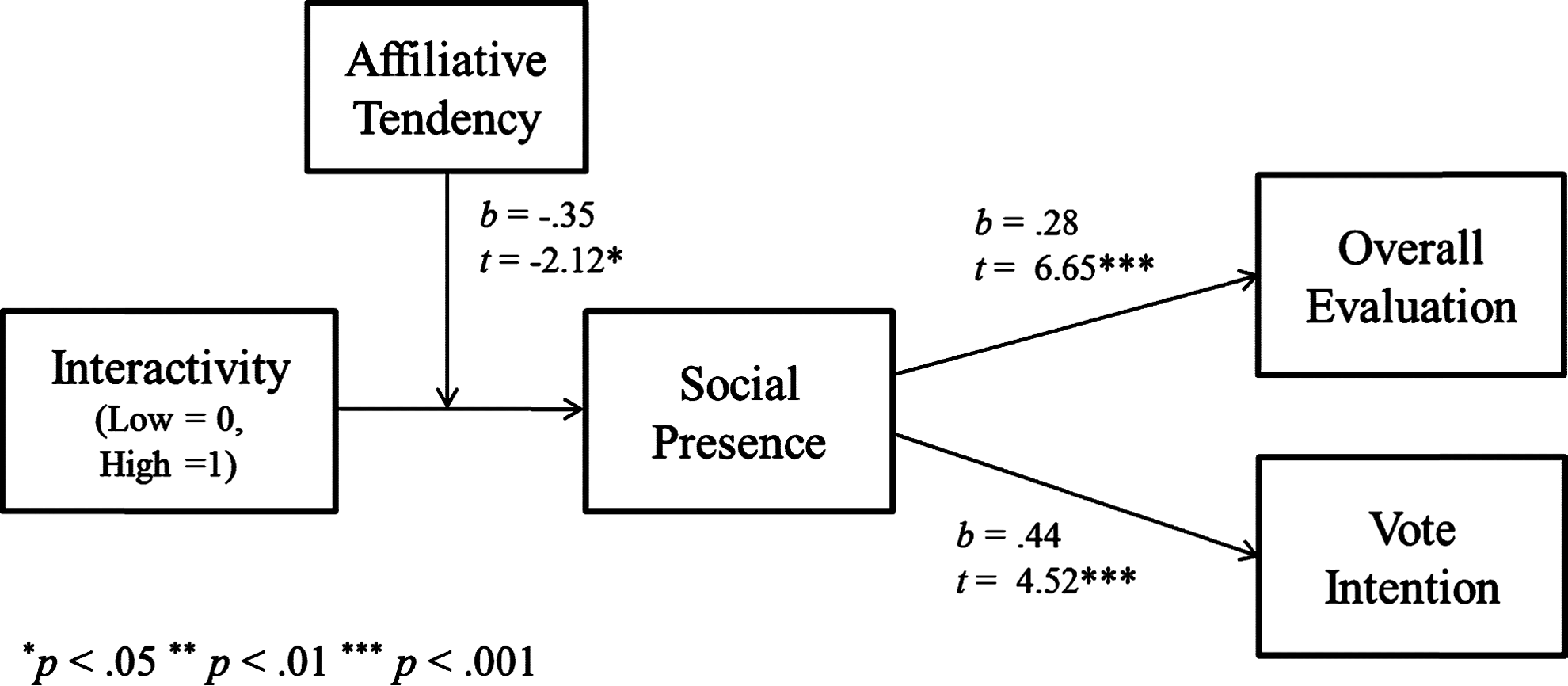
Moderated mediation model for indirect effects of interactivity.
Lastly, RQ1a–c concerned how interactivity affects individuals' message processing. Since there was no significant correlation between negative and positive thoughts (r=−0.07, p=0.24) and source-related and issue-related thoughts (r=−0.07, p=0.25), and the data deviated from normal distribution, Mann–Whitney U-tests were performed for each variable, separately. Results showed that the high-interactivity Twitter page generated more positive thoughts than the low-interactivity page, p=0.001, but had no significant effect on negative thoughts, p=0.71. Second, the high-interactivity Twitter page engendered fewer issue-related thoughts, p=0.02, with no significant effects on source-related thoughts, p=0.62. Lastly, those exposed to the high-interactivity Twitter showed poorer recognition of the issues mentioned, p=0.03.
Discussion
This study investigated how the level of interactivity in a politician's Twitter communication affects the public's evaluations of and their willingness to support the politician, as well as their message processing. Less affiliative individuals experienced varying degrees of the candidate's presence depending on how much his Twitter communication entails reciprocal conversations with other followers, whereas more socially active and practiced individuals' reactions did not change significantly. Still, given that the target was a well-known politician, the facts that interactivity nonetheless significantly altered less affiliative individuals' impressions of him and their vote intention seem to suggest robust effects.
Contrary to the uniformly positive effects on affective reactions, high interactivity appeared to divert the participants' attention from the politician's tweets and hinder message elaboration. Although they had more positive thoughts while viewing the high-interactivity Twitter page, they listed fewer issue-related thoughts and displayed poorer recognition of the candidate's policy agendas. While presenting a practical dilemma for politicians who wish to utilize Twitter to raise the public's awareness of their agendas, such results resonate with the past findings that (a) the joint presence of high text-based and high campaign-to-user interactivity lowered issue recall 13 and (b) people found the interactive news Website to be more credible and informative, but more confusing and frustrating, once again highlighting the paradoxical effects of interacitivity. 15
Some issues demand further investigation. First, our participants simply viewed the target's Twitter communication as third-party observers. However, their reactions might change when they actually engage in an interaction with the target, however limited that may be, capturing the true value of SNS. Second, seeing other followers casually addressing questions to the politician might have affected participants' perception of the politician's popularity. Although overall evaluations of the candidate included items tapping perceived likability and attractiveness, they represented the participants' own feelings, rather than their beliefs about how others view the candidate. Thus, future research should examine whether observing the candidate's interaction with other Twitterians alters individuals' perceptions about how the public thinks of the candidate, which may or may not affect their own reactions. Lastly, the current results might have stemmed in part from unique properties of Twitter and, thus, might not be replicable with other SNSs. Considering that people use Facebook primarily for relationship maintenance, while using Twitter for information sharing, 35 for example, politicians' interaction with voters might be more expected on Facebook than on Twitter, which demands further investigation.
As a medium that is privately owned, yet capable of reaching the mass audience in no time, SNSs can serve as a cost-effective means of direct communication with voters. Extending previous studies examining interpersonal orientations as predictors of SNS use, we demonstrated that affiliative tendency also serves as a moderator of its effects, thereby drawing attention to the reception side of SNS-mediated communication, a relatively understudied domain thus far. More than anything else, our findings highlight the need for more theory-grounded research on the implications of Twitter as a campaign tool, going beyond the sheer number of followers and the frequency of retweets.
Footnotes
Acknowledgment
This research was financially supported in part by the Institute of Communication Research, Seoul National University.
Author Disclosure Statement
No competing financial interests exist.
*
All assumptions for statistical analyses were met, unless noted otherwise.
†
Among the demographic variables (gender, age, education), age (r=0.11, p=0.07) and education (r=0.12, p=0.05) had marginally significant correlations with social presence. However, the interaction between interactivity and affiliative tendency (H1) remained virtually unaltered, even after covarying them out, b=−0.38, t=−2.34, p=0.02. Likewise, although the more educated participants listed more issue-related thoughts (RQ1b) (r=0.12, p=0.04), there was no significant difference in the level of education between the high- and low-interactivity conditions (t<1), indicating that education does not explain the interactivity effect.