




Abstract
Abstract
The aim of this study was to determine the prevalence of cyberstalking victimization, characteristics of victims and offenders, and the impact of cyberstalking on the victims' well-being and mental health. An online survey of 6,379 participants was carried out, involving users of the German social network StudiVZ. Subjective mental health status was assessed with the WHO-5 well-being index. The prevalence of cyberstalking was estimated at 6.3%. In various aspects, cyberstalking was comparable to offline stalking: cyberstalking occurred most often in the context of ex-partner relationships; most of the victims were female and the majority of the perpetrators were male. Compared to non-victims, victims of cyberstalking scored significantly poorer on the WHO-5 well-being index. The prevalence of cyberstalking is considerable. However, if stringent definition criteria comparable to those of offline stalking are applied, it is not a mass phenomenon. The negative impact of cyberstalking on the victims' well-being appears similar to that of offline stalking. Hence, cyberstalking should be taken as seriously as offline variants of stalking by legal authorities and victim assistance professionals.
Introduction
T
Whereas stalking research has evolved over the past two decades, research on cyberstalking is still sparse. The few estimates of cyberstalking victimization vary considerably across studies, ranging from 3.7% 5 to 82%. 6 These variations are primarily due to different definitions of the phenomenon. Studies that are based on broad inclusion criteria found prevalence rates for cyberstalking of approximately one third to almost half of the sample.2,4,6–8 Using a more restrictive definition of cyberstalking—for example, including a particular duration or quality of the unwanted contacts—far lower prevalence rates of 6%, 9 9%, 10 and 10–15% 11 were found. The latter estimates are comparable to those reported for population-based studies of (offline) stalking.12–16 Inconsistent definitions pose a problem on stalking research in general. However, definitions of (offline) stalking typically include unwanted and repetitive behaviors which are perceived as intrusive, frightening, threatening, or harassing.13,17 Specifically, the majority of antistalking legislation requires the perpetrator's behaviors to cause a reasonable person fear. 17 Whether cyberstalking is more prevalent than stalking, as some authors assumed,2,4 can only be clarified if comparable definition criteria for cyberstalking and (offline) stalking are applied, which is an objective of this study.
Another unanswered question is whether cyberstalking should be regarded as one of many variants of stalking, or if it represents a distinct phenomenon. Some studies found considerable differences between (offline) stalking and cyberstalking; for example, a higher frequency of male victims of cyberstalking compared to offline stalking 5 or strangers as the most frequent type of perpetrators in cyberstalking but not in offline stalking.4,11 These results suggest that online environments may attract perpetrators who would not harass other individuals outside the virtual world. On the other hand, there is evidence that communication technology is frequently used by both females and males to monitor intimate partners 18 and that online social networking sites like Facebook facilitate relational intrusion-like behaviors. 19 Similarly, some studies report ex-partners as the most frequent category of cyberstalkers,3,5,20 comparable to (offline) stalking. Sheridan and Grant (2007) 3 found cyberstalking to be adjunct to or indistinguishable from offline stalking in many characteristics. Furthermore, cyberstalking behavior is reported in one of four stalking cases. 1 There is also evidence for an overlap between online and offline harassment in adolescents, with cyber technology providing new tools for youth who already engage in aggressive behaviors 21 or cyberstalkers being often (former) offline friends or acquaintances. 22
Research on (offline) stalking showed detrimental consequences for the victims' well-being, social life, and mental health.23–28 One study indicates that the extent of physical, emotional, and social consequences did not significantly differ between stalking victims with differing degree of cyber-involvement. 3 However, this result stems from a sample of self-referred stalking victims; no study has yet compared the well-being of cyberstalking victims and non-victims within one sample. Furthermore, the health status of cyberstalking victims has not been assessed to date by means of a standardized measure.
The aims of this study are, first, to estimate the prevalence of cyberstalking. In particular, we hypothesize:
Second, we aim to investigate characteristics of cyberstalking, specifically methods of cyberstalking, duration, and frequency, as well as characteristics of victims and offenders. Third, we aim to study the psychosocial impact of cyberstalking from the victims' point of view and the mental well-being of victims and non-victims. Specifically, we hypothesize:
To our knowledge, this is the first study that directly compares the well-being of cyberstalking victims and non-victims.
Methods
Procedure
Since Internet use is a prerequisite to become a victim of cyberstalking, our study sample comprised only Internet users. As stalking is an interpersonal phenomenon, 2 a sample of individuals using social networking sites was recruited. To avoid nonprobability sampling, we chose all members of a popular German social network—StudiVZ—as potential participants. StudiVZ was founded in 2005 as an online community for students, and was extended to pupils (“schuelerVZ”) and Internet users without academic background (“meinVZ”). StudiVZ had 16 million members in 2011 and operates solely in German. With 27% registered members among all German Internet users, the VZplatforms are the second most popular social network in 2011. 29 For 24 hours, a teaser from the network operator inviting users to participate in the survey and a link to the questionnaire were presented to every StudiVZ user when logging into their account.
Participants
Of the approximately 45,000 clicks registered on the link to the online questionnaire, 6,379 resulted in complete responses, corresponding to a response rate of about 14%. Missing values were not an issue, as all data entry fields were compulsory (except for text field data). The sample was 42% female, with a mean age of 24.4 years. Of these, 75% had a higher level of education (similar to high school degree) with 50% of participants attending school or university, 38.3% employed, and 11.4% unemployed. The majority (59.6%) were single, with 40.4% in a permanent relationship. For reasons of data protection, StudiVZ provided only gender and mean age of their members: 48% of all StudiVZ members are female with a mean age of 24.4 years. Thus, our sample is representative of the population of StudiVZ members in terms of gender and age.
Measures and analytical strategy
The survey comprised the following parts: (a) study information and informed consent; (b) sociodemographic, Internet use, and well-being data, which were assessed in all participants; (c) filter questions to screen for cyberstalking victimization; and (d) questions on methods, duration, frequency, and consequences of cyberstalking, which was only presented to participants who were screened as potential victims under (c). The filter questions were “Have you ever experienced that someone: (a) repeatedly contacted you personally via the Internet (e.g., by e-mail, in forums, or chatrooms) although you did not want it; and/or (b) used the Internet in any way in order to harass you, insult you, and/or spread rumors/lies about you?” The questions were adopted from the questionnaire that had been developed for the first German population-based study on stalking. 12 Questions about cyberstalking behaviors were formulated after reviewing the literature and are shown in Table 3.
Analogous to the definition criteria in the population-based study of stalking in Germany, 12 cyberstalking was assumed if (a) at least one of the filter questions was answered with “yes” (i.e., repeated unwanted contact via the Internet and/or online harassment, insult, spreading lies); (b) the duration for the cyber pursuit/harassment was a minimum of 2 weeks; and (c) the cyber pursuit/harassment caused fear. The latter two criteria were assessed by two forced-choice questions that were taken literally from the population-based survey 12 : “How long did or do the unwanted contacts/the harassment last?” (from “less than two weeks” to “longer than one year”) and “Did or do the unwanted contacts/the harassment cause you fear?” (“yes” vs. “no”).
All study participants—independent of whether or not they were victimized by cyberstalking—answered the WHO-5 Well-Being Index. 30 This questionnaire assesses the current mental well-being within the past 2 weeks with five six-step items (range 0–5), has sound psychometric qualities, and is a well-established screening instrument for depression. 31 The items are summed (range 0–25), with high scores indicating good well-being and low scores poor well-being. A score of <13 indicates impaired mental well-being. 30
Descriptive statistics were used to determine the prevalence estimate of cyberstalking (first research question) and to describe characteristics of cyberstalking (second research question). Chi-square tests and t tests were used to test for differences in sociodemographic variables between victims and non-victims. A 2×2 analysis of variance (ANOVA) with the factors “cyberstalking” and “gender” was used to compare the mental well-being (WHO-5 mean score) of victims and non-victims (third research question). Data were analyzed with the statistics program SPSS v17.0 for Windows.
Results
Prevalence of cyberstalking
The prevalence rates of cyberstalking depend upon the definition criteria (see Table 1). More than 40% of the participants stated that they have experienced online harassment at least once in their lifetime. However, adding the other two criteria—duration >2 weeks and harassment causing fear—the prevalence estimate strongly decreased down to 6.3%.
Cyberstalking victims differed significantly from non-victims with respect to sociodemographic data (Table 2). Among cyberstalking victims, there were significantly more females, more persons with fewer than 12 years of education, more unemployed persons, and fewer singles than in the group of non-victims. There were no significant differences with regard to age or nationality.
Duration, intensity, and methods of cyberstalking
A total of 32% of victims reported that cyberstalking persisted for up to 1 month. Among them, 45.1% indicated that cyberstalking persisted for up to 1 year, and 22.8% were harassed for more than 1 year. Twenty-seven percent of the victims reported having been stalked several times daily; 20.6% were contacted daily by their cyberstalker, 30.1% several times a week, 10.8% several times a month, and 11.5% only occasionally. The cyberstalking methods were as manifold as the possibilities the Internet opens up. Table 3 shows the cyberstalking behaviors that were listed in the survey, in descending order of frequency.
Relationship between perpetrator and victim, and possible motives for cyberstalking
Victims reported data of the perpetrators as far as these were known to them. Of the perpetrators, 69.4% were male, 28.1% female, and for 2.5% the sex was unknown. With regard to the relationship between perpetrator and victim, the most frequently reported category was “other person.” In about 10% of the cases, though, the acquaintanceship was solely Internet-based, while in all other cases, offline contacts occurred. Almost 35% of the cases involved so-called ex-partner-stalking, respectively stalking by a former partner of one's new partner. In 28.5% of the cases, the cyberstalker was a (former) friend or acquaintance. Figure 1 depicts the different types of perpetrator–victim relationship.
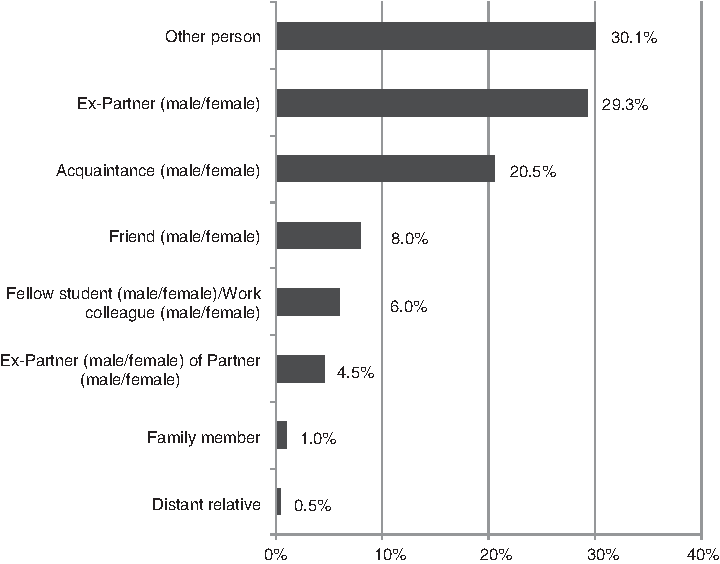
Relationship between perpetrator and victim, if known.
In addition, the presumed motivation of the perpetrator from the victim's point of view was assessed (multiple entries were allowed). In most cases, the motive was seen as a result of either a real rebuff or behavior that was interpreted as such, or as an injury or insult by the victim (61.9%). Jealousy was assumed by 54.9% of the victims, and 49.4% presumed that the cyberstalker wanted to initiate a love relationship. Revenge was the assumed motive in 39.8% of cases. Other motives included “the stalker saw something in me or imagined me to be someone I am not” (34.3%), “the stalker wanted to refresh a relationship” (31.1%), or “the stalker wanted to initiate a friendship” (23.3 %). In 13% of cases, the victims could not identify any motive for the cyberstalking behavior.
Transitions from online to offline stalking
Many victims reported transitions from cyberstalking to offline stalking or the reverse, respectively the simultaneous occurrence of both methods. Only one fourth of the cases classified as cyberstalking (25.8%) experienced purely cyberstalking. Forty-two percent reported a simultaneous onset of cyberstalking and offline stalking. In 16.5% of cases, cyberstalking was followed by methods of offline stalking, and in 15.8% of the cases, methods of offline stalking were used first, with cyberstalking setting in later. Victims of cyberstalking were also confronted by violent attacks. Twelve percent of victims reported having been grabbed or held down by the perpetrator, 8.8% reported having been hit with the hand, and 3.8% reported having been attacked with objects.
Impact of cyberstalking on the victims
Victims were presented a list of psychosomatic and psychosocial problems, and were asked if they had suffered from any of them as a consequence of cyberstalking (see Fig. 2). Only 2.5% reported that cyberstalking did not have any negative consequences. More than half of the victims reported feelings of anger and aggression as well as of helplessness, two thirds reported sleep disturbances and distrust toward other people, and almost 80% reported a feeling of inner unrest. Sixteen percent of cyberstalking victims reported that they referred themselves into professional counseling or therapy because of the negative impact of cyberstalking.
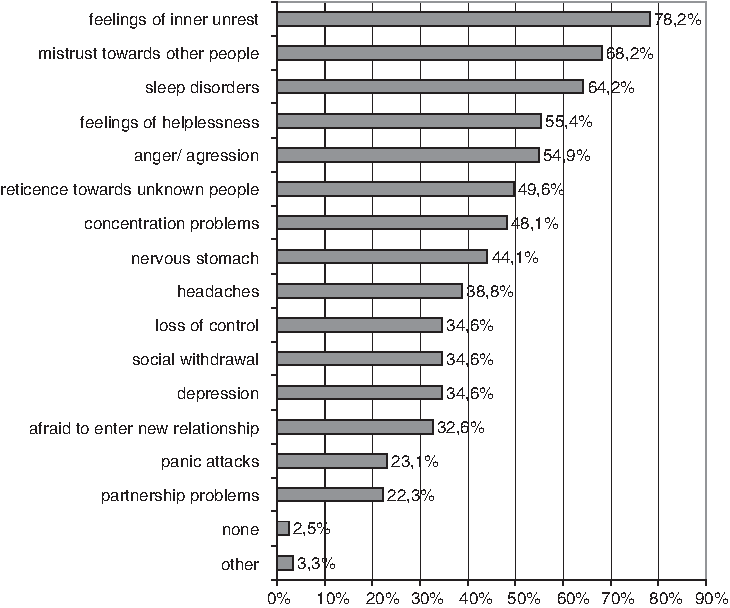
Frequency of psychosomatic, psychological, and social consequences of cyberstalking.
The WHO-5 Well-Being Index 30 was used to assess mental well-being in victims and non-victims. A 2×2 ANOVA with the factors “cyberstalking” and “gender” showed a highly significant main effect of cyberstalking on the WHO-5 total score, F(1, 6,375)=43.8, p<0.001. Victims of cyberstalking showed a poorer mental well-being with a mean score of 11.47 (SD=5.18), compared to a mean score of 13.38 (SD=4.94) in the group of non-victims, resulting in an effect size of d=0.39 (using pooled standard deviation). The gender of the victim had no significant main effect on the WHO-5 score, F(1, 6,375)=0.9, n.s.). There was also no significant interaction effect of sex and cyberstalking victimization, F(1, 6,375)=1.9, n.s., meaning that the negative effect of cyberstalking on the victims' mental well-being was comparable for men and women. There was no difference in the WHO-5 sum score between victims of cyberstalking only (M=11.61, SD=5.37) and victims who were also harassed offline (M=11.43, SD=5.11, t(397)=−0.314, p=0.754).
Discussion
The present study investigated the prevalence of cyberstalking, typical features of the victims and the perpetrators, as well as the potential negative impact of cyberstalking in members of the social network StudiVZ.
If all individuals who stated unwanted contacts/harassment via the Internet were included, cyberstalking would apply to almost half of our sample. However, by using definition criteria comparable to those applied in the first population-based study on stalking in Germany, 12 the prevalence rate for cyberstalking was estimated at 6.3%, which is similar to the prevalence estimate for (offline) stalking in Germany. 12 This result supports our first hypothesis. Considering the large (and still growing) number of Internet users, cyberstalking can indeed be termed a frequent phenomenon. At the same time, our result shows that cyberstalking does not represent a mass phenomenon, as suggested by some studies,2,4,6–8 if definition criteria analogous to those of offline stalking are applied. Our prevalence estimate of cyberstalking also corresponds to the prevalence rates of other studies with rather restrictive definition criteria.9–11,22 In our opinion, not every unwanted contact via the Internet should be classified as cyberstalking. Instead, we suggest that future studies define cyberstalking based on acknowledged definition criteria for offline stalking. 17 As most legal definitions require the perpetrator's behavior to cause a reasonable person fear, 17 we recommend adding this subjective criterion to the definition of cyberstalking. Likewise, somewhat jokey terms like “Facebook Stalking”—that is, gathering information about people or keeping track of someone's Facebook profile 32 —should be omitted, as they trivialize the seriousness of cyberstalking. To name less severe methods of online pursuit, alternative terms have been proposed, for example “cyber obsessional pursuit (COP)” 33 or “online obsessive relational intrusion.” 34
Significantly more women (80.5%) than men in the current study had been victimized by cyberstalking, while among the perpetrators, men significantly predominate. This finding is in line with population-based studies on stalking.12–16 However, the percentage of female perpetrators is somewhat greater than that in studies of offline stalking: 28% of the victims reported a female cyberstalker, while the percentage of female perpetrators in population-based studies was noticeably lower.12–16 It seems that the opportunity to avoid direct perpetrator–victim interaction in online environments may tempt more women to engage in cyberstalking, which is in line with the finding that more women than men use indirect stalking behaviors. 34
Comparable to offline stalking, the majority of cyberstalking victims are acquainted with the perpetrator. In almost 35% of cases, cyberstalking involves the so-called ex-partner stalking, and in an almost even percentage of cases, cyberstalking occurs in other offline social relationships. The current study cannot support the assumption of Hoffmann (2006) 35 and Pathé (2002) 36 that the cyberstalker develops his/her obsession for an unknown individual in a chatroom and then later might extend his/her pursuit behaviors to other channels. Also the victims' report of the assumed motivation of the perpetrator shows obvious parallels to the motives for (offline) stalking. 12 Our results support, in line with other studies, the notion that cyberstalking rather represents an adjunct or a variant of stalking than a distinct phenomenon.3,20
The self-rated mental well-being of cyberstalking victims was significantly worse than that of non-victims, which confirmed our hypothesis. The mean WHO-5 score of the cyberstalking victims was similar to the mean score of stalking victims in the German population-based study. 12 Comparable to Sheridan and Grant (2007), 3 we found no differences between victims of “pure” cyberstalking and victims who were additionally harassed offline. Thus, there is evidence that the negative consequences of “pure” cyberstalking are similar to those of stalking cases, which exclusively or additionally involve offline harassment. Moreover, we found neither gender differences in the WHO-5 score nor did the negative effect of cyberstalking on the victims' well-being differ between males and females. This result seems contrary to findings that women suffer greater health consequences from stalking than men.26,37 One explanation for divergent results may be the fear criterion that was required for cyberstalking victimization in our study: Victims' fear levels were shown as the best predictor of physical and psychological health consequences, mediating the relationship between victim gender and the consequences of stalking. 38
Limitations and strengths
The study participants could not be randomly selected. Therefore, the sample cannot be regarded as being representative of the total population. However, our sample corresponds to the total population of the networking site StudiVZ with respect to age and gender, indicating representativeness at least regarding basic sociodemographic data. Since the motivation to participate in the study is unknown, a certain overestimate of the determined prevalence rates must be assumed. However, this bias must also be assumed for population-based studies.12–15
Even if negative health consequences of stalking victimization can no longer be doubted,23–28 it should be pointed out that, due to the study design, only correlative statements can be derived. Contrary to a poor mental health status as a result of cyberstalking victimization, a reverse relationship might also be possible. One study indicates that an existing mental disorder may pose a risk factor for becoming a stalking victim. 39
With almost 6,400 participants, the current study is the largest on cyberstalking carried out to date. Furthermore, about half of the sample comprised non-students. As most of the existing cyberstalking studies rely on convenience samples, have small sample sizes, and/or exclusively investigate college samples,2,4,5,6,11 this study offers a broader empirical data basis to shed light on cyberstalking and its impact upon victims.
Footnotes
Author Disclosure Statement
No competing financial interests exist.