




Abstract
Abstract
In a national online longitudinal survey, participants reported their attitudes and behaviors in response to the recently implemented metered paywall by the New York Times. Previously free online content now requires a digital subscription to access beyond a small free monthly allotment. Participants were surveyed shortly after the paywall was announced and again 11 weeks after it was implemented to understand how they would react and adapt to this change. Most readers planned not to pay and ultimately did not. Instead, they devalued the newspaper, visited its Web site less frequently, and used loopholes, particularly those who thought the paywall would lead to inequality. Results of an experimental justification manipulation revealed that framing the paywall in terms of financial necessity moderately increased support and willingness to pay. Framing the paywall in terms of a profit motive proved to be a noncompelling justification, sharply decreasing both support and willingness to pay. Results suggest that people react negatively to paying for previously free content, but change can be facilitated with compelling justifications that emphasize fairness.
Introduction
The NYT is an American daily newspaper that has been in circulation since 1851 4 and is commonly known as the “newspaper of record.” 5 Its online “audience” in the fall of 2011 was roughly 34 million. 6 Aside from a 2-year period when the company required subscriptions for articles by its columnists, the NYT has been free to visitors since 1996 when it went online. 7 In March 2011, the NYT implemented “digital subscriptions.” The publisher described the change as “an investment” to strengthen the company's “journalistic mission” and allow “digital innovations,” 8 but provided little overall justification. Thus, it is unclear what specifically motivated the change. Readers would need to purchase a digital subscription or be limited to 20 free articles every 4 weeks. In April 2012, the number of free articles decreased to 10. Despite these changes, the paywall remains relatively easy to bypass with loopholes or creative workarounds. 9
The NYT is not the first news provider to charge for online access, 3 but as the Internet's fifth most visited news site in the United States,10,11 the NYT's decision is likely to have a broad impact and provides a unique opportunity to study consumer responses. We surveyed consumers just as the paywall began to assess initial perspectives and again 10 weeks later to determine whether people accepted or resisted the change. We also implemented a justification manipulation to test whether explanations for the paywall affected consumer acceptance. The importance of justification is exemplified by the chief executive of Netflix, who acknowledged that “full justification” may have prevented the public outcry that emerged in response to the online movie-rental company's proposed price restructuring. 12
Considering the publisher's omission of a strong justification for the NYT paywall, we expected negative reactions to its implementation. Although people accept price increases seen as fair, 13 they often have aversive responses to restrictions on their behavioral freedom. 14 Psychological reactance can prompt attempts to bypass restrictions 15 and devalue a restricted choice. 16 If the NYT paywall motivated reactance, consumers unable or unwilling to pay might seek out loopholes, devalue the NYT, and find alternatives. 17 In contrast, participants who paid may increase their value of the NYT.18,19
Because reactance may be particularly high without a compelling justification,13,20 we reasoned that a justification manipulation would affect support and willingness to pay. We hypothesized that participants led to believe that the paywall was a result of financial necessity would be more accepting than those led to believe it was motivated by profit. Effects of justification may be amplified by partisan affiliation.21,22
Method
Participants and procedure
Data were collected in two stages. A first survey allowed a cross-sectional analysis of participant perspectives just as the paywall began. A second survey allowed a longitudinal analysis from a subset of participants who completed both surveys.
Data were originally collected from 954 volunteers, using a chain-referral sampling strategy. 23 This approach maximized the likelihood of reaching participants who were at least occasional NYT readers (i.e., those most likely to be affected by the paywall). The survey was initially announced on social networking Web sites, online news outlets, blogs, and by e-mails to list serves and individuals. Announcements contained a request to publicize the survey. Participants represented 520 unique American zip codes across 46 states and the District of Columbia. Seventy participants (7 percent) resided outside the United States. The first survey became available 8 days after the paywall announcement—3 days before its implementation on March 28th. 24 Even though the “prepaywall” survey remained available until April 6th, 87 percent of responses were received by March 28th. *
Participants were evenly divided by gender (51 percent women), had an average age of nearly 42 (M=41.62), median annual income between $50,000 and $79,999, and were primarily college educated (93 percent)—similar demographics to the online NYT readership. 6 Most participants described themselves as liberal (78 percent), with relatively few moderates (11 percent) and conservatives (10 percent).
Beginning June 15, 2011, participants were asked to complete a postpaywall survey. Participants had not been required to provide their e-mail address and many did not, reducing the available pool to 656. Sixty-one percent of these completed the postpaywall survey (n=400). †
Several differences emerged between those who only completed the prepaywall survey and those who completed both surveys. Returning participants were younger (Mpost= 39.39; Mpreonly=43.24) and were more likely to have some graduate education (85 percent vs. 73 percent) (ps<0.001). Returning participants also had lower incomes—approximately 51 percent earned under $50,000, compared with 39 percent of those who only completed the prepaywall survey—and were more likely to report being liberal or extremely liberal (74 percent vs. 55 percent) (ps≤0.02). In general, however, the magnitude of differences appeared relatively small.
Measures
The prepaywall survey asked about participant's behaviors, attitudes, and intentions (complete survey available upon request). Participants were asked how frequently they visited the NYT Web site; how much they valued the NYT in news, opinion, and information (forming a single “value” scale; α=0.74); and whether they planned to pay. Participants who planned not to pay were asked about possible responses (e.g., switching to another news source), their reason for not paying, and the certainty of their choice. All participants rated how expensive they found the price of digital subscriptions. Demographic questions concluded the survey.
Participants responded to several items assessing their views about the paywall. Principle components analysis led to the creation of three scales (see Appendix): social inequality (α=0.81) assessed views that the paywall would exclude some groups, financial necessity (α=0.74) assessed views that the paywall was fair and necessary, and polarized content (α=0.85) assessed views that the paywall would cause the news to become polarized.
Items on the postpaywall survey were similar but reframed when necessary to reflect behaviors rather than intentions. The experimental justification manipulation was presented at the end of the postpaywall survey. Participants were randomly assigned to one of two conditions. In both, participants read a short paragraph with factual information, but the justification differed. In the profit condition, participants read that “revenue from subscriptions has traditionally been a small contributor to newspapers' bottom line (Grueskin, Seave, & Graves, 2011)” and that “data from the NY Times’ most recent quarterly report (May 2011) show that the company made over $5 million in profit.” The paragraph concluded that “…if the NY Times does not implement online subscriptions, the likelihood that it will remain profitable seems high.” In the bankrupt condition, participants read that “advertising does not work as well online as in print (Grueskin, Seave, & Graves, 2011)” and that “data from the NY Times’ most recent quarterly report (May 2011) show that both circulation and advertising revenue have decreased.” The paragraph concluded that “…if the NY Times does not implement digital subscriptions, the likelihood that it will go bankrupt seems high.” Following the experimental manipulation, participants rated how the information changed their support for the paywall and their willingness to pay.
Results
Prepaywall descriptive statistics and attitudes
Participants were regular visitors to the NYT. Approximately half (48 percent) visited the NYT online at least once daily, with a modal response of several times per day. Participants also valued the NYT with a mean response near 3 (M=2.96) on a scale from 1 (Not at all) to 4 (Very much). Nevertheless, only 7 percent planned to buy or had already purchased a digital subscription. Another 12 percent already had a paper subscription that provided online access and 16 percent were unsure of their response. Of the 65 percent who planned not to pay, 59 percent felt very certain of their response.
Results suggest that price and availability of free news sources were barriers to paying. Most participants rated the paywall as expensive (68 percent), though only 18 percent of those who planned not to pay or were unsure said it was “very true” that they could not afford it. Few (6 percent) thought the price was inexpensive, with about a quarter (26 percent) indicating the price was about right. Participants who planned not to pay or were unsure most commonly planned to stay within the free monthly limit (60 percent), switch to other news sources (44 percent), and use loopholes (39 percent).
Participant clusters
We conducted a series of two-step cluster analyses to investigate participant characteristics based on the social inequality, financial necessity, and polarized content scales. Results consistently revealed a two-cluster solution. Subsequent analysis using K-means clustering yielded the same two clusters and stable cluster membership across repeated analysis and randomization of data order. Discriminant function analysis supported the two-cluster solution: Wilks' λ=0.36, χ2 (3)=969.92, p<0.001.
People in the “inequity” cluster (n=514) felt the paywall would contribute to social inequality and, to some extent, polarized news content, and disagreed that charging was a financial necessity (see Fig. 1). People in the “indifferent” cluster (n=440) were relatively neutral about whether the paywall would affect social inequality, felt it was unlikely to polarize news content, and were neutral about its financial necessity.
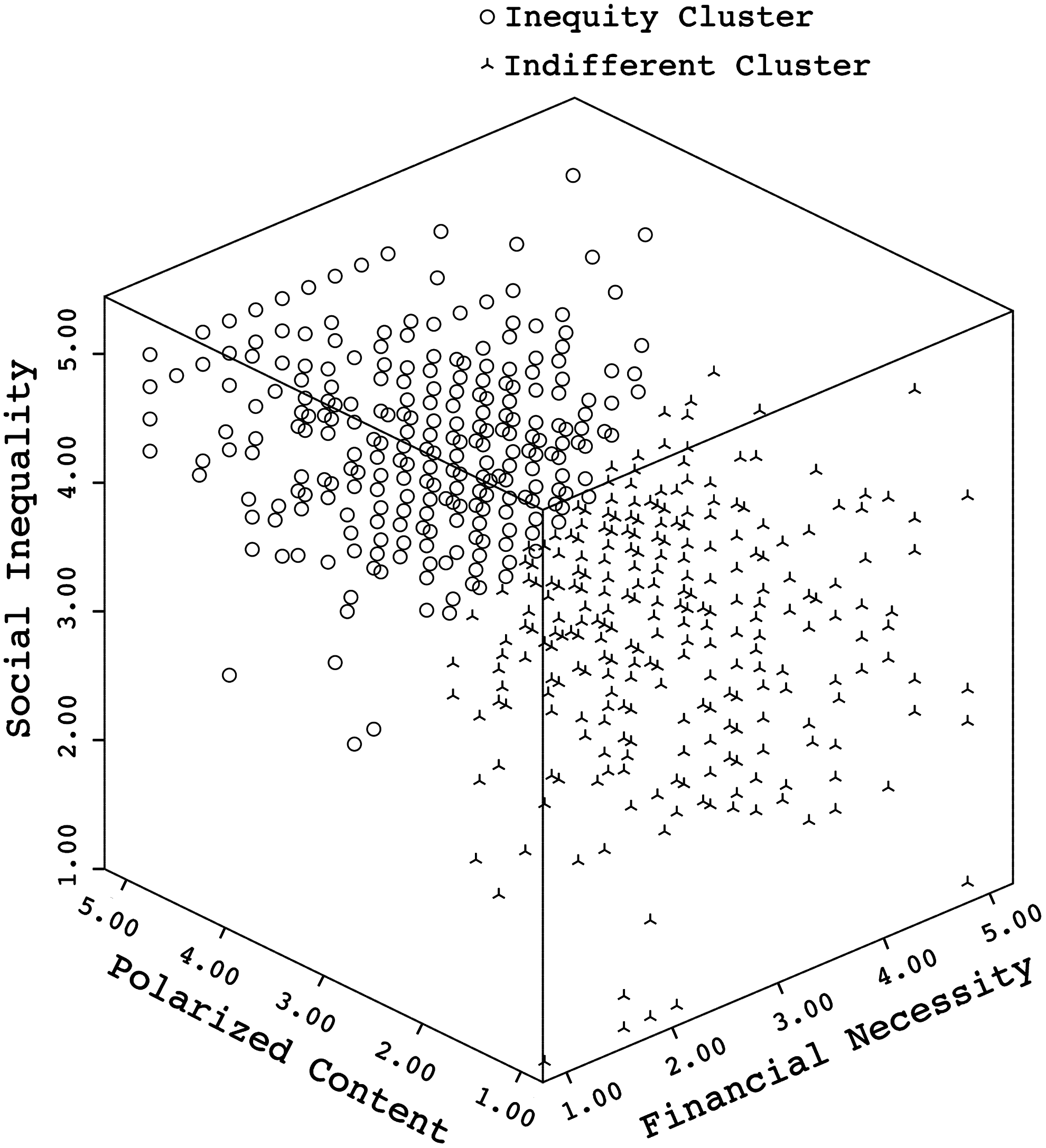
Three-dimensional scatterplot of 2-cluster solution based on the social inequality, polarized content, and financial necessity scales.
The clusters differed on reactions to digital subscriptions (see Table 1). People in the indifferent cluster more frequently planned to initiate a print subscription to get online access, but they were also more unsure of their planned response. People in the inequity cluster more frequently reported that they would not purchase a digital subscription and that they would stop reading the news and switch to another news source. Participants in the inequity cluster viewed the price for digital subscriptions as more expensive, more often reported they could not afford the price, more often did not want to pay on principle, and more often felt that other free news sources were just as good. The clusters did not differ by participant education, age, or political affiliation, although there were fewer men in the inequity (45 percent) than in the indifferent cluster (53 percent) (p=0.01) and participants in the inequity cluster had slightly lower incomes (M=3.99) than those in the indifferent cluster (M=4.29) (p=0.02), where 4 signifies an annual salary of $50,000–$79,999 and 5 signifies $80,000–$109,999.
Significance tests indicate difference between the two clusters.
Responses provided on a scale from 1 (several times per day) to 7 (hardly ever).
Responses are the percent who planned not to pay. People with “not sure” responses were excluded, reducing responses by 151.
Responses provided on a scale from 1 (very inexpensive) to 5 (very expensive).
Possible scores ranged from 1 (not at all) to 4 (very much).
Responses are the percentage of people who indicated the given response. Participants could choose multiple responses.
Participants who had already purchased a digital or print subscription or planned to, were not presented these items, reducing the data set by 184.
Response ranged from 1 (not at all certain) to 3 (very certain). Participants who were unsure of their response, who had already paid for it, and who had a paper subscription were excluded from this question, reducing the data set by 295.
Responses ranged from 1 (not at all true) to 4 (very true).
p≤0.05; **p≤0.01; ***p≤0.001.
Postpaywall behaviors among participants who completed both phases of the study
The paywall greatly reduced participants' frequency of visits to the NYT: t(389)=−12.10, p<0.001, d=−0.62. Prior to the paywall, participants had visited the NYT between once per day and several times per week (M=2.63) (higher scores mean less frequent visits). After implementation, the rate was closer to once per week (M=3.64). Participants in the inequity cluster decreased their visits (Mdifference=−1.27) more than those in the indifferent cluster (Mdifference=−0.75) [F(1, 387)=9.69, p=0.002, d=0.31] and people who had planned not to pay or were unsure decreased their visits (combined Mdifference=−1.28) more than those who planned to pay or already had a paper subscription (combined Mdifference=−0.38) [Fcontrast(1, 385)=18.43, p<0.001, d=0.43] (the remaining plan-to-pay variance was nonsignificant, p=0.29).
Consistency between plans and behaviors
Most participants' behavior (92 percent) aligned with their plans. A small number (6 percent) planned to pay but ultimately did not and even fewer (2 percent) planned not to pay but ultimately did. Consistency was not related to change in frequency or value of the NYT (ps≥0.50).
Changes in perceived value of the NYT
Participants' rating of the value of the NYT remained high, but decreased from the prepaywall survey (M=3.14) to the postpaywall survey (M=3.06) [t(389)=2.74, p=0.01, d=0.14] on a scale from 1 to 4 (higher scores indicate greater value). Decreased visit frequency was marginally associated with decreased value [r(388)=−0.09, p=0.09]. Change in value was not associated with participant cluster category, plan to pay, or decision to pay (ps≥0.25). Thus, there was no evidence that paying increased value. The more that participants felt other free news sources were available, the more their value for the NYT decreased [r(297)=0.12, p=0.04].
Using loopholes or workarounds
Regression analysis revealed that younger participants (Wald=6.60, p=0.01) and more frequent visitors (Wald=15.29, p<0.001) were more likely to use loopholes. Fifty-seven percent of participants who knew about loopholes thought they helped people adapt to the paywall.
Does justification affect the acceptance of digital subscriptions?
The experimental manipulation, which justified the paywall based on financial need versus profit motive, affected participants' support and willingness to pay. Subscribers were excluded. On a scale where 1 indicated lower support or willingness to pay, 2 indicated no change, and 3 indicated more support or willingness to pay, support decreased in the profit condition (M=1.48) [t(297)=−11.70, p<0.001] and increased in the bankruptcy condition (M=2.29) [t(297)=6.67, p<0.001], yielding a large between-groups difference [t(297)=12.99, p<0.001, d=1.51]. Similarly, willingness to pay decreased in the profit condition (M=1.61) [t(297)=−9.87, p<0.001] and marginally increased in the bankruptcy condition (M=2.07) [t(297)=1.73, p=0.09], yielding a large between-groups difference [t(297)=8.21, p<0.001, d=0.95].
Cluster category did not moderate condition (ps≥0.13), but political orientation did (see Fig. 2). Liberals were more reactive to the manipulation than conservatives. A significant condition×political orientation interaction emerged for participants' paywall support [t(295)=−2.59, p=0.01, d=−0.30] and their willingness to pay [t(295)=−2.00, p=0.047, d=−0.23]. Analysis of simple slopes 25 revealed increased support and willingness in the bankruptcy condition relative to the profit condition for both “liberals” (i.e., those one standard deviation below the mean in political orientation) and “conservatives” (i.e., those one standard deviation above the mean) (ps<0.001). The interaction indicates that the condition difference was larger for liberals.
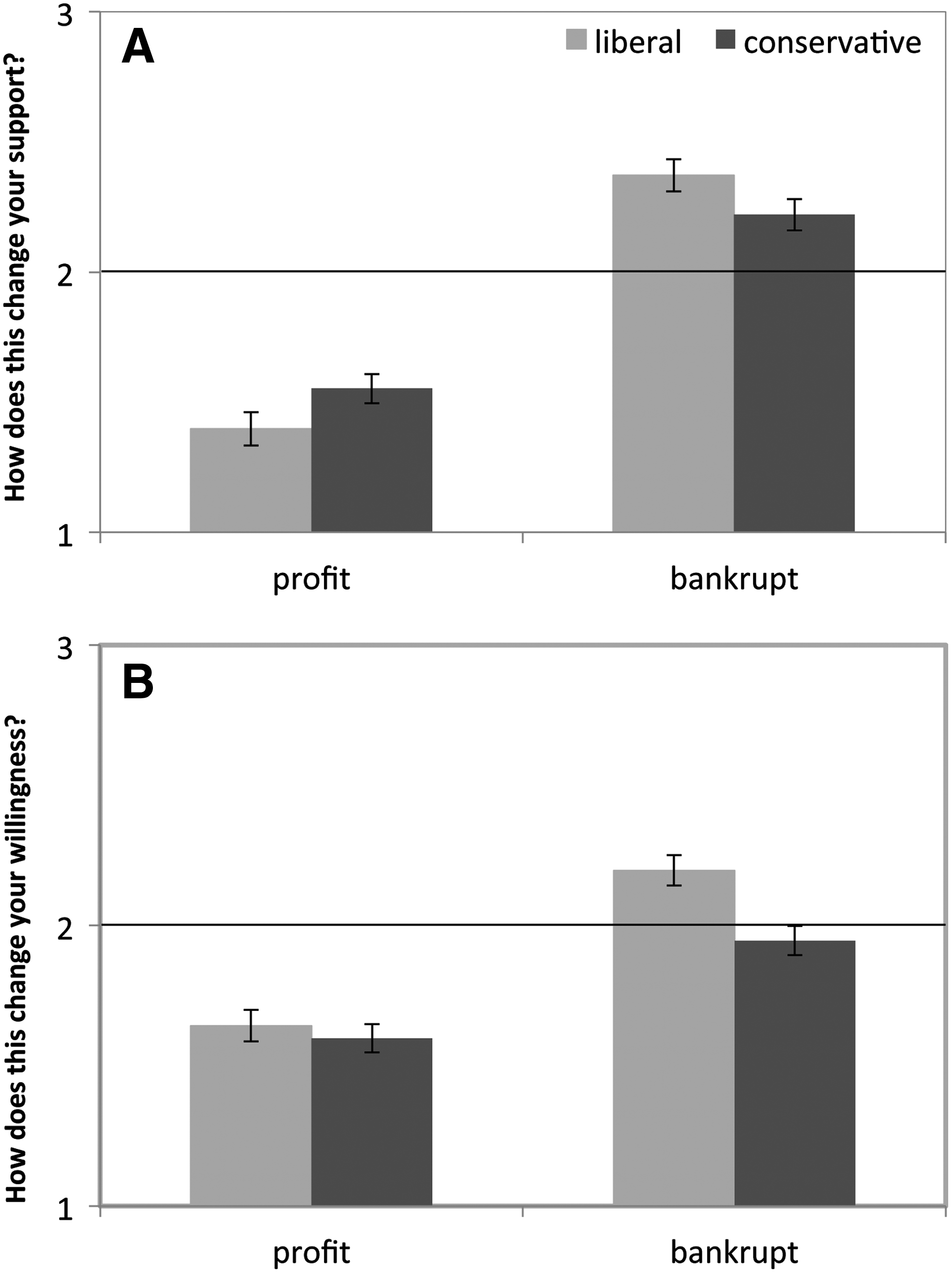
Change in support
Comments from readers
Approximately 26 percent of respondents left a comment in the prepaywall survey and 18 percent in the postpaywall survey. Common themes included the belief that people should pay for quality news content, that the pricing was too expensive and complicated, that alternative pay structures would be better, and that other news sources were available.
Discussion
The Internet has dramatically changed the way people access information. 26 Once predominantly free, the Internet is changing as well, as content providers increasingly charge for access. Paying to access information has potentially far-reaching social, political, and economic consequences. Results suggest that at least over the relatively short timeframe of the current study, participants exhibited strong psychological reactance, particularly those in the inequity cluster. Participants generally did not plan to purchase a digital subscription and were remarkably consistent in their subsequent behavior. They decreased their visits, devalued the NYT, and frequently planned to exploit loopholes to bypass the paywall or switch providers altogether.
To our knowledge, this is the first study to apply psychological and economic theory of fairness to consumer responses on the Internet, particularly related to the emergence of paywall systems. Results suggest that fairness is a key market constraint that applies equally to consumer interactions on the Internet as to traditional commercial transactions. When participants were provided with a compelling justification for the paywall—that the NYT was likely to go bankrupt without it—their support and willingness to pay increased. In contrast, when participants were provided with a justification that emphasized financial stability, their support and willingness to pay decreased. It is possible that this latter condition simply confirmed participants' sense that the paywall was unfair, rather than providing a compelling profit justification. Either way, results suggest that content providers could benefit from more thorough attempts to justify price structures.
Like all studies that use nonprobability samples, generalizability may be limited. By design, participants are likely to have been more devoted readers of the NYT than the general public. They may also have differed in some way from the population of NYT readers. Participants who completed both surveys were somewhat more educated and liberal, and had a lower income than the original sample. Returning participants may have been particularly engaged in the research topic and this may have affected responses. Reassuringly however, our overall sample demographics were quite similar to those published by the NYT and the decline reported in our study is echoed in the decrease of over 3.3 million unique visitors reported in NYT marketing materials between the fall of 2011 and spring of 2012.6,27
Our findings highlight how Internet users adapt to paying for goods and services that were previously free. This type of change exemplifies the modern Internet, where businesses initially eager to create a Web presence now struggle to generate revenue. In this sense, our research is methodologically novel, capturing a significant real-world change—the implementation of digital subscriptions by one of the Internet's most-visited sites—as it unfolded. Our results imply that many NYT readers resisted the newly implemented paywall and that perceptions of fairness are key to helping consumers adapt to abrupt changes in pricing. As other content providers follow the lead of the NYT, they may benefit from providing compelling justifications that convince consumers of financial necessity.
Footnotes
Acknowledgments
The authors thank survey participants for their time and David Krantz for valuable feedback. This research was not sponsored by or affiliated with the NYT in any way.
Author Disclosure Statement
No competing financial interests exist.
Appendix
*
Excluding later participants did not substantively affect results.
†
Many people provided bogus e-mails. Consequently, response rate based on eligible e-mails is higher than reported here.