




Abstract
Abstract
The social web stimulates learning through collaboration. However, information in the social web is often associated with information about its author. Based on previous evidence that ingroup information is preferred to outgroup information, the current research investigates whether group memberships of wiki authors affect learning. In an experimental study, we manipulated the group memberships (ingroup vs. outgroup) of wiki authors by using nicknames. The designated group memberships (being fans of a soccer team or not) were completely irrelevant for the domain of the wiki (the medical disorder fibromyalgia). Nevertheless, wiki information from the ingroup led to more integration of information into prior knowledge as well as more increase of factual knowledge than information from the outgroup. The results demonstrate that individuals apply social selection strategies when considering information from wikis, which may foster, but also hinder, learning and collaboration. Practical implications for collaborative learning in the social web are discussed.
Introduction
The social web is as heterogeneous as the real world and brings together people of different groups, affiliations, interests, or races. In many cases, the information in the social web is associated with information about its author: A blog is conceptualized as a personal journal of an author, 6 SNSs provide information about authors, 8 and in a wiki, which might seem to be an unidentifiable mixture of different authors' information, authors and their contributions are identifiable by the version history and authors' names. 16 Even if users do not display names or pictures that inform others about sex or race, and even if users choose to disguise their identity by nicknames and avatars, their choices often reveal personal characteristics that leave impressions. 17 In addition, the artifacts produced by authors (e.g., posts, links, and comments) reveal attitudes and might foster the deduction of underlying opinions, group memberships, or personal characteristics. Thus, most information in the social web is presented together with information about the author directly or indirectly, so that deductions about author characteristics are likely.
In wikis, it is not the authors, but the information that takes center stage. However, as we have explained that the deduction of personal characteristics of authors can hardly be avoided by readers, the current research investigates whether learners who use wikis are affected by indirect information about previous authors. There is evidence that certain information, namely, information about authors' group memberships, has an impact on information processing. Thus, we assume that group-membership information may also influence collaboration and learning processes when people use wikis.
Literature Review and Hypotheses
According to a social comparison theory, 18 relevant others help individuals to define and validate reality. Information from individuals that share a social category (i.e., ingroup members) are particularly relevant, because they are perceived as more trustworthy19,20 and more independent in their judgment 21 than outgroup members. Similarly, the self-categorization theory 22 proposes that members of a salient group perceive themselves as interchangeable with other ingroup members. Consequently, divergences between one's own view and the ingroup view violates the expectation of a shared view22,23 and, thereby, elicits active processing of information. 24 Taken together, this theorizing proposes that ingroup information should induce learning more readily than outgroup information.
Persuasion research has indeed demonstrated that messages from ingroups were more persuasive than outgroup messages. More specifically, if the message concerns a topic that is relevant to one's group, ingroup information profits from more intensive processing (i.e., longer processing times and different levels of persuasion due to weak or strong messages), whereas outgroup messages are not processed deeply and are more likely to be rejected. 25 However, outgroup messages have this disadvantage in processing depth, 26 agreement, and recall 27 only when the groups are salient. It is noteworthy that a message does not have to be prototypical or even relevant to the topic of the intergroup situation, the ingroup will still prefer a message coming from an ingroup member. If the topic itself is irrelevant to the ingroup, ingroup messages are not elaborated upon, but still readily accepted, whereas outgroup messages remain rejected. 25
In sum, research has demonstrated that information profits from coming from the ingroup: it is more deeply processed and is more readily accepted than outgroup information. In other words, as soon as relevant group memberships are involved in situations in which information is shared, assessed, and integrated, information from an ingroup has advantages over outgroup information. So far, this effect has been demonstrated for messages and arguments on recall, elaboration, and persuasion of information. It has not been tested, however, whether learning—in terms of integrating new information into prior knowledge and in terms of an increase of factual knowledge—is also affected by group membership.* The effects of group memberships on knowledge integration and the acquisition of factual knowledge have not been investigated for collaborative learning in the social web. When using the social web, it is almost impossible to avoid personal information about authors, which often includes references to social categories (e.g., gender or religious affiliations). In collaborative wikis, this information about the authors might affect the way the wiki information triggers learning. On the basis of previous group membership research, we state the following hypotheses:
Method
Design and participants
To test these hypotheses, we conducted an experimental study with the between-subject factor group (ingroup vs. outgroup). In a collaborative wiki, participants encountered information that differed from their own prior knowledge. Participants were made to believe that this information was provided by either an ingroup or an outgroup. Knowledge integration and the increase in factual knowledge served as dependent variables. The data of 70† German-speaking university students (32 females, age M=24.14, range 19–40 years) were analyzed. They were recruited in the cafeteria via advertisements for a “study about wikis” and via the participant pool. Participants received 16 Euros as compensation and were randomly assigned to the ingroup (N=34) or outgroup (N=36) condition.‡
Material and procedure
The study took place during the soccer World Cup in 2010, when supporting or not supporting the German soccer team was very salient in Germany. Therefore, being a fan or foe of the national team was chosen as group context. To increase salience of the group membership, participants were first asked whether they were fan or foe of the German soccer team. Data from the few nonfans were excluded from the analysis.
The procedure followed the method of Moskaliuk et al.'s 30 study. The experiment was conducted by student assistants. Participants worked separately on computers (without seeing each other's screens) in groups of up to 10 people. To induce prior knowledge, they first read a text about causes of the pain disorder fibromyalgia. This topic was chosen because it was entirely irrelevant to the intergroup context (i.e., soccer), and it was likely that it was personally irrelevant to the participants who had no previous knowledge about fibromyalgia. Afterward, the salience of the group membership and the social identification with the group was reinforced by a bogus implicit association test that confirmed participants' judgment that they were fans of the German soccer team. After a short tutorial about wikis, participants were asked to log in with a nickname that indicated that they were fans of the German soccer team. Then, they worked on a wiki about the causes of fibromyalgia, where new information was introduced. Participants were told that other participants had written the wiki information before them, but in fact, all participants worked with the same simulated wiki. To simulate group membership of the previous wiki authors for manipulation purposes, a frame within the wiki (on the right top of the screen) showed the nicknames of the former authors. The nicknames either indicated that four out of five previous authors were fans (ingroup condition, e.g., “black-red-gorgeous” in reference to the German national flag) or foes (outgroup condition, e.g., “black-red-gruesome”) of the national team. Participants worked on the wiki for 50 minutes with the instruction to improve the text. Afterward, the dependent variables knowledge integration and factual knowledge were measured. Finally, participants were debriefed, thanked, and paid.
Measures
Knowledge integration was measured with concept maps of the knowledge about causes of fibromyalgia. Using concept maps, the acquisition of conceptual knowledge can be assessed. 31 Integration was conceptualized as the number of links that connected prior knowledge with new information from the wiki.
Factual knowledge was measured with a knowledge test on causes of fibromyalgia. This test consisted of 16 statements about causes of fibromyalgia. For each item, the participants had to decide whether the statement was correct, incorrect, or whether they did not know. Eight items were correct, eight were incorrect. We calculated a score of correct answers, whereby, the “I don't know” option was counted as a wrong answer to reduce the probability of guessing.
Results
We expected main effects of group on knowledge integration (H1) and factual knowledge (H2). To test these predictions, we conducted separate t-tests for the dependent measures. As expected, for knowledge integration, ingroup information was more strongly related to prior knowledge (M=1.71, SD=1.84) than outgroup information (M=0.78, SD=1.17), t(55.61)=−2.51, p=0.015, d=0.62. Likewise, for factual knowledge, wiki information from the ingroup led to more factual knowledge (M=8.85, SD=1.54) than information from the outgroup (M=8.00, SD=1.85), t(68)=− 2.09, p=0.040, d=0.51 (see Table 1).
It is likely that the increase of factual knowledge is more effective if learners integrate new knowledge into existing knowledge structures. We, therefore, explore whether knowledge integration mediated the effect of group on the development of factual knowledge by mediation analyses. 32 When regressing group only, factual knowledge was stronger when individuals encountered an ingroup wiki (β=0.25, p=0.040), but this effect ceased upon including knowledge integration in the regression (β=0.18, p=0.139); whereas knowledge integration increased factual knowledge to marginal significance (β=0.22, p=0.074, see Fig. 1).
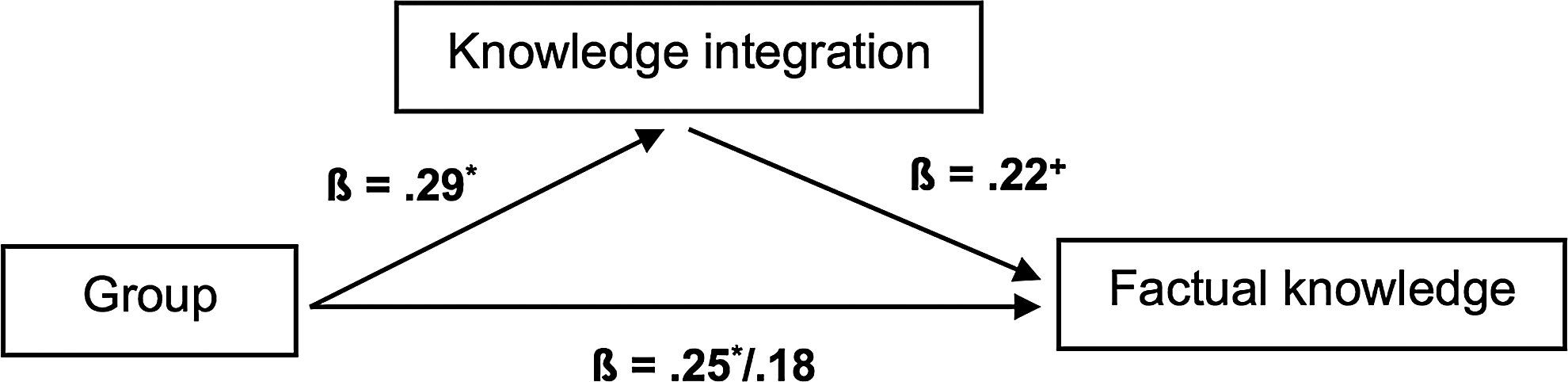
Mediation analysis of the indirect effect of group on factual knowledge via knowledge integration (N=70).
The bootstrap confidence intervals based on 1,000 bootstrap samples confirmed the indirect effect of group on factual knowledge via knowledge integration, b=0.11, SE=0.07, CI α=0.05 [0.087; 0.306].
Discussion
The current study tested whether group memberships of previous authors (ingroup vs. outgroup) affected collaborative learning with wikis. We expected and found that ingroup information in a wiki induces stronger knowledge integration and the acquisition of more factual knowledge than outgroup information. Moreover, the findings demonstrate that this advantage is due to the fact that ingroups cause superior integration of new information into prior knowledge compared to outgroups in a shared wiki.
The current findings are the first application of group membership effects on learning through collaboration in the social web. They demonstrate that even in a wiki—where information is assumed to be neutral—learners are affected by the group membership of other authors. This finding underlines the fact that learning with wikis does not take place unconditionally or without bias, but that learners have to consider the knowledge presented in a wiki. If the information comes from a doubtful source (e.g., an outgroup member), the information is integrated to a lesser degree into one's own mind and induces less learning. In line with the social comparison theory 18 and self-categorization theory, 22 information by relevant others has a greater chance of being considered and inducing integration and learning, whereas new information by irrelevant others is disregarded.
It is particularly noteworthy that the group effect occurred in wikis that had a stronger focus on the information itself (and not its authors) than other social software tools. It is also striking that this effect was found even though the topic (i.e., a medical diagnosis) was totally unrelated to group membership (i.e., soccer or the national team), and even though the group memberships had been manipulated very indirectly. Thus, if group memberships are salient, even unrelated information provided by an outgroup member is disregarded. Considering that we found this effect in a controlled laboratory setting, where participants are usually highly motivated to comply with the instructions, the effect is probably even more pronounced in the overcrowded social web that is full of unreliable information from various sources. If practitioners want to induce collaborative learning with wikis in formal or informal environments, the current findings provide evidence that the context can become a serious boundary condition for learning. Three implications might be derived for practitioners: (1) Consider letting individuals collaborate who already share group memberships (a rather conservative suggestion). (2) Improve understanding of common group membership among collaborative learners. Subgroup memberships should be made nonsalient and the common learning group should be emphasized. (3) Create an unprejudiced atmosphere, where diversity is expected and appreciated. 33
The current results demonstrate that it is worthwhile investigating the impact of group effects on collaborative learning with wikis. Future studies should include a control group, where no group membership is given. Moreover, findings should be replicated in the field with (unpaid) participants who interact naturally. This would allow testing whether personally relevant topics are also affected by topic-unrelated group memberships, even though existing research 34 would suggest that this is not the case. Our results have implications for learning through collaboration in the social web, as group memberships are omnipresent in names, nicknames, pictures, or avatars and will inevitably play a role. 17 These implications are even more significant for real wikis or SNSs, where group memberships are often related to the expression of certain attitudes. Expression of attitudes may render the ingroup source even more persuasive 35 and, thus, harden the fronts between the groups. This would reduce the chance that diverse information would stimulate cognitive conflicts which, in turn, induce learning. 12 Future research should find means to overcome limiting group boundaries and develop mechanisms to stimulate unbiased collaboration with wikis.
Footnotes
Acknowledgments
J.K is indebted to the LANDESSTIFTUNG Baden-Württemberg (Königstr. 46, 70173 Stuttgart, Germany) for financial support of this research project by the Eliteprogramme for Postdocs. This research was also supported by the German Federal Ministry Education and Research and the European Social Fund (grand number: 01PF 08005 C).
Author Disclosure Statement
No competing financial interests exist.
*
Our reasoning in addressing knowledge integration and increase of factual knowledge as two aspects of learning follows the distinction between accommodation and assimilation as introduced by Piaget. 28 Assimilation means that individuals simply use prior knowledge to understand new information. Accommodation describes the more complicated process in which individuals modify their existing knowledge as a result of integrating new information. In accommodation, individuals will qualitatively change their knowledge, not just assimilate additional information into existing knowledge. This is also in line with the ideas introduced by Rumelhart and Norman. 29 They differentiated accretion, the accumulation of knowledge, from tuning/restructuring, the development of new schemata.
†
Nineteen participants did not pay attention to the manipulation and were therefore excluded from the analyses.
‡
The participants in both conditions did not differ concerning gender, t(68)=0.70, nor age, t(68)=1.96, both p's>0.05.