




Abstract
Abstract
With greater Internet availability, the pathological use of the Internet has become an emerging mental health issue among adolescents in China. The objective of this study was to examine the associations between Internet addiction and depression in migrant children (MC) and left-behind children (LBC). The present study was conducted using a cross-sectional design with 3,254 participants (8–17-years old), which included 1143 LBC, 574 MC, and 1287 nonleft-behind rural children (RC) from 12 schools. Young's 8-item Internet Addiction Scale was used to assess Internet dependency. The Children's Depression Inventory-Short Form was used to measure child depression. The results showed that the prevalence of depression was 10.9 percent among RC, 19.7 percent among MC, and 14.3 percent among LBC. The prevalence of Internet addiction was 3.7 percent among RC, and was 6.4 percent among MC and 3.2 percent among LBC. Depression was effected by the interaction between types of children and Internet addiction. LBC with Internet addiction (odds ratio [OR], 2.780; 95 percent confidence interval [CI], 1.237–6.248), MC with Internet addiction (OR, 2.922; 95 percent CI, 1.116–7.652), and MC with no Internet addiction (OR, 2.735; 95 percent CI, 1.974–3.789) had higher risks of depression than that for RC with no-Internet addiction. The results indicated that Internet addiction might be associated with an increased risk of depression in LBC, and migration was an important risk factor for child depression.
Introduction
With the greater availability of the Internet, the pathological use of the Internet has become an increasing mental health issue among children and adolescents. By comparing the data derived from two studies using the Young's 8-item questionnaire, Chan 7 found that the prevalence of Internet addiction increased from 3.0 percent in 2000 to 14.7 percent in 2002. Using the modified Young's 10-item questionnaire, Lin found that 9.6 percent of the 293 respondents from Fuzhou in Mainland China were addicted to the Internet. 8 In recent years, Internet addiction was especially a worse problem among children who do not receive proper parental care. 9
Previous studies have reported associations between Internet addiction and psychiatric symptoms, such as depression, anxiety, loneliness, and self-efficacy among adolescents.10–12 Likewise, other researchers found that almost one-third of subjects in their study were found as Internet addicts and had significant levels of depressive symptoms that required psychiatric intervention. 13 However, the pathology between Internet addiction and psychological studies is still under debate. Most studies about this issue focus on college students, instead of adolescents and younger children. With the proliferation of computers, children are accessing computers at younger ages. Evidence has shown that depressive symptoms tend to occur before puberty. For example, one study identified genetic vulnerability for a major depressive disorder, the experience of stressful life events, as well as the presence of psychiatric disorders during childhood as key risk factors for depression onset and recurrence at school age as well as later in life. 14 Therefore, more attention should be paid to depression in children. 15 In addition, studies investigating the effects of migration on the psychological well being of MC have produced varied and inconclusive results. While some studies have found that the migration–integration process induces stresses that lead to psychological distress in migrants, 16 others have failed to find a higher level of distress among the migrant population. 17
The objectives of the present study were to evaluate the associations between Internet addiction and depression among MC and LBC, using data from a cross-sectional survey in China.
Method
Study design and participants
A cross-sectional study was conducted between November and December 2008. A three-stage cluster sampling was used to select participants of LBC and nonleft-behind RC in the selected sites. According to the local economic development and the concentration of migrant workers population, the Henan and Shaanxi province were chosen as study sites in the first stage. Then, we randomly selected nine schools from the two areas.
Many migrant workers live in the urban fringe areas around big cities, and some nonpublic schools for MC were held by private enterprises and individuals. Therefore, with the target sampling methods, the sample of MC was randomly selected in three schools for MC in Shunyi and Changping districts of Beijing.
The analysis sample comprised of 4th- to 9th-grade 3,254 children aged between 8 to 17 years, which include 1143 LBC, 574 MC, and 1287 nonleft-behind RC. Two hundred fifty children whose parents were divorced or dead were excluded.
Measurement
1. Depressive symptoms were assessed with the Children's Depression Inventory-Short Form (CDI-S). The full Children's Depression Inventory was widely used to diagnose depression in children according to the Diagnostic and Statistical Manual of Mental Disorders (4th edition) (DSM-IV) criteria. CDI-S had a correlation of 0.89 with the full inventory. 18 It was a valid and reliable screening tool of depressive symptoms for 7- to 17-year olds. This questionnaire was composed of 10 questions and asked the children to choose one out of the three statements that explained their feelings most closely in the past 2 weeks. Answers were scored on a three-point scale, where zero corresponded to no symptoms; the total score was calculated by adding the scores of all questions (range, 0–20). Depression was defined as the CDI-S total score equal or higher than 7. 19 The internal consistency coefficient for the CDI-S in this sample was Cronbach's α=0.75.
2. Internet Addiction was measured using the Young's 8-item Internet Addiction Scale. 20 It was used by many researchers and some Chinese studies. 21 The diagnostic questionnaire consisted of eight items modified from the DSM-IV criteria for pathological gambling. Respondents who answered “yes” to five or more of the items were classified as addicted Internet users (dependents). The reliability of this Young's 8-item Internet addiction scale in this study was Cronbach's α=0.72.
3. Nutritional status, health condition, and health behaviors: Children's nutritional status was measured with a 6-item food intake frequency questionnaire (eating times of milk, soybean, vegetables, fruits, eggs, and meat. Possible answers and scores were everyday=6; 4–6 times per week=5; 2–3 times per week=4; once per week=3; less than once per week=2; and never=1). The index was coded into bad (score 6–18), common (score 19–24), and good (score 25–36) according to the total score of all items (range, 6–36).
Self-reported health was measured by the question, “How would you rate your health compared with same-aged peers?” The answers were very good or good, satisfactory, poor, and very poor. This subjective health assessment was measuring an integrated perception of personal health, which covered biological, psychological, and social dimensions. Thus, the subjective assessments of general health could potentially be even more sensitive than external measures in monitoring the population health. 22
Any occurrence of disease in the previous two weeks was measured by whether they have respiratory or diarrhea illnesses. These two indicators were sensitive measurements for child health. 23
Health behavior variables included drinking (often drink or not in the past semester) and smoking (often smoke or not in the past semester). As mentioned above, these variables were known to be associated with depression among children. 24
4. Family and personal variables: A number of demographic and economic variables were measured, including gender (male and female), age category (under 11, 11–13, 14, and above), parental education attainment (primary school or below, junior high school, senior high school, or above), and self-reported family financial situation (poor, medium, and rich).
Statistical analysis
Data were analyzed using the SPSS statistical software program (PASW 16.0). Chi-square analysis was conducted to test the between-group differences of the pathological use of the Internet, depression, and all other variables. All the children were divided into 6 groups as interactive variables to examine the interaction of Internet addiction (Yes/No) and types of children (LBC/MC/RC). After adding the interactive variables into the regression model and adjusting for potential confounders, including demographics, family economic status, personal health behaviors and health status, multiple logistic regressions were employed to examine the different impacts of Internet addiction on depression among common children, LBC, and MC.
Results
Description
The sample consisted of children aged between 8 and 17 years with a mean age of 12.56 (standard deviation [SD]=1.83) years. There was an almost even distribution between boys and girls of LBC and RC, but boys were slightly more than girls of MC (57.1 percent vs. 42.9 percent). The characteristics and outcome measures of the participants are summarized in Table 1.
In general, MC had a higher prevalence of depression and Internet addiction (Table 1). The prevalence of depression in this sample was 13.9 percent, whereas in MC was higher (19.7 percent) compared to LBC and RC. Moreover, 4.0 percent of the whole sample and 6.4 percent of MC were addicted to Internet.
The relationship between depression and Internet addiction
Depression was significantly correlated with the types of children and Internet addiction. The prevalence of depression was significantly higher in the Internet-addicted than no-addicted (28.1 percent vs. 13.3 percent)
(χ2(1,3004)=21.32, p<0.001) group. The prevalence of depression was significant higher among the Internet-addicted than no-addicted group in LBC (37.8 percent vs. 13.6 percent) (χ2(1,1143)=17.17, p<0.01) (Fig. 1).
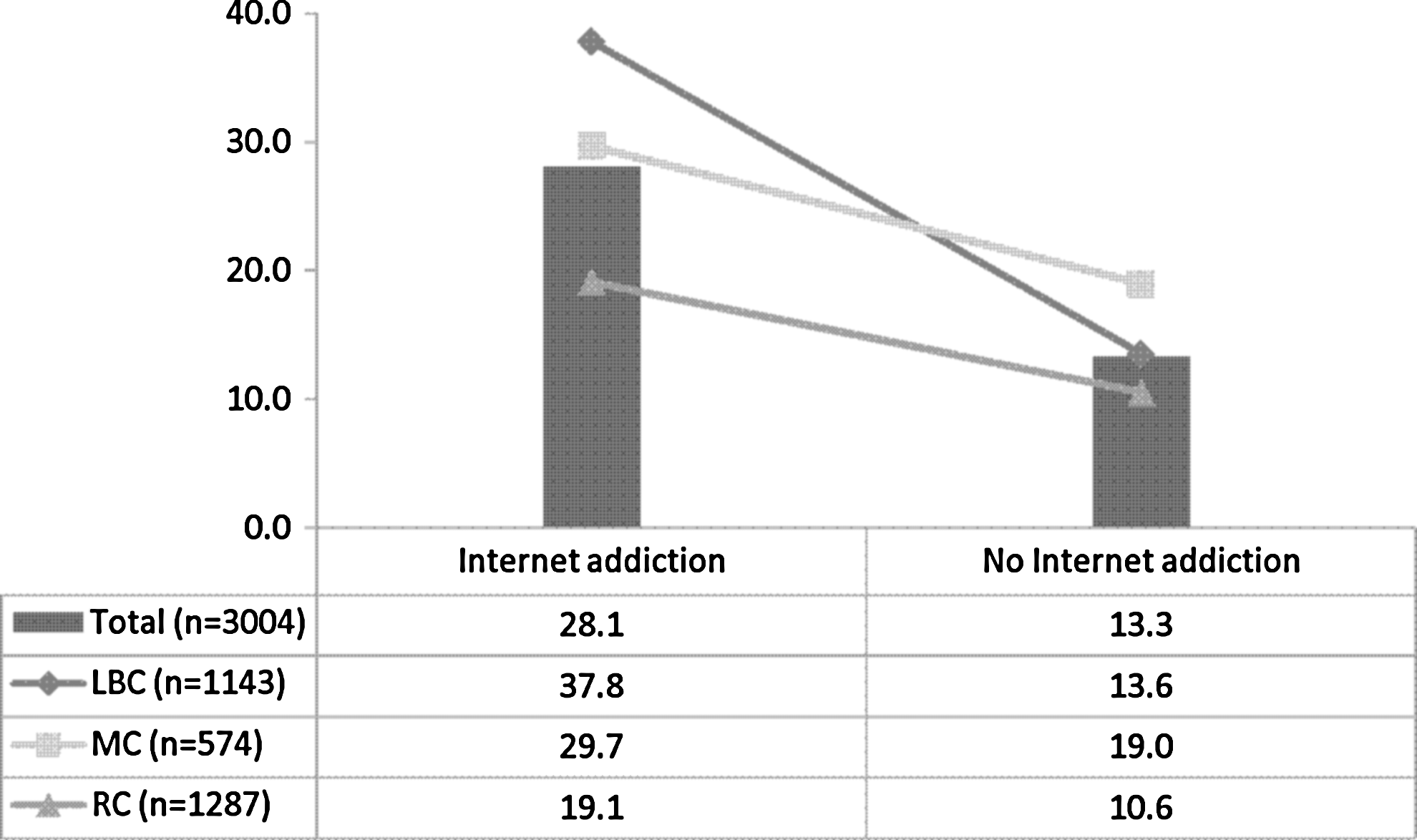
Prevalence of depression in Internet addiction by types of children (percent).
The results in Table 2 showed that, adjusting for demography information, nutritional status, self-rated health, respiratory, and smoking had relations with depression (Model 1). All the children were divided into 6 groups, according to Internet addiction (Yes/No) and types of children (LBC/MC/RC). After adding the interaction of Internet addiction and types of children into the model and adjusting for other variables, Model 2 showed that the following characteristics significantly increased the risk of depression: LBC with Internet addiction (odds ratio [OR], 2.78; 95 percent confidence interval [CI], 1.24–6.25), MC with Internet addiction (OR, 2.92; 95 percent CI, 1.12–7.65), and MC with no-Internet addiction (OR, 2.74; 95 percent CI, 1.97–3.79).
Discussion
The results suggested that the prevalence of depression and Internet addiction was significantly higher in MC than LBC and RC, and the Internet-addicted group had more depression symptoms than the no-Internet-addicted group; particularly, there was an increased risk of depression for LBC with Internet addiction. A prior study found that the relationship between migration and health is complex and dynamic, and the impact of parental migration on the mental health of LBC is an almost unexplored topic. 25 This study contributes to the literature by comparing different groups and adds information to the issue of relationship between migration and health. The results suggested that Internet addiction increased the risk of depression in LBC, and migration was an important factor most correlated with depression. The conclusion supported the need for further research on Internet addiction as a risk factor for depression and promoted the community service for vulnerable children.
According to the present study, the prevalence of depression for MC was as high as 19.7 percent. This suggests that children may develop psychological and behavior problems when they migrate from the country to the city. The reasons are as follows: first, although MC are still living with their parents, insufficient parental care often ensues. This can be explained by the nature of occupations for most of migrant parents, which are usually extremely time consuming, laborious, and unstable, thus interfering with the time that would otherwise be spent with their children. 9 Second, they might lose former friends and neighbors when moving to cities, and face more challenges in the new communities. According to the Social Network Construction perspective, peer relationships of MC are key to their integration and identification in urban life. 26 Third, the household registration policy often makes the nonlocals being discriminated. This can, in turn, lead to lower self-esteem and feeling of alienation. Gu 27 suggested that MC are easily socially excluded in their classrooms, treated unjustly by their teachers, and discriminated against by the parents of their fellow students. The situational variables are likely to support attributions to discrimination, such as family situation, economic situation, and school environment. 28 The urbanization rate of China in 2009 is 46.59 percent, and it still grows at the rate of 0.8 percent per year, and the percentage will reach 50 percent in 2015. 1 The group of children migrating into cities cannot be neglected anymore.
Internet addicts had higher odds of depression. The prevalence of depression was significantly higher in the Internet-addicted group than the no-Internet-addicted group. This is consistent with previous studies, which have investigated the relation between Internet addiction and the psychological characteristics of adolescents, including depression. 29 Compared with earlier studies, 4 the prevalence of Internet user in this study is lower in the current study. The reason may be that our participants are from rural area, and Internet penetration is not as deep and wide as in urban areas. At the end of 2010, children under the age of 18 accounted for 28.4 percent of Internet users in China and reached 130 million people. 30 Meanwhile, the rate of overuse and inappropriate use of the Internet was increasing as well. Hence, from a public health perspective, a program to promote the proper use of Internet in primary and middle schools could be considered as a prevention strategy of children's depression.
LBC and Internet addiction had an interaction effect for depression, and there was an increased risk of depression for LBC with Internet addiction. Indeed, Internet addiction was found to be associated with subjective distress and social impairment. 31 Other studies also showed that separation from parents for more than a year before age 17 represents a significant risk for major depression. 32 Meanwhile, LBC with Internet addiction are easier to have depression problems than others. The reason may be that the Internet can serve as an outlet of expressive emotions for children who are encountering problems in reality. It is plausible that depressives are drawn to electronic communication because of the anonymous cover granted to them by talking with others through fictitious handles, which helps them overcome real-life interpersonal difficulties. 33 On the other hand, due to paucity of parental support and inadequate supervision from their guardians, certain LBC will develop withdrawal moods and lack self-confidence. These children will have a tendency to lose control and are at a higher risk of Internet addiction, in turn resulting depression.
There are some potential limitations in this study. First, as a cross-sectional study, it is hard to determine the direction of the relationship between depression and Internet addition for children. In the future, we can use longitudinal data to explore the psychological and behavior change for MC. Second, CDI-S and Young's 8-item Internet Addiction Scale are screening instruments, but not clinical tools. Therefore, the rates of depression and Internet addition may be overestimated. Third, not all potential confounding factors were measured and adjusted for in the analysis. Factors such as family relationship, parental rearing styles, and parental control were not assessed in this study.
Footnotes
Acknowledgments
This paper was supported by the Beijing Normal University “Cross-Disciplinary Social Sciences Salon” grant. The authors thank Rong Ding, Weiqiang Huang and all the graduate students who conducted the interviews. The authors also thank the anonymous reviewers whose suggestions significantly improved the paper.
Author Disclosure Statement
No competing financial interests exist.