




Abstract
Abstract
Social networking sites such as Facebook attract millions of users by offering highly interactive social communications. Recently, a counter movement of users has formed, deciding to leave social networks by quitting their accounts (i.e., virtual identity suicide). To investigate whether Facebook quitters (n=310) differ from Facebook users (n=321), we examined privacy concerns, Internet addiction scores, and personality. We found Facebook quitters to be significantly more cautious about their privacy, having higher Internet addiction scores, and being more conscientious than Facebook users. The main self-stated reason for committing virtual identity suicide was privacy concerns (48 percent). Although the adequacy of privacy in online communication has been questioned, privacy is still an important issue in online social communications.
Introduction
With the advent of SNSs, the offline (face-to-face) social life of many individuals has been complemented with an online (Internet-based) social life, offering possibilities that are hardly feasible in the offline world. With more than 950 million active users, Facebook is by far the most popular SNS worldwide,2,3 followed by Twitter 4 and MySpace, 5 with both also having user counts in the millions. Although this sounds as if the world is moving together, there are also problems associated with these trends. It has been shown that SNSs facilitate jealousy and suspicion in romantic relationships because of the ease of reaching other potential partners, 6 have (potentially negative) influences on the evaluation of job candidates, 7 and might open up new modes for stalking and harassment. 8
Probably, these negative aspects and other concerns of SNS users (e.g., privacy) have led to a counter movement, comprising of users who quit their online social life by committing virtual identity suicide (sometimes also called Web 2.0 suicide).
9
This demand has been met by new Internet applications such as The Suicide Machine (
However, the motivation behind the phenomenon of virtual identity suicide largely remains unclear. Fogel and Nehmad, 10 in a sample of American college students, found that individuals with an SNS profile, as opposed to those without any SNS profile, had higher risk-taking attitudes and were more likely to share identity information online in the future. Offering personal information online can lead to problems (e.g., cyber harassment); hence, privacy concerns could be a reason for leaving SNSs.
Another important issue when it comes to online social interactions is Internet addiction. 11 It is often reported that SNSs have an addictive quality that manifests itself in an irresistible and overpowering urge to check the online status of one's friends repeatedly throughout the day. 12 Some users might become aware of their increased overuse of SNSs (e.g., problems with job, school, or real-life friends), and therefore opt to quit their SNS completely. Thus, Facebook quitters might have higher Internet addiction scores than Facebook users.
Concerning personality differences, research suggests associations between Internet use and personality. 13 Individuals high on neuroticism tend to use the Internet to avoid loneliness and have a strong interest in using the Internet for communication. 14 Conscientiousness seems to be negatively related to Internet use in general, 15 because conscientious individuals seem to be more dutiful in their everyday (offline) tasks and tend to regard the Internet (and Facebook possibly even more) as an unwanted distraction from their daily routine, which might lead to less engagement in online activities. Openness is associated with looking for new experiences, which might be the reason why individuals try out new means of communication such as Facebook in the first place. 16
We hypothesized that certain personality characteristics might not only be predictive for SNS use, but also for leaving them. Hence, besides privacy concerns and Internet addiction tendencies, we were also interested in personality characteristics of individuals who decided to leave Facebook by committing virtual identity suicide. To complement the description of virtual suicides, we also added an open-ended question directly asking participants for their reasons for leaving Facebook. To sum up, we were interested in two aspects: (1) privacy concerns, Internet addiction tendencies, and personality characteristics of Facebook users versus Facebook users who committed virtual identity suicide and (2) the motivation of Facebook quitters to leave Facebook.
Methods
Recruitment of Facebook quitters
Because users who quit their Facebook account cannot be reached through Facebook anymore, we had to rely on different forms of recruitment. The primary source for our convenience sample of Facebook quitters was the Website of the online initiative Quit Facebook Day. On this Website, Facebook users had the possibility to announce their intention to delete their account on May 31, 2010, which was declared as the Quit Facebook Day. More than 34,000 Facebook users had confirmed to delete their Facebook account on this particular day. The Website also had a blog, giving users the possibility to discuss this topic or to report their successful deletion of their Facebook account. We posted a short invitation for participation in regular time intervals on that blog to recruit virtual identity suicides. Further, on May 31, 2010, we also searched for Twitter users (i.e., Twitter is a microblogging service that allows users to send very short messages to other users) who both included the search tag #quitfacebookday in their tweets (i.e., small text messages) and indicated that they successfully quit their Facebook account. Users who met these two criteria were contacted directly via Twitter to invite them to take part in the online study. Finally, invitations were posted on relevant blogs (e.g.,
Recruitment of Facebook users
To obtain a convenience sample of Facebook users, we posted the link to the online questionnaire on several portal sites dedicated to the recruitment of participants in online research (e.g., Social Psychology Network [
Participants
Facebook quitters (n=310; 71.5 percent men) were on average 31.0 years old (SD=11.3; range 11–75 years). They lived in 47 different countries all over the world, representing all five continents (see Fig. 1). On average, they had quitted their Facebook account 24.8 days before they filled in the online questionnaire (SD=62.5; range 0–370 days) and lost on average 133 online friends (SD=171.0; range 0–1,500 friends). Before quitting their Facebook account, they had been using Facebook on average for 1.9 hours per day (SD=2.3) and had possessed their account for about 26 months (SD=14.4; range 1–70 months).
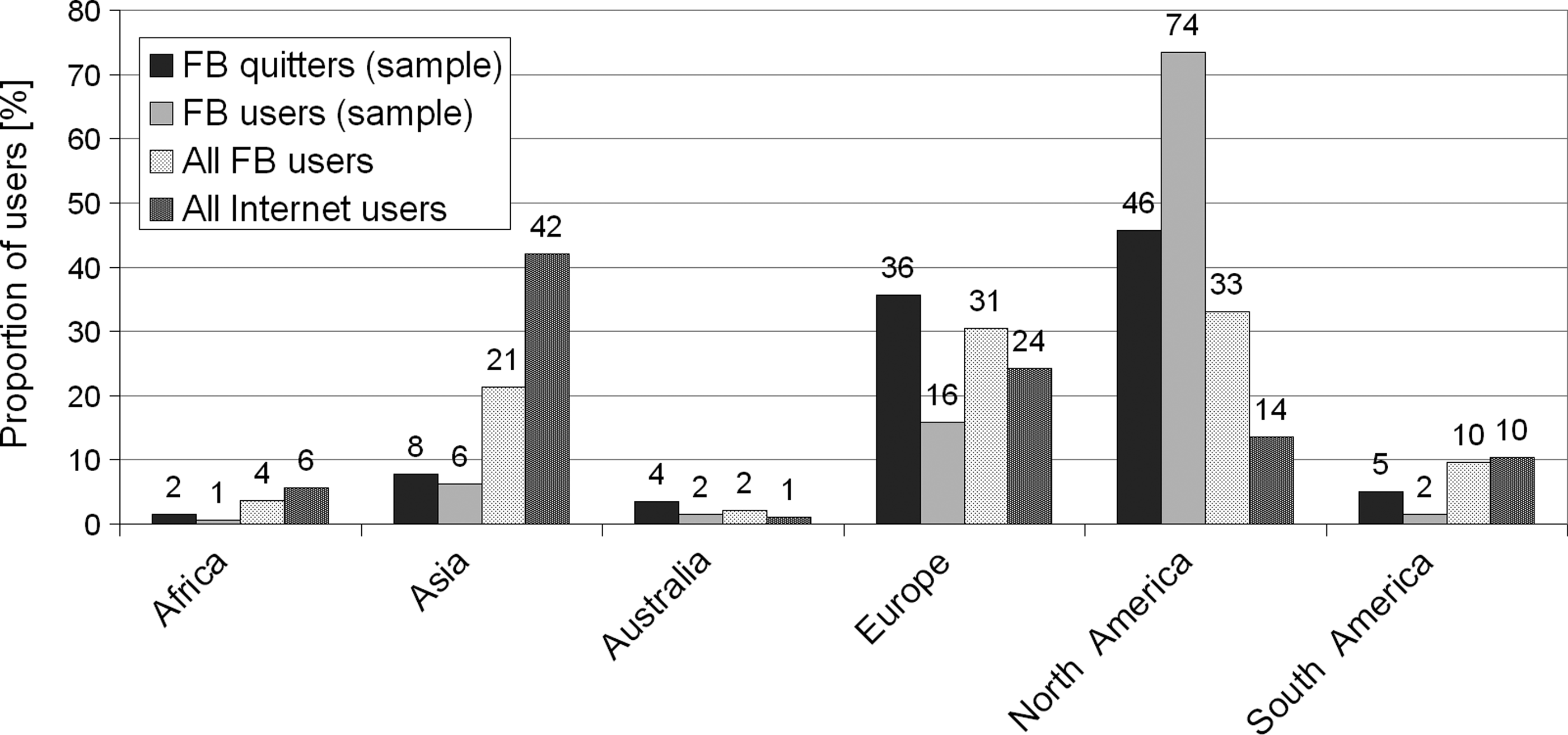
Sample proportions of Facebook quitters and users compared with population statistics (all Facebook users and all Internet users) by continent. Note: FB, Facebook. Data regarding all Facebook users were obtained from
Facebook users (n=321; 70.5 percent women) were on average 24.0 years old (SD=10.0; range 15–63 years) and were from 41 different countries (see Fig. 1). On average, they had 349 online friends (SD=317.4; range 0–2,000), and their last login to Facebook was about 4.5 days ago (SD=20.2; Modus=1 day [69 percent of participants]; range 0–300). They spent on average 1.8 hours per day on Facebook (SD=1.8) and had registered on Facebook about 29 months ago (SD=17.2, range 0–90). About half of them (46.8 percent) stated that they had already considered quitting Facebook in the past.
Materials
Privacy concern scale (PCS)
The PCS is a short six-item questionnaire measuring general concern about privacy (sample Cronbach's α=0.79). 17 Participants had to answer on five-point scales (1: Never; 5: Always) how frequently they engage in certain behaviors related to privacy in everyday situations (e.g., Do you hide your bankcard PIN number when using cash machines/making purchases?).
Internet addiction test (IA-T)
The IA-T is a 20-item questionnaire (α=0.91) measuring Internet addiction by asking how personal Internet use affects daily routine, social life, productivity, sleeping pattern, and feelings (five-point scales; 1: Never; 5: Always). 18 Overall scores can range from 20 to 100. Higher scores reflect greater problems caused by Internet use. A score of 20–39 points reflects average amounts of Internet usage, whereas scores of 40–69 signify frequent problems due to Internet usage. Scores of 70–100 indicate that Internet usage is causing significant problems. 18
Mini international personality item pool (Mini-IPIP) personality measure
The Mini-IPIP is a 20-item measure of the Big Five personality dimensions (five-point scales; 1: Very accurate; 5: Very inaccurate). 19 Four items each refer to the personality traits: extraversion (α=0.79), agreeableness (α=0.73), conscientiousness (α=0.71), neuroticism (α=0.68), and openness to experience (α=0.73).
Procedure
Participants who accessed the first page of the online questionnaire had to agree to an informed consent form to proceed with the online questionnaire. If informed consent was obtained, they had to state their demographics (gender, age, nationality, and further usage demographics of Facebook, which were adequately adapted for the two research samples). Facebook quitters were additionally asked to indicate their reasons for leaving Facebook in an open-ended comment directly after the demographic questions. Then, Facebook users and quitters filled in the PCS, the IA-T, and the Mini-IPIP. Finally, participants were thanked for their participation.
Results
Compared to the sample of Facebook users, Facebook quitters were older (quitters: M=31.0, SD=11.3; reference group: M=24.0, SD=10.0; t[629]=8.19, p<0.001, d=0.65) and more likely to be men (quitters: 71.5 percent men, reference group: 29.5 percent men; χ2=110.1, p<0.001). Age was positively correlated with privacy concerns (quitters: r=0.24, p<0.001; users: r=0.20, p<0.001) and negatively with Internet addiction (quitters: r=−0.20, p<0.001; users: r=−0.16, p=0.01). Differences in study outcomes could therefore be confounded with age and gender differences between the groups. Thus, all further analyses (except for the qualitative analysis) were controlled for gender and age (Table 1).
First-line entries=Facebook quitters (n=310); second-line entries=Facebook users (n=321). ‡p<0.10, *p<0.05, **p<0.01, ***p<0.001. Madj= adjusted means controlled for different sample composition (age and gender).
Key findings from this series of analyses included that Facebook quitters had a significantly higher general concern about privacy, higher Internet addiction scores, and were more conscientious than Facebook users (Table 1). Effect sizes for privacy concern were small to medium, whereas effects for Internet addiction and conscientiousness were small.
Because personality traits were also correlated with privacy concerns and Internet addiction, it could be possible that personality traits influence the likelihood of quitting one's Facebook account indirectly via privacy concerns and Internet addiction. In this case, the concern about one's privacy and Internet addiction propensity would not be directly in charge for quitting one's Facebook account, but would function as mediators of the underlying personality traits. To test this possibility, we used structural equation modeling. We used a partial mediation model where personality traits have both direct and indirect effects on Facebook quitting, the latter being mediated by Internet addiction and privacy concerns.
The partial mediation model provided a moderate fit to the data (root-mean-squared error of approximation=0.057; comparative fit index=0.931; Tucker–Lewis index=0.906). Regarding the hypothesis of an indirect effect of personality on Facebook quitting, the only significant effects we found were the direct and the total effect of conscientiousness. All other direct, indirect, and total effects of personality variables on Facebook quitting were not significant (detailed results omitted for brevity). This result also implied that the total effect (−0.11, p=0.009) of conscientiousness on Facebook quitting was largely driven by direct (−0.11, p=0.031) and not by the insignificant indirect effects (−0.01, n.s.). This suggests that indirect effects of personality traits on Facebook quitting are virtually negligible.
Further, the reasons for quitting Facebook were qualitatively analyzed. Almost all Facebook quitters provided comments about their motivation to quit Facebook (95.2 percent). After a first inspection of all written statements, five broad categories turned out to be reasonable. These were as follows: (1) the treatment of personal data through Facebook (privacy; e.g., privacy issues, data protection, ethics, and selling of data), (2) the feeling of getting addicted to Facebook (addiction; e.g., spending too much time on Facebook), (3) negative aspects concerning Facebook friends (friends; e.g., feeling forced to communicate, shallow conversations, social pressure to add friends, and friends are not real), (4) general dissatisfaction with Facebook (general dissatisfaction; e.g., monopoly of Facebook, design changes, and waste of time), and (5) other/unspecific motivations (other; e.g., lost interest, SPAM [unsolicited e-mails], and harassment). Since these categories were not mutually exclusive, we allowed for the possibility that each participant's written statement could be classified into more than one category. Reasons for quitting Facebook were mainly privacy concerns (48.3 percent), followed by a general dissatisfaction with Facebook (13.5 percent), negative aspects of online friends (12.6 percent), and the feeling of getting addicted to Facebook (6.0 percent; other/unspecific, 19.6 percent). Categorization was done by two independent raters. Inter-rater reliabilities for the categories were as follows: privacy, Cohen κ=0.86; dissatisfaction, κ=0.63; online friends, κ=0.63; addiction, κ=0.91; other/unspecific, κ=0.35.
Participants who stated that they had left Facebook because of privacy concerns indeed had a higher general caution about privacy (Mprivacy=19.5, SD=5.2; Mother=17.8, SD=5.4; t[293]=2.72, p=0.007, d=0.33). Similarly, participants who left Facebook because they had felt addicted to it had higher Internet addiction scores than those stating different reasons for leaving Facebook (MInternet addiction=49.4, SD=15.4; Mother=43.6, SD=14.7; t[293]=2.10, p=0.04, d=0.38).
Discussion
The present research is to our knowledge the first to focus on psychological characteristics of individuals leaving social networking sites (SNSs) by committing so-called virtual identity suicide. Compared to Facebook users, quitters had higher general concerns about privacy, higher Internet addiction scores, and higher conscientiousness. Further, personality traits (especially conscientiousness) did not substantially alter the likelihood of quitting one's Facebook account indirectly via privacy concerns and Internet addiction.
Recently, privacy attracted much media interest when the CEO of Facebook postulated that privacy is an outdated social convention. 20 This led to heated public debates about whether or not privacy is really outdated when it comes to online communication. 21 Although the Facebook quitters of the present sample represented only a very small amount of all Facebook users, many of them seemed to be concerned about privacy to such an extent that it outweighed perceived advantages of Facebook and eventually led them to quit their virtual Facebook identity.
Regarding Internet addiction, Facebook quitters had higher scores than Facebook users, although this difference was small (3.5 points). However, relating Internet addiction scores to the published reference ranges by Young 18 (see the Methods section) revealed that, on average, individuals of both samples already showed signs of frequent problems due to Internet usage (reference range: 40–69 points). This is emphasized by the qualitative analysis of reasons for quitting Facebook, wherein 7 percent of quitters stated that spending too much time on Facebook was their reason for leaving.
Concerning personality differences, Facebook quitters in the present sample turned out to be slightly more conscientious than Facebook users. There were no differences regarding the other personality dimensions. Further, extraversion, conscientiousness, and openness were found to be negatively associated and neuroticism to be positively associated with Internet addiction (Table 1), which is in line with prior research 22 and attests to the validity of the current data. In light of these findings, it is also interesting to note that Facebook quitters had higher conscientiousness and higher Internet addiction scores compared to Facebook users.
Although conscientious individuals have been reported to use the Internet less frequently, 15 Facebook quitters showed the opposite pattern. This might suggest that the wish to reduce the amount of time spent on Facebook could have been a main reason for quitting Facebook. Although tempting, this rationale is only based on mean differences that do not necessarily imply that most individuals scoring high (or low) on Internet addiction are at the same time also scoring high (or low) on conscientiousness. To shed further light on this issue, we performed a post hoc analysis. We used median splitting with the variables Internet addiction (high vs. low) and conscientiousness (high vs. low) and classified each participant into one of the four possible combinations. Despite the fact that individuals scoring high on consciousness and low on Internet addiction were the most frequent group, the frequencies of all the four possible combinations were not significantly different—neither for Facebook quitters (χ2=1.64, p=0.20) nor for regular Facebook users (χ2=0.51, p=0.48). Further, the group frequencies for Facebook quitters did not significantly differ from regular Facebook users (Breslow–Day test for homogeneity of odds ratios: χ2=0.18, p=0.68). These results suggest that there is not one prototypical kind of Facebook quitter. Facebook quitters are a rather heterogeneous group, and that there is no such thing as a configuration of high or low scores on Internet addiction and conscientiousness that is characteristic for all Facebook quitters.
With regard to the term virtual identity suicide, some additional remarks are in order. We believe that it would be overstated to take the term suicide in this context in its literal sense, because users terminate their presence only in one SNS, which might not necessarily mean that they stop their social networking activities in general. They might still use e-mail, instant messaging, or other online communication channels after leaving Facebook. Further, committing virtual identity suicide is—in our view—not connected to a state of increased psychological distress, as it is typical for suicides, but rather to a deep dissatisfaction with some facets of SNSs (e.g., privacy, broad definition of friend, and peer-group pressure to be online).
Limitations
The results of the present study are limited by the fact that both groups only represent a small and probably not representative (i.e., self-selected) fraction of the intended target groups. Yet, we believe that this is a general vulnerability of online data collection and not specific to the present study. Recruiting of matching reference groups is difficult with online samples, because there are no central online registries, and many online communication channels such as instant messaging
23
or even Facebook itself either have very strict SPAM guidelines or severely restrict the sending of messages to users who do not have the sender listed in their personal address book or friends list. Therefore, we had to opt for an open approach by posting the online questionnaire on well-known portal sites for online questionnaire studies and online experiments. This resulted in a reference sample with more female participants and also with more participants from North America than expected (based on national Internet penetration rates and data from
Future Directions
The present study found evidence for an elevated risk of developing Internet addiction in SNS users. 24 This might open up new perspectives on SNSs' addictive facilitation and could provide additional insights into ongoing debates regarding what factors or qualities make the Internet addictive (e.g., mood regulation, disinhibition, and flow) 25 by adding facets of online group interaction (e.g., accumulating hundreds of online friends easily; wanting to know what friends are doing by frequently checking their Facebook page).
Although the control group as well as the group of Facebook quitters might not be representative for their underlying populations (i.e., all Facebook users and all Facebook quitters), we think the current study gives first insights into this new phenomenon. Analyzing data from quitters seem as valuable as analyzing data from users, complementing the picture of reasons for using or leaving SNSs.
Footnotes
Author Disclosure Statement
No competing financial interests exist.