




Abstract
Abstract
The fast proliferation of social networking sites (SNS) offers Internet users new possibilities for developing and maintaining their social network. Despite a growing interest in SNS, less research attention has been paid to SNS usage from the perspective of personality, that is, the Big Five personality traits. This study develops a model to elucidate how extraversion, an important dimension of personality, affects the perceptions of SNS users and their continuance intention. The research model is empirically tested with answers gained from 221 usable questionnaires. The results indicate that extraversion positively affects perceived satisfaction, supplementary entertainment, and critical mass directly, and indirectly influences both playfulness and SNS continuance intention.
Introduction
Due to its popularity, research on SNS abounds, mostly from the perspective of technological characteristics.1,3,4 However, there is only a limited understanding of how personality, that is, the Big Five traits, affects the use of SNS. In the marketing literature, dispositional personal factors, such as personality, have been analyzed in depth and found to affect consumer behavior outcomes such as repeat purchasing. However, research on the influence of personality on information systems (IS) usage is still scarce.5,6 MCElroy et al. 5 argue that current IS adoption theories, such as the technology acceptance model (TAM), all rely heavily on the cognition or perception of users to predict IS use while ignoring the role personality plays in predicting IS use. They call for more investigation into IS use from a personality perspective. In response to this research call, this study investigates SNS use by integrating extraversion from the Big Five personality model as a factor influencing SNS users' perception of an IS. In prior research, extraverts were found to be more talkative and active when making friends in daily life compared to introverts, but does this apply in SNS contexts?
This study investigates individuals' continuance intention to use SNS in China. Surprisingly, the statistical report released by the China Internet Network Information Center (CNNIC) in 2011 showed that there had been a decrease in the SNS user population since 2010. 7 As specified in prior IS literature, continued IS usage plays a critical role in IS success. Retaining customers is thus of high financial importance because acquiring a new customer may cost as much as five times more than retaining an existing customer. 8 Consequently, there is an academic and practical imperative to investigate the factors driving SNS continuance.
Literature Review and Theoretical Background
Big Five personality theory
Personality is a stable set of characteristics and tendencies which determine commonalties and differences in people's psychological behavior, such as thoughts, feelings, and actions. 9 Personality is reflected in an individual's thoughts and actions,4,7 and describes the unique facets of each human being. 6 The Big Five personality model is one of the most widely used theories for investigating human personalities. It consists of five key factors: agreeableness, conscientiousness, extraversion, neuroticism, and openness to experience. The definitions of these five personalities are shown in Table 1.
Recently, several studies have highlighted the importance of including personality factors in IS adoption research.5,6 McElroy et al. 5 argue that current IS adoption models are predominantly based on individual users' perceptions (i.e., perceived usefulness) rather than the more constant factors of an individual user's personality. In their study, McElroy et al. 3 found that personality is a more superior predictor of Internet use than cognitive variables, and they suggest that personality variables should be included in future IS adoption models. In this study, we integrate the “extraversion” personality variable in order to predict SNS continuance, since extraverts' SNS use should mirror their social life behavior.
Psychologists claim that extraversion represents an individual's ability to engage in the environment. 10 Extraverts show high levels of sociability, participation, and positive self-esteem. They are characterized as sociable, lively, active, assertive, carefree, dominant, venturesome, and sensation-seeking. 11 Some prior research finds that extraverts behave differently in their use of IT innovations, such as in the context of web-based decision support systems, 12 monitoring systems, 13 and Internet use. 5 Extraverts are found to be more likely to use the Internet for social interaction and have more friends compared to introverts.14,15 Krishnan et al. 16 found that extraverts are likely to spend more time on cyberloafing, and Ross et al. 17 indicate that individuals with higher levels of extraversion join more Facebook groups. Extraverts tend to be more instrumental and goal-oriented in their use of the Internet, such as when searching for information or music sharing. 11 Extraverts and introverts have different communication preferences, resulting in behavioral differences when using the Internet. 18 Cunningham et al. 19 suggest that extraverts have different preferences for Web site design compared to introverts; extraverts prefer pictures of people, whereas introverts prefer pictures of nature and solitude. 19
A handful of recent studies try to explain extraverts' behavioral differences by investigating how personality affects users' perceptions. Wang and Yang 20 find individual extraversion positively relates to perceived performance expectancy, effort expectancy, facilitating conditions, and the social influence of online stocking services. Lu and Hsiao 18 argue that social value has a stronger influence on perceived value for extraverts than for introverts. Interestingly, Rosen and Kluemper 21 integrate the Big Five personality traits into the TAM to predict SNS acceptance. However, they only investigated the mediation effects of perceived usefulness and perceived ease of use on the Big Five personality traits regarding SNS use intention by using a correlation analysis—a basic statistic solution. 15 Their study offers limited insights into cause–effect relationships between personality and SNS use, and neglects the interaction effects between independent variables as well as model fit issues.
Hypotheses development
In addition to extraversion, our research model includes four additional variables for predicting SNS continuance intention: critical mass, satisfaction, playfulness, and supplementary entertainment. Critical mass refers to those who make major contributions to the collective action of later subscribers.22,23 Critical mass represents an important segment of SNS users. A new network requires a group of subscribers if it is to start up, and the network starts to become mature after a critical mass has initially assembled.
23
The critical mass comprises the pioneers of an SNS who pay the start-up costs and set up a circle of acquaintances for newcomers; thereafter new subscribers to a mature SNS can join one after another but not as a group.
23
According to the theory of reasoned action, Ajzen and Fishbein16,24 identify how extraversion—as one of the personality traits—affects beliefs about behavior. Prior research indicates that extraverts are preoccupied with external appearance and how others perceive their actions.
11
Extraverts like voicing their opinion and therefore become opinion leaders and have a stronger social influence over others' IS usage.11,20,25 Therefore, it is expected that extraverts are more likely to influence others and help form the critical mass. Hence, we hypothesize:
Furthermore, a potential user may choose to subscribe to a specific SNS in order to join a circle of his/her acquaintances already using the SNS. In this sense, the acquaintances form the critical mass that has started a network, making it ready for her/him to join in. For an existing user, s/he may choose to continue using a SNS because the SNS maintains his/her critical mass, such as close friends and other acquaintances. Thus, we hypothesize:
It is self-evident that the use of SNS is related to the social connections it has for an extravert. Therefore, it is expected that it is more likely that extraverts will yield a feeling of satisfaction in their SNS use. Therefore, we hypothesize:
As proposed by Bhattacherjee,
26
the Post-Acceptance IS Continuance Model notes that satisfaction is a significant determinant of continuance intention. Based on the model and other prior studies,
27
it is expected that satisfaction will also drive SNS continuance intention. Hence, we hypothesize:
Recent IS studies indicate the importance of investigating hedonic IS usage.28,29 Hedonic use means that people use an IS in pursuit of a self-filling value, such as enjoyment, rather than utilitarian value.28,30 It is proposed that extraverts are more likely to feel enjoyment when using an SNS, as it is a social interaction oriented service and consistent with their propensity for sociability. Therefore, we hypothesize:
Furthermore, playfulness or perceived enjoyment describes a sort of intrinsic motivation, and has been found to be a significant predictor of user satisfaction and continuance intention.28,31 Therefore, we hypothesize:
Supplementary entertainment refers to the entertainment services offered by a SNS. The entertainment services provided by a SNS aim to offer users the possibility to play entertaining games and compete with peers, but not for information sharing or communication purposes. Prior studies have indicated that extraverts enjoy exploring the functionalities of new IT innovations.11,32 Hamburger and Ben-Artzi
32
found that those with higher levels of extraversion tend to use more leisure services online. Extraverts are more likely to utilize instrumental and goal-oriented Internet services alike.
11
Hence, it is expected that extraverts are more likely to explore the supplementary entertainment of SNS. Therefore, we hypothesize:
Providing supplementary entertainment has been a widely adopted strategy for SNS operators. For example, the social game “Happy Farm” is one of the most popular social network games initiated by the SNS operator Qzone in China. There are about 23 million active users who log on to it every day. The provision of supplementary entertainment is expected to bring more pleasure to SNS users. Thus, we hypothesize:
The research model is depicted as shown in Figure 1.

Research model.
Research Methodology
An online questionnaire survey was conducted to collect data for model evaluation. We selected Qzone, the biggest SNS provider in China, as the SNS provider for the survey. 33 The questionnaire was initially developed in English and subsequently translated into Chinese by one of this article's authors. Another author conducted a back translation to ensure the accuracy of the translation. A 5-point Likert scale ranging from 1=“disagree” to 5=“agree” was used to measure each indicator of the latent variables (see Appendix). The questionnaire was published on a professional online survey site to collect data—the survey site has more than 2.6 million registered subscribers. We also posted a hyperlink of the survey web page on forums, including several university forums, to guide the respondents to the online version of the questionnaire. Finally, we collected 228 samples in 1 week. Seven of the respondents indicated that they had no prior Qzone use experience, and they were therefore discarded. The final valid sample base for this study is 221 respondents, consisting of 99 males (44.8%) and 122 females (55.2%). A total of 87.8% (n=194) of the respondents had used computers for more than 3 years; 73.3% (n=162) of the respondents had used Qzone for more than 3 years; and 44 respondents (19.9%) had 1–3 years' experience. Only 15 participants (6.8%) had used Qzone for less than 1 year.
As shown in Table 2, the values of the factor loadings, Cronbach's alpha values, composite reliability, and the average extracted variance (AVE) of all the constructs satisfy the recommended level of 0.7, 0.8, 0.8, and 0.5 respectively, indicating good internal consistency. As shown in Table 3, the square roots of the AVE of all constructs are greater than the correlations estimate with the other constructs, supporting discriminant validity. The model fit indices are assessed and listed in Table 4, demonstrating a good fit between the model and the data. 34 Further, Harmon's one-factor test was applied to test common method bias in the study. 35 No factor was found to account for the majority of the covariance in the variables, suggesting that the data are unlikely to suffer from common method bias. Additionally, a single factor model test was conducted. The single factor model showed a poor fit (CMIN/DF:11.752; p<0.001; GFI=0.506; NFI=0.545; TLI=0.511; CFI=0.565; RMSEA=0.221) against the existence of common method bias.
The bold diagonals are the square roots of the AVEs of the individual constructs; off diagonal values are the correlations between constructs.
χ2/df, ratio between chi-square and degrees of freedom; AGFI, adjusted goodness of fit index; NFI, normed fit index; CFI, comparative fit index; TLI, Tucker–Lewis coefficient; RMSEA, root mean square error of approximation.
As shown in Figure 2, the significant level of the path coefficients is assessed based on a one-tailed t test. Eight of the nine hypotheses are supported. Against expectation, extraversion has no significant and direct influence on playfulness. Extraversion significantly affects supplementary entertainment (β=0.210, p<0.01), which in turn influences playfulness (β=0.732, p<0.001). Satisfaction is a product of both extraversion (β=0.089, p<0.05) and playfulness (β=0.738, p<0.001). Critical mass is significantly affected by extraversion (β=0.264, p<0.001). Playfulness (β=0.311, p<0.001) together with satisfaction (β=0.365, p<0.001) and critical mass (β=0.250, p<0.001) are direct determinants of continuance intention. The model interprets 48.5% of the variance of continuance intention, 4.4% of supplementary entertainment, 56.1% of playfulness, 58.2% of satisfaction, and 6.9% of critical mass. Furthermore, the results of the total effect analysis show extraversion has significant total effects on playfulness (β=0.222, p<0.01), satisfaction (β=0.252, p<0.01), and continuance intention (β=0.227, p<0.01).
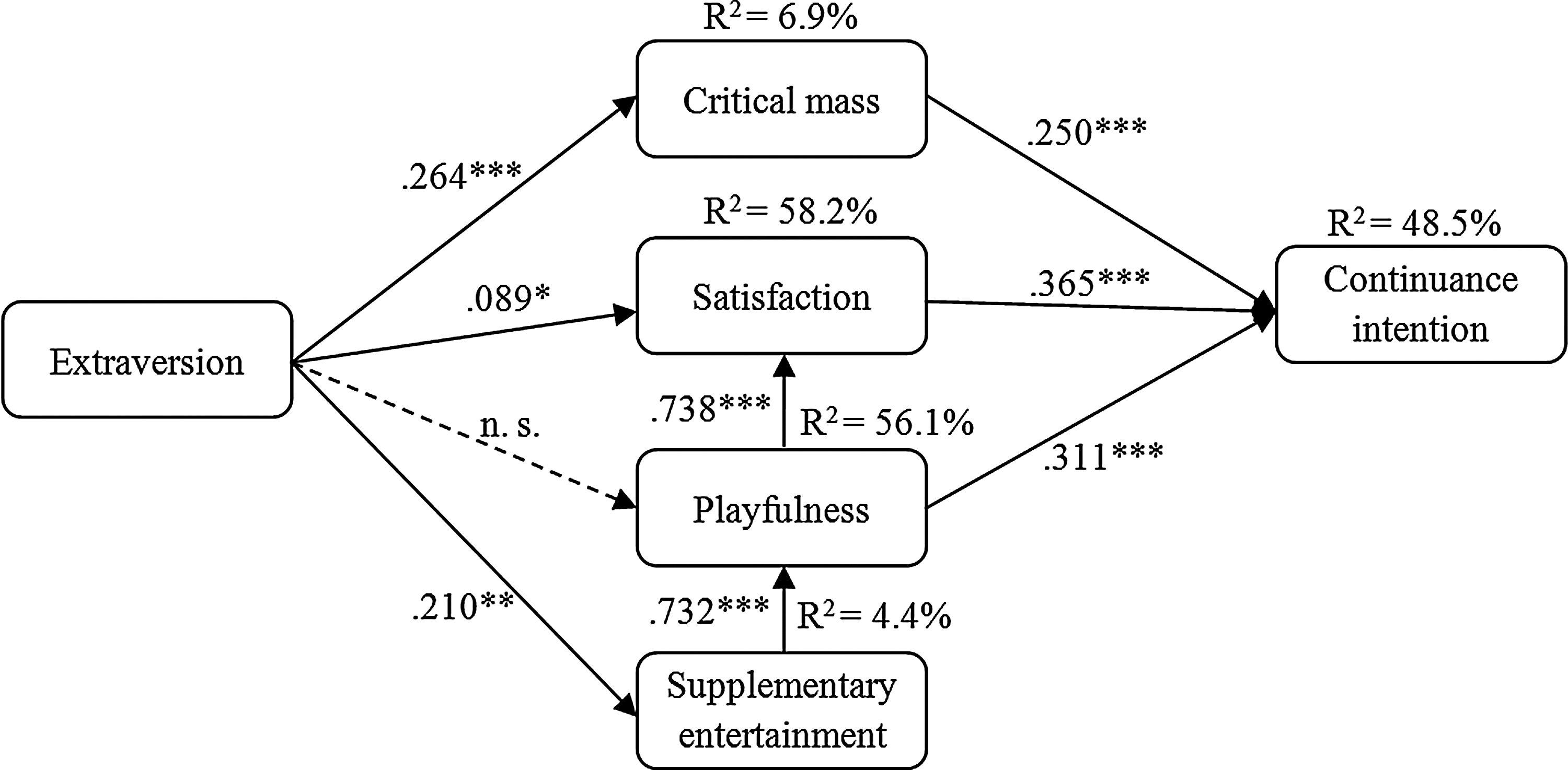
Results (n.s., insignificant; *p<0.05; **p<0.01; ***p<0.001).
Discussion and Implications
Prior studies suggest that personality is reflected in all of an individual's thoughts and actions.6,9 The present study provides evidence that human personalities, such as extraversion, also affect individuals' continuance intention regarding SNSs. While most personality relevant IS studies gave an intuitive comparison of behavioral differences between extraverts and introverts, this study interpret extraverts' behavioral differences by modeling perceptions of an SNS. Consistent with our hypotheses, extraversion is found to have a significant influence on SNS perceptions and continuance intention. Supplementary entertainment mediates the effect of extraversion on playfulness. This may suggest that extraverts are more likely to utilize the supplementary entertainment services provided by an SNS. Also their use of supplementary entertainment brings them more happiness. In addition, extraverts are more likely to be satisfied with their SNS use—partly due to an enhanced perceived playfulness gained from using supplementary entertainment. Furthermore, a significant relationship between extraversion and critical mass indicates that extraverts are more likely to be accompanied by similar SNS users. Finally, all the five predictors are found to be significant motivators of SNS continuance intention. Specifically, extraversion and supplementary entertainment have significant indirect impacts on continuance intention, and playfulness, satisfaction, and critical mass have direct influences. Extraversion exerts an indirect influence on SNS continuance intention through the mediating effects of playfulness and satisfaction.
The study partly addressed the call to incorporate dispositional personality into cognitive perceptions of IS for modeling user behavior. Whereas most prior IS studies on the effects of the Big Five personality traits on IS use are based on the use of linear regression and correlation analysis, few of them employed structural equation modeling technologies. This study offers new insights by intensively investigating how personal extraversion influences perceptions of IS and motivates IS continuance intention. A number of new and significant relationships are reported, and the indices show a good model fit. Consistent with prior studies, the study shows that personality has important effects on users' IS behavior with regard to SNS.
The results contribute to several new insights for practitioners. First, SNS operators should pay more attention to consumer personalities when considering the importance of extraversion in shaping IS perceptions. Not only are extraverts more likely to continue using SNS services, but they also facilitate the extension of the critical mass. Hence, they appear to be a critical user group for retaining existing users and are vital to the profitability of SNS operators. In addition, extraverts are more likely to subscribe to supplementary entertainment services, which offer more revenue for SNS providers. Moreover, it is important to attract consumers with a provision of supplementary entertainment services, increasing user perceptions of both playfulness and satisfaction with SNS. Therefore, an investment in developing and providing supplementary entertainment services becomes necessary for SNS providers. Furthermore, maintaining a critical mass in a SNS is important for keeping users to continue using the SNS. If an individual's critical mass leaves an SNS and switches to other service providers, the user is very likely to follow his/her critical mass to the new SNS.
This study has limitations. First, other important personality traits, like openness or conscientiousness, were not included in the study, and they may have a significant influence on IS continuance. This provides avenues for future research. Second, the study is based on a sample of Chinese consumers. Special attention is therefore required when generalizing the research findings to users from different cultural backgrounds.
Footnotes
Acknowledgments
This work was partially supported by the Fundamental Research Funds for the Central Universities (No. 2012GSP057), the National Funds of Social Science, PR China (No. 10CTQ010), and Wuhan University Academic Development Plan for Scholars after 1970s (“Research on Internet User Behavior”) and Key Research Institutes of Philosophy and Social Science by Ministry of Education, PR China (11JJD630001). The authors would like to thank József Mezei from IAMSR in Åbo Akademi University for constructive comments.
Author Disclosure Statement
No competing financial interests exist.