




Abstract
Abstract
This study explored whether agreeableness, extraversion, and openness function to influence self-disclosure behavior, which in turn impacts the intensity of checking in on Facebook. A complete path from extraversion to Facebook check-in through self-disclosure and sharing was found. The indirect effect from sharing to check-in intensity through life satisfaction was particularly salient. The central component of check-in is for users to disclose a specific location selectively that has implications on demonstrating their social lives, lifestyles, and tastes, enabling a selective and optimized self-image. Implications on the hyperpersonal model and warranting principle are discussed.
Introduction
P
Location-based services (LBS) is defined as any service or application that extends spatial information processing or geographic information capabilities to end users via the Internet or wireless network. 4 Researchers have identified mobility, the use of paths, and the potential for communication created by the mapping of friends on the interface of the mobile device. 5 Social location disclosure allows new means for people to share their perceptions of their surrounding physical and social spaces. Facebook Places, a GPS location-based service, allows users to check in via their mobile devices, tagging friends who are with them, and letting their friends know where they are and what they are up to. A more general location-tagging feature also enables users to share their location on a status update, photo, or wall post. This study only focuses on smartphone users who check in to announce their arrival during activities, rather than a retrospective past experience or an expectation of a future plan.
Location disclosure provides spatio-temporal data as records for the understanding of different aspects of human mobility and travel. 6 Location-awareness applications on mobile devices serve as a reminder and awareness mechanisms related to the whereabouts of the other person, and define new places that can be used for future location disclosures. 7 Space awareness is both a cause of object perception and brings about the ability to generate accurate verbal expression concerning a perceived object. 8 In this sense, people tend to describe what surrounds them through environmental perception and cognition, map perception, or location interpretation to maintain social relations with geographically distant others.
Facebook check-in allows one-to-many announcement of one's whereabouts and is considered social-driven location sharing to enhance self-presentation. 9 Self-presentation is the process of managing the impression one conveys to others, and has three primary functions: to influence others, to enhance the construction of self-identity, and to promote positive emotions. 10 Self-presentation involves strategically disclosing and/or concealing information to portray oneself in a desirable manner. It is impacted by how comfortable people are in communicating across a range of situations and channels and in managing their social relationships. 11 The hyperpersonal model 12 draws heavily on the self-presentation perspective to posit that reduced cues and asynchronous channels of computer-mediated communication (CMC) give users ample time to edit, compose, and select information they prefer to emphasize. The technological aspects of CMC allow individuals to engage in optimized impression formation or selective disclosure of information to present themselves in a desirable manner. The message sender in the CMC context may have greater self-control over which cues are available to receivers. Facebook check-in not only selectively emphasizes physical location but may provide clues to personal activities and lives 13 allowing the recipients to exaggerate subtle social and personality cues as suggested by the hyperpersonal model.
The architecture of Facebook allows users to present their desired images. However, the network also provides tools with which individuals may construct and leave behavioral cues for each other, leading to more carefully crafted presentations of the self. 14 The fact that information on Facebook is generated not only from profile owners but their social networks as well as the computer system has inspired researchers to examine self-generated and other-generated content on Facebook based on the warranting principle, which posits a cue perceived to be unaltered has higher warranting value. 15 A GPS-enabled location check-in can be seen as both self- and system-generated content and may warrant the authenticity of the information that is considered favorable for self-presentation. Self-presentation is one of the major motivations for Facebook use, and abundant research on identity presentation on Facebook has focused on how viewers form impressions based on textual and visual cues. 16 However, the motivations and the extent to which Facebook users would share their trackable physical location as a means to present themselves are underexplored, as it is a newer function. Facebook check-in presents a novel opportunity to study disclosure of place-specific occurrences online strategically in order to evoke offline identity and social interactions, and it is the primary focus of this study.
Location Disclosure on Facebook
A Facebook check-in discloses one's location and shares activities with others. Self-disclosure is oriented toward different types of interpersonal goal accomplishment, such as presenting a positive, likable self-image or attempting to define one's relationship with the recipient.
17
Selective self-disclosure is a strategy for self-presentation, and personality traits play an important role in the extent to which identities are presented.
18
Identity claims are symbolic statements that may be directed at oneself or used to convey messages to others. An identity claim is one of the mechanisms by which personality is manifested in physical environments and the Facebook setting.
19
For instance, people who are high in extraversion, agreeableness, and openness are associated with higher information disclosure on Facebook.20–22
Individuals who are high on neuroticism and conscientiousness have greater concern over online privacy and are less likely to use Facebook or to share personal information on it.23,24 However, contradictory results are found when examining the effects of extraversion on Facebook group membership and number of Facebook friends.22,23 Mixed results have also been generated when testing the relationship between social use of Facebook and extraversion and openness.
25
Although agreeableness reflects the tendency to be kind, warm, and friendly, significant relationships between the trait and social media use have not been found.21–23
These earlier studies are mostly based on the Big Five model, which is often considered universal. However, cross-cultural generalization requires further investigation,
26
as this study is conducted in Taiwan. Thus:
Individuals who are more open to experience are most likely to be associated with using a social networking site (SNS) to seek out novel experiences.21,23 Such individuals have been reported to use more features from the personal information section on Facebook.22,23 While some researchers have found that openness to experience has far more predictive power in using Facebook for real life supplementation and as an interactive tool,
27
others have found, surprisingly, a null relation between openness and SNS use.24,25 The role of openness in Facebook use may be less clear, and considering check-in as a newer Facebook function, it proposes that:
Self-disclosure is the sharing of personal information with a targeted audience. Recent scientific research has provided behavioral and neural evidence that self-disclosure triggers brain mechanics associated with rewards. The effects were magnified when individuals believed that their thoughts would be shared and communicated to others.
28
As such, the tendency to broadcast one's thoughts may engender social bonds and connectedness that ultimately result from sharing more about oneself. Facebook is for users to create profiles and share content about themselves as a result of voluntary self-disclosure among multiple users in a selective network.
15
Greater satisfaction with Facebook use is positively related to a higher level of self-disclosure.
29
Further, Taiwan is a collectivist culture in which people are more concerned about self-presentation and tend to share material benefits and nonmaterial resources with in-group members.
30
Thus:
Agreeableness signifies that individuals are more compassionate and cooperative rather than looking for superficial relationships. The trait is more concerned with equal and honest exchange of information to maintain interpersonal relationships.
31
Past research has found that agreeableness is positively related to the intention of sharing knowledge.32,33 While these studies tend to consider the incentives, motivation, and individual ability of knowledge sharing in an offline context, not much has been done in an online context where people voluntarily share information and mostly without monetary incentive involved. Although researchers have found agreeableness to be unrelated to social use of Facebook,
22
the trait may be a predictor of sharing information on Facebook. Thus:
A location service is defined as a shared object providing information about the physical location of objects.
34
Travelers update their journal entries, maps, itineraries, photographs, and records of their activities and feelings on the road as a reflexive text for their online audience to watch, follow, and monitor.
35
They are encouraged to share their experience to satisfy their desire to tell their story via new technological tools.
36
People share information, knowledge, and skills to motivate, help, and encourage others,
37
and benefit more from sharing a positive emotion with others than simply experiencing the positive event.
38
Sharing positive experiences is associated with a heightened degree of positive affection and life satisfaction.
39
Life satisfaction is an individual's general assessment of the present state of affairs,
40
and it is affected by frequent social interactions and positive affect.
41
Thus:
People tend to check-in when they are at new, unique, unusual, or nonroutine locations to show that the place is interesting. 13 Location sharing is used not only to express whereabouts but also moods, lifestyle, and events within social groups. 42 Location disclosure can serve as a means to present one's happiness and enjoyment. Recall that self-presentation functions to promote positive affections. It is therefore expected that people who are more satisfied with their lives are more likely to share their positive emotions via location check-in. In addition, past research has found a positive relationship between Facebook use and life satisfaction, 41 while another study found that life satisfaction moderates the relationship between Facebook use and perceived offline connectedness. 29 The role of life satisfaction in relation to Facebook use is inconclusive, and, in particular, the effect of life satisfaction on Facebook check-in is uncertain.
Accordingly, this study further tests the path between sharing and check-in intensity given the fact that there may be an indirect effect through life satisfaction.
Method
Participants and procedures
To test the proposed model and hypotheses, a questionnaire was hosted on a popular survey hosting site in Taiwan. This was fielded in January 2012 for 3 weeks. Survey announcements were made through popular portal sites, as well as through the largest Bulletin Board System in Taiwan. Participants who visited the online survey link through any of the announcement channels were directed to a short description of the study, information about confidentiality, and incentives. As a reward, all participants were eligible to participate in a raffle for 100 gift certificates. After removing 22 entries due to duplicate responses, 523 respondents were retained for analysis (Table 1).
Note. a1=<18, 2=19–25, 3=26–30, 4=31–40, 5=41–50, 6=>51 years old; b1=<30 minutes, 2=30–60 minutes, 3=1–2 hours, 4=2–4 hours, 5=4–6 hours, 6=6–8 hours, 7=>8 hours; c1=<1 year, 2=1–2 years, 3=2–3 years, 4=>4 years; d1=<3 months, 2=3–6 months, 3=6–12 months, 4=1–1.5 years, 5=1.5–2 years, 6=>2 years. eTop five most frequent check-in locations: restaurants (16%), scenic areas (13%), movie theaters (9%), department stores or shopping malls (8%), and night markets (7%).
Measures
All scale items in this study were measured on a 5-point Likert-type scale, ranging from 1=“strongly disagree” to 5=“strongly agree.” Participants were asked to rate the extent to which they agreed or disagreed with each statement.
Personality traits
Three dimensions—agreeableness, extraversion, and openness—of the Five-Factor Inventory 43 were adopted, with composite reliabilities of 0.559, 0.792, and 0.684, respectively.
Self-disclosure on Facebook
Three items from the General Disclosiveness Scale (GDS) 44 were adopted with some changes to the wording. Five additional items were created to facilitate an understanding of the respondents' self-disclosure behavior on Facebook. Respondents were instructed to imagine the updates they posted on Facebook when answering these items. The composite reliability was 0.735.
Sharing
Four items from the subscale of blogging motives for helping/informing others 37 were adopted with wording changes. Five additional items were created to offer insight into the degree to which respondents check in as a way of sharing experiences. The composite reliability was 0.836.
Life satisfaction
The Satisfaction with Life Scale (SWLS) 40 consisting of 5-item instruments to measure global cognitive judgments of satisfaction with one's life was adopted. The composite reliability was 0.862.
Facebook check-in intensity
The intensity of check-in follows the rationale of Facebook intensity 29 that measures the extent to which users are emotionally connected and engaged in Facebook activities. This measure includes four self-reported assessments of check-in behavior. Respondents were also asked to recall how often they had checked-in on Facebook per week, over the past few months. The composite reliability was 0.801.
Analysis
The normality of all variables was checked before proceeding to test the measurement and model using Structural equation modeling (SEM) with LISREL v8.8 and model parameters obtained using the robust maximum likelihood method. 45 Confirmatory factor analysis (CFA) was conducted to assess model fitness and to determine the validity and reliability of the constructs. Following current conventions,46,47 CFI, TLI, and RMSEA were reported. The values of CFI and TLI are recommended to be greater than 0.90, and the RMSEA ranging from 0.05 to 0.08 are acceptable. 48
The initial model fitness was unsatisfactory (χ2=3,267.77 with df=968; χ2/df=3.376; CFI=0.78; TLI=0.76; RMESA=0.067 with a 90% confidence interval [0.065; 0.070]). Factor loadings, unique variances, and modification indices were then computed, and items with factor loadings less than 0.5 were deleted. In order to examine whether the adjusted measurements after item reduction could reflect the meaning of each construct effectively, a Pearson correlation test using SPSS was conducted to compare the initial items with the reduced items of each construct. All the correlation values were above 0.80, indicating that the initial items and reduced items of each construct were highly correlated. Thus, the adjusted measurements were still able to explain the initial meaning of each construct.
After deleting items, the CFA was repeated, and the model fitness increased. All the fit statistics demonstrated that the adjusted measurement model was appropriate to measure the constructs (χ2=1043.88 with df=413; χ2/df=2.53; CFI=0.95; TLI=0.95; RMESA=0.054 with a 90% confidence interval [0.050; 0.058]). Thus, evaluation of construct reliability and convergent and discriminant validity was able to proceed.
Internal consistency and convergent validity were examined based on Cronbach's alpha coefficients, factor loadings, composite reliabilities, and average variance extracted (AVE). The value of Cronbach's alpha for each construct surpassed 0.70, except for openness and agreeableness; thus, the model was marginally acceptable. Moreover, all factor loadings, composite reliabilities, and AVEs by each construct were checked for convergent validity, as well as item and scale reliability. Only the AVEs of agreeableness and openness were slightly lower than the recommended 0.5 for outcome control. However, close to 50% of the variance in these two constructs can still be explained and was marginally acceptable.
Discriminant validity was tested by comparing the shared variance between constructs with the AVEs of the individual constructs. The AVEs of the individual constructs were greater than any squared correlation among constructs, confirming discriminant validity. 49 In addition, a complementary assessment of discriminant validity was examined to determine whether the correlation coefficient between any two constructs plus or minus two standard errors did not include 1. 50 This study computed three standard errors to increase the confidence interval to 99% (Table 2).
Note. aCorrelation coefficient between two constructs; bSE between two constructs; c±three SEs around the correlation estimate between the two constructs.
Results
The research hypotheses and the hypothesized model were tested using path analysis. Paths between constructs indicate individual hypotheses, and this study estimated each path for statistical significance of the path coefficient. The analysis of this model produced a chi-square of 1,154.92 (df=422; χ2/df=2.77; p=0.00). The fit indices exhibited a reasonable good fit to the data (CFI=0.94; TLI=0.94; RMSEA=0.058 with a 90% confidence interval [0.054; 0.062]).
The analysis also provided results for all of the hypotheses (Fig. 1). Every structural path was significant, except the paths from agreeableness and openness to Facebook self-disclosure and openness to Facebook check-in intensity (β=−0.21, 0.22, and −0.01 respectively). These three paths were then constrained to zero to examine whether the fit of the model to the data would worsen. The result for this modified model also showed a very good fit to the data with a chi-square of 1,157.94 (df=425; χ2/df=2.72; p=0.00) and fit indices of CFI=0.94, TLI=0.94, and RMSEA=0.057 (with a 90% confidence interval [0.054; 0.061]). This indicates that the three direct paths from agreeableness and openness to Facebook self-disclosure and openness to Facebook check-in intensity did not significantly contribute to the fit of the model. Thus, H1, H3, and H4 were rejected, while H2, H5, H6, H7, H8, and H9 were all supported.
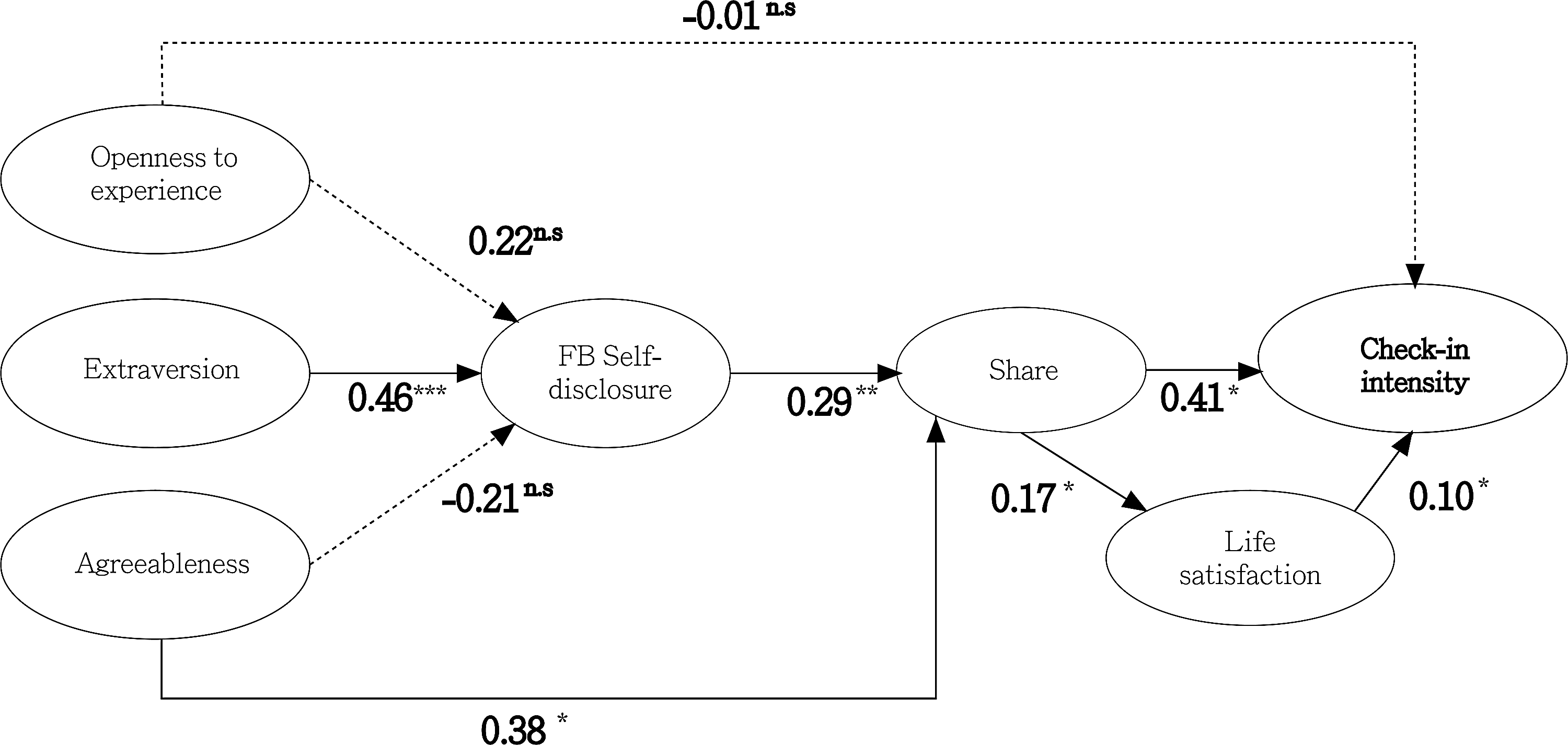
Results of standardized path coefficients. *p<0.05, **p<0.01, ***p<0.001, n.s., nonsignificant.
This study further examined the indirect effect followed by Sobel's (1982) test. 51 The indirect paths, sharing→life satisfaction and life satisfaction→check-in intensity on Facebook were significant, and the direct path, sharing→check-in intensity was also significant (Fig. 1). The Z test (z=1.797, p>0.05) was not statistically significant. Thus, partial mediation was achieved, 52 and H10 was supported.
Discussion
In line with previous studies,20,21 the path from extraversion to Facebook self-disclosure was significant. There was also a positive relationship between the level of agreeableness and the tendency to share things about oneself on Facebook. A complete path from extraversion to check-in through self-disclosure and sharing was confirmed. The indirect effect from sharing to check-in intensity through life satisfaction was particularly salient. Yet, the prediction that there would be a direct path from openness to check-in intensity was not supported. An earlier study 23 suggested that Facebook may have become a relatively mainstream communication tool rather than a unique experience, making the role of openness to experience in Facebook use unclear. It may also be understood that past research tended to examine users' preferences for various Facebook functions rather than the extent to which users engaged in these activities. This study examined the relationship between level of openness and the intensity of Facebook check-in. Although check-in is a newer function that may attract people who are high in openness, they may not continue to devote their efforts to it due to their tendency to seek other new experiences. Further, openness emerges more readily in individualist than in collectivist cultures, 30 and the findings may echo this statement.
A number of theoretical implications are suggested. First, researchers have suggested that Facebook is a corresponding and valid means of communicating personality. 19 However, some empirical findings on the relationship between Facebook use and the Big Five have found that traits may not be as influential as expected.23,25 Considering that the extent to which an individual is motivated to self-present on Facebook may be affected by how relevant the image is to the attainment of one's goals, 10 leading to the increased importance of personality traits as a predictor of selective self-disclosure. Therefore, this study went one step further to explore more sophisticated paths to understand the linkage among traits, motives, and human behaviors. It demonstrates that the intensity of using certain Facebook features may not directly reveal the extent to which individual's personality traits are; personality traits, however, may serve as antecedent factors to reinforce certain behavioral tendencies that ultimately trigger the individual's extensive online behavior. Additionally, more and more social psychologists are focusing on mediational models of social behavior, where a mediator is a variable that can explain the psychological mechanism between two other variables. 53 The mediation effect discovered in this study further provides a nuanced path to understand individuals who differ in their level of life satisfaction to use specific features on Facebook.
Second, various online environments such as personal homepages and SNS can facilitate self-presentation. 14 Facebook allows users to construct tailored impressions for their social networks that may elicit the selective presentation of particular characteristics of oneself to make desired outcomes that can still be attributed to one's offline image. People engage in self-presentation to promote their well-being, and the impressions conveyed may maximize rewards such as approval, friendship, or power, and enhance identity development. 10 The tendency to present positive emotions and share knowledge to encourage others may strengthen the motivation of impression formation. As found in this study and other research, 13 restaurants, movie theaters, and scenic areas are the most popular locations from which people check in. It indicates that people tend to share things about their entertainment and recreational activities to demonstrate their social lives, life-styles, and tastes, promoting a selective and optimized self-image. In this sense, location disclosure is how a place is perceived and interpreted within the social context, and offers a new perspective on impression formation through place-specific cues. The GPS-enabled check-in information may further have the capacity to draw a reliable connection between a presented identity online and a trackable location offline, and thus can hold greater warranting value between self-presentational claims and offline activities. The findings here support the hyperpersonal model in general, and suggest an extension to the warranting principle that trackable location information may serve to validate one's self-presentation cues for others to follow, enabling a heightened sense of reward and identity.
Finally, the majority of the posts on SNS are simply for announcing one's own immediate experiences. 28 Sharing personal detail has become the norm, as channels for self-disclosure proliferate online and through smartphones. In the age of mobile social media, people associate having feelings with sharing them. 1 Facebook check-ins encourage the exchange of location-based information because of how the nature of sharing connects users to both the surrounding spaces and people. 3 As the structure and design elements of Facebook foster connection sharing, 16 this study provides empirical findings to support the statement that people are motivated to share life experiences with existing contacts and to satisfy their social goals through a real-time-based communication channel. Recent scientific research 28 also shows that individuals place high subjective value on opportunities to share their thoughts and feelings and, in doing so, engage neural and cognitive mechanisms associated with rewards. The rewarding outcomes are magnified if they communicate to others, suggesting that sharing experiences plays an important role in social connectedness and contributes to fundamental wellness. Extending this rationale to Facebook check-ins, social connectedness involves awareness, and location checking-in can be understood in this way, conveying connectedness through an awareness that friends and family can locate the user in real time, even when there is no further message exchanged. Checking-in allows users to share the status of their immediate surroundings, providing an attachment to people that may simultaneously enhance a sense of belonging. Social location sharing may also reveal the reality of how people depend on each other for psychological well-being.
From a practical perspective, as the development of mobile social networks matures, users share their whereabouts through more tailored and contextual information. Although location disclosure offers high-warrant information that is practically trackable, this may be less about technical issues than about emotional and social ones. As such, LBS or other sensor-based services driven by mobile communication can enable new ways for users with different clusters of traits to fulfill their sociability and psychological needs.
Limitations of this study include that it only looked at Facebook check-in users, and did not compare the personality traits of users with those of nonusers. It only explains the extent to which traits, motives, and check-in behavior interplay with one another, but does not suggest that check-in users are higher in certain traits than nonusers. This study did not examine all dimensions of the Big Five structure, nor did it consider traits other than that. It only investigated those traits that may be relevant, based on the existing literature. Although the Big Five may be transcultural, 26 future research could consider different cultural dimensions and include more indigenous factors. This study draws upon performative aspects of check-in users. How check-in is perceived by the audience deserves future attention. A cross-sectional design also limited the potential to discern causality. The data were based on participation recruitment through certain online channels, and the final sample yielded a large proportion of younger and more highly educated respondents. Although Facebook users do tend to be younger and better educated, this should be noted as one possible limitation.
Footnotes
Acknowledgments
This study is funded by Aim for the Top University Project of Electronic Commerce Research Center, NSYSU. The author would like to thank the two reviewers for their valuable comments.
Author Disclosure Statement
No competing financial interests exist.