




Abstract
Abstract
An experiment (N=123) examined how individuals cognitively process online news stories depicting African-American characters with stereotype-consistent and -inconsistent attributes and whether distracting online ads interfere with story processing. Two cognitive control functions, updating and inhibition, were predicted to moderate the effects of distracting ads. Recall of characters' attributes and overall characters' description were included in the study as dependent measures. Findings indicated that distracting online ads hinder recall of information about and descriptions of story characters. Inhibition and updating affect dependent measures and moderate the effects of distracting online ads on characters' descriptions.
Introduction
The study examined how distracting online ads interfere with the processing of online news stories about a social outgroup's representatives (African Americans). The study measured recall of attributes linked to African-American story characters and the overall description of these characters. Some attributes were consistent with the racial stereotype (i.e., easier to process); some were stereotype inconsistent (i.e., more difficult to process). Cognitive control functions, inhibition of automatic responses, and updating memory with new, stereotype-inconsistent items were predicted to moderate the effects of distracting ads on dependent measures.
African Americans in Media
African Americans have been often stereotyped in news.17–21 Activation of a racial stereotype after the exposure to mediated portrayals can lead to stereotype-consistent cognitive, affective, and behavioral responses.22–32 Counter-stereotypical depictions can reduce stereotype-driven responses.33,34 The present study investigated the processing of stereotype-consistent and -inconsistent attributes of racial outgroup representatives included in news stories. Cued recall, a common measure of storage35,36 that has been used in research on stereotyping effects,37,38 was included in the present study as a dependent measure to indicate how well participants store stereotype-consistent and -inconsistent information. Another dependent measure, description, was included in the study to account not only for accurately recalled but also for incorrectly assigned, yet, stereotype-related attributes.
Processing of Stereotype-Related Information
Stereotypes are cognitive structures, or stable knowledge stored in memory. 39 Stereotypes are easily activated after the exposure to primes (e.g., mediated messages). Controlled and automatic processes are often discussed in relation to stereotype activation.40–42 Automatic processes are effortless, unintentional, and unconscious. 40 Activation of African-American stereotypes after the exposure to a news story about an African American happens with little cognitive cost and often without a person's awareness. Racial stereotype activation can lead to negative stereotype-consistent responses.19,20,22,23,26,28,32 Individuals often do not show negative responses due to internal and external motivations.41,43 Inhibition of stereotypical responses is discussed within the theoretical framework of cognitive control.37,44
While control over stereotypical responses can occur unintentionally and without awareness, 45 it is exerted with greater cognitive costs. Using cognitive resources to complete additional tasks can lead to failure in controlling stereotypical responses.37,38,46,47 Stangor and Duan 38 found that when participants read a profile of a social group's representative and simultaneously listened to a news broadcast, they recalled more stereotype-congruent than -incongruent information. The ability to recall stereotype-incongruent information was impaired, because cognitive resources needed to store stereotype-incongruent attributes were used to react to the distracting news broadcast.
The present study employed distracting online ads on news Web pages to test whether they impair readers' ability to process stereotype-inconsistent information. Distraction was conceptualized as a novel, irrelevant stimulus that affects performance on a primary task.48–50 Highly and low distracting ads in this study were selected based on the scope of their psychological effects.2,10–14
The study posited that adding a highly distracting ad on a news Web page would be particularly damaging for the storage of stereotype-inconsistent information.
Cognitive Control and Stereotype Processing
Cognitive control, a working memory function51,52 that helps individuals deal with cognitive challenges, affects regulation of stereotypical responses. 37 Collecting information about and making impressions of a social group's representative, one often relies on the social group's stereotype. Stereotype-consistent information is processed with a great degree of automaticity. Stereotype-inconsistent information poses two cognitive challenges associated with cognitive control: the need to inhibit stereotype-consistent responses and the need to update memory with new information. Inhibition is a purposeful prevention of automatically activated responses. Updating refers to monitoring, coding new information, matching it with existing knowledge, and “replacing” old items if necessary. 44 Since effective processing of stereotype-inconsistent information depends not only on cognitively demanding situations (e.g., distraction) but also on one's abilities to inhibit and update, 37 cognitive control functions were included in the present study as individual difference variables 53 and were predicted to moderate the effects of distracting ads on dependent measures.
Method
Participants and procedures
Participants (N=161) for the experimental study were recruited from courses at a Midwestern university. Only the responses of Caucasians (N=123), due to their sensitivity to the stereotype of the African-American outgroup, were included in data analysis. Caucasian participants were mostly women (68 percent) with an average age of 20.4 (SD=3.80). About 84 percent were undergraduate students.
The study was conducted in a lab with 20 computers equipped with MediaLab software. 54 Each computer had a 17” monitor, keyboard, and headphones. First, participants completed cognitive control tasks. After a short break, they read three personal profile stories about African-American characters (Appendix), each placed on a different Web page and paired with an ad.* The order of Web page presentation was automatically randomized. Each story included stereotype-consistent and -inconsistent character attributes. Half of the participants read stories paired with low distracting ads, and another half read stories paired with highly distracting ads. After completing each story, participants typed attributes of a story character in a box on the monitor (cued recall task). They reported demographic information at the end.
Design and independent variables (IVs)
The study was a 2 (Distracting ad: low vs. high)×2 (Stereotype attribute: consistent vs. inconsistent)×2 (Cognitive control ability: low vs. high)×3 (Message repetition)×3 (Story-Ad Combination) mixed-factorial experiment.
Distracting ad
A distracting ad was a between-subjects factor. Participants were exposed to stories with either low distracting static banners or highly distracting video ads. To ensure the distracting power of video ads, a pilot experiment was conducted.
Pilot study participants (N=44) viewed words in three conditions. In control condition, no ad was present on the screen. In banner condition, participants viewed words next to a static banner ad. In video condition, they viewed words and were simultaneously exposed to a video ad. Word recall in video condition was significantly lower (M=2.60, SD=1.42) than in static banner (M=3.73, SD=1.58; p<0.001) and control (M=3.70, SD=1.67; p<0.001) conditions [F(2,86)=21.45, p<0.0001, η2=0.33]. No difference was found between control and static banner conditions (p=0.85), which allowed the exclusion of the control condition from the main experiment.
Stereotype attribute
A stereotype attribute was a within-subjects factor with two levels. Ten stereotype-consistent and 10 stereotype-inconsistent attributes were included in each story. The attributes were selected from previous literature40,55 and pretested. Pretest survey participants (N=95) rated the consistency of 80 attributes with African-American stereotypes on 7-point scales from 1 “Not at all” to 7 “A lot.” Attributes with the highest means were treated as stereotype consistent; whereas attributes with the lowest means were considered stereotype inconsistent. The means of the attributes did not differ across the stories.
Moderators
Moderating effects of updating and inhibition were tested one at a time. Median splits were performed to dichotomize two continuous cognitive control variables.
Inhibition
Go-stop task measured how well participants inhibited automatic responses. Participants practiced to categorize green right- or left-pointing arrows on the screen by pressing left or right arrow buttons on the keyboard. Then, participants were instructed to continue categorizing green arrows unless they turned red (stop signal). Participants had to inhibit responses (not to press any button) if they saw a red arrow. The probability of inhibition failure (d′) was calculated.44,56
Updating
Keep-track task measured the updating ability. Participants memorized six categories and category exemplars. Then, they viewed several trials of random words flashing on the screen that included a few category exemplars. At the end of each trial, participants recalled the last exemplars associated with salient categories. The ratio of correct responses to the total number of responses was calculated.44,57
Message repetition
Three stories were used in each treatment condition (within-subjects factor).
Story-Ad combination
Participants within each distracting ad condition were exposed to three combinations of ads and stories (between-subjects factor).
Message repetition and story-ad combination did not interfere with the effects of treatment on the dependent variables (DVs); thus, they did not create any confounding effects.
Dependent measures
After reading each story, participants recalled attributes of an African-American character, with the character's name serving as a cue. Open-ended cued recall responses were coded, and two dependent measures were derived. Recall accounts only for attributes correctly assigned to characters. Description deals with all stereotype-related attributes correctly or incorrectly assigned to characters. The second coder analyzed 11 percent of responses to obtain intercoder reliability indices.
Recall
Correctly recalled attributes and their close synonyms (e.g., “smart” and “intelligent”) were categorized as stereotype consistent (Krippendorff's α=0.81) or stereotype inconsistent (Krippendorff's α=0.80).
Description
Some participants assigned the attribute of one character to another or generated attributes that were not present in stories but could be coded as stereotype consistent or -inconsistent (e.g., “good” or “bad”). To account for “extra” attributes, variable description was created (stereotype-consistent description: Krippendorff's α=0.88; stereotype-inconsistent description: Krippendorff's α=0.87). 58
Results
H1a and RQ1a
A 2 (distracting ad)×2 (stereotype attribute) repeated-measures analysis of variance (ANOVA) with recall as a DV indicated a marginally significant main effect of the distracting ad, F(1,120)=3.80, p=0.05, η2=0.03. Participants in a low distracting ad condition accurately recalled more attributes (M=6.07; SD=2.55) than participants in a highly distracting ad condition (M=5.28; SD=2.44). A repeated-measures ANOVA with the same factors and description as a DV showed a significant main effect of distracting ad, F(1,117)=5.14, p<0.05, η2=0.04. Participants generated more attributes of characters in a low distracting ad condition (M=7.24; SD=3.42) than in a highly distracting ad condition (M=6.24; SD=2.87; Table 1).
The main effect of stereotypes on description was significant, F(1,117)=8.53, p<0.05, η2=0.07. Participants used more stereotype-inconsistent attributes (M=7.14; SD=3.28) than -consistent attributes (M=6.31; SD=2.52) to describe characters (Table 1).
H1b and RQ1b
Two 2 (distracting ad)×2 (stereotype attribute) repeated-measures ANOVAs did not indicate distracting ad×stereotype interaction effects on recall, F(1,120)=1.68, not significant (n.s.), and description, F(1,117)=2.61, n.s.
H2a and H2b
Two 2 (distracting Ad)×2 (inhibition)×2 (stereotype attribute) repeated-measures ANOVAs indicated no distracting ad×inhibition×stereotype interaction effects on recall, F(1,112)=0.11, n.s., and description, F(1,109)=0.57, n.s. Distracting ad×inhibition effect on description was significant, F(1,109)=4.36, p<0.05, η2=0.04. Low inhibitors generated more characters' descriptions in a low distracting condition (M=15.79; SD=4.49) than in a highly distracting condition (M=11.56; SD=3.73; p=0.001). No difference was found between low distracting (M=13.70; SD=5.51) and highly distracting (M=13.23; SD=4.94) conditions among high inhibitors (Fig. 1; Table 2).
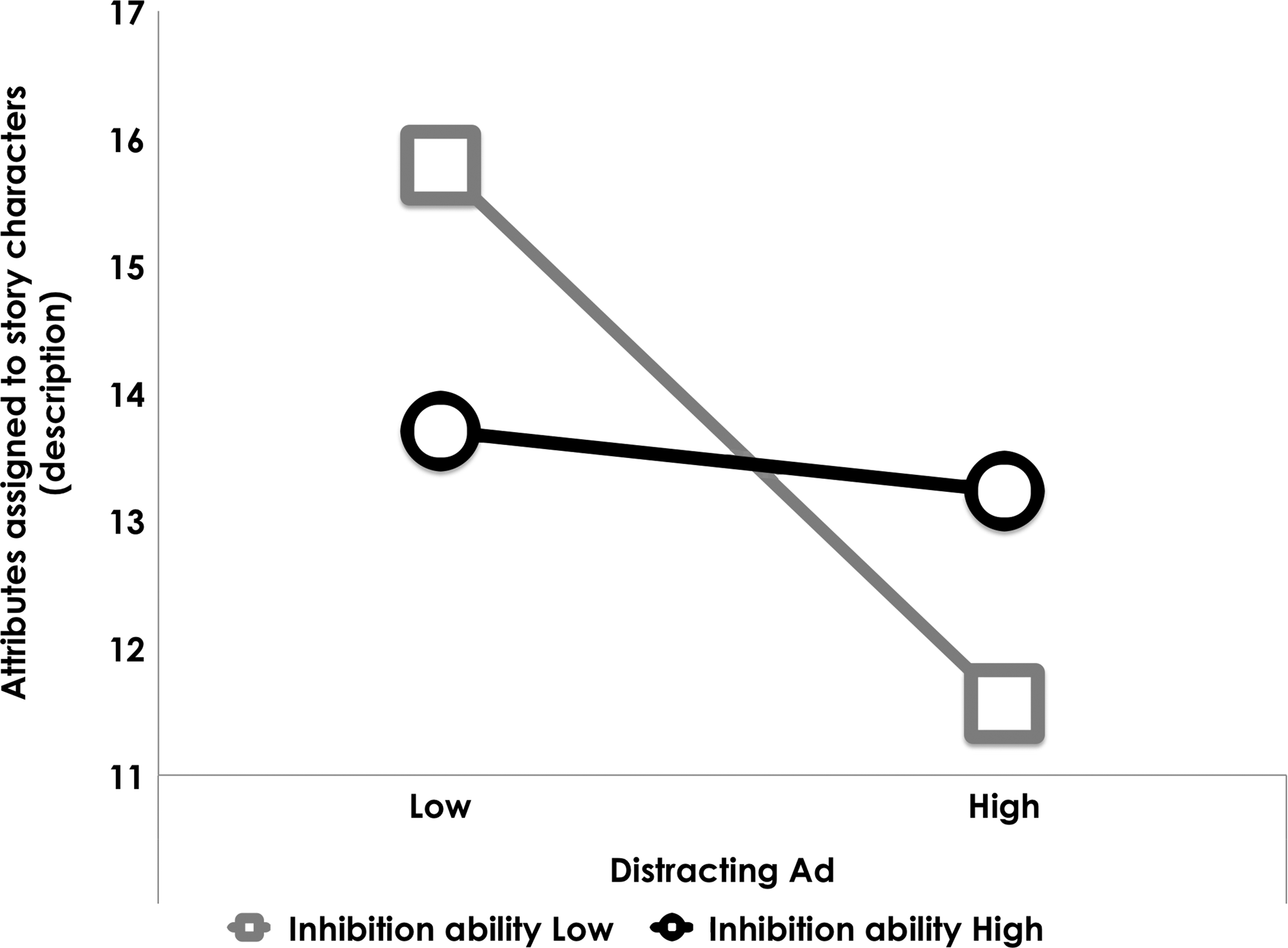
Inhibition moderates the effects of distracting ads on the description of story characters.
H3a and H3b
Two 2 (distracting ad)×2 (updating)×2 (stereotype attribute) repeated-measures ANOVAs showed no distracting ad×updating×stereotype interaction effects on recall, F(1,114)=0.23, n.s., and description, F(1,111)=0.41, n.s. However, the main effects of updating on recall, F(1,114)=15.36, p<0.001, η2=0.12, and description, F(1,111)=12.23, p=0.001, η2=0.10, were significant. High updaters accurately recalled (M=6.58; SD=2.57) and generated more attributes (M=7.65; SD=2.89) than low updaters (recall: M=5.04; SD=2.45; description: M=6.13; SD=3.42). In addition, a distracting ad×updating interaction effect on description approached significance, F(1,111)=3.34, p=0.07, η2=0.03. High updaters used more attributes to describe characters (M=17.32; SD=5.75) than low updaters (M=12.69; SD=4.11; p<0.001) in a low distracting ad condition. In highly distracting ad condition, the difference between high (M=13.27; SD=4.62) and low updaters (M=11.81; SD=4.14) was not significant (Fig. 2). In addition, high updaters generated a significantly higher number of attributes to describe story characters in a low distracting condition than in a highly distracting condition (p<0.01; Fig. 2, Table 3).
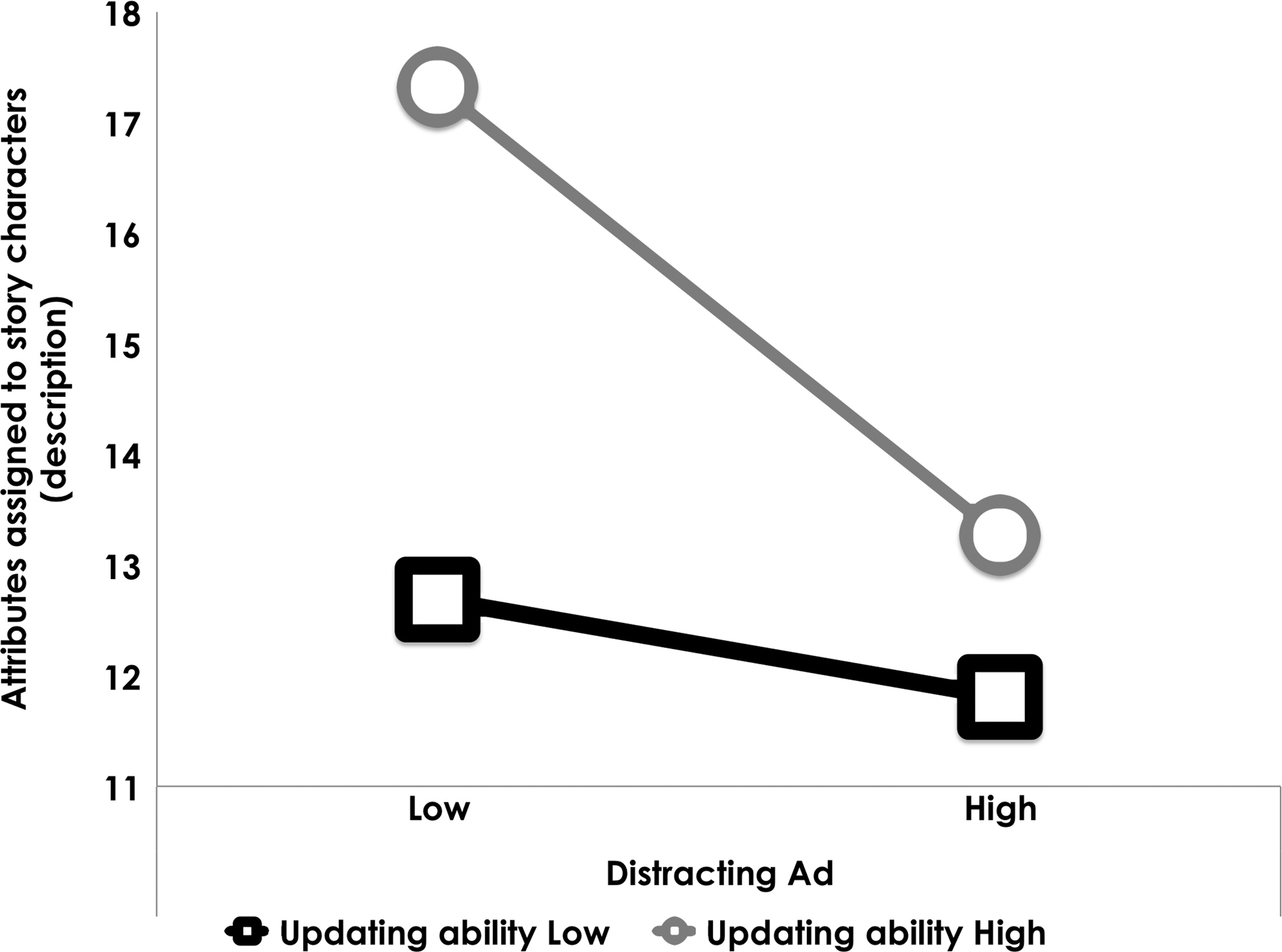
Updating moderates the effects of distracting ads on the description of story characters.
Discussion
The results of this study indicated that highly distracting online ads added to news Web pages hindered recall of online news story contents. Such effects remained significant with description as a DV, suggesting that “cognitive exhaustion” due to distraction could not only lead to poor recall of story information but also make participants generate fewer characters' descriptions.
The type of information about African-American characters also mattered. Participants used more stereotype-inconsistent than -consistent attributes (correct and incorrect) in characters' descriptions, which could suggest that participants successfully exerted control over stereotype-consistent responses and were not affected by highly distracting online ads. It could also happen that participants exerted control not when they read the stories but when they completed the cued recall tasks, as they had more cognitive resources available to individuate story characters. Interestingly, participants accurately recalled similar numbers of consistent and inconsistent attributes (Mconsistent=5.58; Minconsistent=5.76); but incorrectly assigned attributes were predominantly inconsistent. This finding is extremely important and calls for further investigation. It suggests that recalling information from external stimuli (e.g., news stories) may not lead to disassociation of characters from the salient racial category. However, when individuals generate their own descriptions and have cognitive resources to do so, they may individuate racial group representatives.
Two cognitive control functions—inhibition and updating—moderated the effects of distracting ads on characters' descriptions. High updaters recalled and generated more attributes than low updaters. In a low distracting ad condition, high updaters used a greater number of attributes to describe characters than did low updaters. The ability of high updaters to generate attributes deteriorated when they read stories in a highly distracting condition. These findings suggest that updating function plays an important role in storing information from news stories, and highly distracting ads interfere with the process of forming impressions of story characters among better updaters.
Low inhibitors generated more characters' descriptions in a low distracting ad condition than in a highly distracting ad condition, while high inhibitors did not differ in this regard. This finding could be explained by taking a closer look at inhibition, which is not a unitary function and can be fractioned. 59 Inhibition of prepotent responses, such as stereotype-driven responses, is correlated with inhibition of responses to a distracter, 59 which could suggest that people with a low ability to suppress automatic responses could also fail at ignoring distracting ads. This negatively influenced the performance on characters' description tasks.
The findings of the current study show that reading online news stories is a cognitively demanding task. The fact that distracting online ads did not make a difference in recalling stereotype-consistent and -inconsistent attributes could be explained by the complexity of manipulated stories. Articles provided narratives about individuals' lives. Putting stereotype-consistent information in context could increase the difficulty of processing and make it similar to stereotype-inconsistent information. Another study limitation suggests that the recall of ads had to be measured to fully understand the degree of their distracting power. In addition, distracting content and structural ad features as well as ad relevance to users have to be taken into account. Furthermore, cognitive control functions have to be measured in future studies with the use of multiple tasks and over a period of time to ensure that they measure cognitive abilities stable over time rather than short-term abilities. Finally, the sample used in the experiment posed some constraints, as it was homogenously Caucasian and included two thirds of women. Although gender did not significantly affect DVs or interacted with treatment, it is suggested that future research uses a more balanced split of men and women. As for racial representation, a similar study should be administered with a sample of African Americans to explore whether the representatives of ingroups control stereotype-driven responses when faced with stereotype-inconsistent information.
The implications of the present study are discussed on practical and theoretical levels. First, the knowledge of how individuals process online news stories and ads altogether helps professional journalists deal with fast Internet-driven changes in the industry while communicating socially significant messages to the public. Second, the present study advances the existing theory of media and stereotyping by investigating psychological reactions to mediated stereotype-inconsistent information and focusing on cognitive control functions, as they play a great role in the processing of news stories about social outgroup representatives.
Footnotes
Acknowledgment
Bert van Beek (2006) is acknowledged in this manuscript for programming the computer task “Arrows” to measure inhibition (go-stop task).
Author Disclosure Statement
No competing financial interests exist.
Appendix
News story example
Demond Johnson
African-American carpenter
SAVANNAH, Ga.—Demond Johnson used to have a
“Fifteen long years of being an “official”
Johnson dropped out of school when he was 15. He never returned to complete his education
Hanging out with “bad black guys” and being
After the prison, one of the many challenges for Johnson was to find a job. Johnson decided he would be a
Johnson thought that the most important quality he obtained in adjusting to life after prison was
Randy Morgan, a carpenter in the same firm, describes Johnson as a
Johnson thinks he is still cautious of people. “I am an
Last year, Johnson started seeing someone. “This relationship is the biggest gift life gave me. I am very
*
Eighteen Web pages represented different story-ad combinations. Nine Web pages combined stories and banners (low distracting ad condition), and the other nine Web pages included stories and videos (highly distracting ad condition). Static banners advertised garden tools, medical services, and home paints, while videos downloaded from YouTube depicted clothes and beverage products. The lengths of stories and videos were controlled.