




Abstract
Abstract
Online entertainment communities have exploded in popularity and drawn attention from researchers. However, few studies have investigated what leads people to remain active in such communities at the postadoption stage. We proposed and tested a dual model of entertainment-based and community-based mechanisms to examine the factors that affect individuals' continued participation in online entertainment communities. Survival analysis was employed on a longitudinal dataset of 2,302 users collected over 2 years from an online game community. Our results were highly consistent with the theoretical model. Specifically, under the entertainment-based mechanism, our findings showed that the intensities of initial use and frequent use were positive predictors of players' activity lifespan. Under the community-based mechanism, the results demonstrated that the number of guilds a player was affiliated with and the average number of days of being a guild member positively predict players' lifespan in the game. Overall, our study suggests that the entertainment-based mechanism and community-based mechanism are two key drivers that determinate individuals' continued participation in online entertainment communities.
Introduction
A central concern for the development of online communities is how to keep members coming back. However, little research has investigated what leads people to remain in online entertainment communities. Heijden 5 studied the factors affecting an individual's initial participation in online hedonic systems at the preadoption stage. Hou and Ma 6 proposed that it is necessary to focus on individuals' behaviors in online entertainment communities at the postadoption stage (e.g., continued participation) as well as the preadoption stage (e.g., initial participation). Many Information System (IS) scholars contend that continued use deserves more attention, because the eventual success of an information system depends on not only initial use but also continued use over the long run.7–9 Thus, we attempted to explore the factors affecting individuals' continued participation in online entertainment communities. Particularly, we examined WOW players' participation lifespans to uncover what may influence their long-term retentions.
This work applied the survival analysis approach using gamers' actual behavioral data to assess continued participation or activity lifespan in the entertainment community of WOW. Past studies examining players' loyalty primarily take a belief–attitude–intention approach. 2 Our study aimed to supplement continued use research; we undertook the first longitudinal field study of a game using unobtrusive panel data of user behavior.
Literature Review
Past research points out that usability and sociability are two key factors that determine the success of communities.2,10 Usability is primarily concerned with the interaction between users and technology. Pyy's 11 research further indicated that the way we interpret usability may vary between different kinds of technologies, “but at least with games it is usually essential because enjoyability is one of the main reasons to play games in the first place” (p.10). Many game studies12–14 have shown that the usability of online games is demonstrated by its entertainment characteristic. In other words, users play a game or initially choose to play a game primarily because they enjoy the entertainment characteristic of the game.12–14 A recent empirical study by Ma and Kim (unpublished work) examined a continued use of an online gambling community and indicated that individuals engage in frequent gambling due to the entertainment characteristic of the gambling community. Our study investigated the continued use of a popular computer game—WOW. We, therefore, used the entertainment-based mechanism to reflect the usability dimension of this special type of technosocial system. Moreover, we used initial use and frequent use (i.e., play the game) to describe its entertainment-based mechanism.
Sociability, on the other hand, mainly considers the interpersonal interaction and relationship among members of a community. MMO games have been recognized as important sites of community,15–17 and “foster informal sociability and cultivate virtual communities” (p.12). 18 Many studies have suggested that individuals engage themselves in WOW due to the online community characteristics of the game.15,19,20 Particularly, WOW players are able to interact with others and form communities through guilds. Steinkuehler and Williams 16 found that “as gamers become more involved in long-term social network such as guild, their activities become more hardcore” (p.903). We thus used the number of guilds and the average number of days in guild to describe the community-based mechanism of the WOW game.
As such, we propose a framework embracing two antecedent mechanisms—entertainment-based mechanism and community-based mechanism. Specially, as shown in Figure 1, we use this dual-mechanism framework to predict the lifespans of individuals' participation in WOW.
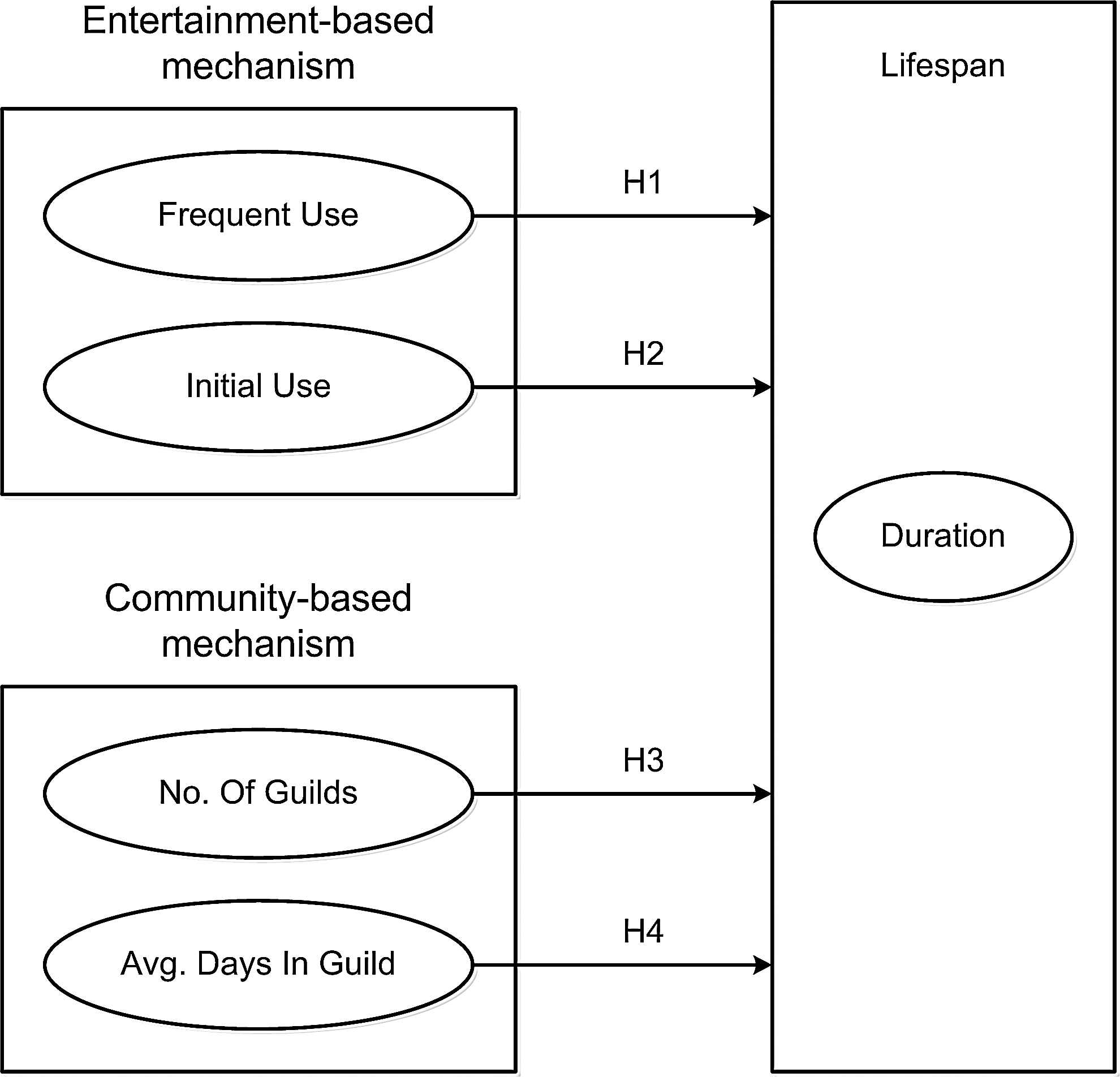
Theoretical framework: A dual model of continued participation in online entertainment communities.
Entertainment-based mechanism to influence continued participation
Cognitive psychology scholars posit that the memory storage, which is like a tank gradually filled with a collection of learning, conscious deliberation, and unconscious deliberation over time, 21 is associated with continued use. 22 More specifically, the memory storage is divided into three memory-processing stages, namely, sensory memory, short-term memory, and long-term memory. As individuals initially use a technology or a service, sensory memory, the first stage of memory processing, will start operating in an individual's brain. At this stage, a large number of sensory images and sounds rush into a receptor's brain in seconds or minutes. Once WOW players start playing the game, its attractive images and sounds (i.e., various entertainment characteristics) unavoidably rush into their brains. At the second stage, the short memory starts to work, processing active decision-making tasks. At the third stage, the information pieces of short memory are transferred and preserved in long-term memory for a longer period or even an entire lifetime. 22 This process is the root of automatic use and continued use. Thus, the transformation of players' short memory of the game to their long-term memory is likely to trigger players' automatic and continued participation in WOW. Such a transformation of short memory to long-term memory is typically achieved through intensive participation in an initially short time period and subsequently frequent participation over the long term.
Numerous studies have identified a strong relationship between initial use and continued use. For example, Bhattacherjee 8 proposed that the initial use experience positively affects continued use of online services, just as customers' repurchasing behavior in general is influenced by the initial purchase experience. Jon, Carter, and Zmud 23 found that individuals would perform their behaviors for a long time in future if they experienced a satisfactory initial use. Kim and Malhotra 7 proposed that initial use, which can be considered as earlier evaluation of IT services, affects continued use of those services. The positive relationship between frequent use and continued use has also been widely demonstrated. Ma and Kim (unpublished work) found that frequent gambling/use in an online gambling community has a positive effect on subsequent gambling. IS and consumer study scholars contend that frequent use is positively associated with habit, which can be interpreted as the continued use out of the automatic manner. 22 Similarly, Bagozzi and Warshaw 24 suggested that a high frequency of past behaviors tends to form habits in future. Ouellette and Wood 25 further discovered that a frequent past behavior is positively associated with the strength of habit. As individuals more frequently involve into the game, the hard-wired scripts in their brains are strengthened.21,26 Consequently, we believe that the frequent use serves as a catalyst to deepen the hard-wired scripts and eventually leads individuals to play the game for a long time. Therefore, we propose that the intensities of initial use and frequent use are both positively associated with continued participation, that is, survival duration.
Community-based mechanism to influence continued participation
Individuals' continued participation in an online entertainment community is driven by not only the entertainment-based mechanism but also the community-based mechanism.2,10 In studying entertainment communities such as those in online games, scholars have devoted a great amount of attention to the social network or community aspect of game play in the last decade.17,27 Most MMO games allow individual players to self-create digital characters or avatars and to interact not only with the game but also with other players. As one MMO gamer put, “[Meeting new people is] the most interesting aspect of the game. This gives it a social dimension. There's another person behind every character.” 28 In WOW, players typically interact with others, engage in shared play experiences, and form communities through guilds. A guild is a small group in which certain players jointly beat monsters, an activity that they alone cannot easily achieve. Guild mates can engage in social interaction with other guild members through a dedicated chat channel. Each guild has its own specific characteristics, including guild strategies, reputation, and culture. Players can choose to join a number of different guilds through their avatars; they can also quit guilds any time they want. Through a combination of survey study, participant observation, and player interviews, Steinkuehler and Williams 16 found that as gamers become more involved guilds, their activities become more hardcore.
Although many aforementioned studies emphasized the importance of social influence on participation, empirical research investigating the community-based mechanism on continued participation and survival pattern is comparatively rare. Hou 29 found that an increased level of perceived social interaction within a game leads to greater usage of that game. Yoo and Alavi 30 found that group cohesion, a sense of members' attraction to the group community, 31 has a significant effect on task participation. Hsu and Lu 2 showed that perceived group cohesion has an indirect impact on gamers' loyalty. Instead of using a perception-based measure, we monitored the number of guilds a player is affiliated with and the average days of being a guild member, and used them to indicate a player's involvement in guilds. We hypothesize that the more involved a player is in the communities of an online game, the longer he or she will stay in that game. Specially,
Method
Data description
Our WOW data were collected from a public data site that allowed any researcher to download for free. 3 This dataset comprised the observations of 91,065 avatars over 1,107 days between Jan. 2006 and Jan. 2009. The complete lifetime observations were acquired using a three-step sampling procedure. First, we identified 6,037 distinct avatars within the first month (i.e., Jan. 2006). Second, only level-one avatars, that is, those avatars that have just started the game within this month, were chosen. This procedure narrowed our sample down from 6,037 to 2,302. Third, we monitored the usage scripts of the 2,302 avatars for 24 months (i.e., Jan. 2006 to Jan. 2008).
It should not be ignored that we hypothesized continued participation of individual game players, while we analyzed the behavioral data of avatars as our unit of analysis. However, we believe that this is not a significant issue that would impair our results. Williams12,17 found that most players use one avatar as the main avatar in the game. Thus, in our study, we analyzed the usage scripts of avatars, and used those to represent individual players' usage scripts.12,17
Measurement
All of our study variables were operationalized based on the usage scripts we monitored. Table 1 presents their operational definitions. Specifically, two independent variables reflecting an entertainment-based mechanism (i.e., frequency and initial use) and two independent variables reflecting community-based mechanism (i.e., number of guilds and average number of days in the guilds) were calculated. We also included an avatar's race, class, and level as control variables. Measurements are described in detail in Supplementary Data A (Supplementary Data are available online at
WOW, World of Warcraft.
The descriptive statistics and correlation matrix of our study variables are reported in Tables 2 and 3. According to Table 3, the highest correlation was observed between Avg. Days In Guild and Frequency (r=0.65). We further checked the Variance Inflation Factor (VIF) of those variables. The highest VIF is 2.88, which is less than the generally accepted threshold of 5.00, suggesting that there was no significant multicollinearity.32–34
Survival analysis and duration
Theoretically, avatars survive in the game if they keep playing. However, the actual survival duration is always uncertain, because a certain proportion of the avatars may still be alive after the end of the observation period. This phenomenon is referred to as censored observations. 35 Survival analysis is especially developed to address such issues. We employed survival analysis to examine the duration that avatars survive in the WOW game (see Supplementary Data B for a detailed description). We chose to declare an avatar's death if it remained inactive in the last 30 days of the observation period. To ensure that we produced robust and reliable results, we performed multiple robustness checks using alternate cutoffs (i.e., 15 and 60 days) and obtained consistent results. In addition, we randomly selected a subdataset accounting for 33.33% of the original dataset, and found that the results of the random subdataset were consistent with the results of original dataset.
Results
The Statistical Analysis System (SAS 9.2) program was used to analyze the data. The survival analysis procedure was applied to test our models. Avatar survival curve (Fig. 2) showed that nearly half of the avatars quitted the game within the first 3 weeks, which is in line with past studies arguing that initial interaction is critical for user retention.36,37 The curve flattens after 680 days, suggesting that some avatars stay in the game, and that they are likely to remain even longer. We compared the survival curves between avatars who have guild affiliations and those who have not (Fig. 4). Overall, guild avatars are significantly more likely to remain active than nonguild avatars. Moreover, while nonguild avatars had a stark initial dropout rate, with 60% of avatars quitting after ∼3 weeks, guild avatars did not exhibit such a dramatic behavioral pattern, but instead left WOW equally likely within our observation period.
We developed four models to test our hypotheses; Table 4 presents their regression results. A comparison analysis showed consistent results across those models (Supplementary Data B). Thus, we report our results based on Model 1, which is comparatively more straightforward. Model 1 in Table 4 shows that after accounting for other variables, as Frequency increases one unit, the time an avatar stays in the game goes up by 6,177%† (β1=4.1396, p<0.001), supporting H1. It should be noted that this is a mathematical explanation of the result. In reality, increasing frequency (days/month) by one unit, or doubling the number of days of game play in a month, is very unlikely.
Significant at 10% level.
Significant at 5% level.
Significantly at 1% level.
AIC, akaike information criterion.
In a similar way, H2 predicted that the intensity of initial use was positively associated with duration. The significant positive effect (β2=0.3906, p<0.001) indicated that the avatar survival duration increases by 47% as the initial use increases one unit, after other variables in the model are controlled for. Thus, H2 is supported.
H3 suggested that the number of guilds an avatar affiliated with was positively associated with duration. Model 1 in Table 4 (β3=0.6333, p<0.001) showed that for one unit change in variable No. Of Guilds, the percentage of the expected survival duration will increase by 88%, with other variables held constant. Subsequently, H3 is supported.
H4 predicted that the average days of an avatar being any guild member was positively associated with duration. Survival analysis reported that for one unit change in variable Ave. Days In Guild, the percentage of the expected survival duration will increase by 0.75%, keeping other variables constant. H4 is supported.
Discussion
The purpose of this study was to explore the factors that affect continued participation in online entertainment communities. While numerous studies have examined community participation in the context of online games,6,29 little research is devoted to investigating players' survival patterns with actual behavioral data. Drawing on past studies, we proposed a dual-mechanism framework—entertainment-based mechanism and community-based mechanism—and empirically tested our framework by examining players' continued participation in an online game community.
Theoretically, our findings showed that continued participation in online entertainment communities is driven by a joint impact from both their entertainment and community aspects. An abundance of adoption literature has examined why individuals choose to use certain technosocial systems,38–40 such as becoming a member and participating in online communities. 38 There are, nevertheless, few studies that investigate what leads individuals to remain in online communities. Scholars2,10 proposed that the postadoption stage deserves more attention. Our findings sought to contribute to this line of research. In addition, past research studying continued use or user loyalty primarily takes a belief–attitude–intention approach.2,40 Our study sought to supplement previous research using unobtrusive panel data of user behavior. More importantly, for this research field to establish a long-term causal relationship, a longitudinal method should be employed to help triangulate the findings. We undertook the first longitudinal field study of a gaming community.
Our study provides empirical support for the proposition suggested by many IS scholars2,10 postulating that usability (i.e., in our case, gameplay) and community are two key components that decide the success of communities. Specifically, survival analyses indicated that players' continued participation in the community is strongly influenced by the intensity of their initial play as well as the frequency of their ongoing game play. In other words, players who have a greater use of the game at the initial adoption period tend to have a longer life within the game. Our results support the contention of game researchers who suggest that players tend to stay longer if they are hardcore gamers; that is, hardcore gamers are more likely to be long-lived gamers as well.
Our findings also indicated a community-based aspect to entertainment communities of online games. We found that players who have guild affiliations for a long period are more committed gamers and tend to have long lifespans. Both how many guilds players joined and how long they remained members in guilds significantly influenced their continued participation in the game. These findings confirm previous game studies proposing that most regular and active gamers in MMOs are guild members.16,41 Our results are also consistent with studies examining general technosocial systems that emphasized the vital role of sociability, interpersonal interaction, and community environment afforded by those systems on user participation. 29
Practically, a long-lived online community is always a coveted dream for all online community operators. Moreover, continued participation is the key to user retention and loyalty. We believe that our study has several practical implications for community operators. First, our finding demonstrated a high rate of drop-off users in the beginning period (Fig. 2). We suggest that the designers and operators of the online entertainment communities should devote more resources to enhance users' initial interaction with the online entertainment community. For example, positive feedback for every successful action the user performs should be awarded during the initial period. Secondly, our results showed that players with a higher intensity of initial use remained in the game much longer than those with low initial use (Fig. 3). Moreover, players with high frequent use also tended to have a longer lifespan in the game community. Thus, developers should consider employing multiple devices (e.g., mobile device and tablets) to stimulate and facilitate frequent use. Especially, mobile devices are able to minimize time and space constraints on usage. Thirdly, we found that players affiliated with guilds were more loyal users than those who were not guild members. This finding may suggest that developers consider incorporating incentive elements to encourage users to become group members, thus improving users' membership tenure (Fig. 4). Designers should also pay attention to the community environment that fosters social interaction, reciprocal culture, bridging and boing relationships, etc.
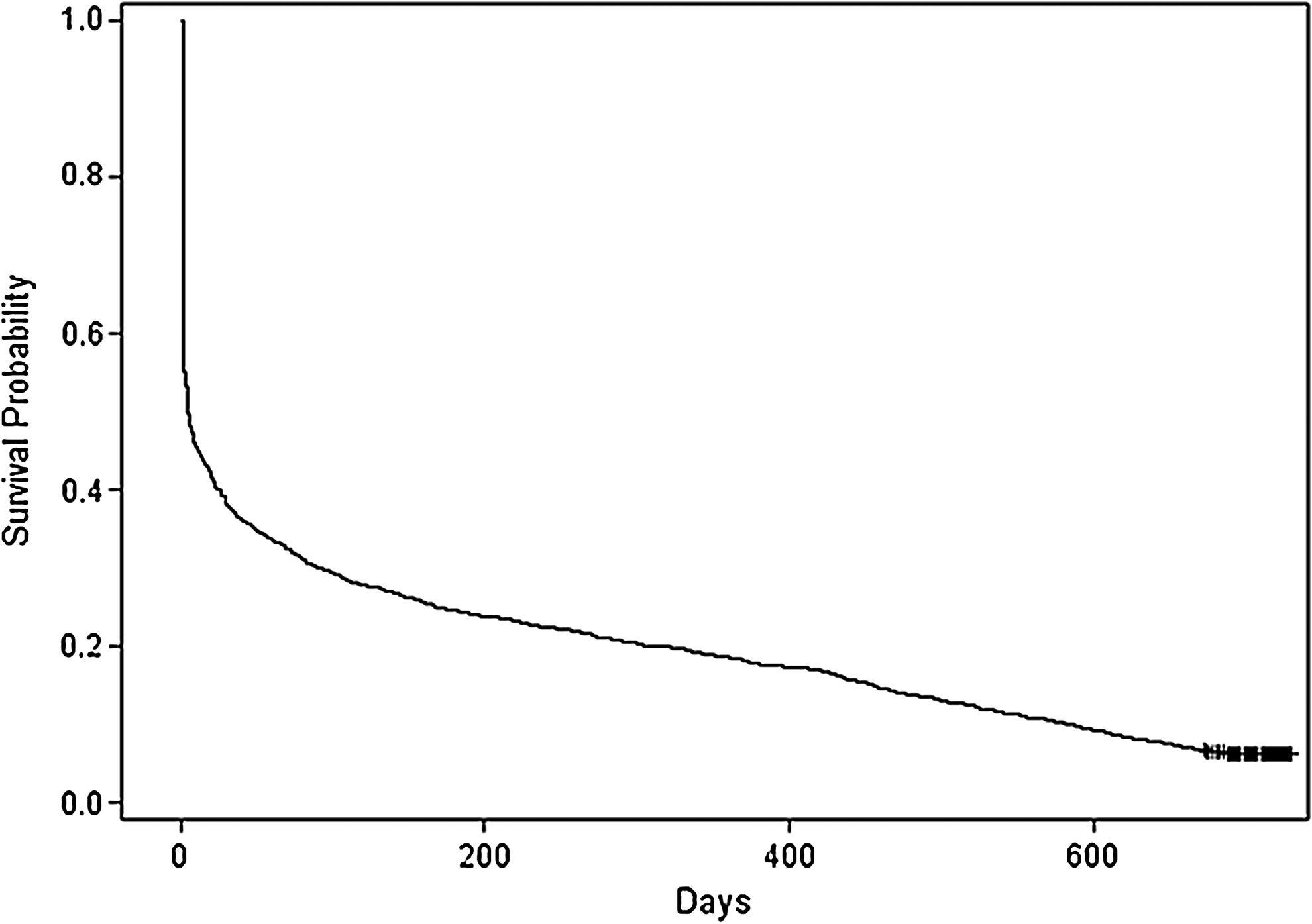
Survival probability of avatars. This figure plots the number of days since an avatar's first play on the X-axis and plots the percent of avatars that are still alive (survival probability) on the Y-axis.
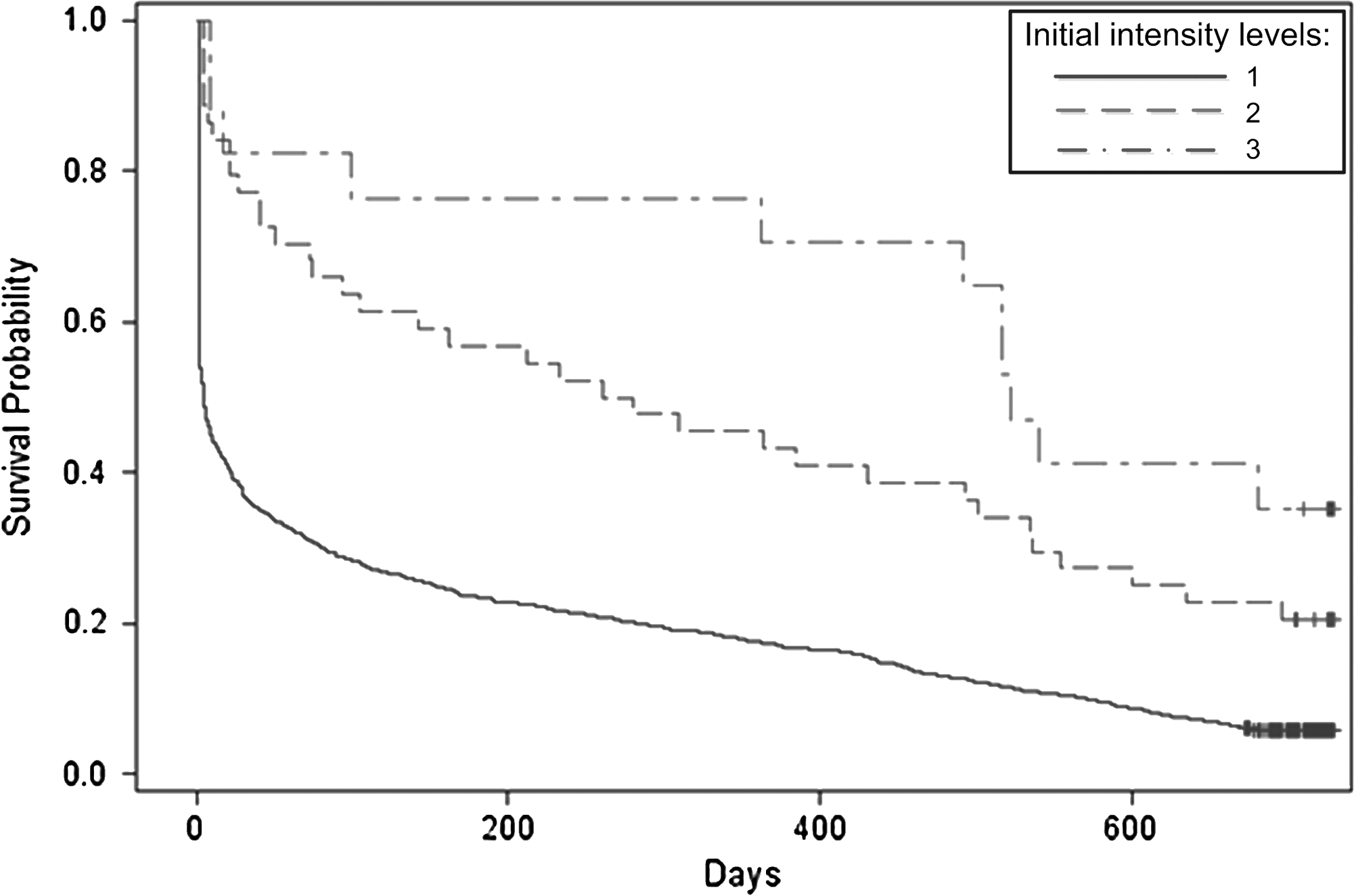
A comparison of survival probability among avatars with various intensity levels of initial use. This figure compares the survival patterns of avatars with various intensity levels of initial use (“1” indicates lowest intensity, and “3” indicates highest intensity). It plots the number of days since an avatar's first play on the X-axis and plots the percent of avatars that are still alive (survival probability) on the Y-axis.
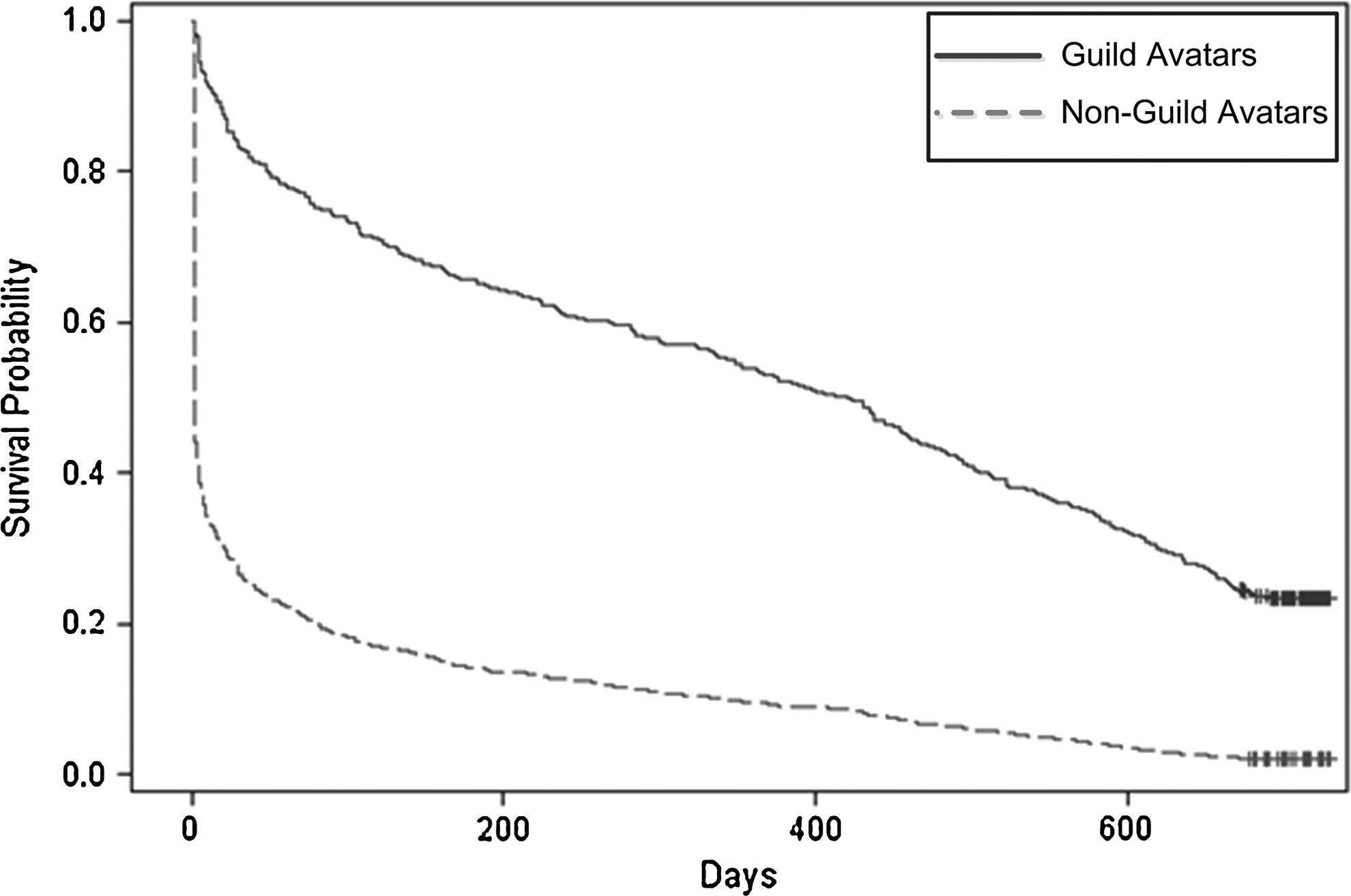
A comparison of survival probability between guild and nonguild avatars. This figure compares the survival patterns of avatars who have guild affiliations and those who have not. It plots the number of days since an avatar's first play on the X-axis and plots the percent of avatars that are still alive (survival probability) on the Y-axis.
Our study is not without limitations. First, the generalizability of our study may be limited, because the dataset was collected from a single online game. We are uncertain whether different genres of online entertainment communities would change the results. Second, because of the limited measures available at the individual level, our study may be susceptible to the issue of individuals' heterogeneity (e.g., income and nationality of the player). Thus, several directions to extend our work can be identified. First, richer datasets of gamers' online playing activities can be obtained from multiple online games to make estimations less sensitive to the design styles of a specific game. Second, future researchers can incorporate and control more information of players to alleviate the heterogeneity effect.
Footnotes
Acknowledgments
This research was supported by the National Science Foundation of China (No: 71071066), the Ministry of Education of China Humanities and Social Science Foundation (No: 11YJA630098), Youth Project of National Social Science Fund (No: 12CGL101), Major Program of the National Social Science Foundation of China (No: 11AXW006), and the Chinese Scholarship Council (CSC). We would like to thank Professor Sung S. Kim for his valuable comments.
Author Disclosure Statement
No competing financial interests exist.
†
The transformation calculation from the coefficient is 100*(e4.1396−1)=6,177%.
References
Supplementary Material
Please find the following supplemental material available below.
For Open Access articles published under a Creative Commons License, all supplemental material carries the same license as the article it is associated with.
For non-Open Access articles published, all supplemental material carries a non-exclusive license, and permission requests for re-use of supplemental material or any part of supplemental material shall be sent directly to the copyright owner as specified in the copyright notice associated with the article.
