




Abstract
Abstract
To evaluate the quality of public discussion about social movements on Twitter and to understand the structural features and evolution of longitudinal discussion networks, we analyze tweets about the Occupy Wall Street movement posted over the course of 16 days by investigating the relationship between inequality, emotion, and the stability of online discussion. The results reveal that (1) the discussion is highly unequal for both initiating discussions and receiving conversations; (2) the stability of the discussion is much higher for receivers than for initiators; (3) the inequality of online discussions moderates the stability of online discussions; and (4) on an individual level, there is no significant relationship between emotion and political discussion. The implications help evaluate the quality of public discussion, and to understand the relationship between online discussion and social movements.
Introduction
In addition to the obvious advantages of integrating information from all types of mass media, celebrities, and related organizations, online social networks have great potential for mobilizing people. Scholars have been interested in the effects of participation in online social networks on political participation and have found correlations with news learning, information sharing, debating, and informal interaction.1–4 Before the emergence of social media, a similar role played by interpersonal communication and mass media in stirring people's interest was discussed. 5 However, in this era of social media, scholars can better understand how conversational ecosystems operate by tracking online users' activities. 6 For example, Twitter users mention other users using the symbol “@,” which indicates their motivations to draw attentions toward a particular topic.
Given that public discussions of certain public issues are playing an increasingly important role in fostering the public opinion, the quality of online discussions remains uncertain. Online discussion, however, is a longitudinal, dynamic process, which makes it difficult to select an appropriate theoretical framework to evaluate the quality in order to adequately examine most of the crucial dimensions. 7
Instead of focusing on Twitter's role in social movements in general, we studied the specific discussion network of Occupy Wall Street on Twitter, aiming at understanding how it evolved with the rise of the event. Specifically, based on the level of analysis (agent, structure, content, and time) and relevant theories, we evaluate three dimensions of the quality of public discussion: equality, stability, and emotion. Ultimately, the study will offer general understandings about how such a particular case fits into a broader theoretical lens, and how the framework we propose here travels to further investigations.
The Quality of Online Discussion
To construct an empirically grounded, beyond normative study for public discussion, scholars have developed different models from various perspectives, for example, focus of content, ideological direction, and participation equality.2,8–11 Habermas proposes an idealized vision of the public sphere with regard to three dimensions: equality, quality, and reciprocity. 12 Price and Neijens argue that the quality of public opinion is inextricably bound to a broader conception, as democratic decision making is a complex process that involves multiple phases and collective participants. 13 Schneider defines the quality of public discussion as participants' likelihood to remain engaged with the topic. 14 Scheufele distinguishes cognitive and affective dimensions of public discussion and emphasized two dimensions of public opinion: the decision to allocate attention (i.e., intensity of opinion) and the direction of attitude (i.e., valence). In addition, the public is effective in making decisions and forming attitudes (i.e., emotion). 15 Taking previous discussions into consideration, we will include equality, stability, and emotion to establish a foundation for evaluating the quality of public discussion on Twitter.
Equality of public discussion
Equality of online discussion is the extent to which contributions to discussions are evenly distributed among all participants, which is consistent with the crucial feature of the public sphere.
Discussion participants who are popular will get more attractive in a growing conversation network. The principle of “Matthew effect” (i.e., “the rich get richer,” “the 80-20 rule”) underscores a preferential attachment process (or “Yule process”). Preferential attachment is a common explanation for the emergence of long-tail distributions (e.g., Pareto distribution, Zipf distribution),16–18
which widely exists in various fields, including online discussions. For example, Himelboim's studies about online discussion conforms such “the rich get richer” pattern in online forums.19,20 Wu ea al. find that elites users who compromise only a minor proportion of the user population dominate major attentions within Twitter.
21
If new conversations are sent preferentially to more popular people, then the resulting distribution of the number of connections possessed by discussion participants follows power laws, implying that participation is highly unequal.
22
Thus, the value of the Internet in facilitating free and equal access to political debates has been challenged, as discussion is by no means equally distributed.
8
The concerns voiced earlier lead to the first hypothesis:
Stability of public discussion
In online discussion studies, stability is considered the duration of an individual's attention and accumulative contributions to certain topics. Schneider measures stability through participants' continuous participation in the discussion. 14 Other scholars argue that stability changes dramatically when there is a lack of thorough thinking, 9 limited interactions with others, 23 and limited capacity of public attention. 24 For example, Twitter users are always exposed to the latest tweets and distracted from a niche of topic. According to the reasons given earlier, we expect that the stability of both initiators and receivers of conversations decreases along with time.
Since the rise of social media, a number of studies have adopted a network analysis to identify social roles and key actors.10,25 For example, Himelboim et al. label people who are most likely to evoke contributions to discussions as “discussion catalysts.” Karnstedt et al. confirmed that public attentions in large forum communities are more likely to be drawn toward “leaders.” 23 These studies imply that structural features impact discussion behaviors among different discussants. Specifically, we are interested in the extent to which the stability of Twitter conversations is constrained by users' structural features in the network in terms of both social roles (i.e., conversation initiators and message receivers) and network centrality (i.e., central participants and marginal participants).
First, user activity is to what extent one initiates a conversation with others by using @ function, and likewise, user popularity is defined by their degree of being mentioned in others' tweets. Activity is featured for the burst phenomena that indicates less stable,
26
while popularity as the quality of being well liked is an aggregated outcome of individual behaviors guaranteed by social status and preferential attachment; thus, popularity is more stable. We label discussion participants who are often spoken to in a discussion as the “generals” of the discussion and those who are active in mentioning or initiating discussions with others as the “soldiers.” We expect generals to stay in the barracks, while soldiers come and go. Thus, we propose the following hypothesis:
Second, inequality of participation reinforces social roles' impact on stability. Recent studies have found that the centrality of users notably impacts churning action in online communities.
23
For discussion initiators, individuals occupying the more central positions in the discussion network tend to be less stable, as they experience a stronger burst of participation, despite their stronger motivations to stay on the topic; while for conversation receivers, individuals occupying the more central positions in the discussion network tend to be less stable, which is guaranteed by their stronger popularities. By controlling the centrality, we propose the following hypotheses:
Emotion and public discussion
The perspective of previous studies has shifted from a cognitive-only approach to a cognitive-plus-affective approach, 27 which gives the emotional component of attitudes more weight. Over the past two decades, research on emotion has exploded. 28 On the aggregate level, scholars have linked sentiment embedded in the tweets with stock markets, 29 presidential polls, 30 consumer opinions, 31 and debate outcomes. 32 Rational and deliberative aspects of public opinion are desirable. However, as Price and Neijens note, nonrational factors are inevitable. 13 The platform of social media is fragmented and individualized, which leads to personal expressions with more emotional components. Emotion may have a nontrivial impact on the structural features of public discussions and individual behavior.
Emotions impact the popularity of tweets. In addition to resembling group members and maintaining the population's enthusiasm, emotion also arouses attention and expands influence for the broader population. Quercia et al. find that sentimental expression determines the influential degree of tweets, and negative mood is a desirable factor in terms of problem solving, idea production, and social influence.
33
Naveed et al. find that tweets with annoying or displeasing content and emoticons tend to be retweeted more.
34
In terms of citizen activism, Hill and Hughs find that discussion cascade is related to the impoliteness of messages.
9
Thus, tweets with emotional words attract more public attention, and the expectation of supportive feedback would stimulate their tweeting behavior, which then shapes the equality of public discussion. Therefore, we present the following hypothesis:
Emotion enables past experience to be encoded and current situations to be evaluated, 35 thus it creates a channel for persuasion. 27 In addition to that, it plays a central role in evaluating and taking action in social movements, because it is capable of stirring people up and causing them to abandon habitual commitments. Schemer et al. find that anger enhances political participation, while fear weakens participation. 36
Emotion gives group members a group consciousness and a motivation to participate in collective endeavors, thus playing a positive role in maintaining online discussions. Emotions are associated with issue salience. Practically, important events render a relatively small fluctuation in sentiment strength,
37
which implies that emotion would be a better detector for events of different importance. Since emotion plays a positive role in maintaining online discussions by persuading and building group members' group consciousness and motivation to participate in collective endeavors, emotions in tweets are helpful to the stability of public discussion. Thus, we propose H3b:
Methods
As a platform for online discussion, Twitter provides an opportunity for both collecting data and matching different theoretical statements about an ideal public sphere with unobtrusive observations. Focusing on the public discussion of the Occupy Wall Street social movement, the rise and fall of the real-time online discussion grants us a chance to gauge the quality of public discussion of social movements over time with the design of a natural experiment.
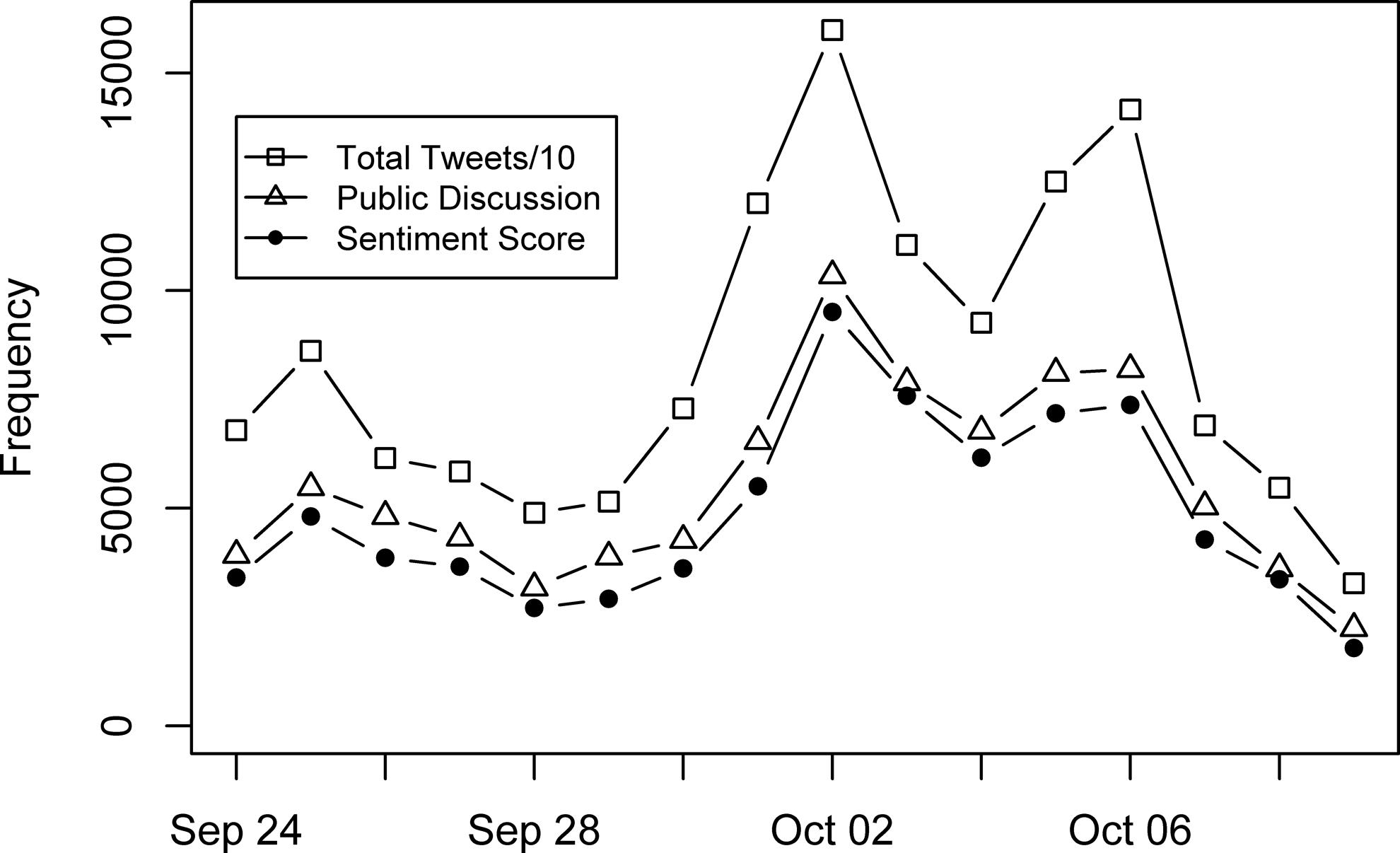
We employ novel data retrieved through Twitter's open API by R-shief 1 . The data contain 1,353,413 tweets of Occupy Wall Street over the course of 16 days (September 24, 2011- October 10, 2011), within which 88,601 discussions are identified by the symbol “@” (See Fig. 1).
The shift in public discussion, total tweets, and sentiment scores over time.
A longitudinal network analysis is used to investigate the evolution of time-based discussion networks. Braha et al. find that node centrality changes dramatically every day; thus, they suggest adopting dynamic centrality and dynamic network instead of static centrality and an aggregated network. 38
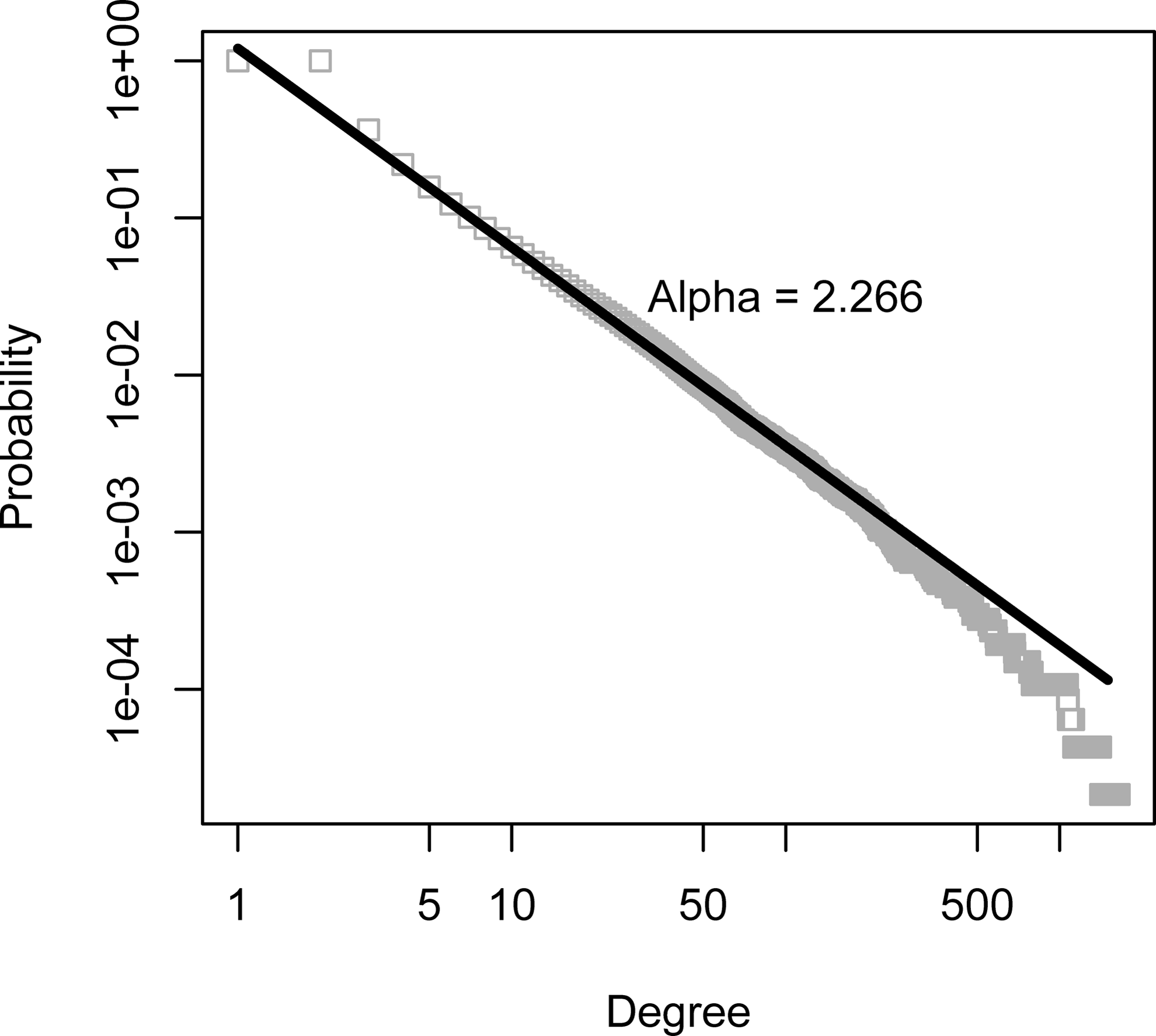
Equality of participation is measured based on the degree of nodes. We fit the power law distribution of node degree and test goodness of fit following the method proposed by Clauset et al. 22
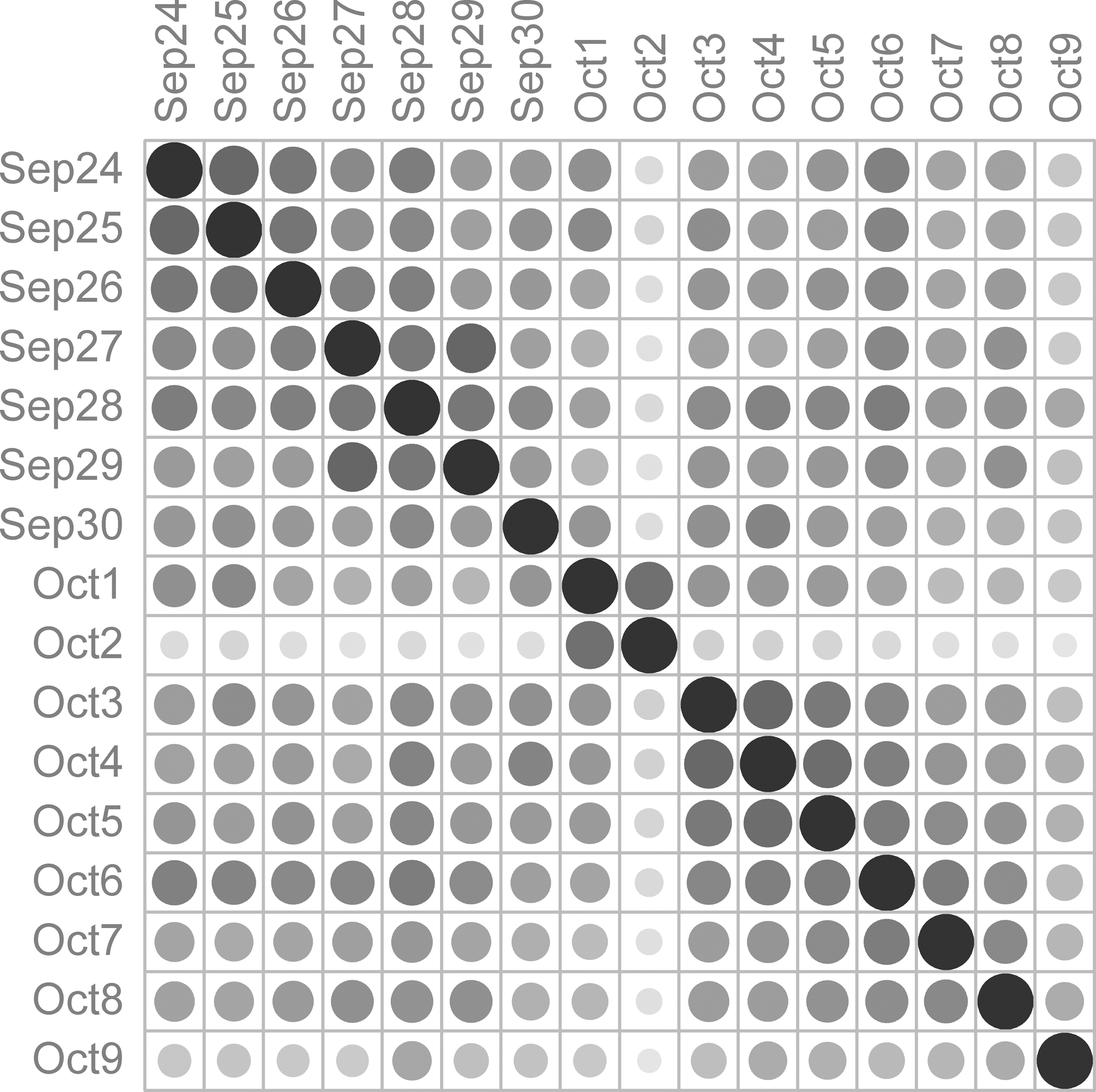
Stability is measured in two ways: (1) by calculating node centrality and analyzing the correlation matrix of individuals' participation in online discussion over 16 time windows and (2) by calculating the standard deviations for each individual's participation over time.
To evaluate the emotional feature, we adopt a sentiment analysis to measure the positive and negative sentiment for each tweet. Sentiment refers to emotions that develop into generalized long-term beliefs.39,40 Following a line of psychological research, we distinguish emotion from mood, as the former requires a triggering event, while the latter does not. The wording and phrasing of each post are detected with the opinion lexicon developed by Hu and Liu. 41 The words in each post are compared with the lexicon that contains lists of sentimental words (including the misspelled words appearing frequently in social media content), and their frequency of occurrence indicates emotion strength. 42 The emotions of each individual are normalized by the number of tweets tweeted by them.
Results
To test the first hypothesis related to equality, we examine the centrality of network (i.e., degree, in degree, and out degree). This result reveals that the degree of nodes follows the power law distribution (alpha=2.07, The Kolmogorov—Smirnov statistic D=0.02, p<0.001, see Fig. 2). The dynamic centrality follows power law distributions over time, with only a very weak fluctuation of alpha values for degree (M=2.54, SD=0.13), out degree (M=2.61, SD=0.15), and in degree (M=1.97, SD=0.19). Furthermore, only 16.8% of the participants are both conversation initiators and receivers, and reciprocity, which defines the proportion of mutual connections in a directed graph, is very small (0.005). Consistent with the power law distribution, the assortativity for node degree, which measures the extent of homophily, is negative (−0.01), implying that the discussion network is quite heterogeneous. Thus, we confirm the first hypothesis:
Degree distribution.
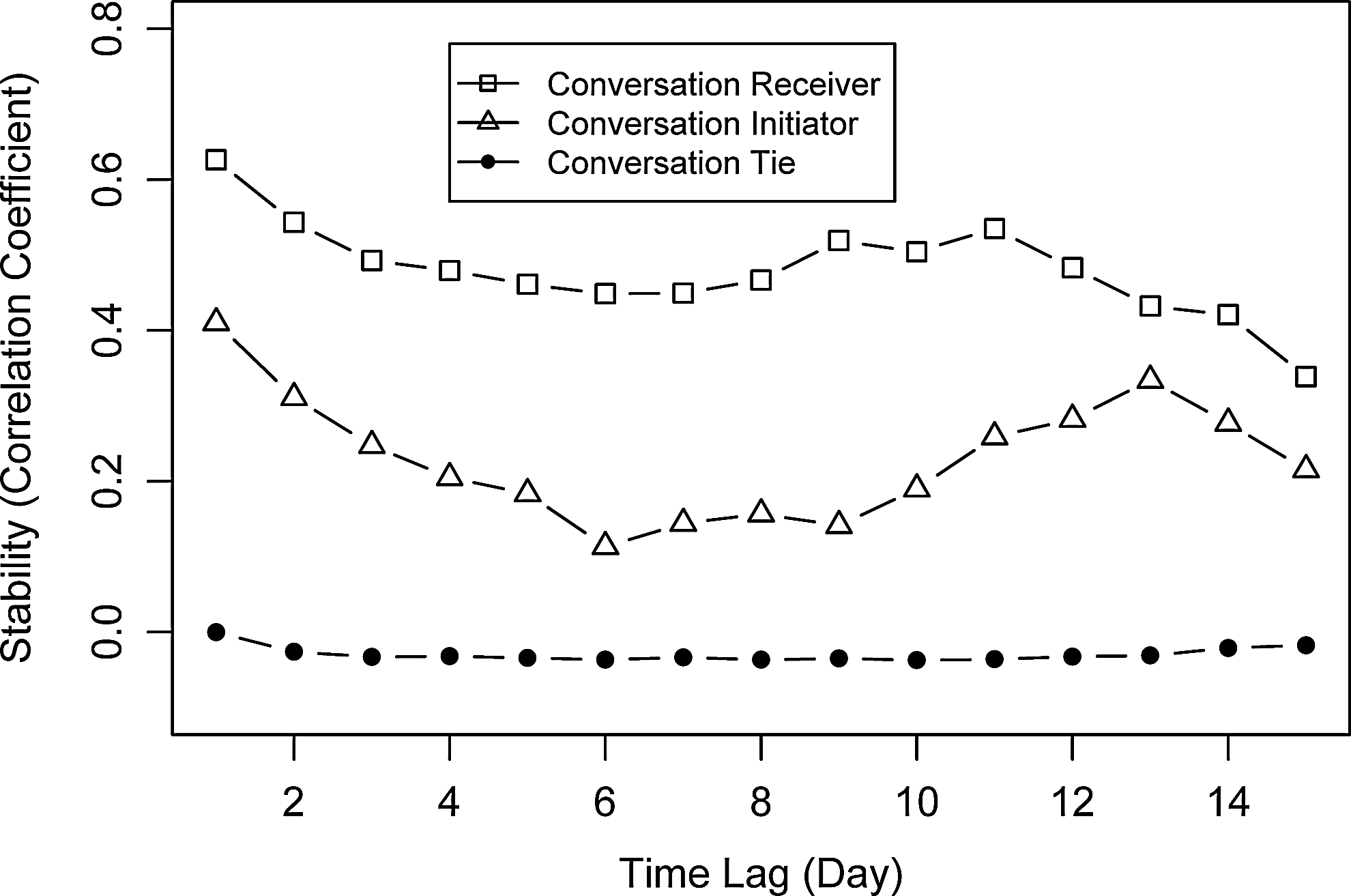
For the second hypothesis regarding stability, we find that the stability of conversation receivers is clearly higher than the stability of conversation initiators (see Figs. 3–5). Thus, we confirm H2a.

Stability of conversation initiators.
Stability of conversation receivers.
Stability of the discussion network.
Active conversation senders are less stable (see Fig. 6), while the stability of popular conversation receivers is higher than that of ordinary receivers (see Fig. 7); thus, we confirm H2b and H2c.
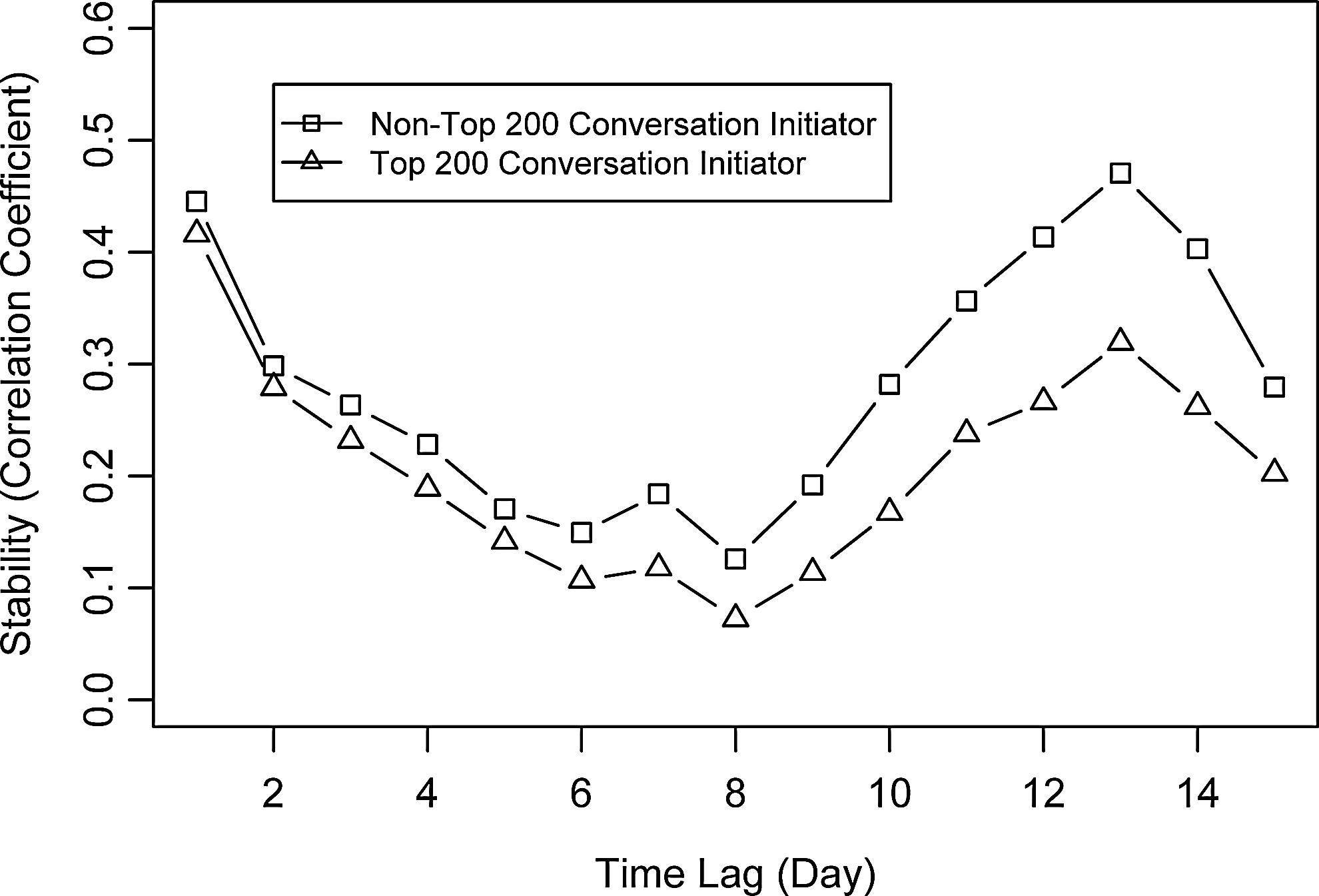
Equality and stability of conversation initiators.
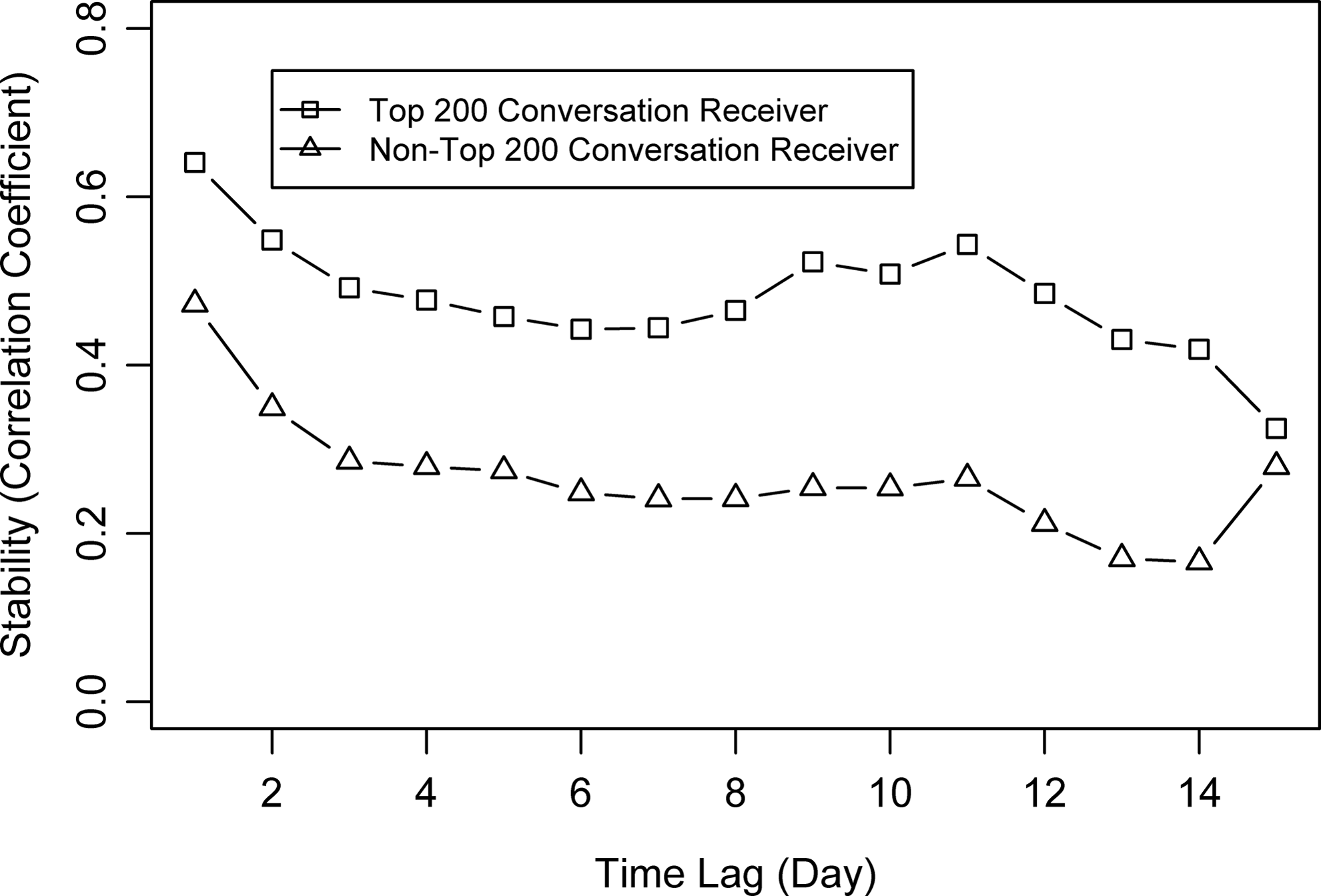
Equality and stability of conversation receivers.
On an aggregate level, there is strong correlation between emotion and public discussion (r(14)=0.99, p<0.001) and total tweets (r(14)=0.96, p<0.001) (see Fig. 1); however on an individual level, the average emotion per tweet is very weakly correlated with the number of tweets (r(25096)=−0.01, p=0.42). Similarly, the average emotion per tweet is also fairly weakly correlated with the standard deviation of the number of tweets across the 16 days (r(25096)=−0.007, p=0.26). Thus, we failed to fully confirm hypotheses H3a and H3b.
Discussion and Conclusion
Drawing on the literature on the quality of public opinion, this paper aims at gauging online discussion of social movements in terms of equality, stability, and emotion. Our findings reveal that the intensity of public discussion is highly skewed and that the stability of daily participation over time varies with individuals' social roles and positions in the network. First, conversation receivers are more stable than conversation initiators. The impacts of social roles are determined by individual activity and popularity. Due to the burst of individual attention, individual activity is not as stable as popularity. Thus, the people initiating discussions tend to be less stable than those who receive conversations. Second, inequality of participation reinforces social role's influence on stability. For discussion initiators, those who are more central are less stable; for conversation receivers, those who are more central are more stable.
The line of research on emotion's role predicts that discussions of social movements should be accompanied by emotional reactions, but no evidence for this belief is supported in our study. On an aggregate level, we find a nontrivial proportion of emotional discussions (see Fig. 1), and the collective emotion is parallel with the total number of tweets; thus, it mirrors the change of public attention over time, and that is why it has the potential for predicting elections, stock market, and so on. Focusing on an individual level, our analysis is different from time series analysis on a collective level. The findings on the individual level indicate that emotion has no influence on either frequency or stability of public discussion.
A follow-up semi-structured interview of top 200 conversation senders shed some light on these questions about whether emotion could make conversation participants initiate and stir more discussions. The results show that instead of appealing to emotions, most conversations senders stick to facts and logical reasoning, or merely share news articles; meanwhile a small proportion of people voice their opinions continually with emotional languages (see Table 1). However, overall, such simultaneous discussions of a social movement based on sharing content and rational deliberation bring dynamics of network focus and create a situation where public opinions are better perceived by discussion participants. 43
Our findings about emotion's role in public discussion about social movements imply that participants are relatively rational and objective, and underscore the weak tie theory which serves as the competing hypothesis about emotion's role in online discussion. As how “Twitter Revolutions” shook the Arab world in 2011, social media's powerful lies in its ability to maintain and amplify weak ties. First, the channel capacity of a weak tie is more restricted, making it similar to a conduit for information sharing instead of emotional expression.44,45 This may be attributed to the fact that the maximum length of a tweet constrains Twitter users from using too many affective words in practice. Second, a weak tie requires little or no emotional attachment in a fast-paced and inexplicit conversational context, which makes it possible to allow people to hold diverse opinions and to spread novel information. It is confirmed in another twitter study that conversation initiators tend to be polite and rational to others. 6
Users strategically participated in the discussion to mobilize the elites. The identities of the top 200 active users were manually coded and categorized into 9 groups. The results demonstrate that the largest proportion of conversation receivers comprises news media (39%), followed by individual activists (23%), celebrities from the entertainment industry (10%), newspaper or magazine column writers (8%), official Twitter accounts of Occupy Wall Street (8%), government (7%), NGOs (2%), and university professors (2%). These results imply that in the collective's view, Twitter users intentionally mobilize the journalistic community, politicians, and the celebrities by initiating discussions with them, which provides some evidence for Twitter's potential impact on the offline social movement. Although individuals participated highly unequally in the online political discussion, collectively, there is wisdom in the crowd.
Altogether, in terms of the quality of public discussion on Twitter, our findings imply that although the discussion is highly unequal, it tends to be rational, objective, and strategic. We find a strong structural impact on stability (e.g., inequality strongly influences stability). A small group of users contribute to the majority of the discussions. This finding holds for both conversation senders and receivers. Popular conversation receivers are not necessarily active discussion initiators, and vice versa. However, it is possible to control inequality by aggregating the number of individuals rather than by aggregating the number of tweets to follow the principle of “one person one vote,” 46 which should be investigated in future research.
In general, this study contributes to the literature by providing another perspective to investigate public discussion on Twitter. While previous theories of public opinion have investigated how mass media and political elites shape public opinion in terms of phenomena such as agenda setting,47,48 spiral of silence, 49 our study reveals that ordinary social media users are active in mobilizing the elites and mass media, performing as voluntary participants other than passive audiences in an interactive and networked environment, thereby elucidating the revolutionary role of social media. Although this result does not come without caution, it is encouraging to move toward embracing a substantially improved and more suitable lens to gauge online public discussion.
Footnotes
Acknowledgment
The study was supported in part by a GRF grant (CityU 154412) from the Hong Kong SAR Research Grants Council.
Author Disclosure Statement
No competing financial interests exist.
1