




Abstract
Abstract
This article discusses the potential of emotionally based strategic communications (EBSCs) as an extension of traditional strategic communications in prevention of societal stress-related disorders. The concept of EBSCs takes into consideration dominant emotional maps of a specific sociocultural environment in which communications take place. EBSCs may have a significant potential to transform mainly negative-dominant emotional maps of targeted social groups into more positive ones, as a precondition of building a more resilient and stress-resistant social environment. A better understanding of dominant emotional maps and their conditioning may facilitate restoration of more positive emotional maps by touching the right emotions of significant parts of the targeted social groups in the right way. Dominant emotional maps of societies afflicted by economic downturns, natural disasters, conflicts etc., are typically characterized by negatively valenced emotions. Persistent negatively valenced group-based dominant emotions may be used as a quantitative statistical measure of potential stress-related disorders and post-traumatic stress disorders among respected group members. The toxic power of extreme negative emotions, attitudes, actions, and behavior might be reduced by EBSCs as a communication method for transforming negative-dominant emotional maps into more positive ones. EBSCs are conceptualized as the positively valenced stimulation of a negatively emotionally affected group by an appropriate communication strategy to minimize dominant-negative emotional maps and behavior of the targeted group.
Introduction
Dominant emotions in crisis-ridden societies are mainly characterized by fear, anger, desperation, humiliation, pessimism, hopelessness, hatred, rage, frustration, and other negative emotions. Deep emotional traumas on the societal level may also cause massive post-traumatic stress disorders (PTSDs), and such collective traumas may characterize collective emotional orientations of entire societies. The consequences of untreated or inadequately treated societal stress-related disorders are far reaching, affecting individuals and their families, as well as society in general, in the form of lost work productivity, marital and parenting problems, domestic violence, unemployment, homelessness, drug and alcohol abuse, suicides, and others. 2 Large-scale disturbing events are associated with adverse psychological effects, such as stress-related disorders and suicides: 25 percent of PTSD cases after 1999 earthquake in Turkey; 3 30.6 percent of PTSD cases in children and adolescents after cyclone in India; 4 increased rates of PTSDs, depression, and anxiety after 2004 tsunami in Indian Ocean;5,6 the negative impact of downsizing on employees' mental health, 7 relevant for massive layoffs 8 in recessions; increased percentages of suicides in economic crises,9,10 and so on. During the Troubles in Northern Ireland, deeply disruptive phenomena have been observed at the societal level that closely paralleled symptoms of PTSDs at the individual level: pattern repetition; disrupted relationships between individuals, between groups, and individual to group; emergency mode of community functioning; decivilization or societal regression; political paralysis and a confused identity at the societal level. 11 A recent research report on the situation in Afghanistan notes that in some provinces, “[w]hen asked about their emotional state, more than half of the interviewees spoke of feelings of anger, and almost a third felt depression and frustration.” 12 Furthermore, according to Afghanistan's health minister Dr. Suraya Dalil, 60 percent of the Afghan population is suffering from mental health problems. 13 Seeking for more effective ways of coping with large-scale negative emotions, emotional traumas, and the associated disorders is a challenging, yet indispensable, task.
This article is based on our research regarding controllable Virtual Reality (VR) stimulation of individual's emotions for PTSD prevention and treatment.14–16 We explore possibilities of extending those methods to the group and the societal level. We argue that group emotions can be represented in the form of emotional maps. In particular, the emotions that prevail in a particular group can be captured by dominant emotional maps. Then, we introduce the notion of emotionally based strategic communications (EBSCs), which derive from the more traditional concept of strategic communications, and augment it by taking into consideration a larger social and cultural environment within which communications take place. EBSCs are conceptualized as a controllable stimulation of group emotions accompanied with permanent updating of the stimulation strategy to influence perceptions, attitudes, and behavior of the targeted group. We argue for a significant potential of EBSCs to transform negative-dominant emotional maps of crisis-ridden societies into more positive ones.
Structuring of Dominant Emotional Maps
It has been long since it was argued that “dynamic maps of the emotional ecology of society” would “reveal waves of emotion, attached to cognitions and motivating physical behavior, flowing across social space,” representing a kind of “emotional weather maps,” and providing “a measure of the dynamic factors involved in macroprocesses of economic life, politics, cultural movements.” 17 Notwithstanding a number of significant contributions that followed since then,18–24 not enough progress toward measurement and representation of collective emotions has been made.
We propose representation of emotional maps based on discrete emotions in line with the dimensional model of emotions, that is, as numeric values along valence (unpleasant–pleasant) and arousal (calm–aroused) axes.
25
Emotional map of a targeted group in a moment t is a histogram over valence/arousal space, in which each valence/arousal pair is assigned a number of individuals from the targeted group who experience this valence/arousal, or who, at least, self-report such valence/arousal at time t.
1
Emotional map of the group can also be observed over a period of time (

Illustration of emotional map in dimensional space.
Dominant emotional maps of the targeted group in the observed period of time are intended to capture “dominant emotions,” that is, “publicly expressed feelings perceived by participants and observers as most prominent in an episode of collective behaviour.”
26
Dominant emotional map over an observed period of time (

Illustration of dominant emotional map.
The negative-dominant emotional map can be characterized by negative discrete emotions, such as fear, anger, and humiliation, which mostly have low-valence and high-arousal values in the dimensional representation of emotions, as well as associated physiological signatures, action tendencies, and behaviors. Conversely, the positive-dominant emotional map is characterized by the dominance of positive discrete emotions, such as hope, optimism, and satisfaction, which are mainly situated in the high-valence and medium-to-low-arousal sector of the dimensional representation.
The Concept of EBSCs
Uncontrollable explosions of negative emotions cause insecurity and raise the question of efficacy of efforts aimed at societal resilience and recovery. A free flow of negative emotions and almost unlimited freedom in their production and distribution makes a multidimensional space of emotions in crisis-ridden environments almost uncontrollable. Therefore, analysis of emotional contexts is extremely important for understanding such complex societal situations. Without understanding the crucial influence of emotions, which control the behavior of the local population in such a situation much more than they are able to control them, it is simply impossible to understand political and security realities of crisis-ridden societies.
Therefore, we have to invest in building a culture of positive emotions, such as hope, optimism, and confidence, and development of an appropriate expertise to reduce destabilizing effects of negative emotions on the efforts aimed at societal resilience and recovery. Influencing people by touching their emotions is possible, either in individual psychotherapy or in strategic communications addressing a broader population.
The idea of EBSCs originates from our experience gathered with individual psychotherapeutic techniques, such as VR stimulation of our emotional brain networks.14,15 This technique consists of stimulating an individual's emotions in a controlled way by semantically and emotionally annotated multimedia stimuli in various forms of media, such as real-life video clips, static pictures, sounds, and synthetic images and clips. Such controllable stimulation of an individual's emotions can be extended and generalized to a broader societal context. Exposure therapy,27,16 stress inoculation training, 28 mental readiness training, 29 cognitive therapy, 30 and other well-known individual psychotherapeutic methods can be redesigned to match a broader societal context, and to mitigate dominant-negative emotional collective states by means of the EBSC policy.
The move from individual psychotherapeutic techniques, such as Virtual Reality Exposure Therapy (VRET), 16 toward psychological operations on a strategic level, based on EBSCs, can be justified by their common neurobiological underpinnings. In both cases, we are targeting the same brain neural network, and neurobiological changes induced in these networks by EBSC enrichment and cognitive restructuring may cause positive behavioral and cognitive responses. 31 In addition to a common neural substrate of the human brain, there are also certain procedural similarities between individual psychotherapy and EBSCs.
Individual VRET psychotherapeutic sessions include therapist–patient conversation, and are supplemented by pictures, sounds, video clips, and virtual environment stimuli. The therapist continually adapts such stimulation to the responses of the patient, to lead the patient to the resolution of psychological problems incrementally, as the sessions unfold. In a similar manner, stimulation of the local population is in EBSCs adapted to their responses to facilitate incremental positive emotional changes. In both cases, increments need not add up linearly, but should show an overall trend of improvement. An example of incremental nonlinear changes with the successful trend is demonstrated by the patient's peak subjective response across sessions in PTSD psychotherapy. 32 Achieving success in individual therapy requires considerable knowledge, experience, and dedication of the therapist; similarly, success in EBSCs also requires deeper understanding of the local group dynamics, organization, networking, culture, and heritage. Individual information gathering about the patient in psychotherapy roughly corresponds to an initial sociodemographic survey of the local population in EBSCs, which includes social and cultural values, hierarchical structure, prominent individuals, and channels of mass communication.
While the therapist has a direct personal and almost real-time communication with an individual patient, the international community interacts with the local population using strategic communications mainly with time lag and only with a portion of its members. Thus, it is uncertain whether and how EBSC messages propagate and penetrate to the entire local population. To strengthen and improve the efficacy, responsiveness, and penetration of the stimulation strategy, the concept of agents of change is extremely important, since it is the change of a predominantly negative emotional context that needs to be stimulated with EBSC messages. Agents of change should be dedicated local leaders who support the common recovery goals of the affected local population, since they understand local communication peculiarities and have direct day-to-day contact with distinguished and influential local group members.
As agents of emotional change are more emotionally expressive and transmissive than other individuals, they can play a particularly important role in the process of emotional dissemination, which may occur via biological, psychological, and social means, on both unconscious and conscious levels. 22 If the emotionally charged messages target change agents as their primary recipients, it is to be expected that the heightened emotional expressiveness and contagiousness of change agents will facilitate further propagation of the positive effects of the received messages throughout the entire group, contributing to the group's more positive collective emotional orientation. Social sharing of emotions 33 on the part of agents of change need to be particularly encouraged, so that they may spread the positive impulses outside of their immediate surroundings toward wider social circles, eventually encountering a sufficiently large number of others who would be willing to join in.
An important precondition for individuals to be able to act as agents of change and start a cascade of positive emotional changes is that they belong to a social network. Examination of social networks indicates that happy people tend to be connected to one another. 34 In the absence of networks, positive emotions are not able to reach out of small and closed cliques, and spread within and across groups. The so-called positively connected networks are particularly important in this respect, since such networks contain mutually supportive dyadic ties and incentives to interact with other members of the network. 35 However, the growth of the personal network, that is, establishing additional social contacts, increases ego's happiness only if the extra social contacts are happy themselves. 34
EBSCs as Transformational Method Toward Societal Recovery
EBSCs can be regarded as a way of collective emotion regulation based on attentional deployment and cognitive change. 36 The attention of the targeted group is redirected from negative, conflict-arousing to positive, conflict-deflecting triggering events, leading to a change of the way the group members appraise their current situation. Note that the new attention foci are successful projects improving the quality of life of the local population, which is in line with the view of dynamical social psychology that “real change is created by building new attractors toward which the system will naturally tend to drift, rather than by temporarily disrupting the state of a system within its old equilibrium.” 37
The main focus of EBSCs is on “on-line emotion regulation” taking place immediately after the occurrence of triggering events, and encouraging “specific appraisals that correspond with emotions that serve constructive purposes while avoiding the use of appraisals that are associated with destructive emotions.” 38 However, many small achievements of online emotion regulation may accumulate in time and facilitate prospective emotion regulation occurring on a longer time scale and affecting the longer-term sentiments and moods.
Transformation from a negative dominant emotional map of a crisis-ridden society to a desirable positive-dominant emotional map, which should ideally be achieved, is illustrated in Figure 3. A negative-dominant emotional map in an initial state is characterized by negative discrete emotions and their corresponding values in dimensional valence/arousal representation, as well as the associated physiological and behavioral signatures. The ultimate goal is to change the emotions of a critical mass of individuals in the targeted group (agents of change), so that the dominant emotional map of the group begins incremental transformation, which converges to a more desirable state. Incremental, step-by-step, emotional transformation that takes place at the brain level of each group member in the critical mass shifts the targeted group toward the desirable positive emotional state.
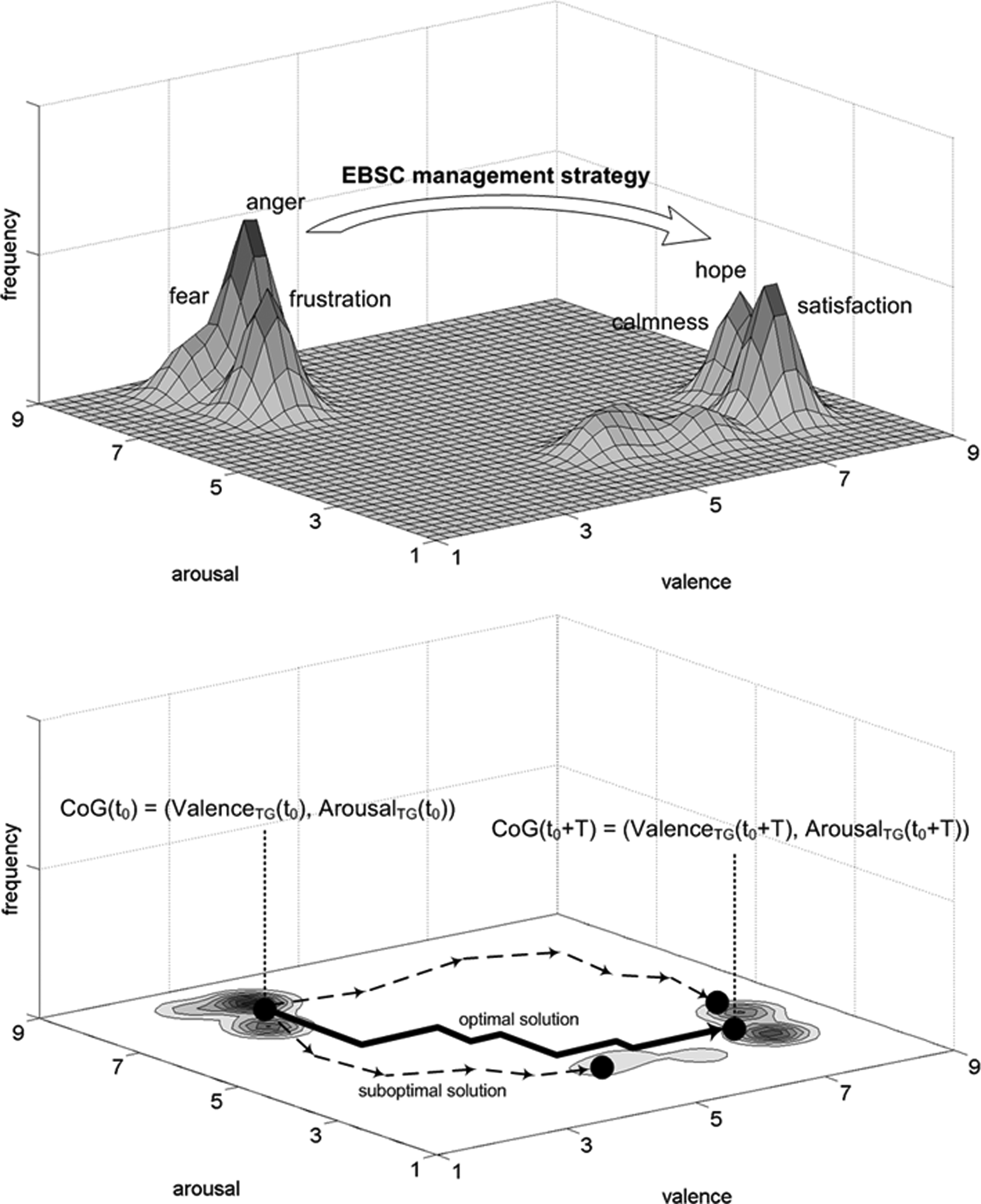
Transformation of dominant emotional maps.
How do we open the cycle of incremental positive emotions, replace the dominant emotion of fear with the emotion of hope, and avoid the mood of pessimism?
EBSC strategy has a specific goal related to achieving appropriate transformation of dominant emotional maps of the targeted group, where available actions at each time, EBSC(t), consist of sequences of pairs of unconditioned (US) and conditioned stimuli (CS). These actions may influence the overall emotional state of the targeted group. The basic ways in which this can occur are related to the associative and reinforcement-based learning and emotional adaptation based on switching between a variety of augmented mental states representing different social contexts or situations. The intention of EBSC approach is to use associative learning to facilitate targeted modification of emotions, attitudes, and behaviors of the observed group regarding current political, economic, and social situation toward the desired goal function, that is, to transform CoG of the targeted group from an initial, dominantly negative, and high-arousing value to a dominantly positive and low-arousing value. Indeed, based on cognitive reappraisal and associative learning, we can forget or overwrite previously stored negative association contents. Moreover, previously associated stimuli that elicit specific emotional response, by experiencing CS in the absence of US, can induce extinction. Extinction as a learning process whereby previously acquired responses are inhibited
39
is the basis of our proposed EBSC policy design and transformation of negatively dominant emotional maps toward more positive ones. Local improvement of CoG(t) in terms of valence and arousal may be related to incremental change of each subcomponent in the right direction, which can be described with the following expression:
In EBSCs, positive, incremental, emotional-added value is achieved by supplementing, disseminating, and amplifying emotional effects of actual, tangible positive actions on the ground. Positive, incremental, communication-added value may, for example, be related to economic growth, opening of new jobs and rising employment rate, agricultural development, infrastructure improvements (bridges, roads etc.), education- and healthcare-oriented grassroots activities (building schools and hospitals and educating nurses and doctors abroad), and other similar measures. Thus, EBSC extends beyond empathy for the plight of the local population, onto an active media campaign coupled with and grounded in real achievements on the ground, to induce positive emotions within the local population. EBSC strives to facilitate emergence of hope and optimism and help the local population to associate these emotions with the efforts invested at societal recovery. Each emotional increment occurs due to a specific positive action on the ground, which is promoted by appropriate EBSCs. Emotional increments need not necessarily add up in a linear fashion, because the size of each increment depends on a multitude of factors: prior attitudes of the local population, the visibility and perceived significance of a particular positive action, a manner in which the action is promoted, and internal targeted group dynamics. Acceptance of proposed actions and corresponding EBSC stimuli depends on their impact on actors' interests. The art of optimal solution finding is in selection of a solution path that is characterized with the smallest possible resistance of all affected parties.
An illustration of EBSC-based project promotion is given in Figure 4, by video clips with appropriate accompanying emotionally nuanced narratives. Valence and arousal annotations of these video clips illustrate desirable and expected emotional response of the local population. These values depend on the current priorities of the local population, and are based on the local knowledge. Valence ratings considerably exceeding the value of 5 indicate that the stimuli are expected to be interpreted by the local population in an overwhelmingly positive way.

Example of Emotionally Based Strategic Communications stimuli sequence (public domain photos; source: USAID photo gallery).
Conclusion
EBSCs have been conceptualized as a means of transforming negative-dominant emotional maps of crisis-ridden societies into more positive ones. Considering the arguments presented in previous sections, we strongly believe that sustainability of any long-term solution preventing societal stress-related disorders and bringing stability and social order to crisis-ridden societies will crucially depend on such an emotional transformation. Prevention and reduction of negative emotions in societies afflicted with natural disasters, economic downturns, or social crises by means of EBSCs can be regarded as a “large-scale [strategy] of emotion regulation.” 38
An interdisciplinary approach, based on neuroscience, psychology and politics,40–42 cyberpsychology,14–16 sociology of emotions,17,43,44 and strategic communications,45,46 may strengthen EBSCs as a potential leverage in ongoing efforts to restore optimism and hope and prevent societal stress-related disorders in crisis-ridden societies. Working together, domestically and internationally in interdisciplinary research teams, we may enhance scientific understanding of relationships between group based dominant negative emotions, their neural underpinnings, their individual and collective behavioral correlates, and the multimodal methods of emotion regulation, including EBSCs. This would bring the vision of “emotion not only as a problem to be overcome, but also as a solution that can help individuals and groups overcome problems” 47 closer to its ultimate fulfillment.
Footnotes
Author Disclosure Statement
No competing financial interests exist.