




Abstract
Abstract
Social networking Web sites, such as Facebook, have changed the way in which people communicate online. The present study examined the relationship between jealousy and Facebook use experimentally by asking participants to imagine viewing their romantic partner's Facebook page. We varied the hypothetical privacy settings and number of photos of the couple publicly available on Facebook. Results indicated that imagined privacy settings and the presence of couple photos affected negative emotions (jealousy, anger, disgust, and hurt). Furthermore, we found sex differences indicating that women felt more intense negative emotions after thinking about the fictitious scenario than did men, particularly when evidence of infidelity was public to others. These results have implications for sex differences in jealousy and suggest that the manner in which people employ Facebook privacy settings can be negative for romantic relationships.
Introduction
Facebook and Personal Relationships
The relationships people have with others on Facebook are visible to many, often resulting in a loss of privacy within personal relationships. In particular, a romantic partner's social interactions with others become largely public.6,8 Misinterpretations of others' Facebook interactions and negative feelings may result, especially between romantic partners. 9 Thus, sharing with others not only maintains social connections but may also have negative implications for romantic relationships.
Facebook recently added the function “See Friendship,” which allows individuals to view entire online relationships and social histories between people. This includes access to all public messages exchanged, photos of the involved people, and events attended. 10 Facebook users can also upload photos and link them to other users, without the profile owner's permission and knowledge. Roughly half of Facebook users surveyed by Tufekci and Spence 7 reported that an unwanted picture of themselves was linked (“tagged”) to their profile by a Facebook friend. The tag to the unwanted photo can be removed by the user, but people who have access to the uploader's Facebook profile can still see the photo. Though removing the tag decreases the chance of a romantic partner seeing this unwanted photo (one's partner would have to be friends with the uploader), these photo histories may still fuel jealousy, serving as permanent evidence of interactions with others outside the relationship.
Although we argue that these public histories on Facebook may fuel negative emotions for couples, it may also be the case that utilization of more stringent privacy settings could produce negative emotions. That is, when individuals utilize settings such that many parts of their profile are private, this may lead to increased suspicion on a romantic partner's behalf. We argue that this could lead to negative emotions in two ways: First, an individual may interpret this as a sign that his/her romantic partner does not publicly acknowledge their relationship. Second, it could indicate that one's partner is hiding evidence of interactions with other potential romantic interests. Overall, we argue that both the public nature of Facebook (allowing individuals access to information they otherwise may not have had) and having very private settings (indicating that the partner may be hiding something) could lead to negative emotions.
Online Jealousy
Jealousy within romantic relationships stems from real or imagined third-party threats to the integrity of the relationship. 11 Situations resulting in jealousy within a romantic relationship range from a partner revealing interest in someone else, having an interaction with a past partner, or obtaining attention from an individual outside of the relationship. 12 Jealousy can occur in online contexts as well as in offline ones. 13
Muise et al. 6 explored the relationship between Facebook use and jealousy and found that individuals who spent more time on Facebook reported more jealousy within romantic relationships and increased monitoring of their romantic partner's Facebook profile. The researchers found that increased time spent on Facebook may lead to increased exposure to ambiguous information (e.g., a nondescript post from a stranger) linked to a romantic partner. Muise et al. argue that exposure to such information without context may lead to increased jealousy given that a person may be unsure about what that public information means, and this may lead to “stalking” behavior on Facebook to find more evidence of relationship threats. Similarly, other research indicates that individuals who use Facebook more often report feelings of jealousy and surveillance of their romantic partner's profile. 5 These results support the notion that Facebook use may produce or exacerbate jealousy within romantic relationships.
The Present Study
Utilizing the theoretical framework of Muise et al., 6 we examined jealous responses to a hypothetical scenario in which participants were asked to imagine a relatively ambiguous scenario involving their romantic partner's Facebook profile. Furthermore, we sought to determine whether or not their romantic partner's specific Facebook settings within Facebook would impact interpretation of these ambiguous scenarios and impact jealous emotions. Specifically, participants imagined seeing their romantic partner's photographs and privacy settings for those photos on Facebook. This methodology using imagined scenarios has been successfully used in previous research13–20 to examine emotions that are typically tied to romantic jealousy: jealousy, anger, disgust, and hurt. We varied the number of photos of the participant and his or her romantic partner together on Facebook and also the photo privacy settings that participants imagined their partner utilized.
Since it has been previously shown that women tend to report greater feelings of romantic jealousy, 18 we expected women to experience more jealousy and related emotions (anger, disgust, and hurt) than men. Second, we predicted main effects for both photo privacy settings and the presence of couple photos available on a romantic partner's profile (photos of the participant along with his/her romantic partner). We predicted that participants would report more intense negative emotions when they imagined their romantic partner had his/her photos to be set to private, as this may indicate that one's partner is trying to hide his/her current relationship. We predicted that participants would report more intense negative emotions when they imagined their romantic partner did not have any couple photos present on Facebook. Again, we expected that this would suggest that one's partner is attempting to hide his/her current relationship. Finally, we sought to answer the following research question: Will gender, privacy settings, and presence of couple photos interact to influence participant's self-reported negative emotions?
Method
Design
Participants were 226 (158 women, 68 men) undergraduates (Mage=19, SD=1.75) who received course credit for their participation. Participants were largely Caucasian (86 percent). All participants included in the analyses were Facebook users and were heterosexual.* This study utilized a 2×3×3 (Participant sex: women vs. men×Photo privacy settings: private photos vs. viewable only to Facebook friends vs. public to all Facebook users×Presence of couple photos [photos of participant with romantic partner]: none vs. few vs. many) between subjects factorial design.
Procedure
Participants accessed the materials for this study online and were told they would be participating in a study on Facebook use. We assessed demographics and whether or not the participant was a Facebook user. Participants were then randomly assigned to one of the nine conditions described earlier, and asked to read the scenario given next.
“Please think of a serious committed romantic relationship that you have had in the past, which you currently have, or that you would like to have. Imagine that you discover a photograph of your serious romantic partner with another person of the opposite sex on Facebook. Imagine that you discover this when trying to login to your own Facebook account, and you notice that your romantic partner's account is still logged in. At this point, you discover that his/her photos set to be viewable by ONLY [All Facebook friends/All Facebook users/him or herself]. In addition, your romantic partner has [No photos of the two of you together/Few photos of the two of you together/Many photos of the two of you together] posted on Facebook.”
Then, participants were asked to complete four items assessing jealousy and related emotions, serving as our primary dependent measures.13,15 Specifically, participants were asked to report how jealous, angry, disgusted, or hurt they would feel in response to the scenario described earlier on a scale ranging from 1 (not at all) to 9 (extremely) (see Appendix A).
Results
Data analysis strategy
In accordance with previous research,13,15,20 a series of ANOVAs examined each of the four emotional reactions separately. The data were analyzed using a 2×3×3 (participant gender: women vs. men×Photo privacy settings: private photos vs. visible to all Facebook friends vs. visible to all Facebook users×Presence of couple photos on Facebook: no photos with their romantic partner present vs. few photos with their romantic partner vs. many photos with their romantic partner present) between-subjects factorial. We used Fisher's LSD tests for all post hoc analyses. Results are presented by each of the four emotional responses. See Table 1 for means for each emotion by participant sex and experimental condition.
FB, Facebook.
Jealousy
There was a significant main effect for participant sex, F(1, 208)=5.74, p=0.02, η p 2=0.03, indicating that women reported feeling more jealous than men in response to the imagined scenario (M=6.01, SD=2.32 vs. M=4.60, SD=2.77). There was also a significant main effect for the photo privacy settings employed by the romantic partner, F(2, 208)=4.91, p=0.008, η p 2=0.05. Post hoc tests indicated that participants reported more jealousy when their partner's photos were set to private (M=6.40, SD=2.10) as compared with being visible to either all his/her Facebook friends or all Facebook users (M=5.13, SD=2.96 and M=5.16, SD=2.34). Next, there was a significant main effect for the presence of couple photos, F(2, 208)=4.28, p=0.02, η p 2=0.04. Post hoc tests indicated that the absence of photos of the participant with their romantic partner produced the highest ratings of jealousy, (M=6.47, SD=1.98) as compared with having a few couple photos available (M=4.54, SD=2.82) or having many couple photos available (M=5.59, SD=2.48). Participants were also more jealous when many couple photos were available as compared with having a few couple photos available.
There was a significant two-way interaction between gender and photo privacy settings, F(2, 199)=3.94. p=0.02, η p 2=0.04. Simple effects indicated that women were more jealous than men when their partner's photos were visible to either all Facebook friends (M=5.87, SD=2.60 vs. M=3.81, SD=3.14) or all Facebook users as compared with being private (M=5.62, SD=2.16 vs. M=4.21, SD=2.47) (Fig. 1).
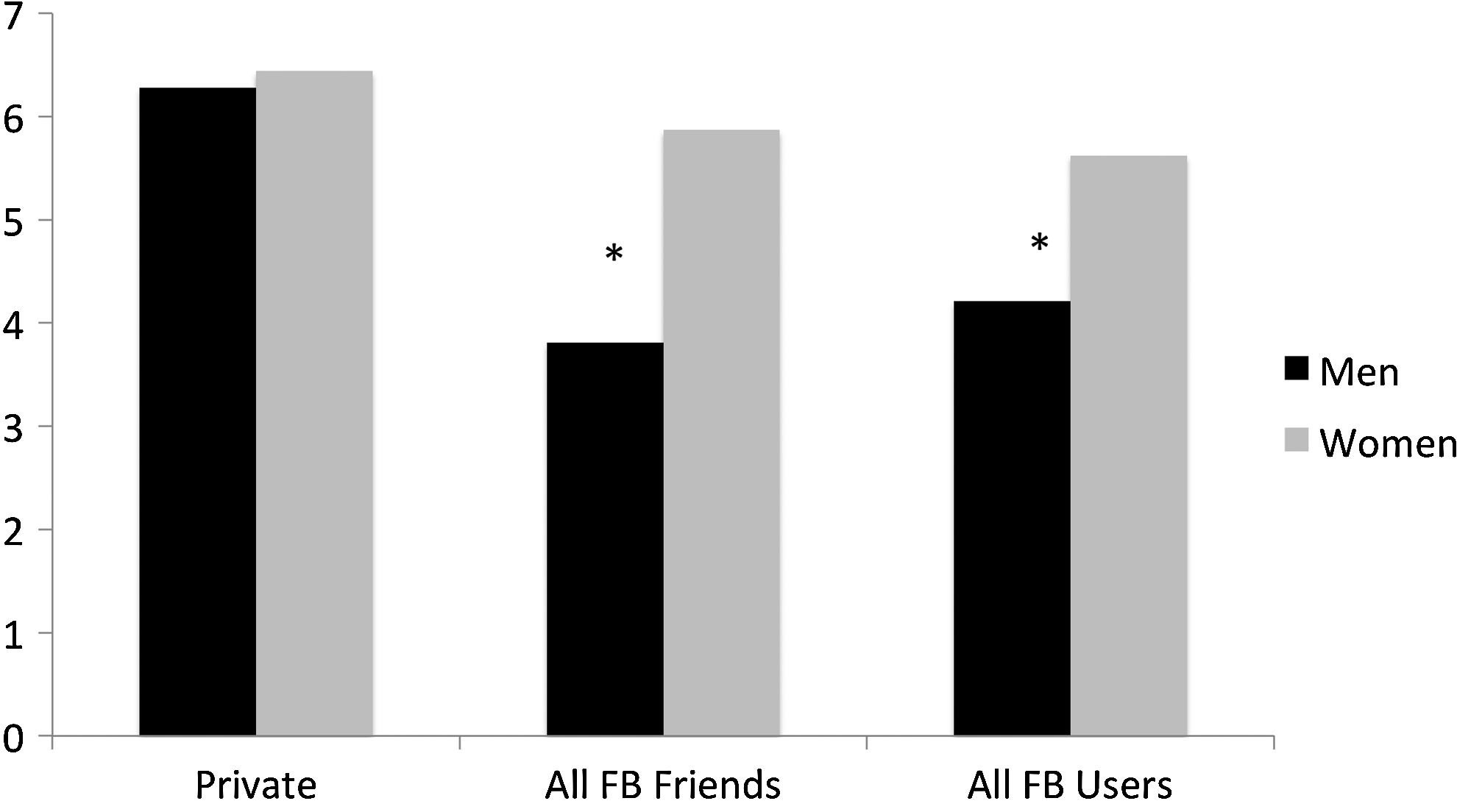
Two-way interaction between participant sex and privacy settings on ratings of jealousy. *Denotes significant differences between bars being compared.
Anger
There was a significant main effect for participant gender on anger, F(2, 208)=5.68, p=0.02, η p 2=0.03, indicating that overall, women were angrier than men (M=6.01, SD=2.23 vs. M=4.97, SD=2.39). There was also a significant main effect for photo privacy settings, F(2, 208)=4.58, p=0.01, η p 2=0.04. Post hoc tests indicated that participants were angrier at the thought of their romantic partner's photos being private (M=6.45, SD=1.97) rather than visible to all Facebook friends (M=5.19, SD=1.30) or all Facebook users (M=5.24, SD=2.21). Finally, there was a significant main effect for the presence of couple photos, F(2, 208)=4.10, p=0.02, η p 2=0.04. Post hoc tests indicated that participants were angrier if there were no photos of the couple present on Facebook (M=6.58, SD=1.86) as compared with their partner having a few photos present (M=4.83, SD=2.61) or having many couple photos present (M=5.40, SD=2.35).
In addition, there was a significant two-way interaction between gender and photo privacy settings. Simple effects indicated that women were angrier than men when their partner had privacy settings, allowing photos to be viewed by all Facebook friends users (M=5.89, SD=2.56 vs. M=3.96, SD=2.46) and all Facebook users (M=5.56, SD=2.06 vs. M=4.58, SD=2.38) (Fig. 2).

Two-way interaction between participant sex and privacy settings on ratings of anger. *Denotes significant differences between bars being compared.
Disgust
There was a main effect for photo privacy settings, F(2, 208)=4.03, p=002, η p 2=0.04. Post hoc tests revealed that participants felt more disgust when a romantic partner's photos were private (M=6.14, SD=2.16) compared with it being visible to all Facebook friends (M=4.92, SD=2.85) or compared with it being visible by all Facebook users (M=4.80, SD=2.47). There was also a significant main effect for the presence of couple photos, F(2, 208)=4.15, p=0.02, η p 2=0.04. Post hoc tests revealed that participants felt more disgust if there were no photos of themselves with their romantic partner on Facebook (M=6.17, SD=2.10) compared with their partner having a few couple photos present (M=4.44, SD=2.05) or compared with their partner having many couple photos available (M=5.16, SD=2.56).
Hurt
There was a significant main effect for gender, F(2, 208)=6.39 p=0.01, η p 2=0.03, indicating that overall, women felt more hurt than men (M=6.53, SD=2.26 vs. M=5.16, SD=2.61). There was also a significant main effect for photo privacy settings, F(2, 208)=4.62, p=0.01, η p 2=0.04. Post hoc tests revealed that participants felt more hurt if they discovered their romantic partner's photos were set to private (M=6.90, SD=1.99) rather than visible to all Facebook friends (M=5.72, SD=2.82) or all Facebook users (M=5.66, SD=2.33). Finally, there was a significant main effect for the presence of couple photos, F(2, 208)=4.67, p=0.01, η p 2=0.04. Post hoc tests revealed that participants felt more hurt if their partner had no couple photos present on Facebook (M=6.98, SD=1.78) compared with having a few couple photos (M=5.20, SD=2.75) or many couple photos available (M=6.03, SD=2.49).
There was also a significant three-way interaction between gender, photo privacy settings, and the presence of couple photos on their partner's profile on Facebook, F(4, 208)=2.50, p=0.04, η p 2=0.05. Simple effects revealed that women felt more hurt than men, specifically when they discovered their partner's photos were set to be viewable by all Facebook friends and there were only a few couple photos present on their partner's profile (M=6.00, SD=2.62. vs. M=2.73, SD=1.67) (Fig. 3).
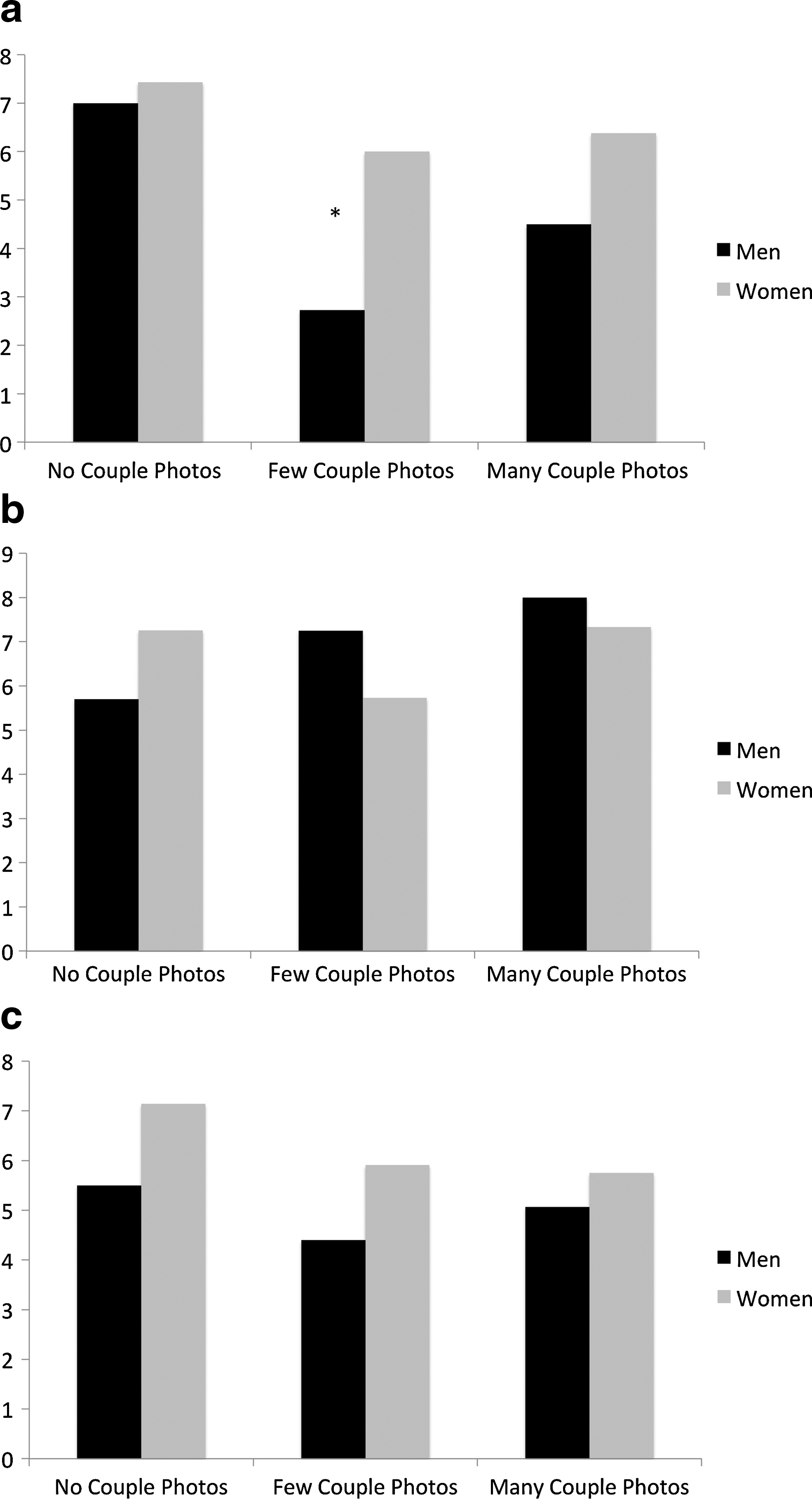
Two-way interaction between participant sex and privacy settings on ratings of anger:
Discussion
The current study provides further evidence for sex differences in jealousy in an online context and, more importantly, demonstrates through experimental manipulation, that sex differences, Facebook privacy settings, and availability of public information all influence the extent to which individuals experience negative emotions via Facebook. This study makes an important contribution to the existing literature by demonstrating that relatively ambiguous information can be interpreted differently depending on the availability of certain types of information—photos in this case—and user privacy settings. Ultimately, subtle differences in the manner in which people utilize Facebook may, at least, temporarily impact an individual's emotional state, leading to more jealousy, anger, disgust, and hurt. Overall, as predicted, women reported more intense feelings of jealousy, anger, and hurt in response to imagining a fictitious scenario on Facebook. This is consistent with previous research which demonstrated that women report more intense emotions in response to situations invoking jealousy. 18
Participants were more jealous, angry, disgusted, and hurt when they imagined that their romantic partner had no photos of them as a couple present on Facebook. We speculate that this may lead to more intense negative emotions, because it indicates that one's romantic partner either does not acknowledge being in a relationship, or may be attempting to hide their current relationship. Similarly, participants reported feeling more negative emotions when they imagined discovering that their romantic partner had his/her photos set to be private as opposed to being viewable by others on Facebook. Again, we argue that this may be an indication (to participants) that their romantic partner is attempting to hide a current relationship, or hide evidence that may indicate interest in other potential romantic partners.
The results of the current study also provide further evidence for sex differences in jealousy in an online context. Specifically with regard to our research question, we found significant two-way interactions between participant sex and photo privacy settings for jealousy and anger. First, women reported more intense jealousy and anger as compared with men when they imagined their romantic partner's photos were viewable by other Facebook friends and users compared with being private. We also found a significant three-way interaction between participant sex, photo privacy settings, and presence of couple photos. Specifically, women felt more hurt than men when they imagined their romantic partner had only a few photos of them as a couple present and their partner had his photos set to be viewed by other Facebook friends. These findings demonstrate that sex differences interact with Facebook user settings to influence emotional outcomes. Overall, these findings suggest that the public nature of potential infidelity may influence emotions differently for men and women. That is, women may experience more negative effect when they believe that others are able to view lack of evidence of being in a committed relationship. This is consistent with research which demonstrates that women are more likely to define themselves in terms of others and also demonstrate a stronger need for positive approval from others.21–24 Since women may base their self-concept on others and also highly value what others think, they may feel more negative emotions when evidence of relational failure becomes public.
Social networking Web sites can be beneficial in allowing people to keep in touch with others, but the results of this study indicate that negative emotions can also be induced by the nature of sites such as Facebook. It should be noted that the scenario we asked participants to imagine was relatively ambiguous (they imagined seeing a photo of their romantic partner with someone of the opposite sex, but were not instructed to imagine specific behaviors). Thus, the results of the current study suggest that Facebook can be a place where individuals interpret ambiguous information in a non-ambiguous way, producing negative emotions.
We suggest that utilizing Facebook in a specific manner can allow individuals access to information they may not otherwise have had access to and can also lead to a lack of public presence on a romantic partner's Facebook profile, which may signal secrecy or a lack of importance of the relationship. Many people believe that a relationship is not real unless it is Facebook official. 25 Thus, it may be unsettling to be omitted from a romantic partner's online profile.
Limitations and future directions
This study utilized empirical methods to provoke negative emotions stemming from use of social media, yet more research needs to be conducted in this area. For instance, one limitation of this study is that it did not examine Facebook related jealousy and its direct impact on a romantic relationship. Future research should determine how user privacy settings and availability of couple-related information would impact an actual relationship over time. It would be interesting to determine whether or not an isolated instance of Facebook related jealousy, such as in the case of this study, has a significant impact on a relationship. In addition, the present research only examined heterosexual college students; thus, the results are likely to be different for individuals with a different sexual orientation and for individuals in different age groups. 16 Considering that Facebook is now open to ages 13 and older, 26 future research should examine how age affects these emotions when viewing someone's profile as research on age differences in jealousy would suggest. 27
Finally, this research examined self-reported emotions in response to an imagined scenario. What is less clear is how these factors would influence behavioral outcomes. Future research should examine to what extent sex, privacy settings, and public Facebook histories influence individuals' behavioral responses once they experience jealousy and other negative emotions. If instances of Facebook jealousy, such as the ones invoked in this study, have the potential to lead to negative behavioral outcomes, this would have implications for real-life interpersonal interactions. One possibility might be that face-to-face interpersonal conflict could result from this online jealousy.
Footnotes
Acknowledgment
Special thanks goes to members of ASPECT for their helpful comments on an earlier version of this work.
Author Disclosure Statement
No competing financial interests exist.
Appendix
*
Twelve participants who were not heterosexual were excluded from the analyses. Participants imagined a romantic partner of the opposite sex, thus this manipulation was only relevant to heterosexual individuals.