




Abstract
Abstract
The survival of a virtual community is guaranteed by the users' creation of content. However, the literature has found that the percentage of users who create innovative content is very modest. The content contribution process can also be interpreted as a social collective action in which we-intentions play a primary role. Nevertheless, some people choose not to participate in the collective action, but to benefit from the community's resources and to maximize individual outcomes. In this study (N=250), we investigated the effects of the free-riding tendency, conceived as the willingness to maximize personal outcomes. The specific setting was a virtual support forum, the most common type of web platform, generally used instrumentally by web users to find information and solutions to specific problems. We used the theory of planned behavior theoretical framework, plus social influence variables to test the effect of the free-riding tendency as a drawback for contributions, considering both the role of individual and we-intentions on the observed behavior. Findings showed that neither we-intentions nor I-intentions predicted the actual contribution behavior. Both types of intentions and contribution behavior were negatively influenced only by the free-riding tendency construct. Considerations and future developments of these results are discussed.
Introduction
The contribution process can be considered as a collective action carried out by the members of a virtual community. Many of the behaviors observable in virtual communities are described by their actors through the use of collective concepts, based on a strong sense of “we-ness” 7 : community members tend to consider themselves as “part of the social fabric of the virtual community.”2(p7) Thus, online social interactions may be described as intentional social actions, 8 a concept that draws its origins from the philosophy of intentionality.9–12 For instance, Tuomela13(p2) introduced the concept of “we-intention” as “a commitment of an individual to participate in joint action and involves an implicit or explicit agreement between the participants to engage in that joint action.” In we-intentions, the constitutive intentions of the individuals are interlocked: every agent has an intention in favor of the efficacy of others' intentions. 14 From the members' viewpoint, the community offers reasons for thinking and acting collectively: the community goals, values, and beliefs can determine the reasons for the group action. 15 The shared intentions may be conceived both in terms of a group action (“We intend to perform action X”) and of a person acting with the group (“I intend that we—other members and I—will do action X”). 16 It is worthwhile noting that in these formulations, actions and intentions only have meaning if the group acts collectively. Individual action by oneself is not enough to attain one's goal in either case. 17
Bagozzi and colleagues2,16–18 studied online participation and social interactions in virtual communities, by reformulating these considerations and introducing the construct of we-intentions within a well-known theoretical model of behavioral prediction, such as the theory of planned behavior (TPB 19 ). The TPB has been successfully employed in hundreds of applied studies, across different behavioral domains (e.g., see Refs.20,21). This theory maintains that behavior is directly influenced by one's intention to act and the perceived control over the behavior; intention to act, in turn, is affected by the attitudes toward the act, subjective normative pressure to behave according to relevant referents' expectations, and perceived behavioral control (PBC). Intentions under the TPB have been construed in a strictly individual sense. 17 For instance, Eagly and Chaiken21(p168) interpret an intention as a “person's motivation in the sense of his or her conscious plan to exert effort to carry out a behavior by him or herself.” Bagozzi and colleagues2,16–18 afterward adopted this as the definition of “I-intentions.”
The TPB and other contemporary models for behavioral predictions deriving from attitude, generally explain the motivations that lead to the formation of individual intentions and behavior, but do not consider social aspects in carrying out group acts. Thus, in their work, Bagozzi and colleagues2,16–18 captured the group dimension of a virtual community, by adding the concepts of group identification and group norms to the general model of behavioral prediction as additional determinants of we-intentions, alongside the other antecedents of intentions. These studies focused primarily on the processes leading to the formation of the we-intentions, confirming the predictive and explicatory power of TPB in this behavioral domain. Nevertheless, the literature has not yet adequately investigated the relationship between the collective intentions, the individual intentions, and the actual behavior of contribution; the current study is aimed at filling this gap.
The literature has shown that the percentage of members who actively produce content is definitely very low. Nielsen 22 empirically analyzed the user content production rate of several virtual communities. The author found that participation generally follows a ratio of 1-9-90: 1 percent of users represents the active content producers, 9 percent is composed of editors, and 90 percent is defined as audience.
This empirical evidence, when considering the collective intentionality framework, raises an important question: why do only few community members actively contribute, even when it is not in their interest to do so, whereas most members do not?
The literature on social dilemmas suggests that in social groups—as users support forums—whose survival depends on cooperation, 23 the choice is between maximizing the outcomes for the group, choosing not to increase individual outcomes, or vice versa, maximizing personal outcomes without contributing to the group.24,25 This latter phenomenon is generally known as free-riding. Tuomela 26 offered a philosophical analysis of free-riding in close relation to a group acting collectively to produce a public good. The author emphasized the role of the individual decision in not participating in the collective action, considering the defection as more advantageous.
On a closer inspection, we may consider online free-riding tendency as a continuum with two extremes: contributing in turn to the community resources or escaping this task. 24 The 1-9-90 rule 22 emphasizes the imbalance in contribution behavior. For these reasons, our aim was to better understand the psychological processes that could impede or promote the actual contribution process in participating in online support forums.
To reveal such processes, we used an augmented version of the TPB (see Fig. 1 in the Results section) to capture users' readiness to perform a given behavior in a virtual community. We considered both we-intentions and individual intentions as proximal determinants of contribution behaviors; we also hypothesized intentions (shared and individual) to be positively affected by the TPB determinants (attitudes toward the behavior, PBC, and perceived social pressure; see Refs.2,16,17). Further, to shape the social dimension of the contribution behavior in a virtual community, social identity and group norms were added as predictors of both intentions (see Refs.2,16–18 for a similar approach). The collective action, in fact, may be shaped by the influence that each group member exerts on the other members, through the intentions.
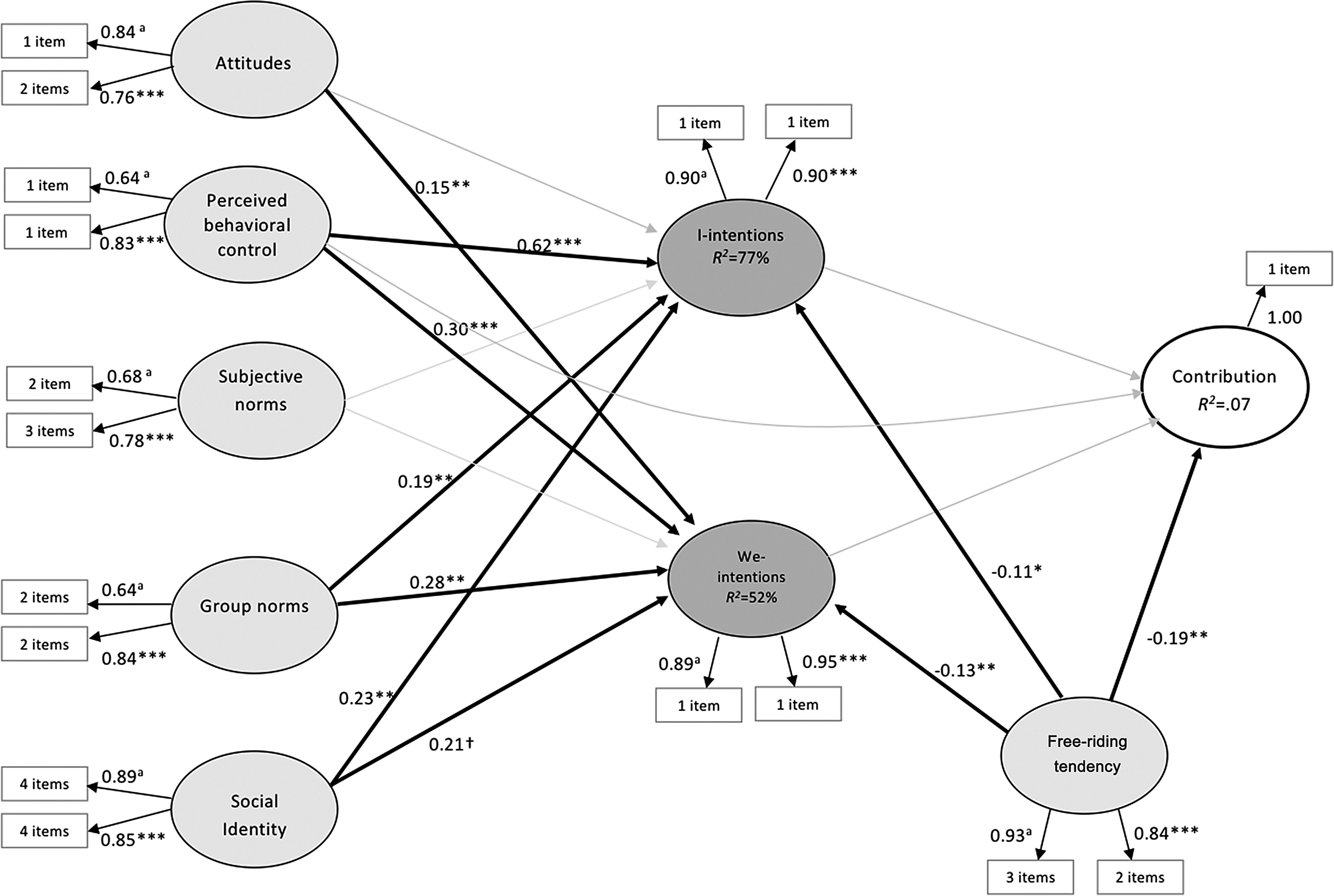
Findings for TPB augmented model, completely standardized parameter (N=250). The gray arrows represent hypothesized, but nonsignificant paths. Errors and correlations are omitted for the sake of simplicity. *p<0.05; **p<0.01; ***p<0.001; †p=0.06; a=fixed parameter.
In the considered behavioral context, both individual and shared users' intentions might be inhibited by the willingness to maximize individual outcomes (free-riding tendency), leading to a lower rate in contribution. However, we assumed that the free-riding tendency takes place more on an individual level. As a consequence, the free-riding tendency was hypothesized to directly negatively affect both types of intentions and the contribution behavioral goal. To our knowledge, this is the first study considering the inhibition effects of free-riding on intentional and actual behavioral processes.
Methods
Procedure
Data collection was performed on a single online support forum, HTCBLOG (
Participants, who took part in the survey voluntarily, were recruited through an invitation e-mail sent by the community administrators. We also put a banner, with a hyperlink to the survey, in the community home page and in some pop-up messages. To encourage the questionnaire completion, we also launched a prize competition.
We designed a two-phase data collection study with both self-reported and objective behavioral measures. In the first wave, data collection was realized through a web-survey programmed with PHP language and supported by a MySQL database. The survey was hosted on the web-community's server and was graphically similar to the
Sample characteristics
A total of 263 participants completed the survey; 219 were men (84.9 percent) and 44 were women (15.1 percent). Their mean age was 33.26 years (SD=14.34).
The average access to the community, measured on a categorical scale with four intervals, revealed that 17.8 percent of total users accessed the community at least once a day, 27.9 percent at least 5 times a week, 24.8 percent between 5 and 15 times a month, and 29.5 percent accessed the community<15 times a month.
Measures
Seven-point items, derived from earlier literature, were adapted to the behavioral domain of contribution. A summary of the measures is listed in Table 1.
To measure attitudes toward contributions, we used four semantic differential items derived from Ajzen, 19 whereas two items for PBC were derived from Perugini and Bagozzi. 28 Two and four items were employed to measure, respectively, subjective and group norms. 17 The latter was measured with items concerning the degree of shared goals between the self and the other group members. To measure identification processes, we used a shortened adapted version of the scale proposed by Capozza et al., 29 composed of eight agreement items. Two items were adapted from Bagozzi and Lee, 30 respectively, for we-intentions and I-intentions.
The free-riding tendency, conceived as maximization of individual outcomes, was assessed with five agreement items adapted from a scale developed by Markòczy 31 to measure free-riding in relation to energy saving.
Finally, the dependent variable of the present study was the contribution behavior. For every participant, we counted the number of messages posted in the forum and the number of comments posted in the internal pages of
Results
Descriptive statistics
All variables were normally distributed and the reliability coefficients were greater than 0.69 for all the scales except for attitude, for which the elimination of one item improved the alpha to 0.82 (see Table 2 for descriptive statistics and reliabilities of each construct).
Alpha calculated on three items.
Both the I-intentions and the we-intentions to contribute to the community were positive. However, I-intentions of members registered for less than one year (n=193; M=4.90, SD=1.40) were higher than those of older members (n=57; M=4.25, SD=1.32), t(248)=3.11, p<0.01. No significant differences emerged for we-intentions.
Finally, the analysis of comments posting frequency indicated that 83 percent of the respondents never posted messages during the considered one-month period; 14 percent posted fewer than 10 times, 1.6 percent contributed more than 10 times, but less than 50 times, and only 1.4 percent contributed more than 50 messages (M=7.69, SD=77.83). It is worthwhile noting that the percentage distribution is consistent with Nielsen's 22 observations. For the subsequent analyses, frequency of posted messages was recorded as follows*: never (0), from 1 to 10 messages (1), 10 to 50 (2), and more than 50 messages on the forum (3) (for a similar procedure, see Tsai and Bagozzi 7 ).
Confirmatory factor analysis
Confirmatory factor analysis was used to investigate discriminant validity of all the considered constructs (LISREL 8.5 ver. 32 ). We ran a model with nine latent variables and two indicators for each latent construct, except for the contribution behavior that had only one observed variable (the input matrix is reported in Table 3). To reduce the number of parameters to be estimated, we used the partial disaggregation method 33 for the variables with more than two items.
p<0.05; **p<0.01; ***p<0.001; ATT, attitudes; SN, subjective norms; GRN, group norms; PBC, perceived behavioral control; WEINT, we-intention; IINT, I-intention; SID, social identity; FREE, free-riding tendency; CONTR, contribution behavior.
The model's goodness-of-fit was evaluated by the χ2 test, the comparative fit index (CFI), and the standardized root mean square residual (SRMR). Satisfactory model fits are obtained when χ2 is nonsignificant, CFI is ≥0.95, and when SRMR is ≤0.05. 34 This baseline model fits the data well: χ2(84)=164.03, p≈0.00, CFI=0.98; SRMR=0.047. Even if the χ2 test was significant, all the other indexes were satisfactory. Factor loadings were consistent and all between 0.64 and 0.96. Discriminant validity emerged from the fact that latent variables showed correlations lower than 1.0 (Table 4) and the confidence interval did not include the perfect correlation.
p<0.05; **p<0.01; ***p<0.001; ATT, attitudes; SN, subjective norms; GRN, group norms; PBC, perceived behavioral control; WEINT, we-intentions; IINT, I-intentions; SID, social identity; FREE, free-riding tendency; CONTR, contribution behavior.
The correlation between I- and we-intentions was moderately large (Φ=0.69, p<0.001, SE=0.04). Similar results were also reported in a number of previous studies.2,16,17 However, since the distinction between the two types of intentions was decisive for our hypotheses, we used also a more restrictive evaluation procedure. We compared the baseline model—where the correlation between the latent construct of I- and we-intentions was freely estimated—with a second model where such a correlation was constrained to be equal to 1 [χ2(85)=316.82, p≈0.0]. The chi-square difference test was then used 35 : χ2d(1)=152.79, p<0.001. The significance of the test indicated that the two models differ from each other and consequently the two types of intentions were to be considered as distinct constructs.
Structural models
We then used structural equation modeling with latent constructs (LISREL 8.5 ver. 32 ) to test the hypothesized model: an augmented version of TPB considering also social influence variables and free-riding tendency (Fig. 1).
Findings showed satisfactory fit statistics: χ2(88)=169.29, p≈0.00, CFI=0.98; SRMR=0.047. Attitude positively determined we-intentions (γ=0.15, p<0.01), but not I-intentions. PBC positively influenced both I- (γ=0.62, p<0.001) and we-intentions (γ=0.30, p<0.001), as well as group norms did (γ=0.19, p<0.01 and γ=0.28, p<0.001, respectively). Social identity emerged as a predictor of I-intentions (γ=0.23, p<0.01) and marginally of we-intentions (γ=0.21, p=0.06). Subjective norms did not predict the contribution intentions.
Both types of intentions failed to predict contribution,36,† and the observed behavior was negatively influenced by the free-riding tendency (γ=−0.19, p<0.01), which inhibited also I-intentions (γ=−0.11, p<0.01) and we-intentions (γ=−13, p<0.01).
The model accounted for a great amount of variance in I- (77 percent) and we-intentions (52 percent), but a smaller amount in contribution behavior (7 percent).
We also performed formal tests of mediation to assess the presence of residual direct effects of the antecedents on the behavior not specified in the hypothesized model.2,17 The inspection of chi-square difference 35 in nested models revealed that each additional path was not predictive of the target behavior (see Table 5 for tests of rival hypotheses).
Discussion
Recent research has highlighted that the long-term life of virtual communities depends critically on members' contribution. 37 The principal aim of this study was to investigate the effect of the free-riding tendency on the behavioral goal of contribution and shed a first light on the processes that may inhibit such a performance in the specific setting of a virtual user support forum.
We included the free-riding tendency in an augmented version of the TPB 19 (see Fig. 1). In line with previous findings,2,16,17 perceived control, group norms, and social identity positively influenced the we-intentions to contribute. The same variables determined I-intentions too, but the effect of the perception of control over the behavior—which includes internal and external factors promoting or impeding the action—was much stronger. Attitude toward contribution—framed as a collective action—determined only we-intentions.
In this behavioral domain, subjective norms did not show significant effects. This is not surprising since participation in virtual communities is anonymous, and members may feel little need to comply with relevant referents' expectations.7,38
Group norms showed strong influence on I- and we-intentions. Usually, within a discussion forum, the forum moderators and administrators who ensure it is observed make netiquette ‡ salient. We speculate that even if most of the members access the forum mainly to satisfy personal needs, certain norms must be respected so that the community will not extinguish, and relevant group members' expectations are not deceived.
Our results reinforce the importance of distinguishing between individual intentions and we-intentions in studying collective action in a virtual community, since psychological processes that underlie these constructs are distinct and show different effects.
The hypothesized model accounted for a great amount of variance in both individuals and we-intentions. Previous studies7,38 suggested that web community members manifested collective intentions toward contributions; still, in our model, we-intentions did not influence the observed behavior. Since the sample was composed of a consistent number of novice users who reported a significantly greater score for I-intentions than older members, and given the instrumental nature of a virtual forum, one could expect that individual intentions would represent a stronger predictor for contributions. Nevertheless, even I-intentions showed no significant effects on it. Indeed, findings revealed that the free-riding tendency, acting at the individual level, could prevent both intentions and directly hamper the contribution performance.
According to Bagozzi and Lee, 30 social action may be classified on a continuum in which at one extreme there are fully cooperative actions, whereas on the other side there are minimally cooperative actions. These latter actions refer to situations in which members of a group share common goals, but not a joint action to cooperate together. We posit that forum members in such a situation, if influenced by the free-riding tendency, may lack the personal motivation—part of the original postulation of we-intentions 12 —in playing their role in the contribution process.
Moving from this point, we suggest that a virtual support forum may be perceived as an extended repository of information that is consulted, or even exploited, only when needed. Members identify with the community group and follow its norms and rules; although, if influenced by the maximization of individual outcomes, once the information sought is found they miss the motivational boost to contribute.
It is worthwhile noting that this is one of the few studies measuring the actual behavior; however, the model accounted for only 7 percent of variance in the behavioral goal. As suggested by the literature,39,40 the predictive power of behavioral models is often low. We think that this is especially true in the case of virtual contributions, which is a complex behavior: to contribute, people have to subscribe to the community and then login in.
Tsai and Bagozzi 7 found that the model of goal-directed behavior 28 (MGB—an augmented version of TPB) plus we-intentions accounted for 57 percent in we-intentions, and a higher level, 15 percent, than the present study of contribution. Such a difference could be mainly due to the nature and the aims of the considered communities: Tsai and Bagozzi analyzed a community aimed at sharing photos and information about personal travel experiences. A virtual support forum, instead, is structured mainly for finding information and solutions to problems. However, since also earlier literature in other domains has highlighted that MGB often has a superior predictive and explicative power than TPB,41,42 future research should address this issue in the virtual support forum context.
Moreover, although a greater improvement is needed in its measurement on the Internet, the free-riding tendency may represent a process that hinders contributions. As expressed by Richetin et al. 43 performing a behavior is not simply opposed to not performing the same behavior, because they rely on separate goals. For these reasons, future research should focus on contribution abstention as a separate goal, and investigate the variables that lead (and not prevent) a user not to contribute, looking at the other side of the process of participation in a virtual community.
Footnotes
Acknowledgment
The authors would like to thank the web master as well as the members of
Author Disclosure Statement
No competing financial interests exist.
*
We divided the number of contributions using five intervals, as suggested by Bagozzi and Tsai. 7 In this way, the variable was normalized and the data variability was reduced.
†
As suggested by Dholakia and Bagozzi, 36 we also ran a series of regressions to test whether, considering subsamples of novice users and experienced users, the effects of I- and we-intentions on contribution behavior were significant. However, no regression coefficient was statistically significant.
‡
Netiquette (short for “network etiquette” or “Internet etiquette”) is a set of social conventions and code of conduct that facilitate interaction in virtual environments as mailing lists, blogs, and forums.