




Abstract
Abstract
The current study explores how competition and gaming expertise affect the satisfaction of competence needs and gaming gratifications. We demonstrate that competition moderates the effect of gaming expertise on the satisfaction of competence needs, which in turn affects game enjoyment and replay intention. Gaming expertise predicted players' need satisfaction, game enjoyment, and replay intention significantly better in a competitive compared to a noncompetitive context. The effect of gaming expertise on game enjoyment and replay intention was, furthermore, mediated by the satisfaction of competence needs. Finally, gaming expertise positively affected the importance of competition for players' self-esteem only in the competitive gaming context. The present findings demonstrate the importance of competition and gaming expertise for the satisfaction of competence needs, gaming gratifications, and the pursuit of self-esteem during gameplay, attesting to the applicability of self-determination theory to gaming contexts.
Introduction and Literature Review
P
The present study focuses explicitly on the satisfaction of competence needs. If the desire to play video games is fostered by need satisfaction in general, the satisfaction of competence needs plays a central role in driving this desire. For example, by providing a variety of balanced challenges to master, along with continuous performance feedback, video games can foster feelings of achievement and competence. Studying the characteristics of the game itself (e.g., intuitive game controls, immersion opportunities), Przybylski et al. 3 demonstrated that the satisfaction of competence needs predicts game enjoyment, replay intention, and short-term shifts in state self-esteem independently from other needs.
Going beyond prior research, we investigate how the satisfaction of competence needs and game-related outcomes can be shaped by the interaction of two factors external to the game: competition with others and players' gaming expertise. As such, the paper contributes to the literature in two respects. First, we explore how a competitive gaming context interacts with players' gaming expertise to influence the satisfaction of competence needs, video game enjoyment, and replay intention. Second, we demonstrate how competition and gaming expertise jointly affect the importance of competition for players' self-esteem.
Gaming Expertise and Competition
Expertise is the result of extended practice and training that is domain or task specific. 6 Gaming expertise has been studied in the context of performance differences between experts and novices. For example, expert action gamers often outperform novices in measures of basic attention and cognitive skills.7,8 When investigating gaming experiences, studies often use expertise as a covariate factor. However, expertise rarely appears as a focal predictor, especially in research on the motivational drivers of gaming.9,10 Still, gaming expertise is built through continuous exposure and participation in video games. Therefore, differences in player expertise are probably associated with intrinsic motivation to engage in video games, making players' expertise an important variable to consider when investigating the motivational drivers of gaming.
Competence is defined as “an organism's capacity to effectively interact with its environment.” 11 Regular participation in video games familiarizes players with universal game controls and formats, their rules, and common success strategies, which improves general gaming skills. Gaming skills, in turn, can transcend any specific game, allowing expectations of superior performance even for unfamiliar games. 3 Therefore, individual differences in gaming expertise should serve as predictors of differences in the satisfaction of competence needs when playing an unfamiliar game: players with high gaming expertise are likely to experience higher satisfaction of competence needs than players with low gaming expertise.
In most games, players aim to perform well, without considering other players' performance. Still, a majority of popular games feature multiplayer gameplay, where players compete to outperform each other. Gaming expertise is relevant for the satisfaction of competence needs in both competitive and noncompetitive contexts. However, in competitive contexts, a player's primary goal is to outperform other players. Thus, performance is more central to the goal of the game, making gaming expertise more relevant to accomplishing this goal. Therefore, we propose that, in a competitive gaming context, players' expertise should be a better predictor of the satisfaction of competence needs compared to a noncompetitive context, where players' expertise may seem less instrumental for accomplishing the game's goal.
SDT views intrinsic motivation as the core mechanism that guides play and sport behavior. 12 In gaming contexts, the satisfaction of competence needs may be especially likely to affect game enjoyment. 3 As such, the interaction between a competitive gaming context and players' gaming expertise should affect game enjoyment and replay intention in the same way as predicted in H1. Furthermore, if game enjoyment stems from the satisfaction of competence needs, the level of satisfaction should mediate the effect of gaming expertise on game enjoyment and replay intention.
Competition and Self-Esteem
Self-esteem is often considered a byproduct of need dynamics, and most research on the topic focuses on individual differences in general self-esteem. 13 However, Crocker and Park 14 demonstrate the importance of how individuals pursue self-esteem to understand motivated behavior better. Specifically, they show that self-esteem is contingent on how well one performs in domains one considers important; these domains vary from person to person. For instance, while some people's self-esteem depends on physical attractiveness, others' self-esteem depends on how well they perform in competitive situations. When investigating the satisfaction of competence needs, the importance of competition and competitive outcomes for players' self-esteem is a relevant domain to consider. We examine how the interaction between a competitive context and gaming expertise affects the importance of competition for players' self-esteem.
The contingencies of self-worth model states that self-esteem is more vulnerable when events are immediately relevant to its contingent factors (e.g., competition). Although self-esteem contingencies are relatively stable over time, research suggests that concrete factors (e.g., attractiveness) are more susceptible to change compared to abstract factors (e.g., religiosity). More specifically, factors on which people can be outperformed are often unstable. 15
Motivated cognition models 16 assume that people react to protect or promote their self-esteem based on external occurrences. In a gaming context, being outperformed by others could damage players' self-esteem, while outperforming others could enhance it based on expertise. However, in noncompetitive gaming contexts, the importance players attach to competition with others is not immediately relevant to players' self-esteem, making it unlikely to differ based on expertise. In competitive contexts, however, expertise is relevant for general self-esteem, since competition with others is central to the game's goal. Therefore, individuals with low expertise will act to protect their self-esteem, downplaying the importance of competition with others. Conversely, the importance of competitive outcomes for self-esteem will be higher for players' with high gaming expertise who will act to promote their self-esteem.
Method
Design, stimuli, and procedure
A two-level (competitive×noncompetitive) between-subjects design was used, manipulating the competitiveness of the gaming context. In the noncompetitive condition, participants were instructed to relax and enjoy the game. In the competitive condition, participants were informed that the scores of all participants would be compared, and the “winner” would receive a monetary prize. At the end of each session, participants were fully debriefed.
The satisfaction of competence needs is enhanced by performance-based challenges coupled with continuous performance feedback. First-person shooter (FPS) games can be considered an exemplary competence-based game genre, since they satisfy both conditions. 17 The game selected for the study was a free demo of Painkiller® (released in 2004). FPS games provide players with instant, continuous performance feedback, ensuring the accurate perception of one's performance level. Simplicity of controls and actions was another key selection criterion to avoid feelings of frustration in players with low expertise. Based on these characteristics of the FPS game selected, we expected high levels of competence needs satisfaction across the experimental conditions. This approach allowed us to isolate the observed effects to our manipulation of competition with others rather than factors internal to the game.
Participants were invited into the laboratory two at a time. Each pair was randomly assigned to the competitive (n=31) or noncompetitive condition (n=34). Participants were individually seated in front of computers in physically separated cubicles. A short introductory session familiarized them with the structure and basic controls of the game. All respondents confirmed that they were not familiar with the game. At the end of the 10-minute session, they were asked to fill in a questionnaire about their gameplay experience, including some sociodemographic variables.
Participants
The sample consisted of 65 undergraduates (26 male) from a public Western European university, who received monetary compensation for their participation. They were recruited by e-mail from an existing database. The average age was 21.5 years.
Measures
Enjoyment is a gaming gratification, which has proven elusive to define. Some researchers have labeled it an emotion, 18 others an attitude, 19 or a combination of affect and cognition. 20 In this study, game enjoyment was measured by the 7-item enjoyment subscale (1=“strongly disagree,” 7=“strongly agree”) of the Intrinsic Motivation Inventory (α=0.89; M=4.08, SD=1.68). 21 Another relevant indicator of what keeps players engaged and motivated to play is their behavioral intention to return to the game in the future. The 3-item scale (1=“not at all,” 4=“very much”) measuring replay intention was adopted from a gaming study on flow experiences (α=0.87; M=2.11, SD=1.05). 22 Gaming expertise was measured by a 3-item scale (1=“strongly disagree,” 5=“strongly agree”) referring to the self-reported frequency of gaming, difficulty of video games played, and perceived gaming skills (α=0.88; M=2.20, SD=1.11). To measure the importance of competition with others for players' self-esteem, the 5-item competition subscale (1=“strongly disagree,” 7=“strongly agree”) of the Contingencies of Self-Worth Scale (CSW) was used (α=0.93; M=5.05, SD=1.16). 23 The satisfaction of competence needs is reinforced by both displaying skills and mastering challenges posed by the environment. 24 We measured the satisfaction of competence needs using a 4-item scale (1=“strongly disagree,” 5=“strongly agree”), referring to perceived competence and perceived optimal challenge during gameplay (α=0.76; M=2.98, SD=1.01). For further reference, all scales can be found in Appendix 1.
Results
To test H1, we performed a multiple regression analysis on players' satisfaction of competence needs with a dummy predictor coding for the experimental conditions (competitive=1; noncompetitive=0), gaming expertise (mean-centered), and their interaction. A significant interaction effect was observed between the competitiveness of the gaming context and gaming expertise on the satisfaction of competence needs (F(1, 65)=5.88, p<0.05; see Fig. 1). In line with our predictions, simple slope tests showed that the positive effect of gaming expertise on the satisfaction of competence needs is stronger in the competitive (b=1.00, t=6.41, p<0.001, R2=0.68) compared to the noncompetitive gaming context (b=0.48, t=3.32, p<0.05, R2=0.21).
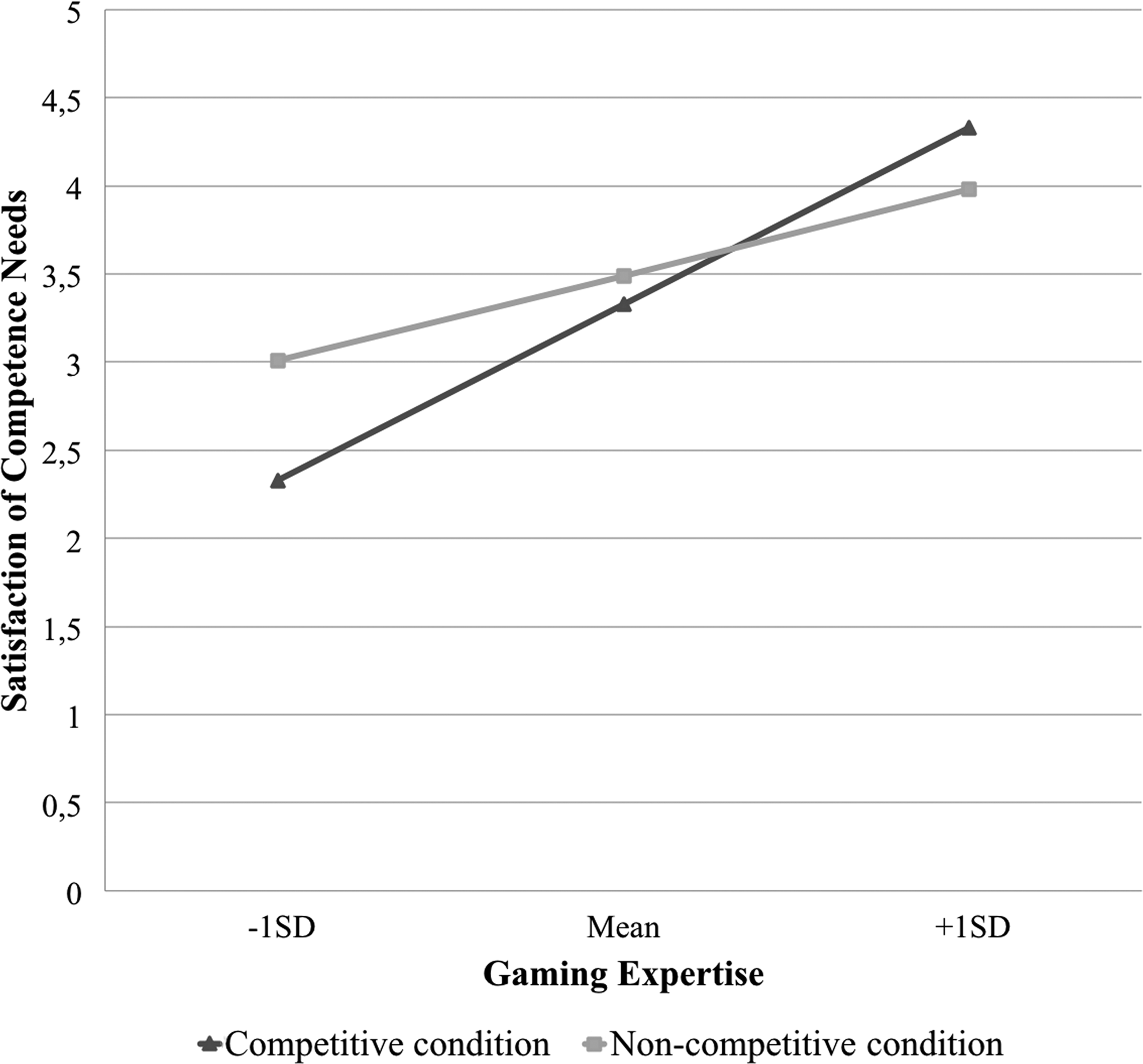
Satisfaction of competence needs as a function of the gaming context (competitive vs. noncompetitive) and gaming expertise.
To test H2a and H2b, we performed multiple regression analyses on game enjoyment and replay intention with a dummy predictor coding for the experimental conditions (competitive=1; noncompetitive=0), gaming expertise (mean-centered), and their interaction. The results for game enjoyment (see Fig. 2) revealed a significant interaction effect between gaming expertise and the competitiveness of the gaming context (F(1, 65)=4.41, p<0.05). Simple slope analyses revealed that, in the competitive condition, gaming expertise predicted game enjoyment significantly better (b=1.26, t=4.83, p<0.001, R2=0.45) than in the noncompetitive condition (b=0.51, t=2.11, p<0.05, R2=0.12). A similar interaction effect is obtained for replay intention (F(1, 65)=3.99, p<0.05; see Fig. 3). However, as gaming expertise increases, replay intention significantly increases in the competitive context (b=0.63, t=4.05, p<0.001, R2=0.33), but no such effect is observed in the noncompetitive context (b=0.21, t=1.42, p=0.16, R2=0.07). H2b is only partially supported by the data.
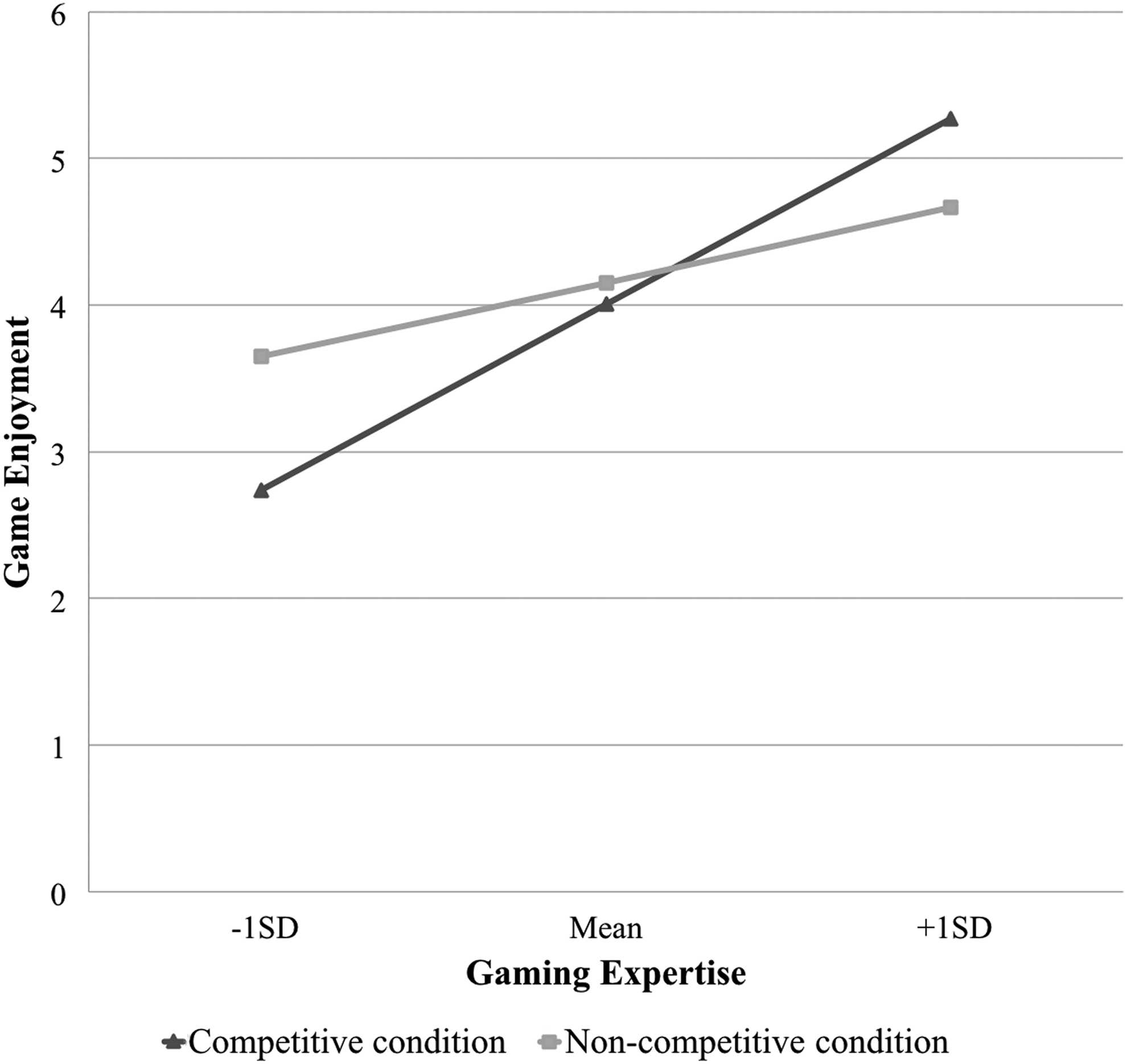
Video game enjoyment as a function of the gaming context (competitive vs. noncompetitive) and gaming expertise.
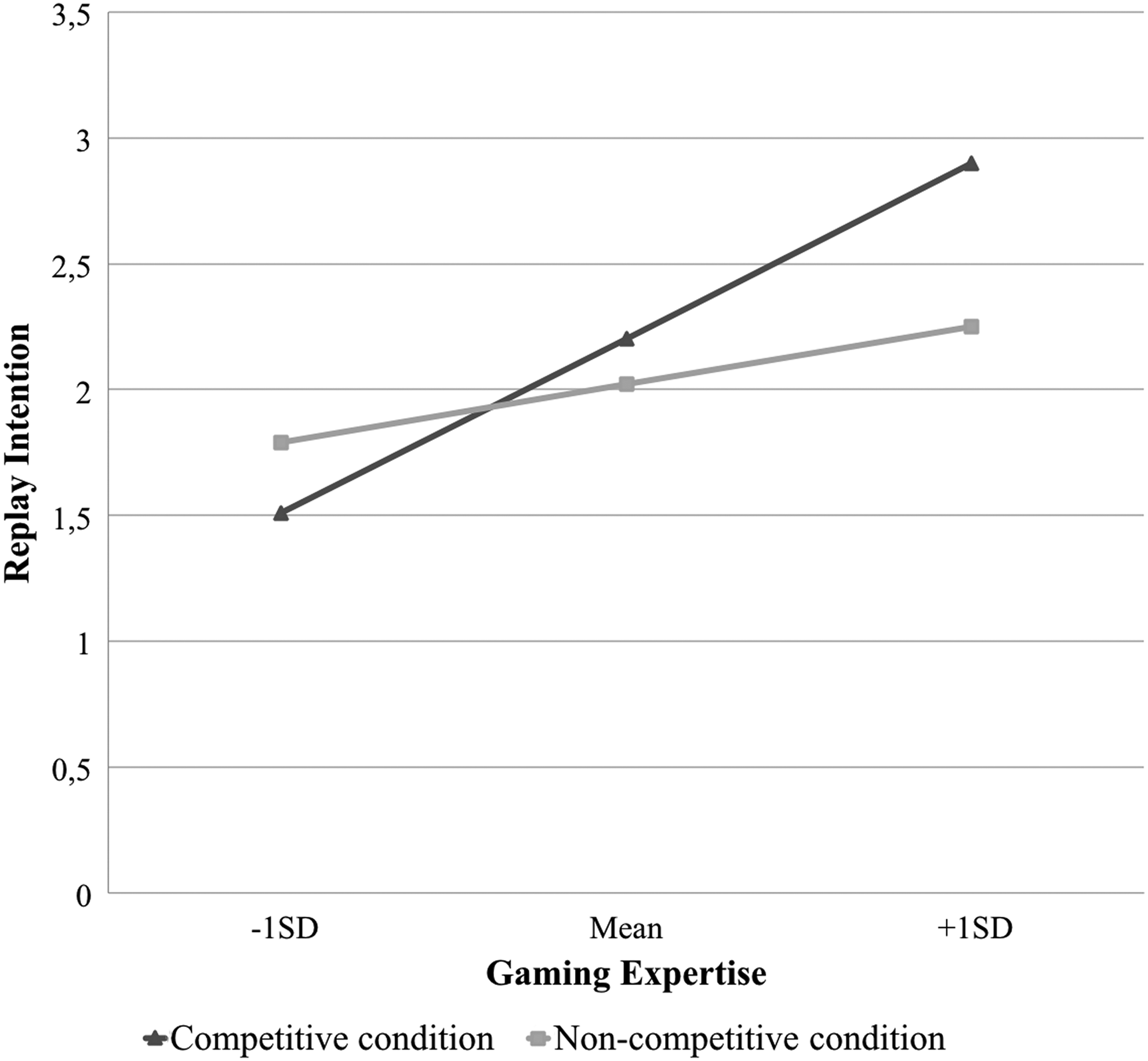
Replay intention as a function of the gaming context (competitive vs. noncompetitive) and gaming expertise.
To test H3a and H3b, the Preacher and Hayes 25 Bootstrap test was used, since it produces more robust results for small samples than the Sobel test. 26 The direct effects of gaming expertise on enjoyment (b=0.151, p=0.27) and replay intention (b=0.112, p=0.32) were not significant when competence needs satisfaction was entered as a mediator. The Bootstrap analysis indicated a significant indirect effect of gaming expertise on both game enjoyment (b=0.429, 99% CI=0.144–0.784) and replay intention (b=0.221, 99% CI=0.064–0.525) through the satisfaction of competence needs, supporting H3a and H3b.
To test H4, we ran a multiple regression analysis on the importance of competition for players' self-esteem with a dummy predictor coding for the experimental conditions (competitive=1; noncompetitive=0), gaming expertise (mean-centered), and their interaction. The analysis revealed a significant interaction between gaming expertise and the competitiveness of the gaming context (see Fig. 4) (F(1, 65)=8.66, p<0.01). Gaming expertise positively affected the importance of competition for players' self-esteem in the competitive gaming context (b=0.71, t=4.19, p<0.001, R2=0.27), while no effect was observed in the noncompetitive context (b=0.03, t=0.19, p=0.85, R2=0.003). H4 is supported.

The importance of competition for players' self-esteem as a function of the gaming context (competitive vs. noncompetitive) and gaming expertise.
Last, we checked for potential confounds. Gender is an important demographic indicator of gaming expertise, with males playing more frequently than females. Additionally, females are less interested in games with competitive elements compared to males. 27 We compared the distribution of gender across conditions and across levels of gaming expertise. A chi-square test revealed that the gender distribution did not significantly differ between conditions (competitive condition: 36% males and 64% females; noncompetitive condition: 44% males and 56% females), (χ2(1, N=65)=0.50, p=0.48). In line with previous findings, male players did report significantly higher levels of gaming expertise (M=3.14, SD=0.90) than female players (M=1.57, SD=0.74), t(63)=7.39, p<0.001, but gender did not account for any of the interaction effects observed when entered as a moderator in the analyses.a Furthermore, average gaming expertise did not differ between the competitive (M=2.18, SD=1.11) and noncompetitive (M=2.22, SD=1.13) condition (t(63)=0.118, p=0.91). Last, mood (Mcompetitive=3.35, SD=0.43; Mnoncompetitive=3.28, SD=0.54; t=−0.54, p=0.59) and frustration levels in particular (Mcompetitive=1.53, SD=0.78; Mnoncompetitive=1.87, SD=1.00; t=1.51, p=0.14) did not differ between conditions. Means and standard deviations for all dependent variables by experimental condition are listed in Table 1.
Discussion
The present study employs an experimental approach to test the role of competition with others and players' expertise in shaping the satisfaction of competence needs in a gaming context. Gaming expertise predicts the satisfaction of competence needs better in a competitive gaming context, probably by making players' expertise more relevant to the goal of the game. The satisfaction of competence needs is, furthermore, closely linked to video game enjoyment and replay intention. We have identified two factors that are external to the game (competition with others and gaming expertise) that affect the satisfaction of competence needs and, consequently, gaming gratifications. The satisfaction of competence needs also fully mediates the effect of gaming expertise on enjoyment and replay intention, supporting the theoretical premise of SDT that need satisfaction is a major motivational driver of video game engagement.
Furthermore, gaming expertise successfully predicted the importance of competition for players' self-esteem only in a competitive context. To protect their self-esteem from external threats, people often reinterpret experiences in order to minimize their threatening implications. 28 Possibly, these findings show that the general human tendency to protect or promote their self-esteem also operates in gaming environments. In the competitive condition, players with low expertise downplayed the importance of competition, thereby protecting general self-esteem from potential poor competitive outcomes. The reverse was true for players with high expertise, however, as they emphasized the importance of competition, possibly because they expected good competitive outcomes.
Limitations and further research
Several limitations need to be taken into account when considering the present results. First, our findings are constrained to the class and difficulty level of the game used in this experiment, which limit their generalizability. Second, the satisfaction of competence needs was measured by combining the two defining elements of competence (perceived performance and optimal challenge), rather than utilizing an established scale, such as the PENS. 2 Furthermore, the study could have benefited from using a more concrete measure of gaming expertise (e.g., number of hours played per week) to avoid subjective responses. While we focused explicitly on the satisfaction of competence needs, further research should explore how the satisfaction of autonomy and relatedness needs contributes to gaming gratifications by experimentally manipulating other aspects of the gaming context.
Introducing a competitive context affected the importance of competitive outcomes for players' self-esteem based on differences in gaming expertise. Ryan and Brown 29 suggest that the more contingent self-esteem becomes (e.g., the more important competition with others is for one's self-esteem), the more prone one is to introjection, a type of behavioral regulation where motivation stems primarily from a desire to obtain external approval. Thus, despite the positive short-term effects on the satisfaction of competence needs and enjoyment, competitive gaming contexts could also entail some costs, especially for people whose self-esteem is more unstable and susceptible to failure. 14 It is unclear whether the observed change was long term or a temporary report, and whether there was an actual shift in general self-esteem, which was not explicitly measured. Further research should explore the effect of competitive gaming contexts on short-term shifts in self-esteem and their long-term implications for general self-esteem.
By focusing on factors external to the game's design and content—competition with others and gaming expertise—this study builds on current research that theorizes basic need satisfaction as the driving force of video game engagement. However, the reported interactions reveal only that competitive contexts enhance the importance of need satisfaction for gaming gratifications. Future research could attempt to parse out the effects of competition and competitive contexts by focusing explicitly on expert players and by manipulating the type and level of competition. Despite these limitations, our findings stress the importance of accounting for potential differences in gaming expertise in current video game designs with strong competitive elements. More specifically, they point to the benefit of providing opportunities for realistic in-game competition, in order to enhance experienced players' enjoyment and increase their motivation to return to the game.
Notes
a. Despite the link between gender and gaming expertise (males reported higher expertise than females), further analyses confirmed that gender does not account for the observed interaction effects. In order to test the role of gender as a potential confound, we ran models that included a three-way interaction between experimental condition, gaming expertise, and gender for all dependent variables and found no significant effects. This implies that gender does not moderate the observed interaction between experimental condition and gaming expertise for any of the dependent variables. In addition, adding gender to the models did not alter the effect of expertise on any of the dependent variables.
Footnotes
Author Disclosure Statement
No competing financial interests exist.
Appendix
Game Enjoyment (alpha = .89)
Anchors: 1 = Strongly Disagree; 7 = Strongly Agree
Replay Intention (alpha = .87)
Anchors: 1 = Not at all, 4 = Very much
Gaming Expertise (alpha = .88)
Anchors: 1 = Strongly Disagree, 5 = Strongly Agree
Satisfaction of Competence Needs (alpha = .76)
Anchors: 1 = Strongly Agree, 5 = Strongly Disagree
Importance of Competition for Self-Esteem (alpha = .93)
Anchors: 1 = Strongly Agree, 5 = Strongly Disagree