




Abstract
Abstract
Social networking sites (SNSs) provide a unique social venue to engage the young generation in philanthropy through their networking capabilities. An integrated model that incorporates social capital into the Theory of Reasoned Action is developed to explain volunteer behavior through social networks. As expected, volunteer behavior was predicted by volunteer intention, which was influenced by attitudes and subjective norms. In addition, social capital, an outcome of the extensive use of SNSs, was as an important driver of users' attitude and subjective norms toward volunteering via SNSs.
Introduction
R
The unique social nature and mounting popularity of social networking sites (SNSs) have begun to provide the connections that can be exploited to promote social change. Not surprisingly, nonprofits have learned to use SNSs as a way to connect with volunteers. For example, Facebook users, through the “Causes” application, can add to their online profile to create a cause (or join an existing one), and recruit potential volunteers and donors. Launched in 2007, “Causes” have had 170 million registrations to 500,000 causes, and they raised $40 million in 2012. 9
This burgeoning success demonstrates the potential of SNSs for engaging primarily young people in philanthropy. While the younger generation is less likely to donate cash to nonprofits given their limited earning power, they possess a particular positive attitude toward volunteering. 10 Nonprofits also realize the importance of building relationships with young people, which, over time, may develop into lifetime partnerships necessary for the organization's long-term success. 10 SNSs thus provide a useful means for nonprofits to engage with the younger generation and channel their collective power for socially desirable ends.
College students are known to be active users of SNSs. They are more likely than any other demographic segments to have SNS accounts, and spend significant amounts of time on such sites daily. 11 In addition, the proportion of American college students volunteering has increased since 2001 from 27.1% to 30.2%, 12 and it exceeds the volunteering rate for the general adult population of 28.8%. 12 It is thus important to study this demographic segment to understand the role of SNSs in increasing volunteering behavior among young adults.
Despite its potential and significance, the question of what drives volunteering through SNSs has yet to be fully explored. 13 The Theory of Reasoned Action (TRA) 14 has been invoked to explain a wide range of behaviors based on a person's attitude toward the behavior and the subjective norms regarding it.15–19 This suggests that the TRA might be an appropriate theoretical framework to help explain why people volunteer via SNSs. The theory's key constructs may make it possible to pinpoint to what extent various factors differentially influence volunteering behavior via SNSs.
SNSs are social venues wherein the users maintain their existing relationships and extend their networks. As such, social relationships should be a critical factor to consider when studying the effects of SNS membership on volunteer behavior. This suggests that the TRA may need to be extended to incorporate social capital into the model. This study investigates the idea that social capital developed through the use of a SNS may affect attitudes and subjective norms as motives to influence one's behavior under the TRA. The goal of this study is thus to elucidate the mechanism of initiating volunteer behavior via SNSs in an attempt to provide needed insights into how SNSs can help engage prospective volunteers and benefit nonprofit organizations.
The Theory of Reasoned Action
The TRA posits that an individual's behavior is directly influenced by his or her intention to act, and that intention, in turn, is influenced by the individual's attitude toward the act and subjective norms about how one should act. 14 Attitude is assumed to be a function of one's beliefs about the likelihood that the act will lead to various outcomes and one's evaluation of those beliefs. Subjective norms are an individual's perceptions of whether significant others think that one should perform a particular act. 14 The subjective norms depend on salient beliefs about the normative expectations of an individual's specific referents, weighted by the motivation to comply with each referent's expectations. The TRA then represents decisions as intentions. Intentions are individual's expectations about one's own behavior in a given setting. 14
In its original formulation the TRA does not include past behavior. However, such behavior may serve as an important predictor of intentions and future behavior.
20
Action can emerge from both conscious and unconscious processes, and research has shown that the potential for a particular behavior can develop through direct or indirect paths.
21
When people are motivated and able, they may systematically form a conscious intention to act based on a variety of factors, including past behavior.22–24
In predicting volunteering via SNSs, with a systematic process, past behavior may be a major determinant of intentions, and thus indirectly of actual volunteering. In addition, prior behavior may be evidence of an automatic response—the activation of a previously stored intention to act in a certain way at a future time when the appropriate situation arises.
20
Past behavior may thus directly contribute to future behavior in contexts that support the development of habits.25,26 This review of the TRA and the influence of past behavior suggest the following hypotheses:
Social capital and social networking sites
The orientation and architecture of SNSs are geared toward social connectivity. Thus, social relationships might be expected to be a critical factor in understanding the effects of SNS membership on volunteering. The concept of social capital is useful in elucidating the nature of the social relationships formed and maintained in SNSs. According to Putnam, 27 there are two types of social capital—bonding and bridging—which are closely linked to the strong and weak tie classification in social network research.28,29 Bridging social capital accumulates when individuals from different backgrounds make connections. 27 Such weakly tied individuals may have tentative relationships, but bridging may broaden their social horizons or world views, and thus promote the diffusion of information.27,30 By contrast, bonding social capital accumulates through strongly tied networks. 27 While strong ties have little diversity in their backgrounds, the bonding provides strong emotional support and mobilizes solidarity.27,30
In SNSs, through intensive use, bridging social capital may be augmented as a number of weak ties are easily formed and integrated into networks. Moreover, bonding social capital may also be strengthened because SNSs provide an additional effective channel for engaging with those with whom one already has strong ties. Therefore, active SNS participation may increase the member's perceived bridging and bonding social capital.
In terms of the TRA, bonding and bridging relationships may have different influences on behavior. Bonding social capital is exclusive in nature, since it exists within a tightly connected network of strong ties.27,30 Conversely, bridging social capital is more inclusive, as it accumulates from connecting individuals from different backgrounds.27,30 This suggests that bonding social capital may be associated with subjective norms, where the beliefs or ideas of similar others are important and people are motivated to comply with them. Bridging social capital may be linked to adding new beliefs or changing the strength of existing beliefs and to the evaluation of new information. Thus, in the context of volunteering via SNSs, bonding social capital may be a stronger influence on subjective norms, while bridging social capital may be more consequential for shaping attitudes toward volunteering through SNSs.
Method
Sample
An online survey was conducted with a total of 309 undergraduates at a large American university. They were recruited from introductory marketing courses and completed the survey in return for extra credit. After eliminating incomplete questionnaires, a final sample of 290 respondents was used in the analysis. The respondents were between 19 and 33 years of age, with an average age of 21. Among them, 170 (58.6%) were female. The majority described themselves as Caucasian (53.4%), followed by Asian-American (19.7%), Hispanic-American (16.2%), African-American (2.8%), and others (7.9%).
Measures
The key variables of the TRA—attitude, subjective norms, and intention—were assessed in the context of volunteering through SNSs using items borrowed from prior research20,31 and modified to fit the context of this study. Past volunteering behavior and actual volunteering through SNSs were measured by using items adapted from the previous work. 20 Social capital in the SNS context was measured by adapting an online bridging and bonding social capital scale tested in previous scholarly work,30,32 and SNS usage intensity was assessed using measures developed by prior study. 32 For each of the variables, only items with a Cronbach's alpha exceeding 0.70 were retained in the model to reach acceptable levels of reliability. 33 Demographic data were also collected. Table 1 presents the specific items, descriptive statistics, and reliability coefficients.
Note. All coefficients are significant at p<0.001 and generated from a final confirmatory factor analysis.
Reference indicator.
Goodness of fit statistics: χ2 (224)=393.64, p<0.001, GFI=0.90, TLI=0.96, CFI=0.97, RMSEA=0.05.
Unstd., unstandardized coefficient; Std., standardized coefficient.
Results
Use of social networking sites
Prior to examining the hypotheses, descriptive information on SNS use was obtained. Facebook ranked as the most frequently used SNS (255, 87.9%), followed by Twitter (22, 7.6%) and YouTube (13, 4.5%). On average, the respondents reported using their most-visited SNS for about 2 hours daily and having begun using the site more than 4 years ago. Of the 290 respondents, 135 (47%) claimed to have volunteered during the previous 12 months, and 100 (35%) said they had joined at least one nonprofit group through a SNS.
Measurement model
Before testing the hypothesized relationships, analyses were conducted to assess if the scales achieved satisfactory levels of reliability and if factor loadings were significantly related to their corresponding constructs. The proposed model was then tested with AMOS v19 using the two-step model-building approach. 34 The measurement model, including the latent constructs and their respective observed variables, was analyzed first. Following that, the structural model with the hypothesized relationships was tested.
Model verification
The results of a confirmatory factor analysis indicate that the measurement model achieved satisfactory fit (χ2=393.64, df=224, p<0.001; GFI=0.90; TLI=0.96; CFI=0.97; RMSEA=0.05). All of the indicators significantly loaded on their corresponding latent constructs (p<0.001), and the construct reliability (CR) and average variance extracted (AVE) were also assessed for convergent validity. The CRs for all constructs ranged from 0.75 to 0.96, and the AVEs were greater than or equal to 0.50. 35 Thus, the variance captured by each dimension was significantly greater than the variance due to measurement error, indicating adequate convergent validity for each dimension. In addition, all square roots of the AVEs were higher than the correlations with other constructs, confirming discriminant validity. 35 Table 2 presents the correlations, covariances, and variances of the latent constructs used in the measurement model.
Note. Variances are on the diagonal. Correlations are in the lower triangle, and covariances are in the upper triangle.
p<0.05; **p<0.01; ***p<0.001.
SNS, social networking site.
Hypothesis testing
Structural equation modeling (SEM) was used to determine the overall relationship structure of the eight latent variables. The results show that all the hypothesized relationships between the latent constructs were statistically significant and in the expected direction (see Fig. 1). With respect to the fit statistics for the full model, the goodness-of-fit indices (χ2=492.56, df=242, p<0.001; GFI=0.88; TLI=0.94; CFI=0.95; RMSEA=0.06) demonstrated a good fit.
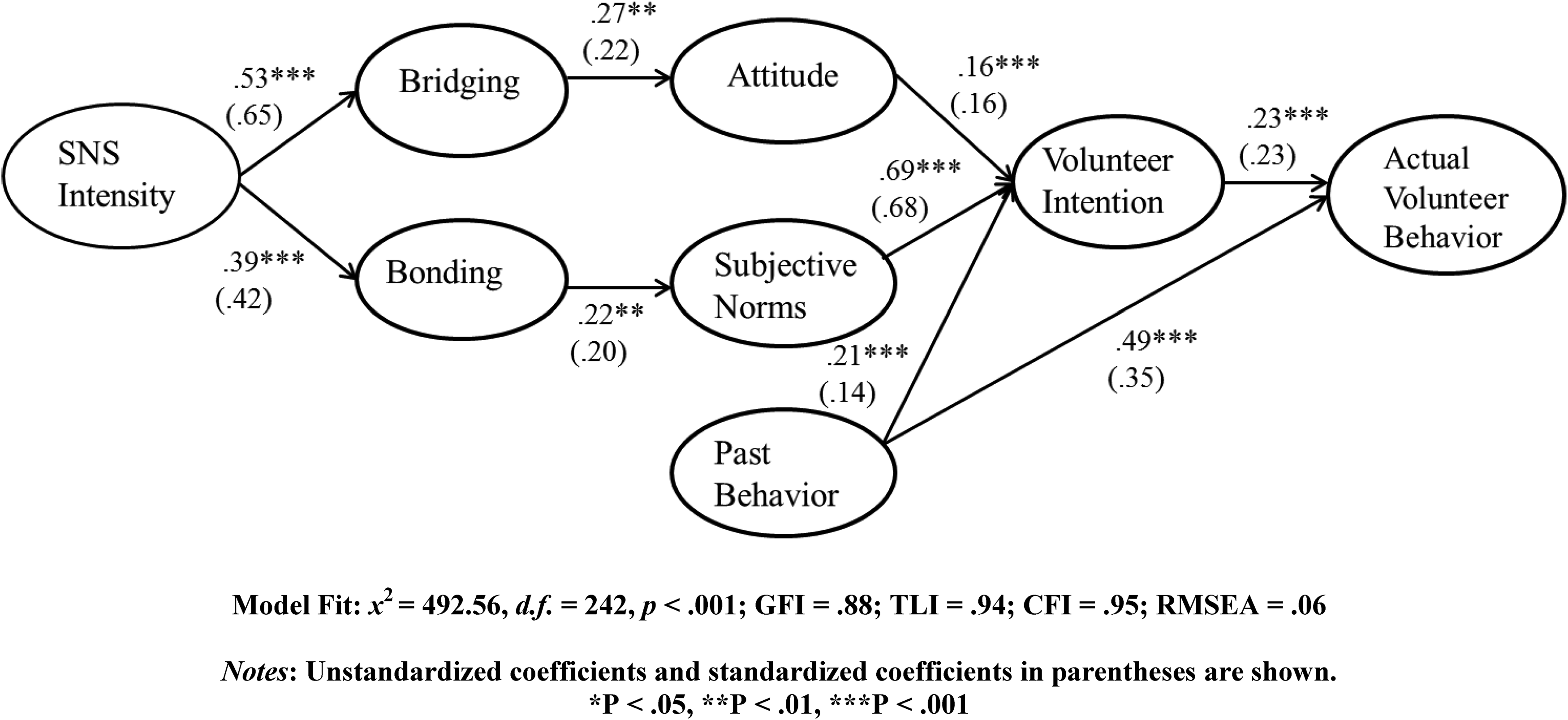
Results of structural equation analysis.
The first four hypotheses discuss the key variables of the TRA. As expected, attitude (β=0.16, SE=0.05, p<0.001) and subjective norms (β=0.69, SE=0.06, p<0.001) both showed significant positive impacts on intention. Intention (β=0.23, SE=0.06, p≤0.001) also showed significant effects on actual volunteering behavior via SNSs. Thus, H1–H3 were all supported. In addition, past volunteering was found to have the expected significant relationship with intention (β=0.21, SE=0.07, p<0.01) and actual volunteering via SNSs (β=0.49, SE=0.09, p<0.001), in support of H4a and b. These results suggest that SNS users may rely on their attitudes and subjective norms in forming an intention to volunteer via SNSs, and that intention leads to actual volunteering, as hypothesized. Also, past volunteering experience may influence actual volunteering via SNSs directly and indirectly through intentions.
The antecedents of the TRA variables are addressed in H5–H7. Specifically, the intensity of SNS use was significantly related to both bridging (β=0.53, SE=0.05, p<0.001) and bonding social capital (β=0.39, SE=0.06, p<0.001), in support of H5. Furthermore, bonding social capital influenced subjective norms positively (β=0.22, SE=0.07, p<0.01), supporting H6. The relationship between bridging social capital and attitudes toward volunteering via SNSs was positive and significant (β=0.27, SE=0.07, p<0.001). This supports H7. The results imply that SNS users' intensive use of SNSs increases their social capital. In addition, bridging social capital significantly influences attitudes toward volunteering, and bonding social capital affects subjective norms about volunteering via SNSs.
Alternative models
In SEM, multiple models may fit the data equally well. Thus, alternative models were also tested to ensure that the model reported in Figure 1 fits the data best. 36 The first alternative model tested whether past behavior had a sole direct relationship with actual volunteering. This analysis was intended to rule out the effect of past volunteering on intention to see if past behavior reflects an automatic and direct response, such as a habit or routine. 20 The second alternative model, in contrast, tested whether past behavior had an indirect effect on actual volunteering through intention, controlling for the direct effect of past behavior on actual volunteering.
Smaller values of AIC and significant chi square differences are indicative of a better-fitting model. 36 In this study, the AIC for the proposed model was 608.56 while it was 615.14 for alternative model 1 and 630.82 for alternative model 2. The proposed model also had the smallest χ2 (492.56), and the χ2 difference with alternative model 1 (χ2=501.14) and model 2 (χ2=516.82) was significant. Taken together, the results provide strong evidence supporting the proposed model as best at explaining the underlying process of volunteering behavior via SNSs.
Discussion
To understand factors influencing volunteering through SNSs, the TRA was employed as the core theoretical framework. The results demonstrate that the TRA is helpful in explaining individuals' volunteering through SNSs. The more positive SNS users' attitudes toward volunteering through SNSs, and the greater social pressure to volunteer they perceive, the more likely that SNS users will have the intention to volunteer. Having volunteer experience also seems to affect actual volunteering via SNSs directly and indirectly through intention.
Given the unique social nature of SNSs, the key predictors of volunteering behavior were explored by incorporating social capital considerations into the TRA. The findings of this study reveal that social capital produced by using SNSs plays a critical role in shaping attitudes toward and subjective norms about volunteering via SNSs. Bridging social capital shows a significant relationship with attitudes toward volunteering, while bonding social capital has a strong relationship with SNS users' subjective norms.
Interestingly, the results suggest that subjective norms have greater influence on intentions than attitudes or past behavior. Previous research on fast food consumption shows that subjective norms influences decisions when eating with friends but not when alone. 20 In the context of fundraising, past research demonstrates that recognition plays an important role, since publicizing donor activities has a positive effect on nonprofits' fundraising.37,38 Apparently, the social nature of SNSs seems to exert social pressure on volunteers' decisions. This could be because SNSs are in the public sphere where one's volunteer activities are easily recognized by peers. For young people, their preferred SNS may act as their hub on the Internet where they regularly visit and freely exchange information and experiences with their connections on a variety of topics. SNSs may thus provide an effective means for nonprofits to promote good causes and motivate young people to be involved in volunteering.
Practically, nonprofit managers should take notice that bridging and bonding social capital serve as important predictors of volunteering in different ways. The effect of bridging social capital seems to be related to the size of one's network of weak ties. As the number of SNS users “friending” an organization grows, the value of bridging social capital may improve. This implies that nonprofits could benefit from using popular SNSs such as Facebook to recruit and educate potential volunteers. Meanwhile, to increase the effect of bonding social capital, nonprofits could facilitate volunteering through invitations from close friend networks.
While the results of this study provide theoretical and practical insights, some limitations should be noted. The self-reported data measuring the respondents' behavior should be cautiously evaluated. 39 Respondents may have been unwilling or unable to report accurately for ego-defensive or impression management reasons. 39 Since volunteering behavior parallels many aspects of impression management, self-reports may overestimate positive attitudes toward volunteering or exaggerate the extent of actual volunteering activity. Employing experimental or observational research in the future should help reduce the potential for social desirability bias in the context of pro-social activities.
The survey methodology used in this study could not establish causality. This limitation could be better addressed by a longitudinal survey study to provide support for the causal relationships proposed here. Moreover, other unmeasured variables not controlled for in this design could display similar patterns and constitute common causes. For example, people who are outgoing with a large offline social network, or pro-social people in general, may use SNSs more often and be more likely to volunteer. Thus, examining other factors that influence volunteering online and offline should be worthwhile. Finally, future research might test the theory of planned behavior and its ability in explaining factors influencing volunteering via SNSs by incorporating perceived behavioral control. Previous research suggests that perceived self-control ability can be a crucial predictor of altruistic intentions. 40 Thus, it appears promising for future research to employ the theory of planned behavior in this context.
Footnotes
Author Disclosure Statement
No competing financial interests exist.