




Abstract
Abstract
The 15-item Generalized Problematic Internet Use Scale 2 (GPIUS2) is one of the few theory-driven instruments to measure problematic Internet use (PIU). Since PIU has emerged in several cultural contexts, it seems relevant to evaluate the psychometric properties of the scale across various cultures. The aim of the present study was to test the psychometric properties (i.e., dimensionality, reliability, and validity) of the Italian version of the GPIUS2. The sample consisted of 371 participants (128 males and 243 females), and their age ranged from 14 to 33 years (M=18.07 years, SD=5.58). The GPIUS2 and the Internet Addiction Test (IAT) were administered individually in both high school and college classes. With regard to scale dimensionality, the best-fit measurement model includes four first-order factors: preference for online social interaction, mood regulation, deficient self-regulation, and negative outcomes (Satorra–Bentler scaled chi-square [S-Bχ2]/df=2.27; comparative fit index [CFI]=0.94; Tucker–Lewis index [TLI]=0.93; root mean square error of approximation [RMSEA]=0.05). With regard to reliability, internal-consistency Cronbach's alpha ranged from 0.78 to 0.89. Convergent validity is demonstrated with significant correlations between GPIUS2 (total score and all the subscale scores) and IAT score. Results showed that GPIUS2 scores significantly discriminated between high school and undergraduate students. The overall findings of the present study provide evidence that the Italian version of the GPIUS2 appears to be an adequate measure of generalized PIU cognitions, behaviors, and outcomes. Suggestions for further research are provided.
Internet Addiction or Problematic Internet Use
The Generalized Problematic Internet Use Scale 2
Although some attempts to measure PIU have been made, these measures have not received extensive and systematic psychometric testing. 20 Recently, some theory-driven instruments have been created.21–23 Among them, Caplan's Generalized Problematic Internet Use Scale 2 19 (GPIUS2), a revised and updated version of the Generalized Problematic Internet Use Scale 24 (GPIUS), has been developed to formally test Davis' cognitive-behavioral model of the GPIU. 16 The first version of the GPIUS was a 29-item scale that was developed to measure the degree to which an individual experiences the types of cognitions, behaviors, and outcomes that Davis claims constitute GPIU. More recently, Caplan 19 proposed an integrated conceptual model of GPIU that combines elements of Davis' cognitive-behavioral theory of GPIU, his own works that address a preference for online social interaction,17,18 and the sociocognitive model of unregulated Internet use.25,26 The GPIUS2 is a 15-item questionnaire developed for the measurement of this integrated conceptual model. It addresses four dimensions: (a) POSI, which is defined as the belief that one is safer, more efficacious, and more confident with online interpersonal interactions than with face-to-face interactions (e.g., “Online social interaction is more comfortable for me than face-to-face interaction”); (b) mood regulation, which pertains to the motivation to use the Internet to alleviate distressing feelings (e.g., “I have used the Internet to make myself feel better when I was down”); (c) deficient self-regulation, which consists of a compulsive use dimension—the inability to control or regulate one's online behavior (e.g., “I find it difficult to control my Internet use”)—and a cognitive preoccupation dimension, which describes obsessive thinking about the online world (e.g., “I think obsessively about going online when I am offline”); and (d) negative outcomes, which describes the extent to which an individual experiences personal, social, and professional problems resulting from Internet use (e.g., “I have missed social engagements or activities because of my Internet use”).
The GPIUS2 19 features two new factors that were not included in the original version of the GPIUS 24 : POSI and deficient self-regulation. In the new version, POSI is considered as a single construct rather than as two separate factors (social benefits and social control). Indeed, Caplan 17 demonstrates the value of combining the social benefits (the perceived social benefits of Internet use) and the social control factors (an individual's perceived degree of control over self-presentation when interacting with others online) into a single subscale operationalizing POSI. The central role of POSI as a key factor for the development of the other GPIU's dimensions is one of the distinctive features of the GPIU perspective in comparison with the Internet addiction approach. Another change is that the GPIUS2 operationalizes deficient self-regulation as a higher-order factor that influences both cognitive preoccupation and compulsive Internet use subscale scores. This change is based on the work of LaRose and his colleague, 26 which suggests that compulsive Internet use and cognitive preoccupation are both symptoms of deficient self-regulation. In addition, the original scale's excessive Internet use subscale was omitted from the new scale, as empirical evidence has emerged that the frequency of Internet use is not necessarily indicative of problematic use. 18 Finally, the names of two of the original dimensions were revised. Specifically, the mood alteration factor was renamed “mood regulation” in order to emphasize the motivation to use the Internet to alleviate and process emotions,26,27 and the withdrawal dimension was renamed “cognitive preoccupation” in order to more clearly reflect its emphasis on obsessive thinking about the online world.
The GPIUS2 is one of the few theory-based measures of the GPIU with good psychometric properties. Moreover, in comparison to the Internet Addiction Test 10 (IAT)—the most-used instrument for assessing PIU—the GPIUS2 is specifically focused on problematic use that arises because of the unique communicative context of the Internet. For these reasons, both the first and the second versions of the GPIUS have been recently used in a variety of contexts for the assessment of the GPIU.18,28–30
Since the diffusion of PIU has emerged in several different cultural contexts,1–9 it seems relevant to confirm the properties of the scale across various cultures. In Italy, a recent study 9 used the IAT to assess the prevalence of PIU in a sample of 2,853 high school students, finding that 1.2% of the participants were addicted to the Internet. However, since the IAT does not capture the problems that come about because of the unique communicative context of the Internet (i.e., the GPIU), these results could be difficult to interpret. Starting from this premise, the aim of the present study was to test the psychometric properties of the Italian version of the GPIUS2 19 in order to provide a reliable and valid instrument to measure problematic use associated with the unique social context available on the Internet.
Methods
Participants
In total, 371 people (128 males and 243 females) participated in the study, and their age ranged from 14 to 33 years (M=18.07 years, SD=5.58). The sample has been selected among high school and undergraduate students, trying to represent the proportion in the Italian population (about 70% and 30%, respectively). 31 To recruit high school students, three public schools in downtown Florence were randomly selected. Data collection consisted of written questionnaires filled out in a classroom setting. Undergraduate students were recruited in the study rooms of two randomly selected faculties of the University of Florence. Participation was voluntary and anonymous. Participants who were younger than 18 years of age needed written consent from their parents.
Measures
The GPIUS2 19 contains 15 Likert-type items rated on an 8-point scale (from “definitely disagree” to “definitely agree”). The Italian version of the GPIUS2 was obtained using a back-translation method. The IAT 10 is a measure of the degree of Internet dependence. The IAT was chosen because specific instruments (beyond the GPIUS2) for the assessment of problematic use associated with the unique communicative context of the Internet are not available. Hence, among the available measures for Internet-related problems, we have chosen the most-used one. The Italian version 32 of the scale contains 20 Likert-type items using a 5-point scale (from “not at all” to “always”), yielding a maximum score of 100. A sample item is, “How often do you find that you stay online longer than you intended?” In the current study, the IAT shows good internal consistency (Cronbach's α=0.89).
Procedures
Both questionnaires were administered individually in high school and college classes, starting with the GPIUS2 and ending with the IAT. In testing the psychometric properties of the scale, dimensionality has been assessed applying a confirmative approach. Specifically, two models have been compared: a higher-order factor model (model A) as defined by Caplan's confirmatory factor analysis, 19 and a model with four factors (model B), in which deficient self-regulation was not divided into two factors (compulsive use and cognitive preoccupation) since the high correlations found by Caplan 19 suggested the presence of a unique factor containing both dimensions.
Internal consistency for both the subscales and the total scale has been assessed by calculating the alpha coefficients. To gain evidence of the convergent validity of GPIUS2 scale scores, the relationship between GPIUS2 scores and IAT scores has been investigated.
Since there is increasing evidence that high school students are particularly vulnerable to PIU,4,33–38 a one-way analysis of variance (ANOVA) was performed to investigate if the GPIUS2 discriminates between high school and undergraduate students.
Results
Analysis of missing data revealed 15 missing data patterns (cases with five or more missing values). Because they represented less than 10% of the total cases in the sample, a list-wise deletion was conducted, excluding cases with missing data. 39 As a result, the sample comprised 356 cases. When missing values were fewer than five, missing data imputation was performed using the item mean.
Univariate distributions of the 15 items were examined for assessment of normality. Skewness and Kurtosis indices of 11 items ranged outside the values of −1 and 1, suggesting that the departures from normality were not acceptable. 40 Table 1 shows descriptive statistics for the GPIUS2 items.
The models were tested by confirmatory factor analyses, using the Satorra–Bentler scaled chi-square (S-Bχ2) for continuous non-normal outcomes, 41 conducted with Mplus 3.0 42 and applying maximum likelihood mean-adjusted estimation. The criteria for assessing overall model fit were mainly based on practical fit measures: the ratio of chi-square to its degree of freedom (S-Bχ2/df), the comparative fit index 43 (CFI), the Tucker–Lewis index 44 (TLI), and the root mean square error of approximation 45 (RMSEA). For the ratio of chi-square to its degree of freedom (S-Bχ2/df), values less than 3 were considered to reflect fair fit. 39 We considered CFI and TLI values of 0.90 and above to reflect fair fit. 43 For the RMSEA, values equal to or less than 0.08 were considered to reflect adequate fit. 46
Results showed a poor overall fit for the hierarchical model (baseline) (S-Bχ2/df=3.95; CFI=0.87; TLI=0.83; RMSEA=0.09) and an acceptable fit for the four-factor model (model A) (S-Bχ2/df=3.17; CFI=0.90; TLI=0.87; RMSEA=0.08). Although TLI was not completely adequate, modification indices suggested adding the error covariance between item 6 and item 10 (referring to compulsive use factor), and between item 2 and item 9 (referring to cognitive preoccupation factor). After adding these constraints (model Amodified), the indices of goodness of fit improved in a statistically significant way, as attested by the chi-square difference (S-BΔχ2). Fit-comparison and goodness-of-fit indices for all the models are summarized in Table 2.
S-Bχ2, Satorra–Bentler χ2; df, degrees of freedom; S-BΔχ2, Satorra–Bentler scaled difference χ2; Δdf, difference in degree of freedom between nested models; p, probability values of S-BΔχ2 test; CFI, robust comparative fit index; TLI, robust Tucker–Lewis index; RMSEA, robust root mean square error of approximation; baseline, hierarchical model; model A, four-factor model; model Amodified, the four-factor model modified with the inclusion of covariances between errors of item 6 and item 10, and between errors of item 2 and item 9.
Model Amodified standardized factor loading ranged from 0.60 to 0.88, all of which were significant at the 0.001 level as well as the estimated correlations among errors (Fig. 1).
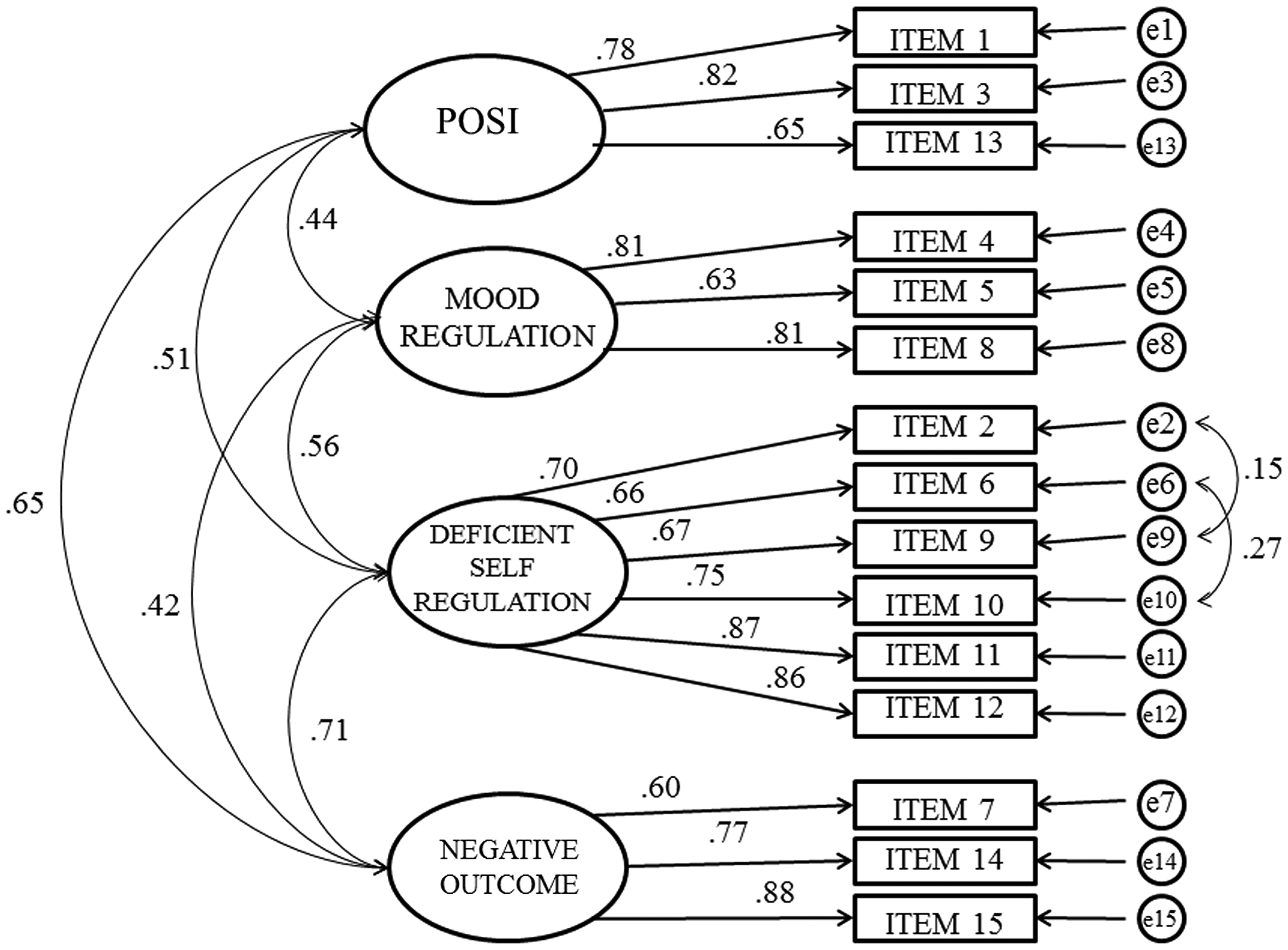
Confirmatory factor analysis of the Generalized Problematic Internet Use Scale 2 (model Amodified).
With regard to reliability, internal-consistency Cronbach's alpha was 0.78 (95% CI=0.74, 0.81) for POSI scale; α=0.78 (95% CI=0.75, 0.82) for mood regulation scale; α=0.89 (95% CI=0.87, 0.90) for deficient self-regulation scale; and α=0.78 (95% CI=0.74, 0.81) for negative outcome scale. When all items are used together to create an overall GPIUS2 composite score, the scale's reliability estimate was 0.89 (95% CI=0.88, 0.91). That value did not increase when an item was deleted, and all item-corrected total correlations were above 0.30.
Concerning validity, all the correlations between GPIUS2 (total score and all the subscale scores) and IAT scores (Table 3) were positive, indicating that a higher level of generalized pathological Internet use was associated with a higher level of Internet dependence. The correlations can be considered high according to the recently proposed cut-off values for convergent validity. 47
p<0.01.
GPIUS2, the Generalized Problematic Internet Use Scale 2; IAT, Internet Addiction Test; POSI, the preference for online social interactions dimension.
To investigate if the scale discriminated between high school (n=242; 38.1% males; mean age=14.6, SD=0.67) and undergraduate students (n=114; 28.9% males; mean age=25.96, SD=3.21), we conducted a one-way ANOVA, which considered the GPIUS2 total score as the dependent variable. Results showed that the GPIUS2 score significantly discriminated between the two groups [F(1, 354)=16.43; p<0.001; η2=0.04]. High school students (M=2.32, SD=1.10) reported a higher GPIUS2 total score than undergraduate students (M=1.82, SD=1).
Discussion
The psychometric properties of the Italian version of the GPIUS2 developed by Caplan 19 were investigated in order to provide a self-report measure suitable for clinical practice and research involving Italian adolescents and young adults. On the basis of the results of the confirmatory analysis, the Italian adaptation of the GPIUS2 appears to be a valid measure of GPIU cognitions, behaviors, and outcomes. Its psychometric properties are comparable with those seen in the original instrument. 19 In terms of scale dimensionality, whereas Caplan 19 identified five first-order subscales, two of which (i.e., compulsive use and cognitive preoccupation) constitute a second-order factor (deficient self-regulation), the current study found that the best-fit measurement model includes four first-order factors (POSI, mood regulation, deficient self-regulation, and negative outcomes) without any higher-order determinants. From a theoretical point of view, this result suggests a strong interplay between obsessive thoughts about the Internet and compulsive Internet use, thus reflecting a unique manifestation of a diminished self-regulation capability.
The findings related to validity are important because few studies have investigated the relation between GPIUS2 and other measures. The scores on GPIUS2 are correlated with scores on other scales that were designed to measure theoretically related constructs. High correlations were found between GPIUS2 subscales and the IAT, another widely employed measure of Internet addiction. In particular, the higher correlation was found with the deficient self-regulation subscale, whereas the lower correlation was found with the subscale that measures preference for online social interaction levels. These results confirm that, in comparison with other measures of PIU, the GPIUS2 is more focused on problematic use because of the unique communicative context of the Internet. Since cognitive symptoms such as POSI have been systematically found to be a key factor in the development of negative outcomes, 17 a measure focused on these aspects might advance research about PIU. Indeed, the GPIUS2 provides a valuable approach to evaluating PIU from a multidimensional perspective and a means of understanding the etiology and development of this problem. This study builds upon previous empirical evidence regarding the cognitive-behavioral model of GPIU in a cultural context that had not previously been studied.
Moreover, we found differences in the GPIUS2 scores between high school and undergraduate students. This result confirmed previous evidence that high school students are particularly vulnerable to PIU.4,33–38
In summary, the present findings indicate that the GPIUS2 is a useful instrument with good psychometric properties for assessing PIU among young people. This scale permits researchers to evaluate different dimensions of PIU, is based on a well-developed theoretical model, and does not take much time to fill out. The implications for research mainly deal with the use of the GPIUS2 to study the prevalence and the manifestations of PIU in Italy. The utilization of the GPIUS2 in clinical settings as a means of screening people at risk to develop PIU is also useful. In cognitive-behavioral therapy settings, the GPIUS2 could also help identify specific maladaptive cognitions and ruminative thoughts that maintain PIU.
Limitations
Further studies should be conducted to strengthen the validity of the scale. For example, the relationship between GPIUS2 dimensions and several indices of psychosocial difficulties associated with PIU25,48,49 (e.g., loneliness and depressive symptomatology) needs to be evaluated. Furthermore, the present study is only partially representative of the population and focuses solely on youth. Studies featuring different age samples should be conducted to support the current findings. Hence, these results have to be regarded as preliminary, requiring further consolidation by the examination of larger population samples.
Footnotes
Author Disclosure Statement
No competing financial interests exist.