




Abstract
Abstract
Gamification design is considered as the predictor of collaborative storytelling websites' success. Although aforementioned studies have mentioned a broad range of factors that may influence gamification, they neither depicted the actual design features nor relative attractiveness among them. This study aims to identify attractive gamification features for collaborative storytelling websites. We first constructed a hierarchical system structure of gamification design of collaborative storytelling websites and conducted a focus group interview with eighteen frequent users to identify 35gamification features. After that, this study determined the relative attractiveness of these gamification features by administrating an online survey to 6333 collaborative storytelling websites users. The results indicated that the top 10 most attractive gamification features could account for more than 50% of attractiveness among these 35 gamification features. The feature of unpredictable time pressure is important to website users, yet not revealed in previous relevant studies. Implications of the findings were discussed.
Introduction
Some studies have considered gamification design as one of the critical factors that contributes to the success of collaborative storytelling websites because of its fun and interactivity.5,6 The definition of gamification refers to the incorporation of game mechanics into nongame settings, which aims to increase users' engagement of the product or service and facilitate certain behaviors. 7 Recently, gamification is widely used for increasing users' interaction and engagement in variety of domains such as business and marketing, 8 health and wellness, 9 education and training, 7 corporate and vocational training, 10 public policy and government. 10 So far collaborative storytelling websites also effectively attract and maintain users via various gamification designs, such as leader boards and badges. 7 Moreover, the gamification features attract uses by providing fun and flow experiences as users create and collaborate on a story together, which result in more daily users and a higher average time on sites. 5 Gamification essentially functions as entertainment, which makes collaborative storytelling website users enjoy actively participating and engaging with others. Consequently, gamification plays a critical role in the survival of collaborative storytelling sites.
Prior studies have been conducted to identify influences on gamification. Many studies have examined the role of achievement aspect (such as goal setting and status) in facilitating the gamification design through increasing users' self-efficacy and recognition.5,9–11 Some scholars have argued that the gamification design should rely heavily on the support of an interpersonal relationship aspect.12–16 Also, other studies have examined that the role-playing aspect foster users' engagement of a product or service through increasing self-identity and fun.17–19 While aforementioned studies have mentioned a broad range of factors that may influence gamification, however, they depicted neither the actual design features (design guidelines) nor the relative attractiveness among them. Identifying the attractive design features for gamification could establish significant milestones on how to make attractive collaborative storytelling websites.
This study aims to identify gamification features for collaborative storytelling websites. The relative attractiveness of these gamification features is also determined. Doing so would help website developers focus those with the greatest weight and identify the best design strategy for improving websites' gamification attractiveness.
Systematic Framework of Gamification Design
In this study, we first attempted to construct a hierarchical model to represent the systematic structure of the gamification design. After reviewing gamification factors from relevant literatures, we then conducted a discussion with four website designers on these factors and the corresponding design mechanics for collaborative storytelling websites. Therefore, through this process, some factors may be excluded because they are lacking the corresponding design mechanics for collaborative storytelling websites. All gamification factors discussed in this study can be divided into three main components: achievement, interpersonal relationship, and role-playing. Achievement means users are motivated by a need to achieve goals or accomplish something difficult through a difficult task and repeated efforts, including such design factors as rewards, goal setting, reputation, and status.5,9–11 An interpersonal relationship refers to the process that facilitates the formation of social networks that connect users with whom the user interacts, including instruction, competition, and altruism.12–16 Role-playing refers users see the world though the viewpoint of their role, including such design factors as group identification, self-expression, and time pressure.17–19 The role and user are not only closely interconnected with each other, but also allows users to accomplish their goals at the personal and social levels. Various sets of gamification features associated with each design factor in the second level are linked to the third level. The hierarchical framework of the gamification design in this study is shown in Figure 1.
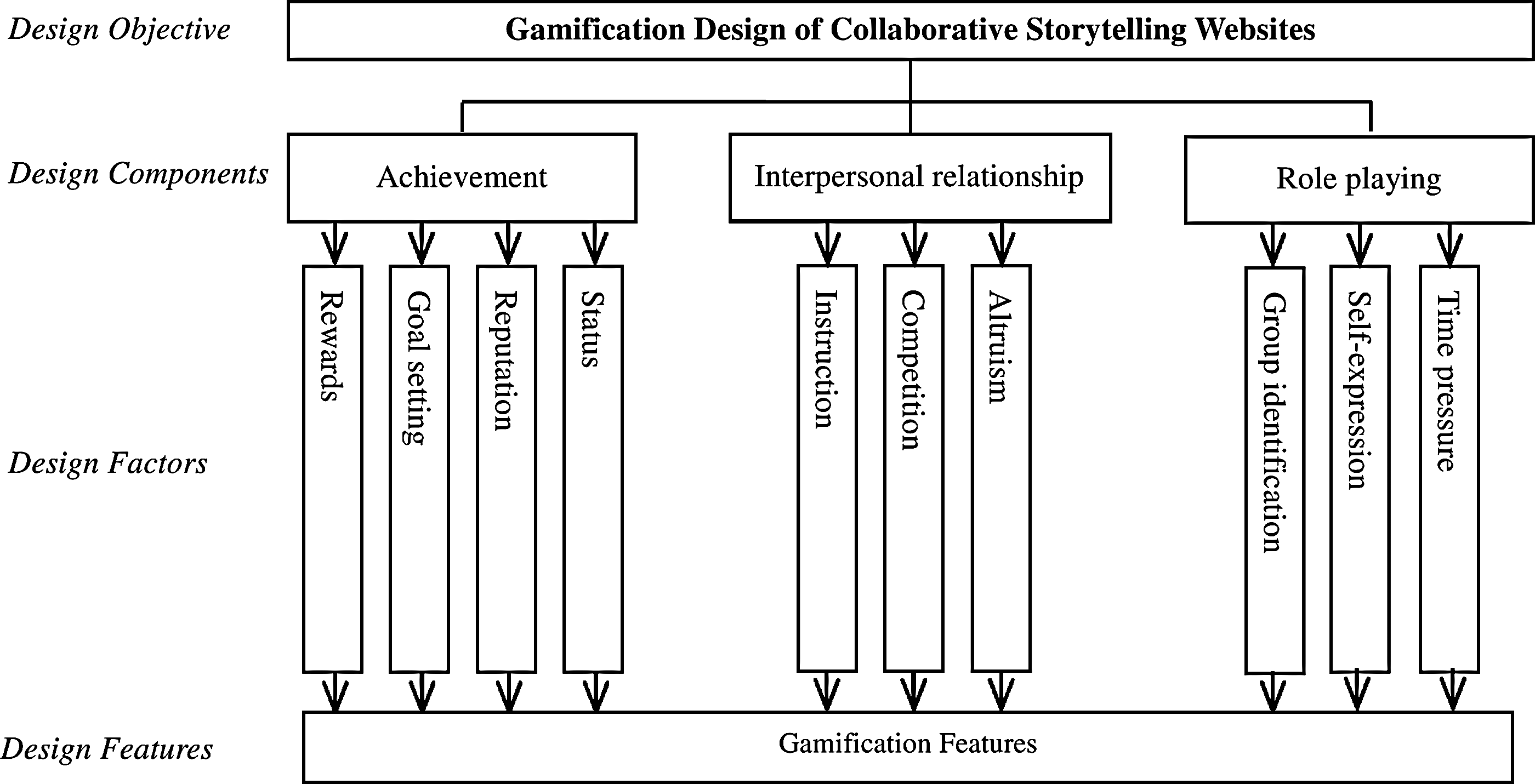
Hierarchical system structure of gamification design of collaborative storytelling websites.
Achievement
Rewards
Rewards refer to the gamification factor that satisfies users shared need and motivates them to implement certain behaviors.10,17 For example, users are motivated to create more stories with others to receive more and more rewards from websites. At present, gamification design mechanics of rewards includes tangible rewards (i.e., points or virtual currency) and intangible rewards (praise or recognition from others) that users can see and use to benefit themselves. 10 The rewards mechanism operates in terms of earning points or the equivalent (like frequent-flyer miles) and effectively forms a reward–behavior cycle. 19 That is, the more time a user invests in the expected behaviors, the more reward they will receive from websites.
Goal setting
Goal setting is related to the most motivating goals, are those that are just out of comfortable reach. 20 Users always conduct certain behaviors toward a specified goal because the fun and interest of goal seeking is often the primary reward itself. 21 In the context of collaborative storytelling websites, the users' goal may comprise either the personal level goal (i.e., individual achievement and learning) or the group level goal (i.e., group achievement and belonging). So far, the gamification design mechanics of goal setting mainly operates in two ways, explicit signs (i.e., trophies and badges) and progress toward goals (i.e., progress bars or percentage). 10
Reputation
Reputation refers to the system that facilitates users' behavior based on the estimation of recognition held by other users.21–23
The idea of a reputation has been widely adopted by online shopping, such as eBay and
Status
As users join a social group, status means the user's need about recognition, fame, prestige, attention, and other users' respect.10,21 Status serves as the users' desire to be recognized and foster users to achieve goals enthusiastically. For websites, the status also represents users' contribution on creating stories and participating in websites' activities. A quantified approach is often used for representing design mechanics about users' status, such as experience points and level-up. 10
Interpersonal relationship
Instruction
As new users (also called newbie) entered into a system, some instructions are required to teach them the social norms.21,24 Instruction not only functions as the social shaping of user activities, but also assists users to master the whole system in an efficient way. In the context of websites, the instruction helps users to learn communication and teamwork skills as they collaborate with others. Nonce helper and billboard is usually used for representing the gamification mechanics of instruction in collaborative storytelling websites. 3
Competition
Competition refers to the user's desire to compete with others, including reaching a high score and win others.10,11 As the user competes with others, the user with the highest score wins the prize or benefit. Thus, users enjoy the well-being and will go on competing with others. The gamification design mechanics of competition is leader boards, which lists winners among all competitors. 10
Altruism
Altruism is the users' desire to bridge and maintain relationship with others through conducting certain behaviors, such as gift-giving or asking for help.10,21 Trivers 25 has suggested that altruism is the user's desire to conduct reciprocal behaviors with others on the basis of trust. Altruists indirectly contribute to their fitness through others who reciprocate back. 10 In the context of websites, support for gift-giving and charity is the most popular altruistic in the game. Specifically, altruism is also considered as a strategy for attracting new users.10,21 For instance, users may receive a gift from someone that pulls them into the game, and then, they are incented to send gifts to friends, eventually creating a great acquisition loop.
Role-playing
Group identification
Group identification represents users' affective and cognitive loyalty to the user group as users participate in a group.10,26–28 Users with higher group identifications are often willing to remain in a group permanently and to strive toward the goals, obey the guild managers' commands, and devote themselves to group affairs. 29 At present the gamification design mechanics of websites are self- organized quest teams or the members' family.
Self-expression
Self-expression refers to users' desire to express their autonomy and originality, which shapes their unique personalities.10,21 Users' self-expression involves users' feeling of social toleration, life satisfaction, public expression, and an aspiration to liberty. Gee 30 conducted a study on digital game-based learning, also considered assisting users to build their self-identity in the virtual world can facilitate user’ involvement. To show off users' uniqueness in websites, the gamification design mechanics of self-expression are virtual goods, spaces, and avatars.10,19
Time pressure
Time pressure means giving users a time limit to conduct certain behaviors to encourage them to interact heavily during this period.5,21 For users, creating time pressure can raise more emotional feedback and encourage greater participation as the time pressure is connected to their goals. For example, some mobile applications set a 5-second time limit to find the targets, which encourage the user to interact with application heavily during this period. As they fail, a new game automatically starts 5 seconds later. To make users' sense time pressure, the gamification design mechanics of websites includes the countdown timer, the time bar, and check points. 10
Methods and Results
This study involves the following two stages: (1) identifying gamification features for collaborative storytelling websites, (2) determining the relative attractiveness of gamification features.
Identifying gamification features for collaborative storytelling websites
A focus group interview is conducted for identifying the gamification features of collaborative storytelling websites. The materials, subjects, and results of the interview are described below.
Materials
Three websites, including
Subjects and procedures
Eighteen experts, nine male and nine female story website users, participated in the interview. All of them are frequent story creators and have at least 5 years of story writing experience. All users were asked to identify and discuss gamification features based on the proposed systematic gamification framework in this study.
Result
To improve the features, three human–computer interaction experts were invited to confirm all of the features. Finally, thirty-five gamification features were developed following the in-depth interviews, as shown in Appendix 1.
Determining the relative attractiveness of gamification features
This study had asked collaborative storytelling website users to identify 35gamification features proposed in the last stage. After that, a fuzzy-AHP methodology was applied to determine the relative attractiveness weight of the gamfication features. The questionnaire design and data collection, data analysis, and result are described below.
Questionnaire design and data collection
This study developed a questionnaire to gather collaborative storytelling website users' assessments of the relative attractiveness of the gamification features in a pairwise comparison data input format based on the hierarchical structure (see Fig. 1) and gamification features described above. This questionnaire format (a nine-point rating scale) represented relative attractiveness of each gamification feature, for example, as equally attractive, moderately attractive, strongly attractive, very strongly attractive, and extremely attractive, as suggested by Saaty 31 (see Appendix 2 for an example of the Fuzzy AHP questionnaire). To validate the instrument, the questionnaire was first pilot tested with thirty evaluators. Evaluators have more than 3 years' experience using collaborative storytelling websites. They were asked to comment on the relevance, clarity, and meaningfulness of the criteria. Therefore, the questionnaire has confirmed content validity. We administered an internet survey and recruited 6333 users who had used collaborative storytelling websites. After primary data analysis, we deleted incomplete questionnaires and outlier data, leaving us with 5566 valid samples (87.9%) for use in this study. The gender distribution of participants was 2639 (47.4%) males and 2927 (52.6%) females. Age interval years included 21–30 (34.7%), 31–40 (39.2%), 41–50 (10.6%), 51–60 (10.1%), 61 and above (5.4%). Additionally, 12.7% have experience using collaborative storytelling websites for less than a year, 31.4% have experience for 1–2 years, and 55.9% have experience for more than 2 years.
Data analysis
There were seven steps in our proposed fuzzy-AHP approach. We first used triangular fuzzy numbers to construct the fuzzy comparison matrix. Second, we integrated the collected users' assessments of each gamification features, design factors, design components using the fuzzy average method proposed by Buckley. 32 Third, we computed the fuzzy weight of each gamification feature using the Approximation Method introduced by Buckley. 32 Fourth, the Center of Gravity Method, a defuzzifying method proposed by Tzeng and Teng, 33 was performed to defuzzify the weight of each gamification feature. Fifth, we normalized the weights of the entire gamification features. Sixth, we aggregated each level of the proposed gamification framework and calculated the relative attractive value of the fuzzy weight for each feature at factor levels. Finally, we computed the consistency index (CI) and consistency ratio (CR) for each fuzzy comparison matrix. The detailed process of data collection and the proposed fuzzy-AHP model are described in the Appendix 3.
Result
Among the 35 fun gamification features, the top 10 most attractive features, listed in Table 1, can account for more than 50% (57.47%) of gamification attractiveness.
Discussion and Implication
In this study, the top five attractive gamification features are discussed below.
The top-most attractive gamification feature is “the relationship between act and rewards is clear.” It means the collaborative storytelling website users pay much attention on the feedback after conducting certain behaviors. Users prefer to know the immediate consequence of his or her behavior. It also reflects the websites' need to assist users map their certain behaviors with rewards intuitively. This finding is consistent with previous studies. Norman 34 considers the natural mapping provide users immediate feedbacks on their controls because it reduces users' effort and memory load. In addition, Ducheneaut and Moore, 18 conducted a survey on Massively Multiplayer Role-Playing Games (MMORPGs), found the clear relationship between act and rewards can foster users' motivation, and drive users to engage in activities more.
The second most attractive gamification feature is “The types of time pressure are unpredictable” This gamification feature makes users so involved that they have to respond to various unexpected events of collaborative storytelling websites. The feature may be correlated to challenge, which is the basic intrinsic motivation of users. Users may be attracted by the challenges shaped by unpredictable time pressure. Surprisingly, this finding has not been revealed in previous literature.
The third most attractive gamification feature is “instruction is easy to learn,” which means users emphasize the learnability or usability of websites' instruction. This finding is consistent with the Crawford's study. 35 Crawford 35 considered good instruction enables users to mater the system effectively, which increases their involvement.
“Building groups with other users to accomplish a story is helpful” is the fourth most attractive gamification feature. This feature reflects the users need to be socialized or affiliated with groups as they write stories online. This finding is consistent with Gee's research, which stated that users are used to constitute an “affinity group,” to work together under the same goals. 30 Moreover, Hsu et al. (2009) also found that the self-organized group will form a social bonding effect, which increases users' engagement of activities.
Finally, “Badges types are diverse and interesting,” the fifth most attractive feature, means that players are attracted by the badges and may prefer to collect all types of badges. This finding is consistent with previous studies. Law and his colleagues, 36 conduct a study on the relationship between gamification and sustainability of mobile applications, proposed badges collection is the important enhancer of users' involvement. As users enjoy collecting different kinds of badges, they are more likely to engage in using mobile applications.
Conclusion
The purpose of this research is to identify attractive gamification features for collaborative storytelling websites. We have proposed an empirical method to identify 35 attractive gamification features of collaborative storytelling websites. Of these attractive gamification features, the feature of “The types of time pressure is unpredictable,” yet not revealed in previous studies. A reasonable explanation may be that, users tend to try something challenging and immerse in the unexpected outcome.
This research has both theoretical and practical contributions. From the theoretical standpoint, although prior studies have mentioned some gamification factors, they did not provide a conceptual framework based on a theoretical foundation. Therefore, we are not sure whether they cover important gamification factors comprehensively and whether they comprise unnecessary factors. More importantly, most studies fail to provide empirical validation of concepts they discussed. To solve these problems, this study constructed a hierarchical framework of gamification and validated attractiveness of features systematically.
In the practical side, prior studies did not establish a relation between the conceptual factors and concrete gamification features. Therefore, even if website owners know which factors are attractive, they do not know how to implement the concepts into practical website features. This study presented a systematic framework of gamification factors and features, which can assist website owners to improve the attractiveness of their websites. Moreover, this study also provides website owners with empirical data that show which gamification features are really worth investing.
Limitations of this research should be noted. We do not suggest that the factors we have discussed represent an exhaustive list. Other possible gamification factors may not be included in this study. Future research can use different methodologies, such as longitudinal studies, focus groups, and the ethnography approach to identify other gamificaion factors for collaborative storytelling websites.
Footnotes
Author Disclosure Statement
No competing financial interests exist.