




Abstract
Abstract
E-mental health services are Internet-based treatment options for mental illness. There has been a proliferation of these services in recent years, with online programs now available for the treatment of mood, anxiety, eating, adjustment, and substance use disorders. 1 E-mental health services allow for greater dissemination of psychological treatments, are cost effective, and may overcome a number of client barriers to care. 1 However, the limited research available indicates that attitudes about e-mental health services are less than optimal. Past research has found that providing information about services can improve attitudes. This study investigated the relationship between knowledge of e-mental health services and attitudes toward e-mental health services. The attitudes examined were the perceived helpfulness of e-mental health services and the likelihood of using the services. Participants (N=217) were randomly assigned to one of three conditions: provision of e-mental health information by means of film; provision of e-mental health information by text; or provision of no e-mental health information. Results indicated that participants perceived online programs without therapist assistance as being significantly less helpful, and reported reduced likelihood of engaging in these programs when compared to other e-mental health services. Participants in the text intervention group reported higher likelihood of e-mental health use in the future, whereas there were no effects for the film group. Results indicate that participants perceive important differences between types of e-mental health services, and that a brief text intervention can improve attitudes toward these services. Limitations of the present study and directions for future research are discussed.
Introduction
E-mental health services allow for greater dissemination of psychological treatments, are cost effective, and may overcome a number of client barriers to care.1,4 Indeed, it has been suggested that these services may be most beneficial to those patient populations with high barriers to care, such as geographical or social isolation, stigmatization, or low socioeconomic status. 5 These services may be able to increase accessibility, patient engagement, as well as patient and therapist concordance with evidence-based protocols.5,6 E-mental health services have great potential for reducing unmet needs among many mental health populations. 1
Despite these potential benefits, relatively little is known regarding consumer attitudes toward e-mental health services. Current research indicates that approximately 59% of adults search the Internet for health-related information, with many also using the Internet to track health-related behaviors, read or watch someone else discuss a health-related problem, or find other people with similar health concerns. 7 Such findings indicate that Internet-based approaches are commonly accepted by consumers as a means of accessing healthcare information. However, as yet, little is known in relation to consumer attitudes toward specific e-mental health approaches. The limited research available indicates that consumers who have not yet experienced involvement in e-mental health services rate them as unlikely to be particularly helpful, and report low likelihood of using these services in the future. 8 In contrast, consumers that use e-mental health services report them to be an effective and acceptable treatment option.9,10
Clearly, it is important to investigate methods of improving attitudes toward e-mental health. As a relatively new form of treatment, consumers are likely to be unfamiliar with e-mental health services. Yet there is some evidence that suggests they may be interested in at least learning more about these treatment options.8,11 Interventions can improve attitudes about mental health services.12,13 Providing information about the efficacy and format of e-mental health services may have a positive influence upon attitudes and, in turn, increase service usage. However, to date, this possibility has not been investigated.
The Current Study
The present research investigated whether providing information about e-mental health services might result in higher ratings of perceived helpfulness of services, as well as higher likelihood of future use of the service. Recent research has investigated possible demographic differences among those adults showing preference or nonpreference for e-mental health services. 8 Klein and Cook 8 assessed mental health preferences using scales measuring perceived helpfulness and likelihood of future use across a range of mental health treatment options. The current study utilized a similar methodology to that of Klein and Cook, 8 with particular reference to measures of attitude and categories of e-mental health services.
Information conditions were compared to a control condition in which no e-mental health information was provided. E-mental health service information was provided as either text or film, as is often utilized in advertising and public awareness campaigns.14,15 The information provided was brief, as opposed to the more extensive interventions utilized in previous research.12,16,17 The current study utilized four service categories (information Web sites, online counseling, programs with therapist assistance, and programs without therapist assistance) as based on the research of Klein and Cook. 8 To the authors' knowledge, this was the first study to assess the efficacy of a brief educational intervention on consumer attitudes toward e-mental health services.
It was hypothesized that provision of educational e-mental health information would be associated with higher ratings of perceived helpfulness and likelihood of future use of these services when compared to the control condition. As no previous research in this field had directly compared a text and film intervention, no predictions were made in relation to the comparative effectiveness of the two information conditions.
Method
Participants
A total of 238 participants completed the online survey. Of these, 164 were recruited via e-mail and social networking sites, and 74 were recruited from a first year student research participation pool. Students who took part in the study were awarded partial course credit for their participation. Participants were required to be at least 17 years of age. The study involved a general population sample, and as such, participants were not required to be in need of or seeking mental health services at the time of data collection.
Twenty-one participants were excluded (18=incomplete questionnaire data, 1=invalid age, 2=younger than 17 years). The remaining 217 participants consisted of 48 males and 169 females. Of the 217 participants, 70 were randomly assigned to the control group, 66 to the text information group, and 72 to the film information group.
The ages of the participants ranged from 17 to 60 years (mean=29.74, median=26, SD=11.94).
Design
The study utilized a mixed factorial design. The independent variables were the information group (three conditions: text, film, control) and type of e-mental health service (four levels: information Web sites, online counseling, online program with therapist assistance, online program without therapist assistance). The dependent variables were attitudes to e-mental health services, as measured by perceived helpfulness of services and likelihood of future use of services.
Materials
The survey was delivered electronically by means of online questionnaire software developed by the Research Survey Centre at Griffith University. 18
Demographic variables
The demographic variables measured included gender, age in years, ethnic background (nine levels: Asian, Middle Eastern, Pacific Islander, Caucasian, Indian, Indigenous Australian, Multiracial, African, and Other), relationship status (two levels: single, in a relationship), and level of education (three levels: secondary education or less, finished or completing tertiary education, finished or completing postgraduate education).
Perceived helpfulness of services
Questions relating to the perceived helpfulness of the services were those used by Klein and Cook. 8 Participants responded to the question, “How helpful do you think the following services would be if you were going through a personal problem of some sort (e.g., something worrying you, you were going through a tough time)?” This question was asked in relation to the 11 types of mental health treatment. These treatments included both traditional and e-mental health services, and were based on those included in the Klein and Cook 8 study. Participants rated each service on a 7-point scale, ranging from “very harmful” to “very helpful,” with “neither helpful nor harmful” as the neutral center point on the scale. In the current study, the reliability of this measure was found to be α=0.766.
Likelihood of future use
The measure for likelihood of future use was also based on Klein and Cook's 8 study. Participants were asked, “If you were going through a personal problem of some sort (e.g., something worrying you, you were going through a tough time), how likely is it that you would use the following services? Please rate your opinion on the following scale.” Eleven forms of mental health service were included. Each service was rated on a 7-point Likert scale ranging from “very unlikely” to “very unlikely,” with “neither likely nor unlikely” as the neutral center of the scale. The internal consistency of this measure was found to be α=0.834.
e-Mental health information
An e-mental health information script was developed to explain that treatment for mental health problems can be delivered via the Internet. Information was provided relating to online counseling, Internet programs with therapist assistance, Internet programs without therapist assistance, and information Web sites. The content focused on describing the different e-mental health services, formats, effectiveness, and benefits. Also discussed were the types of problems that can be addressed through e-mental health services, such as depression, anxiety, and eating disorders. The e-mental health service information was provided in two formats: film and text. The script used for the intervention groups is provided in Appendix A.
Film
The film was presented by a 25 year old male actor. The actor read the e-mental health service information script while looking directly into the camera. The film was 2 minutes and 35 seconds in duration, and was presented against a black background.
Text
The same e-mental health service information was also presented as text.
Procedure
Participants were randomly allocated to one of the three information groups (control, text, or film) by means of the online survey software. Participants allocated to the control group completed the Helpfulness and Likelihood of Future Use measures. Participants allocated to the text or film group viewed the e-mental health information message, and also completed the Helpfulness and Likelihood of Future Use measures. Within the likelihood and future use scales, the order of presentation of the 11 mental health services was randomly generated for each participant.
Results
Preliminary analyses
Chi-square tests of independence and a one-way analysis of variance (ANOVA) were run to investigate whether the control, text, or film information groups were significantly different on demographic variables.
There were no significant differences between the groups in relation to gender (χ2 (2, N=217)=1.577, p=0.455, Cramer's V=0.085), ethnicity (χ2, (14, N=217)=17.748, p=0.218, Cramer's V=0.202), education (χ2 (4, N=217)=4.527, p=0.339, Cramer's V=0.102), relationship status (χ2 (2, N=216)=0.398, p=0.819, Cramer's V=0.043), or age (F(2, 214)=2.197, p=0.114, η2=0.020).
Assumptions of main analyses
Data were screened for outliers and normality. Where necessary, analyses were run with and without outliers and square root transformations. As there were no substantive differences, the reported analyses are based on untransformed data with outliers included.
Main analyses
Two mixed factorial ANOVAs were conducted using the independent variables of type of information and type of e-mental health service. A significance level of p<0.05 was applied to all analyses. Effect sizes were calculated using eta squared.
Perceived helpfulness
A two-way mixed ANOVA was conducted on participants' scores on perceived helpfulness of services. Mauchley's test of sphericity was significant (p=0.002) indicating that the assumption of covariance had been violated. As such, a Greenhouse–Geisser correction was made. The main effect of type of e-mental health service was significant (F(2.836, 606.836)=68.887, p<0.001, η2=0.241). The main effect of type of information was not significant (F(2, 214)=2.643, p=0.073, η2=0.024), nor was the interaction between information and e-mental health service (F(5.671, 606.836)=1.492, p=0.182, η2=0.010).
The main effect of type of e-mental health service was followed up with post hoc main effects comparisons using a Bonferroni correction. It was found that the online program without therapist assistance was perceived by participants as being significantly less helpful than the information Web site (p<0.001), online counseling service (p<0.001), and online program with therapist assistance (p<0.001). Descriptive statistics are displayed in Figure 1.
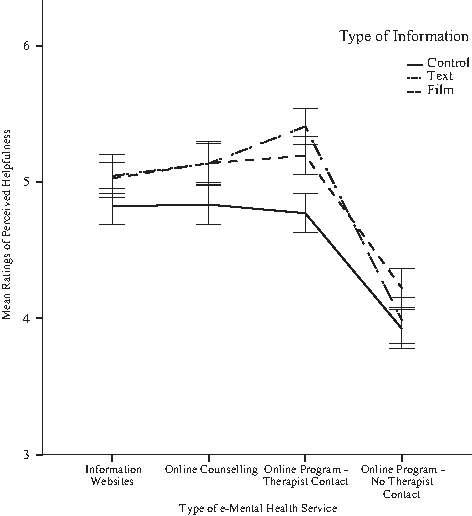
Mean participant ratings of perceived helpfulness of e-mental health services. Error bars represent ±1 standard error of the mean.
Likelihood of future use
A two-way mixed ANOVA was conducted on participants' scores on likelihood of future use of services. Mauchley's test of sphericity was significant (p<0.001) indicating that the assumption of covariance had been violated. As such, a Greenhouse–Geisser correction was made. The main effect of type of e-mental health service was significant (F(2.714, 580.831)=48.946, p<0.001, η2=0.184), as was the main effect of type of information (F(2, 214)=5.280, p=0.006, η2=0.047). The interaction between information and e-mental health service was not significant (F(5.428, 580.831)=1.431, p=0.206, η2=0.011). These effects are displayed in Figure 2.
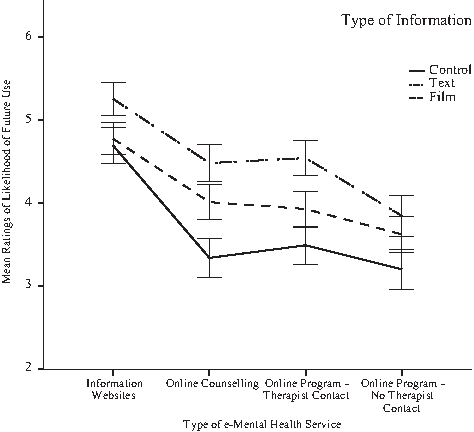
Mean participant ratings of likelihood of future use of e-mental health services. Error bars represent ±1 standard error of the mean.
The main effect of type of e-mental health service was followed up with post hoc main effects comparisons using a Bonferroni correction. Participants reported a significantly greater likelihood of using information Web sites than online counseling services (p<0.001) or programs with (p<0.001) or without (p<0.001) therapist assistance. Furthermore, participants reported a significantly lower likelihood of future use of online programs without therapist assistance compared to information Web sites (p<0.001), online counseling (p=0.003), or online programs with therapist assistance (p=0.002).
The main effect of type of information intervention was also followed up with post hoc main effects comparisons using a Bonferroni correction. Compared to the control group, participants reported significantly greater likelihood of using one of the four e-mental health services when educational information was presented to them in a text format prior to making the rating (p=0.004). No significant differences were found between the text and film groups or film and control groups.
Discussion
This study investigated whether provision of educational service information could improve consumer attitudes toward e-mental health services. The attitudes of interest in this study were perceived helpfulness of services and the reported likelihood of future use.
Findings
The main effects of information upon the perceived helpfulness and likelihood of future use of e-mental health services were examined. It was found that a brief text intervention significantly improved participant ratings of likelihood of future use of e-mental health services but not their view on perceived helpfulness of these services. No effects were found for the film intervention on participant attitudes toward e-mental health services.
Although not of primary focus in this study, differences in attitudes toward the four types of e-mental health services was also examined. It was found that, regardless of information intervention, online programs with no therapist fared worse than other e-mental health services. Participants endorsed lower ratings of perceived helpfulness and likelihood of future use for these programs. These results indicate that e-mental health treatments involving therapist support generate more positive attitudes in consumers than those with a self-directed format, even prior to actual use. Overall, the findings suggest that consumers perceive important differences between e-mental health services.
Limitations and directions for future research
Previous research has suggested that gaining knowledge about mental health services can improve consumer attitudes. 13 It has also been suggested that negative attitudes toward e-mental health services are related to a lack of familiarity with these treatment options.11,13,19,20 The findings of the current study partially support these assertions, as text information was associated with more positive attitudes for e-mental health services. It may be beneficial for future research to examine the efficacy of film information strategies. It is possible that variables such as perceived credibility, authority, or gender of the speaker in the film condition may have influenced the effects of this medium of communication. Such information may prove valuable in the designing of e-mental health Web sites, programs, and advertising.
It is important to note that the mental health status of participants was not measured in the current study. Rather, this study investigated consumer attitudes toward mental health services among a general population/convenience sample. It may be useful to consider that the accessibility of e-mental health services among treatment populations will likely differ in comparison to the sample studied in the present paper. The results of this study may not be representative of those belonging to populations with more limited accessibility to online services and, as such, to the online questionnaire used in the present study. The attitudes of active consumers toward e-mental health services should be a direction of future research. Furthermore, it may be interesting for future research to investigate whether the efficacy of educational interventions varies in accordance with age, gender, or other participant variables. This may be of particular interest given that differences have been found for many of these participant characteristics in relation to general Internet usage.21,22
Conclusion
To the authors' knowledge, the current study is the first to investigate the effectiveness of educational interventions in shaping consumer attitudes toward e-mental health services. E-mental health services have the potential to reduce the unmet mental healthcare needs for many people by overcoming barriers to care such as cost, stigma, and access. Indeed, with a recent study finding that less than 33% of the population's mental healthcare needs are met, 23 strategies to increase the dissemination of psychological interventions are of particular relevance. Consumer attitudes and openness to the use of these services are of great importance, as is the efficacy of educational interventions that may promote uptake of e-mental health services.
In summary, this research examined whether the provision of information relating to e-mental health services could improve consumer attitudes. A simple text intervention was able to improve attitudes toward e-mental health services significantly. Increasing the usage of e-mental health services will be vital in addressing the unmet needs for mental health treatment, and improving attitudes of consumers toward this form of intervention will play an important role in increasing uptake of these services.
Footnotes
Author Disclosure Statement
No competing financial interests exist.