




Abstract
Abstract
Most previous studies assert the negative effect of loneliness on social life and an individual's well-being when individuals use the Internet. To expand this previous research tradition, the current study proposes a model to test whether loneliness has a direct or indirect effect on well-being when mediated by self-disclosure and social support. The results show that loneliness has a direct negative impact on well-being but a positive effect on self-disclosure. While self-disclosure positively influences social support, self-disclosure has no impact on well-being, and social support positively influences well-being. The results also show a full mediation effect of social support in the self-disclosure to well-being link. The results imply that even if lonely people's well-being is poor, their well-being can be enhanced through the use of SNSs, including self-presentation and social support from their friends.
Introduction
The aim of this study was to concentrate on how Internet communication in terms of SNSs changes the well-being of individuals. The Internet has been used as a communication tool. The Internet provides information and a plethora of ways to establish and build relationships with others and help people connect and communicate.12,13 SNSs refer to Web sites that not only display visually articulated lists of one's social connections, but also provide technological features, including public profiles through which users can present themselves to others.3,13 SNSs are used to facilitate studying, forming new relationships, maintaining preexisting personal ties, engaging in self-presentation, looking at photos and user profiles of other people, commenting on messages posted by others, avoiding boredom, passing the time, and procrastinating.1,12,14 These activities help individuals reduce loneliness and accumulate personal social capital, including emotional satisfaction, access to information, increasing one's well-being, and so on.10,15
However, one point worth noting is that associated with studies on social communication is the conceptualization of users' well-being. Some studies have conceptualized well-being as a construct being comprised of various measures, which include an individual's traits such as depression, loneliness, smaller social circles, and overall life satisfaction. 16 In this case, individual characteristics have been conceptualized as a dependent variable. 16 On the other hand, several studies have identified individual traits as a key concept in predicting users' well-being or happiness.14,17 Loneliness is a key construct in predicting well-being and is defined as an unpleasant feeling in which a person feels a strong sense of emptiness, yearning, distress, and solitude resulting from an inadequate quantity or quality of social relationships. 18 Treating loneliness as either a dependent or an independent variable should not be a problem, since authors can approach these topics using different perspectives. However, the effect produced by loneliness—whether it has a positive or negative effect on well-being—has yet to be resolved. In this study, loneliness was treated as an independent variable affecting well-being. To fill the gap found in previous research studies, the research model shown in Figure 1 is proposed.
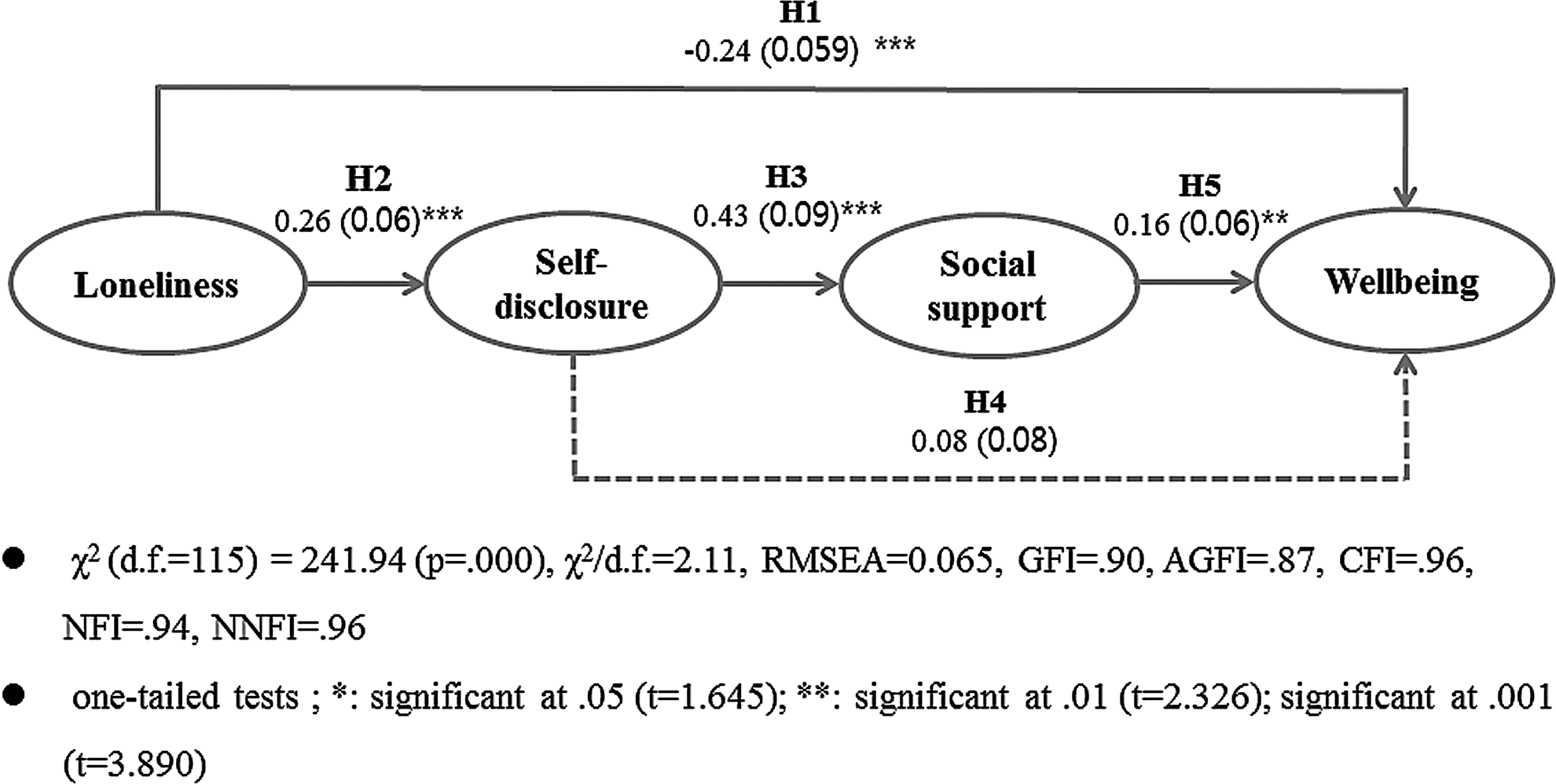
Research model and test results.
Literature Review and Hypotheses
With respect to online interactions, studies have shown that the effect produced by loneliness is inconclusive. Skues et al.
12
attest that lonely students report having more Facebook friends. Ellison et al.
13
show that undergraduate students using Facebook tend to experience higher levels of well-being. However, other researchers suggest that loneliness has a negative impact on well-being.17,19–21 Ceyhan and Ceyhan
19
show that loneliness is associated with problematic use of the Internet. Kim et al.
21
stipulate that lonely people lack social skills, and thus engage in and develop compulsive Internet use behaviors. Displacement theory suggests that the Internet takes away time from the users for social activities and thus replaces social ties, which hinders the well-being of Internet users.6,16,21,22 Accordingly, the following hypothesis is proposed:
Meanwhile, Weiser 23 shows that Internet use driven by communicative use is positively associated with well-being. Stimulation theory suggests that lonely people may engage more in activities provided by the Internet, since the Internet provides an opportunity to gain access to and interact with other individuals online via SNSs. 6 This opportunity increases that individual's well-being. Skues et al. 12 explain this based on social compensation theory, which implies that users use social media to compensate for the lack of offline relationships.
Several empirical studies have shown that loneliness influences well-being indirectly. Kim and Lee 14 demonstrate that (a) the number of Facebook friends has a positive association with well-being; (b) positive self-presentation has a positive effect on well-being; but (c) honest self-presentation indirectly affects well-being mediated by perceived social support. Skues et al. 12 show that loneliness is directly related to an increased number of friends. Lee et al. 10 demonstrate that the time spent on a SNS is not related to well-being; the amount of self-disclosure on SNSs is positively related to well-being. All these results imply that, with respect to the use of social media, the impact of loneliness on well-being is mediated by self-disclosure and/or social support. In other words, unlike the Internet, the mechanism for loneliness influencing well-being may have been changed with the advent and more frequent use of SNSs. In the present study, it is proposed that loneliness may have a positive impact on well-being when mediated by self-disclosure and social support.
One of the distinctive characteristics of SNSs is self-disclosure. Online interactions using SNSs foster more self-disclosure, and a user reveals oneself more compared to face to face interactions. 10 Self-disclosure means communicating personal information, thoughts, and feelings with other people. 24 On SNSs, people have opportunities to engage in self-disclosure using profile construction, status updates, photo management, message posting, replying to messages posted by their friends, and so on. 14 According to Kalpidou et al., 15 people use SNSs to maintain established social capital, rather than developing new relationships. This suggests that people who want their relationships not to be disconnected may engage in self-presentation. The stimulation and social compensation theory implies that the lonelier an individual is, the more he/she is likely to interact with others online via SNSs in order to gain access to and interact with others using the self-disclosing feature. 12 Based on these arguments, the following hypothesis is proposed;
Meanwhile, Gonzales and Hancock 25 put forward the argument that self-disclosure enhances self-esteem. People who tend to disclose themselves on SNSs are interested in bridging, bonding, and maintaining social capital.13,15 One of the resources people accumulate on SNSs is social support. Social support is the cognitive, perceptual, and transactional process of initiating, participating in, and developing online interactions or means of online interactions to seek beneficial outcomes. 26 Valkenburg et al. 27 show that adolescents who use an SNS tend to have more reactions from their friends on their profile. Studies show that people who disclose their identities on their SNSs are more likely to receive social support. In addition, disclosure begets disclosure, such that people who receive intimate disclosures feel obligated to respond with a personal disclosure of equal intimacy. 28 These discussions imply that self-disclosure may be positively associated with social support.
However, with respect to empirical results, the effects produced by self-disclosure are not clear. A few studies show that people who receive higher levels of social support may experience higher levels of well-being.10,14,29 However, Kim and Lee
14
show that honest self-presentation has a positive effect on social support but not on well-being. The results may signify that the effect of self-disclosure on well-being may be mediated by social support. This result implies that people with honest self-presentation have a long term perspective in socializing and want others to support their social identities, which influence well-being. In addition, previous studies have observed that being attached to friends and partners is a source of well-being.14,30 Accordingly, the following two hypotheses are proposed:
Method and Results
Participants
The present study used the questionnaire survey approach to collect data for testing the validity of the model and the hypotheses proposed. We used Facebook users as the most relevant sample. Facebook has achieved dramatic growth as one of the most well-known SNSs in Korea. We collected data from various student groups, including students from graduate courses and undergraduate classes from two major universities in a large southeastern city of South Korea. Participants consisting of 141 female and 124 male students with a mean age of 26.84 (SD=7.70). Most respondents (57.0%) were in their twenties. The vast majority of respondents used Facebook, with 70.9% of them using Facebook more than once a day.
Two tests to examine common method bias were used. First, we performed an exploratory factor analysis by entering all measurement items. The results showed that the largest variance explained by an individual factor was <25%. Podsakoff and Organ claimed that if the variables all load on one factor or one factor explains the majority of the variance, common method variance may be a problem. 31 The results show that neither a single factor nor a general factor accounts for the majority of the covariance in the measures. Second, we performed a confirmatory factor analysis by modeling all items as the indicators of a single factor, and the results show poor fitness. Method biases are assumed to be substantial if the hypothesized model fits the data. 32 The results of both tests indicate that common method bias is not a significant problem for the current study.
Measures
All items used in the present study were adopted from previous studies validated with a pilot test and measured using a seven-point Likert scale ranging from 1=“strongly disagree” to 7=“strongly agree.” Loneliness was measured with five items adopted from Russell's UCLA Loneliness Scale. 33 Self-disclosure adopted the depth of self-disclosure,34–36 and it was measured with three items from Wheeless and Grotz 37 and Leung. 36 Social support was measured with six items used by Shakespeare-Finch and Obst. 38 Well-being was measured with the three items used in previous studies by Lyubomirsky and Lepper. 39 All measurement items and their psychometric properties can be found in Table 1.
Results
A structure equation modeling approach was used. Convergent and discriminant validity of the measures were checked using confirmatory factor analysis provided by the structural equation model in AMOS 7.0. AMOS was used, since it allows the user to test relationships among several concepts, with basic principles that are easy to comprehend and an underlying framework not too different from many other statistical techniques, such as ANOVA or multiple regressions. 40 The convergent validity was checked using loadings, Cronbach's alphas, composite reliability, and variances extracted. 41 Results of the measurement model were acceptable. Compared with the recommended values suggested by Hair et al., 42 most of the fit statistics showed that the measurement model fit well to the data. All the statistics showed that the measures adopted in this study have convergent validity. All factor loadings were >0.4, alphas and composite reliability >0.7, and variances extracted >0.5. Discriminant validity was tested by comparing squared correlations against the extracted variances. All squared correlations were less than the extracted variances. This result implies that the shared variances among variables (squared correlation coefficients) were less than the extracted variances by each construct (extracted variances), verifying discriminant validity.
AMOS 7.0 was adopted to test the hypotheses proposed. As shown in Figure 1, all fit measures had a good fit with the data. The results shown in Figure 1 demonstrate that all hypotheses, with the exception of H4, were supported. As an additional confirmation for testing whether social support mediates the impact of self-disclosure on well-being, a chi square difference test was performed. The chi square value of the research model proposed in the present study (χ2=241.94 with df=115) was compared with the chi square value of the modified model (χ2=240.90 with df=114), in which the path from self-disclosure to well-being is removed. The difference in the chi square values with the difference in degrees of freedom being 1 was not statistically significantly (Δχ2=1.049; p=0.20). Taken together with the nonsignificant path coefficient (β=0.08, p=0.30), no difference in the chi square values implies that the effect of self-disclosure on well-being is fully mediated by social support.
Discussion
Several points are noteworthy. First, loneliness had a negative effect on well-being. This is consistent with most previous studies.21,43 The results imply that lonely people feel lower levels of well-being. Second, loneliness positively influences self-disclosure. Our results imply that lonely people usually lack social skills in an offline context, and rely on SNSs to compensate for their unsuccessful offline relationships.16,17 Third, self-disclosure is positively associated with social support. The results suggest that when lonely people disclose their feelings, mood, and status information, they want their friends to respond and react.27,28 Social response theory says that the responses an individual receives would influence the probability of further advancement of the relationship.44,45 Fourth, social support positively influences well-being. The result implies that the greater the amount of social support received, lonely people feel more increased levels of well-being. Fifth, self-disclosure has no direct effect on well-being. This result is one of the most significant findings in the present study. The result implies that the effect of self-disclosure on well-being is fully mediated by social support. This result is not consistent with previous studies. 14 The results imply that when people use SNSs, they tend to establish strong ties online, and strong ties support high quality friendships and social companionship, which ultimately enhance their well-being. 46
Conclusion
The current study proposed a model to test whether loneliness has a direct or indirect effect on well-being when mediated by self-disclosure and social support. The results imply that even if lonely people feel lower levels of well-being, the well-being of these people can be enhanced by the use of SNSs. The results suggest that when people who are very lonely use SNSs and engage in self-disclosure, they may have opportunities to receive social support from people they already know and accordingly feel increased levels of well-being.
These results have a couple of theoretical implications. First, the results found in the current study suggest the possibility that loneliness may not be an obstacle in building and enhancing well-being. Many studies have suggested that lonely people lack social communication skills and tend to stick to compulsive Internet use, resulting in negative life outcomes.20,21,23,47 Displacement theory suggests that the Internet takes time away from social activity and replaces social ties, which in turn hinders an individual's well-being, that is, increases depression and reduces social circles. 16 Lonely people have a higher preference for online interactions, since they perceive that online communication is relatively less risky and easier than face to face communication, since it has greater anonymity.48–50 The anonymous user feels safer, more efficacious, more confident, and more comfortable with online interactions and relationships than with traditional social activities. 51 However, the present results suggest that lonely people can show feelings, status, and individual information, receive support from their online friends, and feel enhanced well-being. The present results imply that the role of loneliness in previous studies is different. Second, the current study reveals that social support plays an important role between self-disclosure and well-being. Many researchers have demonstrated a positive relationship between self-disclosure and well-being.10,52 However, the current results demonstrate that lonely people engage in SNSs in order to communicate with and receive support from their friends, which ultimately reduce or overcome their feeling of loneliness. This result suggests that self-disclosing itself is not enough. Self-disclosure should accompany reactions and support from their acquaintances in order for the users of SNSs to feel enhanced well-being. The reactions that lonely people experience from their friends within the site are a key mechanism in increasing feelings of well-being.
The results found in this study also have practical implications. First, as societies mature, people are more likely to live alone and marry at later ages. Singles thus feel lonelier.53,54 According to Simenauer and Carroll, 54 loneliness is perceived by singles, especially those who are single by circumstance, as the greatest disadvantage of being single. Behaviors by singles are described as compensating behaviors as they try to cope with loneliness. 53 Singles may seek a completely busy life to compensate for their loneliness. 55 The lack of relationships with friends or family members causes singles to form more intricate casual networks of support in an online environment in order to increase their overall life satisfaction. 56 The present study suggests that interventional treatment may induce lonely individuals or singles to engage in interactions with their friends using SNSs to overcome their feelings of loneliness. Second, marketers from various industries may target these lonely individuals as a potential market. Jacobs et al. 57 suggest that salespeople who encourage customers' social self-disclosure are most likely to develop long-term relationships. Thus, marketers should provide a brand community to help people find others with similar hobbies, post theirs moods and statuses, reply to others' disclosure, and repost others' comments. According to Gupta et al., 58 virtual communities function as potential channels for advertising brand names and promotions, improving store image, product development, gauging demand, and increasing barriers to entry for competitors.
However, the present findings should be interpreted with caution for several reasons. First, the study used a small sized sample for convenience. The respondents did not include people with diverse ranges of age and professions, which might not have represented all users of SNSs. Thus, future studies should include users from diverse backgrounds. Second, the aim of the present study was to investigate the effect produced by loneliness on well-being. Other personality traits and situational variables may moderate the links proposed in the present study. Personality traits and situational variables closely linked to SNSs should be investigated further in future studies. Third, the present study focused on SNS use. However, there are many different points between the Internet and SNS use due to anonymity. Therefore, future studies should compare different effects between Internet use and SNS use. Fourth, the current study measured social support as giving support with one dimension. However, social support has a reciprocal nature, which is reflected in bidirectional support. Future research should measure social support with multidimensional scales.
Footnotes
Acknowledgments
The authors thank the three anonymous reviewers for their helpful comments.
Author Disclosure Statement
No competing financial interests exist.