




Abstract
Abstract
This study examined the factors that influence the intent to seek online counseling among overseas Filipino workers (OFWs). A survey among 365 OFWs revealed that problem severity and technology adoption predict intent to use online counseling. Among the three factors of technology adoption, perceived ease in the use of technology and perceived presence of organization and technological infrastructure to support use predicted intent to use online counseling. Our hypothesis about the presence of interaction between problem severity and facilitating conditions was supported. Among individuals with low problem severity, those who perceive the presence of organization and technological infrastructure to support use have a higher intent to use online counseling. However, at higher levels of problem severity, the effect of facilitating conditions seems to disappear. These findings highlight the crucial role of preventive online mental health services. The study contributes to theory by integrating the stage model of help-seeking behaviors and technology adoption theory in predicting intent to use online counseling. Specifically, that intent to seek online counseling is affected by the existence and perceived gravity of a problem, moderated by technology adoption factors, particularly facilitating conditions. These have implications on the need to educate potential users on the advantages of counseling and ensure that migrant workers have access to technology and that the technology is easy to use.
Introduction
Given the difficulties inherent in migrant labor, providing psychosocial support for workers and their families is important to ensure their wellbeing. However, the greatest difficulty is in reaching workers who are scattered all over the globe. Because of its convenience and its ability to reach people across geographical boundaries, online counseling presents an opportunity to bridge this gap.
Online counseling is defined as “any type of professional therapeutic interaction that makes use of the Internet to connect qualified mental health professionals and their clients,” 5 and can be categorized into three types: (a) information dissemination, (b) peer-delivered support, and (c) professionally delivered treatment. 6 The practice of online counseling is burgeoning especially in the West. 7 However, there is evidence to suggest that Asians are less likely to seek professional help because of the stigma attached to seeking help from others.8,9
In addition, there is a dearth of literature and theories to explain the use of online counseling especially among migrant worker populations. An exploratory study of the viability of online counseling for Filipino migrant workers and their families found that intent to use online counseling is dependent on two broad factors: help-seeking behavior and technology acceptance. 10 This study thus seeks to integrate these two perspectives and empirically test their relationship with the adoption of online counseling.
The stage model of help-seeking behaviors suggests that the help-seeking process generally begins with problem acknowledgement and appraisal. 11 Upon recognizing that they have a problem, individuals make choices about a range of sources of help, whether formal or informal. Using this model, we suggest that intent to use online counseling is predicated first on the existence and perceived gravity of a problem and the perceived need for help. A study by Hechanova, Tuliao, and Ang 12 revealed that OFWs experience a range of concerns that can be classified according to the following themes: marital and relationship, family and parenting, finances, homesickness and loneliness, cultural adjustment, work adjustment, difficulties in relating with government institutions, and interpersonal relationships.
The literature on online counseling has emphasized its help-seeking aspect, but failed to consider its technology component. We argue that, apart from being a process of seeking professional mental health services, online counseling also involves a process of getting acquainted with the concomitant Internet-mediated technology. The Unified Theory on the Acceptance and Use of Technology (UTAUT) 12 describes facets that influence the intention to use technology. Performance expectancy is defined as the belief that a system will increase job productivity and performance. Effort expectancy is the ease associated with using the technology. Social influence is the perception of an individual that significant others believe she or he should use the technology. Lastly, facilitating conditions refer to whether organizational and technical infrastructure exists to support technology use.
Although the above model has not been tested in the context of online counseling, the study of Hechanova, Tuliao, and Ang 10 suggests that although accessibility and the anonymity afforded by the Internet were considered an advantage, the inability to use the Internet was a major barrier to the use of online counseling. Given this, we posit that technology acceptance and adoption will predict intent to seek online counseling. Thus, this study seeks to contribute to the understanding of adoption of online counseling by integrating the stage model of help-seeking behaviors and technology adoption theory in predicting intent to use online counseling. Specifically, we suggest that the decision to seek counseling is affected first by the existence and perceived gravity of a problem but moderated by technology adoption factors. We hypothesize that (a) severity of problems predicts intent to use online counseling; (b) technology adoption, specifically, effort expectancy, social influence, and facilitating conditions, predicts intent to use online counseling; and (c) there is an interaction between problem severity and technology adoption in predicting intent to use online counseling.
Methods
Participants
A total of 365 OFWs (female, 193 [53%]; male, 172 [47%]) were recruited through overseas employment agencies during their predeparture orientations. All respondents had previous work experience as a migrant worker. Participants' age ranged from 17 to 69 years (M=33.14, SD=7.72), and work experience abroad ranged from 1 to 30 years (M=6.19, SD=6.35). Most engaged in blue-collar work (n=240 [66%]), only 10% (n=38) engaged in white-collar or supervisory work, and 24% (n=87) did not report their occupation. Majority were college graduates (n=158 [43%]) or at least had some college education (n=109 [30%]), followed by high school graduates (n=96 [26%]) and postgraduate degrees (n=4 [1%]). Workers have been employed in Southeast and East Asian (n=160 [44%]), Middle Eastern (n=153 [42%]), European and Northern American (n=5 [1%]), African (n=4 [1%]), and Oceania (n=4 [1%]) countries. The rest (n=39 [11%]) did not report their destination countries.
In terms of Internet usage, 290 (80%) report that they use the Internet, whereas 59 (16%) do not use or do not know how to use. Majority reported having Internet connection at work (n=204 [56%]) and their domicile in destination countries (n=179 [49%]), whereas 104 (29%) and 134 (37%) do not have Internet access at their work and home in destination countries, respectively.
Materials and instrumentation
Problem severity and intention to seek counseling
The Intention to Seek Counseling Inventory (ISCI) 13 was revised to measure problem severity and intention to seek online counseling. Because the original ISCI was insufficient to fully encompass the problems presented by the Filipino migrant workers, problems commonly faced by OFWs, such as financial problems, conflicts with spouse and other family members, homesickness, problems at work, and adjusting to a new culture, were included.10,14 Further, problems listed on the ISCI that were not applicable to OFWs, such as speech anxiety, choosing a major, test anxiety, and academic work procrastination, were deleted. To measure perceived severity of the problem, participants were asked to rate how frequently they experience a range of problems, from 1 (never) to 4 (always). For intent to seek online counseling, participants were asked how likely they are to seek online counseling for such problems, from 1 (very unlikely) to 4 (very likely). The coefficient alpha for problem severity was 0.85, and intent to seek online counseling was 0.95.
Acceptance of novel technology
The items used to measure the predictors of intent to use online counseling were lifted from the instrument used by Venkatesh et al. 12 However, we decided to drop one factor—performance expectancy—because the items described the use of technology specifically in relation to one's work, productivity, and career advancement that were not relevant to the study. Other minor revisions were also made, specifically changing the word “system” into “Internet,” and reducing the range of responses from a seven-point scale to a five-point scale (from 1, strongly disagree, to 5, strongly agree). Items for effort expectancy (α=0.77) comprised of questions measuring perceived and actual ease of use, and complexity of the Internet. Items for social influence (α=0.82) describe whether significant others support the use of Internet. Items for facilitating conditions (α=0.70) described the extent to which their organization and bosses provide resources and support for Internet use.
Procedure
After receiving approval of the study from the University Research Committee, a survey was constructed in two languages: English and Filipino. The instruments were pilot-tested and finalized after examining the reliability of the scales. The research team contacted the Philippine Association of Service Exporters to seek their assistance in contacting among migrant workers. The surveys were administered through participating employment agencies.
Results
Problem severity and intent to seek online counseling
Table 1 presents the descriptive statistics and correlational analyses among intent to seek online counseling, problem severity, and predictors of utilization of novel technology. Hierarchical regression analysis was conducted to test the hypothesis that problem severity would predict adoption of online counseling. Before the analysis, predictor variables were first centered (mean scores were subtracted from individual scores) and these centered problem severity scores were multiplied to centered technology adoption scores to create the interaction terms. 15 Centered scores for problem severity was first entered in the regression model (step 1), followed by centered scores for predictors of utilization of novel technology (step 2), and finally by the interaction terms (step 3).
p<0.05; **p<0.01 (Cronbach's alpha).
Results of the hierarchical regression suggest that problem severity is predictive of intent to seek online counseling (β=0.41, p<0.001) and accounts for the greatest variance (R2=0.17). As hypothesized, participants who reported more severe problems have higher intent to seek online counseling (Refer to Table 2).
Technology adoption and intent to seek online counseling
Controlling for problem severity, inclusion of variables associated with adoption of novel technology increased variance accounted for by the regression model by 2%. Results suggest that the perception of ease of use (effort expectancy; β=−0.13, p=0.05) and the perceived presence of organization and technical infrastructure to support use (facilitating conditions; β=0.16, p=0.03) also predicted intent to utilize online counseling.
Interaction of problem severity and facilitating conditions
Our hypothesis about the presence of interaction between problem severity and facilitating conditions was supported (β=−0.16, p=0.05). Our results suggest that, among individuals with low problem severity, those who perceived presence of organization and technological infrastructure to support use have a higher intent to use the platform compared with those without such support. However, at higher levels of problem severity, the effect of facilitating conditions seems to disappear (Fig. 1).
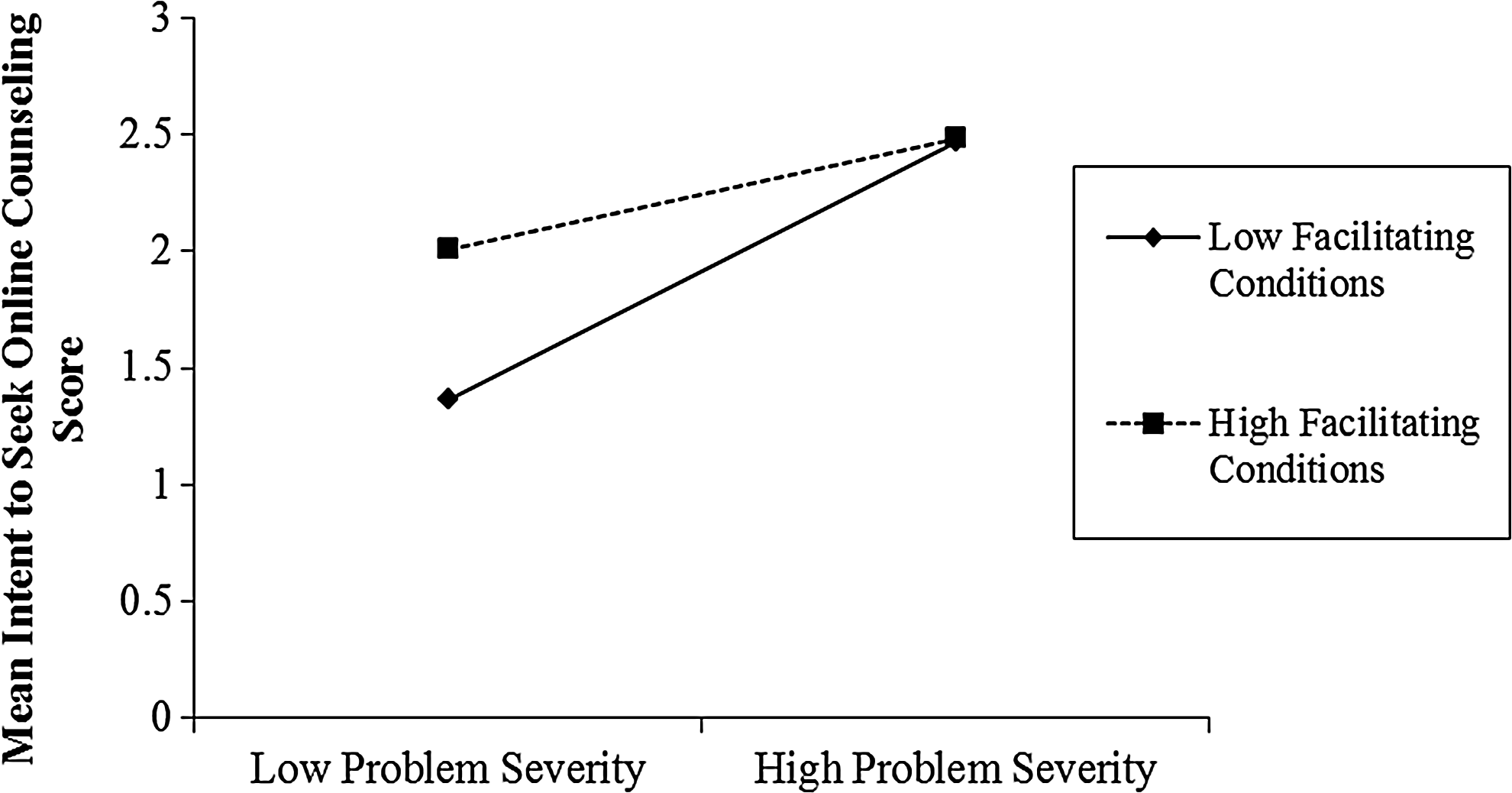
Interaction between problem severity and facilitating conditions in predicting intent to seek online counseling.
Discussion
Problem severity and intent to seek online counseling
The descriptive statistics suggest that the intent to seek online counseling is fairly low, which is not surprising given that findings from previous research that Asians, in general, underutilize mental health services.16,17 In a qualitative study of online counseling adoption, OFWs expressed concerns and questions about the nature of counseling, specifically that those who avail of mental health services are crazy. 10 The reticence may also because of the collectivist nature of Filipinos. In such cultures, family members and friends are seen as the primary sources of social support. 18 Another explanation for the reluctance to seek online counseling may be the Filipino value of hiya, loosely translated as shame. This may inhibit a person from behaving in such a way that might be perceived to tarnish one's dignity or to damage the reputation of one's family. 19 This may lead to a discomfort in discussing one's personal problems with a stranger. 10
Results support the first hypothesis that problem severity predicts the intent to seek online counseling. This validates the stage model of help-seeking behaviors, suggesting that the help seeking process generally begin with problem acknowledgement and appraisal. 11 One implication of these findings is that online counselors servicing OFWs may need to have a greater understanding of sojourner and cross-cultural experiences to make them more equipped to help OFWs.
Technology adoption as a predictor of intent to use online counseling
Our second hypothesis, that technology adoption would predict intent to use online counseling, was partially supported. We used three dimensions from the UTAUT, 12 and results suggest that effort expectancy and facilitating conditions influence intent to seek online counseling. Effort expectancy is the degree of ease associated with using the technology, whether perceived or actual. The implication of this is straightforward—OFWs will adopt online counseling if the technology is easy to use. Another implication of this might be the need to provide Internet training for OFWs.
The other significant predictor of online counseling adoption is facilitating conditions, which refers to the existence of organizational and technical infrastructure supports technology use. However, the results need to be interpreted in light of the interaction between problem severity and facilitating conditions. The interaction between problem severity and facilitating conditions are consistent with the stage model of help seeking, 11 in that perception of problem severity influences OFWs to seek help. In other words, OFWs with more severe problems would seek psychological help from available sources, including online counseling.
An interesting pattern, however, emerges when problems are perceived not as severe; that is, when Internet is easily accessible, individuals with less severe problems would still consider seeking online psychological help compared to those without or with limited Internet access. From a technology acceptance perspective,
12
providing access and eliminating barriers to novel technology use increases the intent and probability of actual use of online counseling despite problem severity. In the study of the website
From the perspective of mental health services utilization, the low intent to seek online counseling for those with no or limited Internet access may parallel the physical barriers to seeking mental health services. Apart from other barriers to seeking psychological help, Leong and Lau 20 suggest that inability to access services because of economic and geographic constraints, as well as the lack of awareness about the available services, hinders Asians from seeking mental health services. Similarly, the lack of Internet access acts as a constraint from accessing online counseling, as well as preventing OFWs of being awareness of the existence of such services. Providing easy access to online counseling may be important from a preventative perspective, especially given that some psychological disorders, such as major depression, are preventable through early intervention. 21
Although the study provides useful insights on the adoption of online counseling among migrant workers, it has its limitations. Although technology acceptance variables were found to be associated with intent to use online counseling, the variance accounted for was not significantly higher than what can be accounted for by problem severity. Furthermore, the variance accounted for by all of the variables in this study was only 20%. The variables in this study may not be sufficient to exhaustively describe the online counseling use among OFWs, and future studies can explore other variables from the counseling and technology acceptance literature.
In this study, online counseling was defined as counseling via Internet. The scale testing the Unified Theory of Adoption of Technology focused on computers as the medium for this. Given the emergence of smart phones, follow-up studies on other online counseling via mobile phones can be investigated. Another limitation of this study is the variable Internet usage among the participants. In particular, only 56% of the respondents have Internet access at work, and 49% in their home in their destination country. This pattern of Internet usage and availability could have an effect on the variables of interest, to which future studies can focus on.
The study also focused on professionally delivered online therapy. Thus, the effectiveness of the use of other forms on online therapy such as information or webinars for migrant workers can be explored in future studies. In addition, as suggested by Fukkink, 22 when trained, peers can provide a variety of social support, including information, tangible assistance, esteem support, access to networks, and emotional support. Hence, peer counseling may be another viable means for providing social support for migrant workers because it may not have the stigma attached to seeing a professional counselor. This is something that can be explored further.
Finally, this sample focused on only Filipino migrant workers. Future studies among other migrant workers are required to examine cultural nuances that may come into play in predicting adoption of online counseling.
Limitations notwithstanding, the main theoretical contribution of this study is the integration of the stage model of help-seeking behaviors and technology adoption theory in predicting intent to use online counseling. Specifically, findings show that the intent to seek online counseling is mainly affected by the existence and perceived gravity of a problem, moderated by technology adoption factors, particularly facilitating conditions. These have implications on the need to educate potential users on the advantages of counseling and ensure that migrant workers have access to technology and that the technology is easy to use.
Footnotes
Acknowledgments
The authors wish to thank the Singapore Internet Research Centre and the Ateneo de Manila University Loyola Schools for their support of this project.
Author Disclosure Statement
No competing financial interests exist.