




Abstract
Abstract
A survey of 2,095 college students in five major cities in China was conducted to examine the influence of personality, parental behaviors, and self-esteem on Internet addiction. We found that psychoticism and neuroticism were both positively related to Internet addiction. The influence of parental behaviors on Internet addition was also significant. However, fathers' and mothers' behaviors had different impacts on their children's likelihood of being addicted to the Internet. Specifically, we found that fathers' rejection and overprotection, and mothers' rejection would increase the risk for Internet addiction. Furthermore, the influence of emotional warmth from parents on Internet addiction was partially mediated by self-esteem. Finally, we found that parental behaviors of mothers and fathers affected males and females differently in terms the risk of being addicted to the Internet.
Introduction
A
Most existing studies on Internet addiction focus primarily on internal and individual factors that may predispose individuals to problematic Internet use. For instance, personality variables such as introversion, psychoticism, and neuroticism are highly associated with Internet addiction. 5 Specifically, individuals with higher negative emotionality and inward thinking are more susceptible to overuse of the Internet. The host of problems associated with Internet addiction, such as antisocial tendencies, social anxiety, and aggression, may in be part traced back to maladaptive personality disorders described in the psychoticism, extraversion, and neuroticism (P-E-N) model.4–7 According to the model, psychoticism is characterized by impulsivity, interpersonal hostility, and sensation seeking. Introverts (the other polar end of extroverts) find less reward around others, have higher levels of social anxiety, and are more inward thinking. Neuroticism is defined as emotional instability and exhibiting negative affect such as depression, jealousy, moodiness, anxiety, and so on.
Bargh et al. suggested that facets of online communication might allow for specialized social control that are not typically found in traditional means of communication, such as one's ability to revise and contemplate before verbalizing, as well as anonymity and lack of social cues. 8 In an exploratory analysis, Petrie and Gunn found that introversion was positively correlated with Internet addiction. 9 Roberts et al. found that shy individuals felt that they were able to create more diverse relationships online than offline. 10 Amichai-Hamburger et al. found that although extroverts may explore the self in both online and traditional interactions, introverts use the Internet primarily for self-exploration. 11 This suggests that introverts may be highly attracted to features of the Internet that improve their social capabilities where they struggle offline.
Similarly, how an individual perceives one's self-worth is also associated with unhealthy levels of Internet use. Individuals with lower self-esteem are also more likely to be identified as Internet addicts.12,13 Similar to an individual's stable personality traits, their perceptions of themselves are also important determinants of Internet addiction. Specifically, self-esteem has received attention from researchers when investigating the causes of Internet addiction. Self-esteem refers to the attitudes a person holds of themselves and their self-worth. 14 Numerous previous studies have indicated that low self-esteem is associated with Internet addiction.12,13,15–18 Individuals with lower self-esteem may find refuge on the Internet because it allows them more control to manage self-presentation and satisfies their need to belong.19,20 Armstrong et al. found that low self-esteem was a good predictor of Internet addiction. 21 However, others have postulated that low self-esteem may be a consequence of Internet addiction (e.g., as a result of social isolation). 22 Although there may be the rationale that self-esteem and Internet addiction is cyclical, 19 it may be that Internet addiction aggravates already lowered self-esteem, as it has been deemed an important focus in the prevention of Internet addiction. 23
Although personality and individual motivational factors have been the focus of most previous research on Internet addiction, there may be a cultural bias toward the individual in the factors associated with Internet addiction. Individualistic cultures often found in the West (e.g., North America, Western Europe, etc.) see the common unit of focus on the individual, whereas collectivist cultures (e.g., Asian cultures) see the common unit of focus on relationships or groups.24,25 Thus, although individual needs and personality may still be important factors predicting Internet addiction, it is equally important to look at the impact of environmental factors, such as parental relationship, for Internet addicts in collectivist cultures. Specifically, problematic family elements may be associated with Internet addiction. There is evidence that in Asian cultures, familial relationships are associated with Internet addiction. For instance, in a Chinese sample, the state of the relationship between the individual and his or her parents may have a bearing on an individual's predilection toward high Internet usage. 26 Other family-related factors such as family cohesion and stability have been shown to play a role in Internet addiction in a Korean sample, suggesting that, especially for adolescents, lacking a supportive and communicative family environment may exacerbate Internet use. 2 Negative parenting style or behavior and familial disturbances play an important role in people being addicted to the Internet. Ko et al. found that the emergence of Internet addiction could be predicted by low family functioning. 12 For instance, results from Park et al.'s study showed that for Koreans, family communication, family cohesion, family violence exposure, and parenting attitudes were associated. 2 Likewise, living in a single-parent family was significantly associated with Internet addiction. 27 Although lacking a parent may have negative consequences for Internet addiction, possibly because of a lack of resources, even within two-parent households, the quality of the relationship between parent and the child is an important factor in Internet addiction. According to Huang et al., children whose parents are overinvolved, rejecting, and display insufficient emotional warmth are more likely to develop Internet addiction disorder. 26 Siomos et al.'s study found that higher parental care and less overprotection were associated with a lower Internet addiction score. 28 Although there is still much debate over whether family stress may promote Internet addiction or whether it is simply a result of Internet addiction, there is ample evidence to suggest that family relationships are important factors to look at beyond individual predispositions such as personality and self-esteem especially.
As the literature suggested, parenting, personality, and self-esteem would be predictive of Internet addiction, informing the following hypotheses:
Method
Participants
A total of 2,397 participants took part in this study. Participants were university students from five major Chinese cities: Xian (n=497), Wuhan (n=470), Nanjing (n=495), Beijing (n=493), and Guangzhou (n=442). In each city, a multistage sampling technique was adopted. First, the researchers randomly selected three universities from an exhaustive list of tertiary institutions. Next, within each selected university, five academic departments were randomly selected. Finally, a list of randomly selected students was picked. The target sample size in each city was 500. Due to an irreversible error during data entry in the city of Nanjing, data from 302 participants had to be removed, leaving a total of 2,095 participants in the further data analyses.
The average age of our sample is 20.35 years old (SD=1.46). A total of 942 participants were male, 1,097 participants were female, and 56 participants did not report their gender. A total of 64.4% of participants reported that they used the Internet at least once a day. The majority of participants (66.4%) spent between 1 and 3 hours online each time they used the Internet.
Key measures
Internet addiction
The degree of Internet addiction was measured by Young's Internet addiction questionnaire. 29 The questionnaire has 20 questions that probe participants' Internet usage (e.g., “How often do you find that you stay online longer than you intended?”). Responses were rated on a 5-point scale ranging from 1=“never” to 5=“always.” The responses were added together to give a total score. The higher the total score, the higher the Internet addiction. The scale has been utilized in previous studies with Chinese participants,27,30 and yielded satisfactory reliability (α=0.70). 30
Parenting behavior
A short form of the Egna Minnenav Barndoms Uppfostran (EMBU) was used to assess parenting behavior. 31 The scale was modified based on the work of Arrindell et al., consisting of 19 items that measure three dimensions, including rejection, overprotection, and emotional warmth. 32 Responses were rated on a 5-point scale ranging from 1=“never” to 5=“always.” Participants were asked to rate their father and mother on each item separately. Summations of specific questions were computed to create a rejection score, an overprotection score, and an emotional warmth score for each parent. Higher scores on a dimension meant higher parental rejection, overprotection, or emotional warmth respectively. All subscales had good internal reliability with Chinese samples (α=0.71–0.80). 33
Personality
The Eysenck Personality Questionnaire (EPQ) was used to assess the participants' personality through four dimensions: extraversion, neuroticism, psychoticism, and predisposition to lie. 6 The questionnaire used contained 85 items with dichotomized (yes/no) responses. Higher scores on a dimension meant higher extraversion, neuroticism, psychoticism, and predisposition to lie. The Chinese version of EPQ had good reliability in a previous study (extraversion: α=0.82; neuroticism: α=0.80; psychoticism: α=0.52; predisposition to lie: α=0.82). 34
Self-esteem
Rosenberg's self-esteem scale was used to measure the participants' self-esteem. 14 This scale consisted of 10 items, which were descriptions concerning one's attitude to the self. Responses were rated on a 5-point scale ranging from 1=“totally agree” to 5=“totally disagree.” Higher scores meant lower self-esteem. A previous study using this scale with Chinese samples had high internal reliability of 0.83. 35
Table 1 provides a summary of descriptive and scale reliability statistics of the aforementioned variables.
Data analyses
In order to test the hypotheses, a hierarchical linear regression model was constructed. In this model, Internet addiction scores were used as the dependent variable. The independent variables were entered in three blocks. In the first block, participants' demographics such as age, gender, family income, parents' education, Internet use frequency, and the average time spent online each time were entered. In the second block, the personality variables (i.e., introversion, neuroticism, psychoticism, and self-esteem) were entered. The goal was to examine the unique and additional influence of participants' personality on Internet addiction after accounting for the demographic factors. Finally, in the third block, the effects of environmental factors, specifically parenting styles, were assessed. Overprotectiveness, rejection, and emotional warmth of each parent were entered into the model as predictors.
All mediation effects in this study were tested by fully identified structural path models using AMOS v20.0. A structural equation modeling (SEM) approach to mediation analysis was preferable to a multiple regression approach for several reasons.36,37 First, SEM allows researchers to test the predicted model together as a whole, as well as to examine each of the path coefficients individually. Second, it enables the testing of multiple dependent and mediating variables simultaneously. Third, unlike multiple regression analyses, SEM does not ignore intercorrelations among criterion variables or measurement errors associated with each variable. Finally, when the sample size is sufficient (i.e., n>200), the maximum likelihood (ML) estimation of coefficients used in SEM allows for more flexible assumptions (such as allowing ordinal data and multicollinearity) than the least square (LS) estimation method used in multiple regression analyses. 37
Results
A simple bivariate correlation test was first performed. A summary of the result is displayed in Table 2. Table 3 presents the results from testing the hierarchical regression model.
Note. **p<0.01.
Note. *p<0.05; **p<0.01; ***p<0.001.
As can be seen, participants' ages were predictive of Internet addiction. Older participants in our sample and male participants were more likely to report more severe symptoms of Internet addiction. Those who used the Internet more frequently were less likely to be addicted to the Internet, but those who spent a longer time online each time when they use the Internet were more likely to be addicted. Duration may be a better marker than frequency for Internet addiction. The demographic and Internet use variables accounted for about 12% of the variance in Internet addiction scores. Neuroticism and psychoticism were both positively related to Internet addiction, but introversion was not. Thus, H1 was only partially supported. Low self-esteem was positively related to Internet addiction in line with H4's predictions of self-esteem and Internet addiction. Overall, the personality and disposition factors explained an additional 10.7% of the variance in Internet addiction.
The overprotection and rejection of the father were significant predictors of Internet addiction, but the father's emotional warmth was not. As for the influence from the mother's behavior, only rejection was positively related to Internet addiction, supporting H2. Together, the parental style variables accounted for 14% of the variance in Internet addiction. The overall regression model successfully explained 36.8% of the variance in Internet addiction.
Additional analyses
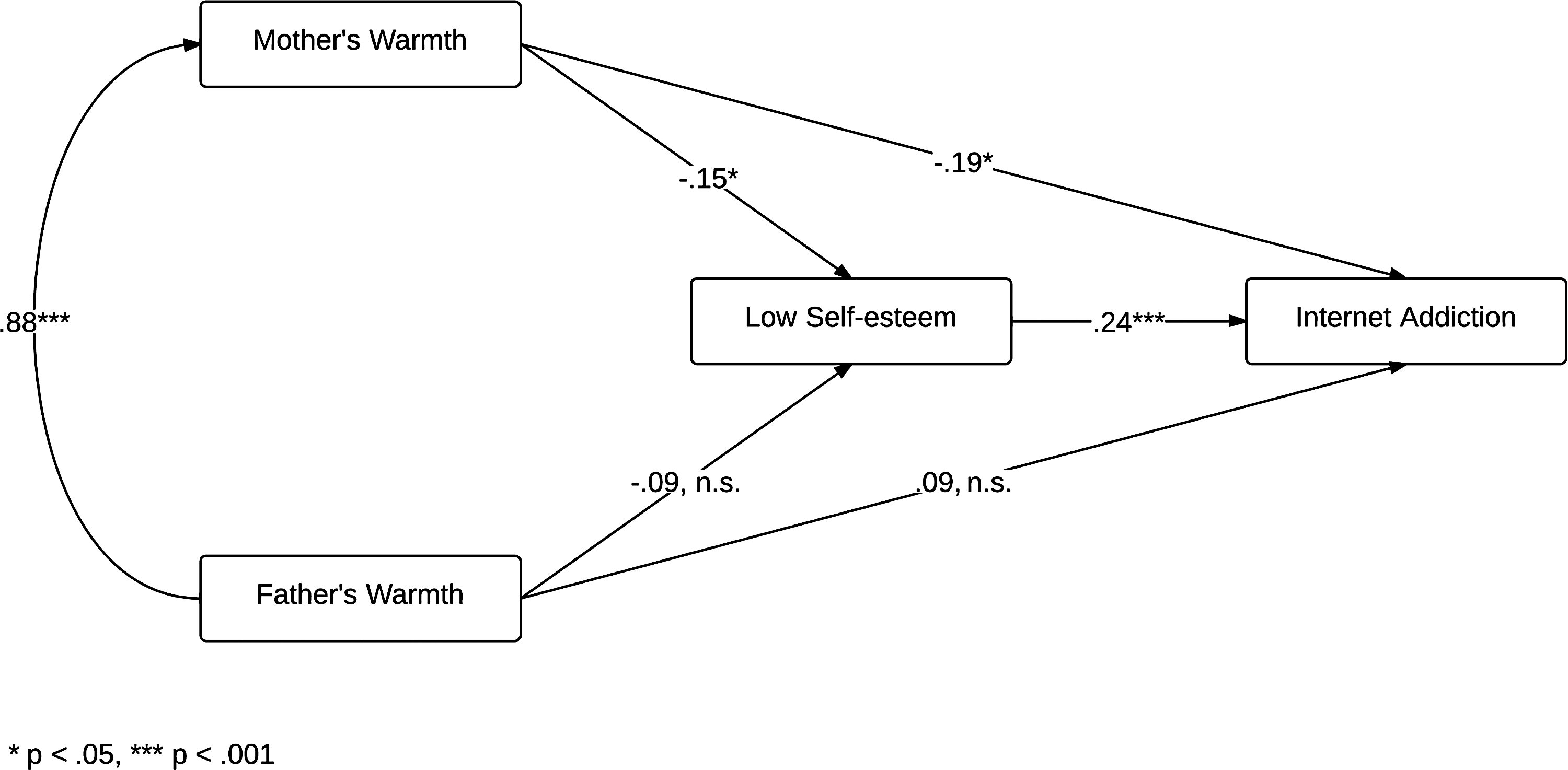
While the regression model seemed to yield some interesting results, the findings were mixed. As such, a series of additional analyses were conducted to parse further out the effects of personality and parental style on Internet addiction. We originally hypothesized that parents' emotional warmth would be negatively related to Internet addiction, but this effect was not significant in the regression model. However, the relationships between parental warmth and Internet addiction, as predicted, were significant at the bivariate level. Furthermore, we found that parental warmth was negatively related to low self-esteem. Therefore, the effects of parental warmth might have been mediated by self-esteem. As such, we tested a mediation path model in which self-esteem was a mediator between parental warmth and Internet addiction (see Fig. 1). The mediation model was tested in AMOS v20.0. The results of this analysis show that the father's emotional warmth was fully mediated by self-esteem. However, the mother's warmth had a direct negative impact on Internet addiction after controlling for self-esteem. H3 was partially supported.

Path analysis of the mediation effect of low self-esteem on Internet addiction.
The effects of gender were further explored. Specifically, we wanted to know if the effects of personality and parental behaviors on Internet addiction were the same for males and females. To address this question, we first tested the hierarchical regression model separately for males and females. The results are shown in Tables 4 and 5. As can be seen, while the effects of personality and Internet use were similar, the influence of parental behavior was different for each gender. Specifically, the father's rejection had a significant influence on Internet addiction but only for females, but the father's overprotection and the mother's rejection only affected males.
Note. *p<0.05; **p<0.01; ***p<0.001.
Note. **p<0.01; ***p<0.001.
Finally, we tested the influence of gender on the mediation effect of self-esteem between parental warmth and Internet addiction. The results are shown in Figures 2 and 3. Interestingly, the mother's emotional warmth reduced the likelihood of Internet addiction among males, even when the mediation effect of self-esteem was controlled for. However, for females, only the influence of the father's emotional support on Internet addiction was mediated by self-esteem.
Path analysis of the mediation effect of low self-esteem on Internet addiction for females.

Path analysis of the mediation effect of low self-esteem on Internet addiction for females.
Discussion
The present study aims to examine the influence of dispositional factors, such as personality and self-esteem, and environmental factors, such as parents' behavior, on Internet addiction. A number of interesting results emerged from our study. First, we found that psychoticism and neuroticism both positively related to Internet addiction. This finding is consistent with previous research, suggesting that individuals with impulse control and emotional instability issues may be more susceptible to problematic Internet use. The expected influence from extroversion/introversion Internet addiction was not found. Although this finding is inconsistent with some earlier research, 9 it is not surprising. The IAT by Kimberly Young was developed in the late 1990s, before the rise of social networking sites. Rapid diffusion of social media enabled by Web 2.0 has completely redefined what it means to be on the Internet since 2005. The earlier assumption that shyer individuals would be more likely to engage in online social activities than extroverts and therefore would be more likely to be addicted to the Internet might no longer be valid today because online social interactions are becoming a norm for both introverts and extraverts.
The roles of parental behaviors on Internet addition are worth noting. We found that fathers' and mothers' behaviors had different impacts on their children's likelihood of being addicted to the Internet. Specifically, we found that the father's rejection and overprotection, and the mother's rejection would increase the risk for Internet addiction. Furthermore, the influence of emotional warmth from parents on problematic Internet use was partially mediated by self-esteem, such that emotional support from both parents would increase their children's self-esteem and in turn would reduce their risk of being addicted to the Internet.
The most interesting finding regarding parental behavior was that parenting had different effects on males and females in terms the risk of being addicted to the Internet. The father's rejection would have a stronger influence on females than on males, but the mother's rejection would only impact males. The father's overprotection is more damaging to males, but the father's rejection is more damaging to females. Because this is one of the first studies on Internet addiction that has differentiated fathers' and mothers' parenting styles, we should not overinterpret these findings. However, the pattern of influence would certainly generate interesting research questions, perhaps from the psychoanalytical and/or developmental perspective, for future research.
An unexpected and counterintuitive relationship between frequency of Internet use and Internet addition was found in our study. We found that those users who went online multiple times per day were less likely to be addicted to the Internet than others. This finding can be interpreted in several ways. First, those who go online multiple times in a short period of time might engage in different online activities (e.g., checking e-mail, updating their status on SNS, or micro blogging) from those who stay online for long periods of times (e.g., playing video games, online gambling, shopping, etc.). The “addictive” nature of these activities would likely be different. Second, users who frequently use the Internet would likely have easier access to the medium than those who use the medium less frequently. As such, they might be less psychologically attached to the Internet, since it is always available to them. Future research should explore these possibilities further. Lastly, our results suggest that duration is an important key in Internet addiction. Spending longer periods of time on the Internet allows individuals to explore and connect online more deeply. This duration may have stronger effects on psychological engagement and motivation.
Footnotes
Acknowledgment
This project was supported by a research grant from the China Youth University for Political Science (No. 18902051001)
Author Disclosure Statement
No competing financial interests exist.