




Abstract
Abstract
The eye movements and penile responses of 20 male participants were recorded while they were immersed with virtual sexual stimuli. These participants were divided into two groups according to their capacity to focus their attention in immersion (high and low focus). In order to understand sexual self-regulation better, we subjected participants to three experimental conditions: (a) immersion with a preferred sexual stimulus, without sexual inhibition; (b) immersion with a preferred sexual stimulus, with sexual inhibition; and (c) immersion with a neutral stimulus. A significant difference was observed between the effects of each condition on erectile response and scanpath. The groups differed on self-regulation of their erectile responses and on their scanpath patterns. High focus participants had more difficulties than low focus participants with inhibiting their sexual responses and displayed less scattered eye movement trajectories over the critical areas of the virtual sexual stimuli. Results are interpreted in terms of sexual self-regulation and cognitive absorption in virtual immersion. In addition, the use of validated virtual sexual stimuli is presented as a methodological improvement over static and moving pictures, since it paves the way for the study of the role of social interaction in an ecologically valid and well-controlled way.
Introduction
Sexual self-regulation
S
As a dynamic regulation process conducted over time and in different contexts, SSR takes effect through the modulation of attention and perceptual motor processes.1,10,11 Sexual self-regulation explains the dynamic variations in intentionality that in turn reflect the existing hierarchical relations between sexual motivation, inhibition processes, sexual arousal, and the sexual act as such.6,11
Eye movement and sexuality
Even though the study of eye movement has been used in research for more than a century, 12 its use in sexuality research has only gained popularity in the last decade. Some researchers using eye tracking technologies have studied heterosexual males' visual attention while viewing sexual images and found that males focused longer on preferred sexual stimuli than on nonpreferred sexual stimuli.13,14 Other studies have demonstrated that males' visual attention focused more on females' reproductive body parts15–18 or face 19 than nonerogenous bodily regions.
Some researchers have also used eye tracking devices with forensic populations to assess eye movements associated with sexual attraction to prepubescent individuals.13,20–25 Results from these studies show that ocular indicators provide valuable information on the presence of sexual interest and allow researchers to distinguish men with sexual interest in children from men with nondeviant sexual interest.
In addition, the use of eye tracking during sexual preference assessments may provide valuable information on the presence of cognitive content previously shown to be implicated in sexual preferences or inhibition.26–29 In a recent study, Hall et al. 30 studied the role of cognitions in influencing gaze strategies in men. Their results suggest that gaze pattern is partially driven by the observer's cognitions, including sexual preferences.
Some studies using distraction and diversion of attention have highlighted the importance of internal processes and cognitive strategies in achieving erectile control.4,5,26–29,31 In these studies, men were instructed to either achieve or inhibit their erection only by using mental processes. It was shown that by using cognitive strategies such as fantasizing, mental imagery, or distracting thoughts, men were successful in both achieving and suppressing sexual arousal. Such results reflect the importance of information processing, and not just visual attention, as an integral part of SSR.
Cognitive absorption
Cognitive absorption can be defined as a high propensity to engage in events with total attention, where the object of attention consumes all the individual's resources.32,33 In a factor analysis of the dimensionality of the immersive tendencies, Weibel et al. 34 found two emerging factors—emotional involvement and absorption (Immersive Tendencies Questionnaire). 35 Absorption refers to focusing attention, losing track of time perception during immersion, and getting involved in games. Results from Macedonio et al. 36 point to the role of immersiveness and hypnotisability in physiological arousal. The Immersive Tendencies Questionnaire as designed by Witmer and Singer 35 is based on three subdimensions—focus, involvement, and games. In the Immersive Tendencies Questionnaire, focus is measured using eight items, such as “Do you easily become deeply involved in movies or TV dramas?” and “How well do you concentrate on enjoyable activities?”
Goals of the study and hypotheses
The first objective of the study is to test the perceptual–motor correlates of SSR in a sexual arousal inhibition task performed in virtual immersion. The second objective is to compare low and high focus individuals on their performance in inhibiting their sexual arousal response when immersed with virtual sexual stimuli. We hypothesized that eye movements recorded while participants used a cognitive strategy to suppress penile tumescence to a preferred sexual stimulus would differ significantly from eye movements recorded while participants viewed the same stimulus without erectile inhibition or viewed a sexually neutral stimulus. We also hypothesized that low and high focus individuals would differ on their sexual arousal responses and on their eye movements when asked to suppress their penile tumescence.
Methods
Participants
Twenty-four adult males volunteered to participate in the study. Subjects were recruited via classified ads placed in newspapers distributed across the Montreal metropolitan area. To partake in the experiment, these individuals had to be healthy, have no criminal record, and declare they had never harbored deviant sexual interests or displayed deviant sexual behaviors. Subjects had to identify themselves as either heterosexual or homosexual. Sexual orientation was assessed using the Kinsey Scale, 37 and only participants reporting an exclusive or predominant sexual interest were accepted (scores 0, 1, 5, and 6 on the Kinsey scale). Three participants disclosed a sexual orientation toward men. Exclusion criteria included epileptic seizures, migraines, or medical conditions affecting balance, intellectual disability, strabismus, alcohol or drug abuse, and previous psychotic episodes. Due to these conditions, four participants had to be excluded from the study, bringing our sample to 20 subjects with an average age of 36.85 years (SD=10.34).
Material
Stimuli
The stimuli were computer generated 3D virtual characters (CGC) depicting realistic naked human beings. They were designed, developed, and validated to simulate the Caucasian mesomorphic body type according to Tanner's developmental criteria.11,31,38,39 As part of a larger research project, a total of five CGCs were presented: (1) an adult male and (2) an adult female character having completed all five of Tanner's stages of development (22–25 years old); (3) a prepubescent male and (4) a prepubescent female character at the end of Tanner's first stage of development (10–12 years old); and (5) a neutral stimulus, that is, a CGC without texture. For the purpose of the present study, only the adult and the neutral characters were kept in the experimental protocol. These characters were animated to simulate a neutral emotional attitude and subtle body movements (head movements, eye blinking, slight rotation of the torso, etc.) and were each presented for 90 seconds.
Penile plethysmography
Penile plethysmography (PPG) measures blood flow variations in the penis during sexual arousal through a mercury-in-rubber strain gauge. Blood flow variations in the penile shaft prompt variations in the electrical conductance of the mercury. These modifications are converted via polygraph (Limestone Technologies, DataPacUSM 16 bit acquisition instrument) and recorded through specific software (Limestone Technologies, PrefTest Professional Suite Software). Scores for erectile responses were obtained by calculating the difference between the highest value obtained while a stimulus was present and the lowest value from the start of the same trial.
Virtual reality and eye tracking system
This project required the use of a head-mounted virtual reality display comprised of a motion tracking system and an infrared camera (NVis, NVisor SX model). While the motion tracking system constantly adjusted the image in accordance with participants' body positioning and head movements, the built-in eye tracking device provided gaze direction analyses. Participants' eye movements were recorded while they scanned the virtual environment and extracted information on stimulus characteristics. Raw data pertaining to eye movements were first processed by ASL Eye-Trac 6—EyeNal Analysis Software and subsequently integrated into a PASW Statistic 17 database for analysis.
Procedure
After arriving at the Virtual Reality Applications in Forensic Psychiatry laboratory at the Philippe-Pinel Institute in Montreal, participants were briefed on the purpose of the study and received a detailed description of the assessment process and methods used to record their physiological reactions. After signing the consent form and taking part in a 20 minute semi-structured interview, participants completed the French version of the Immersive Tendencies Questionnaire.35,40 They were then set up with the head-mounted display and left alone. The experimenter moved to an adjacent room to monitor the progress of the experiment. The two rooms were linked by an intercom system allowing two-way communication throughout the assessment procedure.
Participants were then asked to put a penile gauge into place according to the standard practice in penile plethysmography, that is, around the middle part of the penis. A 120-second habituation period was given, during which the erectile baseline was recorded, and then subjects were presented with a 9-fixation-point calibration screen, which allowed the experimenter to adjust the infrared ocular tracking system for gaze direction monitoring. To ensure methodological control throughout the procedure and across participants, a fixation cross appeared in the middle of the screen before each trial. When participant's gaze was on the cross, the experimenter started the trial. The cross also allowed for the identification and correction of any calibration issues and made sure that all participants were looking at same spot at the start of trials. A return to erectile baseline was also required before any stimuli were presented. Throughout the procedure, participants were asked to keep their gaze on the CGCs at all times. The experimenter closely monitored participants' gaze throughout the procedure to ensure it remained on the CGCs at all times.
Three different sets of instructions were successively given to participants throughout the experimental procedure. First, participants were instructed to explore the stimuli freely and allow their physiological responses to occur naturally. The experimenter then presented the five CGCs in their predetermined order. After all the CGCs were presented, participants received a second set of instructions. They were told they would be shown an aversive image, which they were asked to memorize, as they would be using it in the next phase of the experiment. This negative valence image (disgust) of moderate intensity was selected from the International Affective Picture System, 41 a standardized set of emotionally evocative stimuli widely used in the study of human emotions. The image was a picture of a severely filthy and unsanitary public washroom. The experimenter then presented the aversive image for 30 seconds. Subjects were instructed to use the image they had just memorized as a cognitive strategy to suppress their erectile responses to the subsequent stimulus. In other words, participants were instructed to suppress their erection by constantly reminding themselves of the disgusting components of the image they had memorized. Participants were also reminded to keep their eyes on the sexual stimulus presented to them. The experimenter then proceeded to present the CGC corresponding to the individual's declared sexual orientation while his physiological responses were recorded.
Before leaving the laboratory, participants were debriefed and screened for cybersickness symptoms. Data collected for this study were compiled as part of a larger study that explored the combined use of computer generated stimuli presented in a virtual environment, eye tracking devices, and PPG for sexual interest assessment. Other measurements were explored, some of which are presented in Trottier et al. 31 The entire procedure lasted approximately 60 minutes, and at the end, participants received monetary compensation.
Eye movement variables
Specific information on the sequence by which each stimulus was explored was obtained through ocular trajectory analysis. This procedure requires that areas of interest be identified to produce area-specific data and determine the manner in which fixations transition from one zone to another. In this case, five areas of interest were identified. Four represented areas on the stimulus (head, breasts, genitalia, and feet), and one represented the virtual environment encompassing the stimulus (see Fig. 1). The areas of interest were drawn to be larger than the character in order to include the slight movements performed by the animated stimulus during the 90-second presentation.
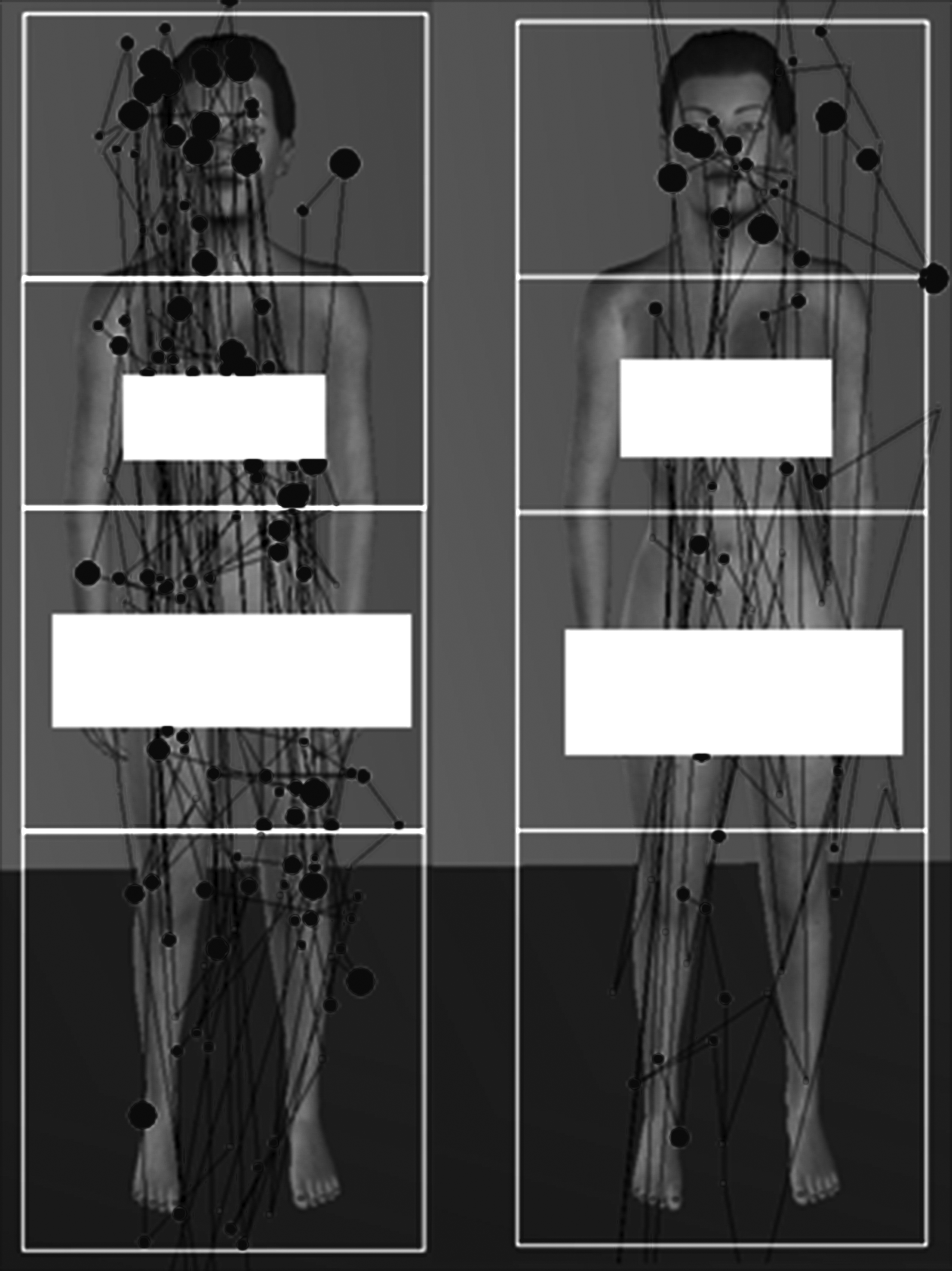
Scanpath comparison between the no inhibition condition (left) and the inhibition condition (right) for one participant.
Three ocular trajectory variables were examined— the number of transitions in the genital zone, the number of transitions from the genital zone to the foot zone, and the total dwelling time in the genital zone. The number of transitions in the genital zone is equivalent to the exact number of consecutive fixations on the erogenous zone before transitioning to another zone. The transitions from the genital zone to the feet represent the exact number of times an individual's gaze went from the genital zone and transitioned directly to the foot zone. Total dwelling time in the genital zone is the total time the individual's gaze scrutinized this area during a trial.
Data analysis
For this study, three sexual self-regulation conditions were compared. The first condition was the viewing of a sexually neutral stimulus (“neutral”). For this condition, participants were instructed to explore the neutral stimulus freely, and their physiological responses were analyzed. The second condition was the viewing of a preferred sexual stimulus without sexual inhibition (“no inhibition”). For this condition, participants were instructed to explore the virtual character corresponding to their sexual orientation freely, and their physiological responses were analyzed. The third condition was the inhibition of erectile response to the preferred sexual stimulus (“inhibition”). For this condition, participants were instructed to inhibit their erectile response to the adult character corresponding to their disclosed sexual preference, and their physiological responses were analyzed.
In addition, the sample of participants was split in two to form a low focus group (LF) and a high focus (HF) group. This was done using the median of the scores obtained from the focus scale on the Immersive Tendencies Questionnaire 35 (LF: M=22.7, SD=2.1; HF: M=29.8, SD=2,9; t(18)=− 6.26, p=0.000).
Statistical analysis consisted of a repeated measures multivariate analysis of covariance (MANCOVA) to determine the effect of SSR conditions (three levels: neutral, no inhibition, and inhibition) and the effect of groups (LF and HF) on four dependent variables: erectile response, total dwelling time in the genital zone, the number of consecutive transitions in the genital zone, and the number of consecutive transitions from the genital to the foot zone. The score obtained on the involvement scale of the Immersive Tendencies Questionnaire was used as a covariate. A MANCOVA was favored over a series of analyses of variance because more than one potentially correlated dependent variable was used, and because it was necessary to control the concomitant effect of involvement in modulating sexual arousal.
Results
The MANCOVA yielded no significant principal effects for both SSR conditions—F(8, 10)=1.38, p=0.310, Λ=0.475—and groups—F(4, 14)=1.22, p=0.346, Λ=0.741. However, a significant omnibus interaction effect between SSR conditions and groups was found—F(8, 10)=3.80, p=0.026, Λ=0.248—with a strong effect size (partial η2=0.752). Because of the significance of this interaction, we can further explore SSR conditions and group effects. 42
A series of within-subjects pairwise comparisons shows us that SSR conditions differed significantly for two of the dependent variables—PPG and the number of transitions in the genital zone (see Table 1). More precisely, erectile responses were significantly stronger with the no inhibition condition than the neutral and inhibition conditions (see Fig. 2a). These PPG results were required to confirm the validity of the experimental procedure in this study. First, they show that immersion with the virtual sexual characters is indeed sexually arousing. Second, they attest to the effect of the experimental manipulation, which required participants to inhibit their sexual arousal using an aversive mental image. While the total dwelling time in the genital zone and the number of transitions from the genital to the foot zone did not significantly differ (although it was quite close), the number of transitions in the genital zone differed significantly from one condition to another (see Fig. 2b and c and Table 1). The inhibition condition had the lowest number of eye movement transitions in the genital zone, significantly less than the neutral and the no inhibition conditions (see Fig. 2d). It appears that mentally self-regulating sexual arousal corresponds to a specific way of processing sexual information—it is possible that participants may not be processing as much critical sexual information at the perceptual level.
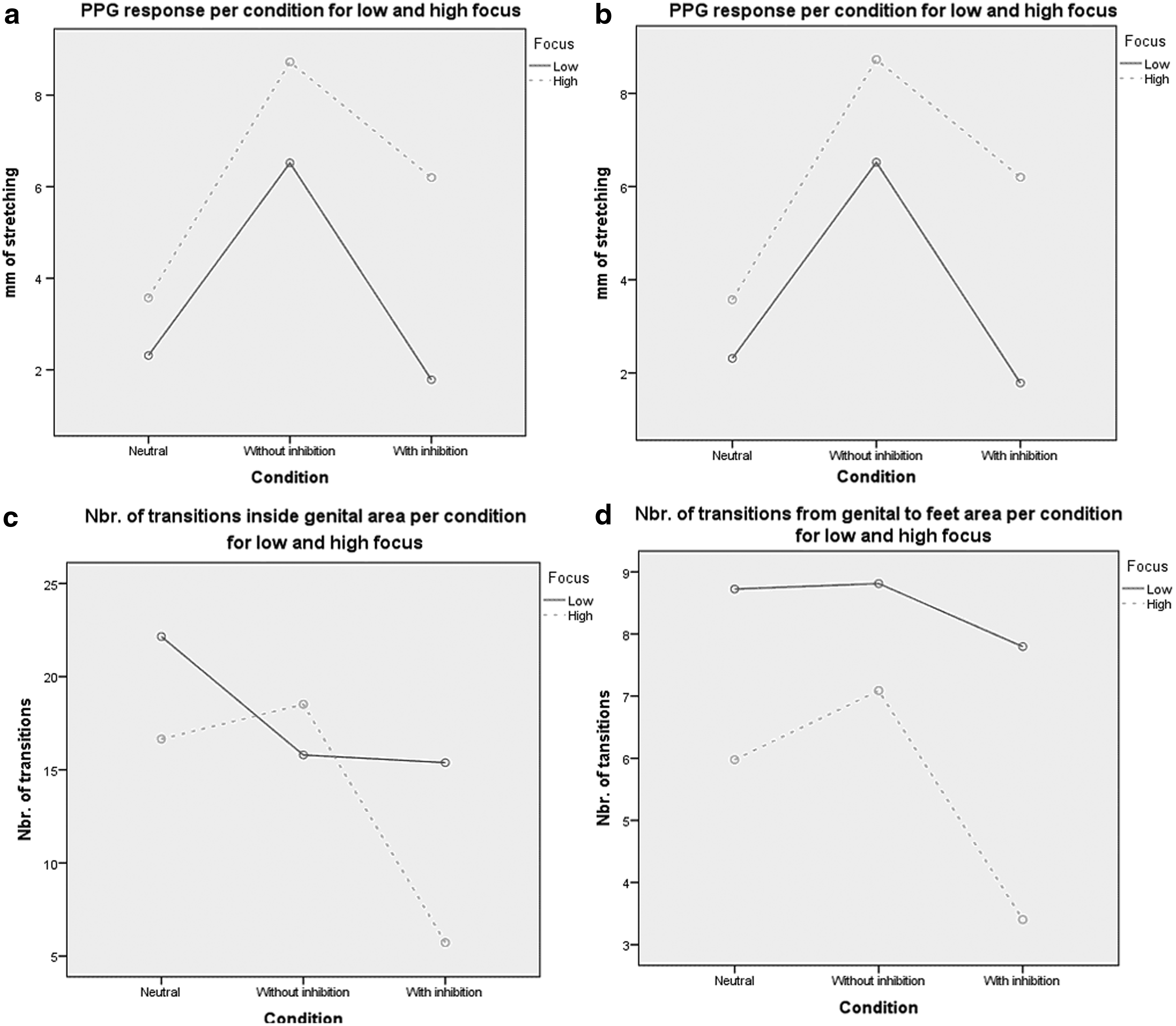
Group effects were tested using a series of analyses of covariance (ANCOVA), again with the involvement score as a covariate (see Table 2). From Figure 2a, it can be seen that the HF group showed overall stronger erectile responses compared to the LF group. However, this difference is significant only for the inhibition condition. It seems that HF participants were more cognitively absorbed in the sexual stimulus, to such an extent that they were less efficient in self-regulating their sexual arousal for the inhibition condition. The cognitive absorption of the HF group leads to distinct scanpath profiles, as shown in Figure 2b–d. A closer look at Table 2 shows us that these profile differences are only significant for the inhibition condition with the total dwelling time in the genital zone, the number of transitions in the genital zone, and the number of transitions from this zone to the feet. The LF group was significantly more active than the HF group in the genital zone, spending more time in it, but at the same time departing more frequently to a less critical zone—the feet.
Discussion
At the outset, it was predicted that eye movement recorded while participants were using a cognitive strategy to inhibit sexual responses to a preferred sexual stimulus would differ significantly from eye movement recorded while participants did not use such a strategy and watched a sexually preferred stimulus or a sexually neutral stimulus. The results obtained partially corroborate this hypothesis. It seems that the SSR involved in the inhibition of sexual arousal requires the modulation of attention and perceptual motor processes.1,10,11 This modulation specifically limits visual exploration of the critical features of the virtual sexual stimulus—its genital area. In the inhibition condition, this may reflect conflicts in the parallel processing of automatic sexual responses and controlled inhibition processes. 31 In contrast, the no inhibition condition allowed overt attention processes to take place freely and automatically, since no distracting cognitive content was present. This resulted in a more active visual exploration of the salient features of the sexual stimulus, leading in turn to a stronger erectile response.11,43–45
Our second hypothesis was that there would be profile differences between LF and HF individuals, and especially that they would differ in their sexual arousal responses and their eye movements when asked to suppress their sexual arousal voluntarily using a mental strategy. Compared to the LF participants, participants in the HF group were less effective in using the SSR strategy; that is, voluntarily using an aversive image to fight the automatic sexual arousal responses prompted by the virtual sexual stimulus in front of them. Paradoxically, while they were more aroused sexually than the LF participants, the HF participants were less active at the perceptual motor level for the critical features of the sexual stimulus. In fact, they spent less time scrutinizing the genital area of the character and were less involved in extracting perceptual features at that level. However, at the same time, their gaze departed less often from the genital zone toward a less critical zone—the feet of the virtual character. From these observations, it may be conjectured that the HF participants were more cognitively absorbed in sexual fantasies brought about by the immersive sexual context. Because they were mostly covertly struggling against fantasy-driven automatic sexual impulses, they used dynamic overt avoidance less efficiently than the LF participants did. In that sense, the cognitive absorption trait might well play a modulating role in the exertion of SSR processes.
We have identified the following methodological limitations to our study. First, the sample size for this exploratory study was small and would need to be increased in order to confirm the results. Second, only one computer-generated stimulus per condition was used during experimentation. At least two stimuli per condition are recommended for PPG assessments 46 and should be used in future studies. Third, to ensure better experimental control, it was decided to provide participants with a cognitive strategy—mental imagery with aversive content. Future studies would benefit from comparing different inhibition strategies, which they could do by providing participants with simple inhibition instructions and seeing if they obtained comparable results. Fourth, it was decided that the order of conditions would remain unchanged throughout the testing process in order to prevent participants from learning an inhibition strategy, which would impact the remainder of the experiment. The lack of counterbalancing implies the possible influence of a confounding factor—the order of presentation—on our results. Future studies should counterbalance condition order to account for any impact it might have on the results.
To conclude on a more practical note, although more research is needed, eye tracking devices could be used to improve the internal validity of forensic PPG procedures, since they can identify sexual interests and the presence of cognitive strategies for erectile inhibition. 31 In the future, this kind of methodology could be used with neurofeedback and real time brain–computer interfaces to develop new treatments for deviant sexual behavior in the emerging field of neurorehabilitation of problematic SSR.47–50 For these reasons, it appears that the use of virtual sexual stimuli represents an improvement over static or even moving pictures.
Footnotes
Author Disclosure Statement
The first author has a financial interest in BéhaVR Solution as president of this company. No competing financial interests exist for the other authors.