




Abstract
Abstract
Healthy emotion regulation is crucial for navigating stressful situations. Interoceptive awareness—the awareness of one's internal states—is important for such healthy regulation. Given the propensity for video games to induce stress, the associations between in-game and real world emotion regulation strategies during duress are worth exploring. We therefore present a method for measuring the interoceptive awareness of negative affect during stressful video game play, and investigate whether individual differences in this ability relate to emotion regulation strategies. Twenty-six proficient video game players were recruited to play a session of the video game Starcraft II in the lab. Players' physiological and subjective states of in-game negative arousal were measured consecutively. A comparison of these measures was used to calculate players' interoceptive awareness of real time in-game arousal. The relation between interoceptive awareness and a suite of emotion regulation strategies was then investigated. We observed a positive relation between in-game interoceptive awareness and the self-reported tendency to actively seek a resolution to negative affect. A positive trend was also observed between interoceptive awareness and the self-reported tendency to seek instrumental social support. Findings are discussed in terms of the relative effectiveness of different emotion regulation strategies for aiding in-game success. We further discuss the benefits and limitations of this pilot testing. In all, we hope to inspire future research into the associations between in-game arousal and emotion regulation strategies used in everyday life.
Introduction
V
The present study builds upon the emotion regulation benefits of interoceptive awareness. Interoceptive awareness describes how aware one is of his or her internal physiological state. 6 Greater interoceptive awareness provides better awareness of internal emotional states because physiological sensations mark, and perhaps underlie, the experience of emotion.7,8 Thus, heightened emotional awareness allows for more effective emotion regulation.9,10 For instance, when asked to observe emotionally evocative stimuli, individuals trained to be more aware of their internal states showed, compared to control subjects, greater consistency between self-reported and physiological indicators of affect. 8 Interoceptive awareness is also positively related with the ability to down-regulate negative affect, 11 and negatively related to alexithymia, the inability to identify subjective experiences of emotions. 12
We investigated whether the ability to recognize negative affective states during gameplay is related to healthy emotion regulation strategies more generally. To determine this, we adapted a methodology developed by Gottman and Levenson.13,14 In this approach, people were videotaped while engaging in an emotionally charged conversation. The tapes were then played back, and people were asked to use an affect rating dial 15 to rate, moment to moment, how negatively aroused they felt over the course of the conversation. In our study, skilled video game players were invited to our lab to play a competitive online video game. Each player's competitive match was recorded and presented to the participant who used the dial while observing the match they had just played. Each participant's moment-to-moment perceptions of negative emotional arousal were compared with the participant's actual in-game emotional arousal, based on heart rate. Importantly, heart rate has been shown to be positively associated with anxiety in general 16 and specifically with in-game tension and negative affect. 17 Further, we selected a notoriously stressful video game for study. We hypothesized that participants who were more accurate in perceiving in-game changes in negative arousal would show healthier emotion regulation tendencies outside the gaming context.
Six emotion regulation strategies were examined, each corresponding to a strategy described in a recent meta-analysis. 18 Healthy emotion regulation tendencies include problem solving, acceptance, and reappraisal. Problem solving can involve instrumental and emotional support seeking, as well as direct attempts to resolve stress. Acceptance refers to the nonjudgmental recognition of negative affect. 19 Reappraisal refers to patterns of thought that alter the way one views (the consequences of) an event. These positive strategies are associated with healthy functioning and effective decreases in negative affective states. 18
Unhealthy emotion regulation tendencies, on the other hand, include withdrawal, rumination, and suppression. Withdrawal involves avoiding a source of negative affect. Rumination refers to thinking repeatedly about negative affect and situations, and excessive worrying. 20 Suppression refers to patterns of thought or action that dull the intensity of an emotional experience. 21 These negative strategies are associated with maladaptive functioning (e.g., depression) and even the exacerbation of negative affective states. 18 Given the regulatory benefits of interoceptive awareness, we expected greater interoceptive awareness of in-game negative arousal to be associated with more self-reported use of healthy and less use of unhealthy emotion regulation strategies.
Method
Participants
Twenty-six male university students (age M=24.51 years, SD=2.57 years) participated in exchange for a chance to win video game–related prizes. Participants were recruited through a local video game tournament (Nijmegen Student Starcraft League, 2012). This sample was chosen because (a) they were proficient gamers, and (b) the tournament's focal game—Starcraft II: Wings of Liberty—is notorious for producing negative affective states, particularly anxiety. The study was approved by the Behavioural Science Institute's ethical committee, and informed consent forms were collected.
Procedure
Participants indicated their interest for being a part of the study via an online emotion regulation questionnaire. In individualized lab sessions, participants watched a relaxing film clip (3 minutes from the opening of Baraka 22 ; participants were told to watch the screen and breath normally), played a competitive match of Starcraft II (duration M=15 minutes 1.8 second; SD=4 minutes 22.8 seconds), and immediately thereafter viewed the match's replay. Base heart rate was calculated during the film clip. Replays were exact recreations of the match, forcing players to observe their own in-game actions. During the replay, participants used an affect rating dial to provide continuous, retrospective ratings of their in-game negative affect. Players were briefed on these procedures beforehand.
Starcraft II is an ideal game for investigating players' interoceptive awareness of in-game negative affective states. Played worldwide, it is among the most popular professionally played video games today. 23 Starcraft II's primary mode of play situates two players as overseers of a virtual map where they each command their units—analogous to the pieces on a chess board—to procure resources, use those resources to construct an army, and defeat the army of the opposing player. This mode generates frustration and anxiety in at least three ways: First, players are blind to the actions of their opponents. Players can only see what occurs in the map areas that they control, forcing players to outthink their opponent without being sure of the other's tactics. Second, it is inherently competitive. Players are paired against opponents of comparable skill, thereby maintaining high engagement and challenge. Finally, Starcraft II players are publically ranked in skill based on their success/failure in competitive matches they play against strangers. This public ranking system is widely considered among players to produce stress, termed “ladder anxiety.” 24
Measures
Emotion regulation questionnaire
Five subscales of the COPE, 25 the Ruminative Response Scale (RRS; a subscale of the Response Style Questionnaire 26 ), and the Emotion Regulation Questionnaire (ERQ) 21 comprised the online emotion regulation questionnaire.
The COPE subscales (4 items; 5-point Likert scale, “I usually don't do this at all” to “I usually do this a lot”) measured the frequency with which participants manage stressful situations through (a) three forms of problem solving, namely, seeking instrumental social support (“I try to get advice from someone about what to do”; α=0.90), seeking emotional social support (“I try to get emotional support from friends or relatives”; α=0.89), and actively seeking a resolution (“I take additional action to try to get rid of the problem”; α=0.74); (b) withdrawal (“I admit to myself that I can't deal with it, and quit trying”; α=0.82), and (c) acceptance (“I accept that this has happened, and that it can't be changed”; α=0.85).
The RRS (22 items; 4-point Likert scale, “almost never” to “almost always”) measured the frequency with which participants engaged in ruminative thinking (“Think about shortcomings, failings, faults, mistakes”; α=0.82).
The ERQ (7-point Likert scale, “strongly disagree” to “strongly agree”) measured the extent to which participants regulate their emotions through (a) reappraisal (6 items; “I control my emotions by changing the way I think about the situation I'm in”; α=0.83); and (b) suppression (4 items; “I control my emotions by not expressing them”; α=0.69).
Heart rate
Electrocardiography (ECG) was recorded using a 2-Lead system configured to a BioPac MP30, sampled at 500 Hz with AcqKnowledge. Electrodes were placed 2 cm below the clavicle and 2 cm medially from the anterior medial edge of the deltoid, and the other, half the distance between the final rib and the superior iliac crest.
Affect rating dial
The dial's signal (range −4 to +4 volts) was sent to the BioPac MP30 system and was sampled by AcqKnowledge at 200 Hz.
Data preparations
ECG data from the baseline and game sessions were transformed using a 2 Hz High Pass Filter. Heart rate was then calculated in beats per minute, and manually cleaned of artifacts. Participants' heart rate time series were resampled to a rate of 2 Hz, and a 3 second Gaussian window was used to smooth the data. To control for individual differences in baseline heart rate, a time series representing in-game percent change in heart rate was calculated for each participant. This time series (hereafter referred to as HR) represents the percent change in heart rate from each participant's baseline every 500 milliseconds.
The dial ratings were also resampled to a rate of 2 Hz, and were smoothed using a 3 second Gaussian window (hereafter referred to as DIAL).
Analytic strategy
Interoceptive awareness was calculated based on differences between the change in HR and the change in DIAL along a sliding window. Figure 1 depicts a screenshot from a player's game. The screenshot is overlaid with an image of the participant's face, the HR and DIAL values from a 50 second segment of the game, during which this screenshot occurred. Figure 2 depicts the HR and DIAL time series and the interoceptive awareness score of two participants.
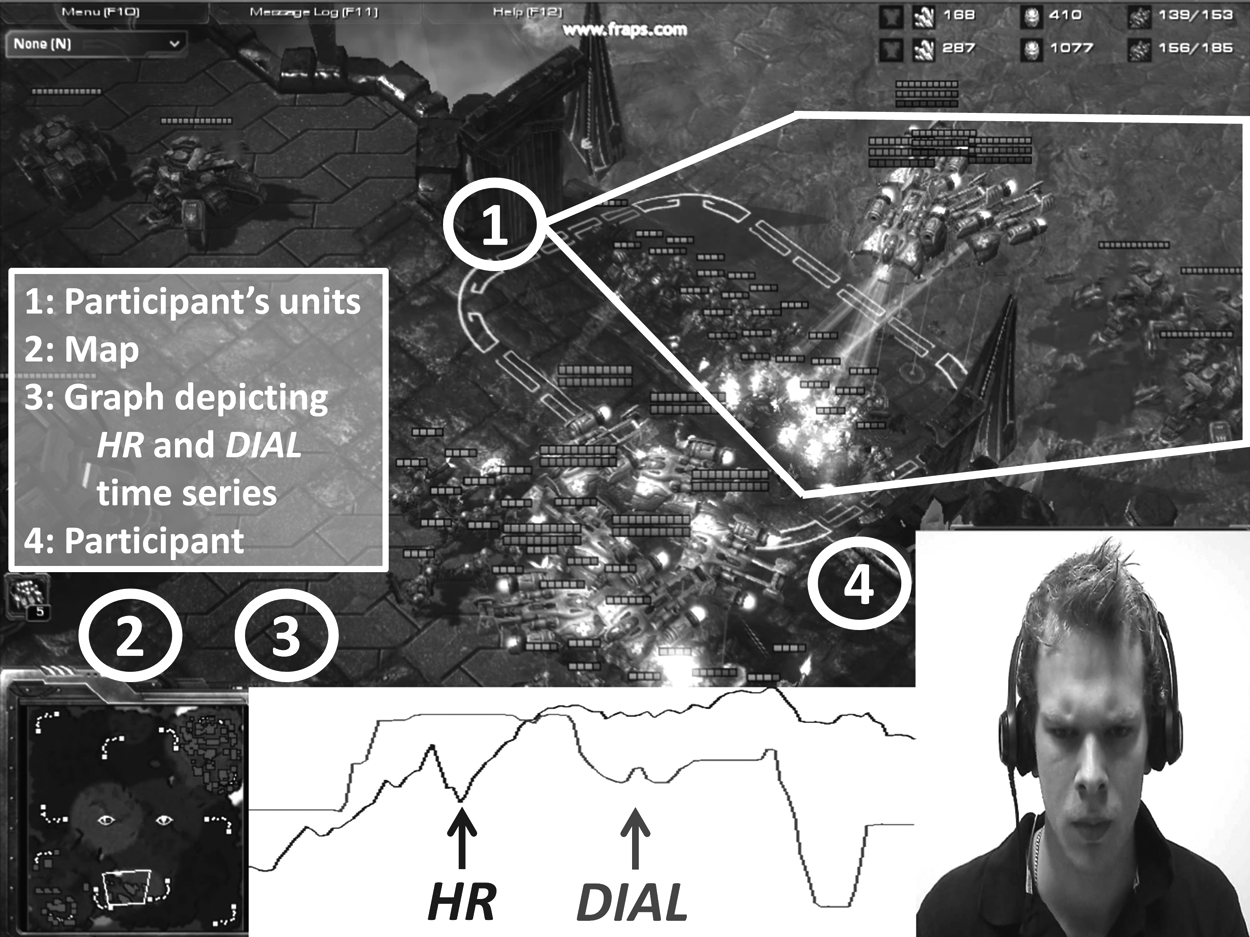
Screenshot of in-game session. Legend, graph, participant's face, and numbers are laid over the original screenshot. HR, percent change in participant's heart rate; DIAL, negative emotional arousal self-reported while watching a replay of the game. HR, DIAL, and participant's photograph are all taken from the same 50 second portion of gameplay from which the screenshot was extracted. Participant consented to use of his photograph.

HR and DIAL from two participants' full sessions. HR, percent change in participant's heart rate; DIAL, negative emotional arousal self-reported while watching a replay of the game; IA, interoceptive awareness score.
HR values were standardized. Each participant's HR was rescaled to match the dial rating's scaling. The rescaled HR and the DIAL were each segmented into 10 second epochs with a 5 second overlap. For each pair of epochs, the value at the beginning of the 10 second epoch was subtracted from the value at the end of the epoch, rendering a difference score for both the rescaled HR and the DIAL epochs. The absolute value of the difference between these difference scores represents the discrepancy between actual and perceived change in negative affect over each 10 second period. Interoceptive awareness was estimated by calculating the mean discrepancy between these measures across all epochs. Thus, higher values indicated greater discrepancy between actual and perceived change in negative affect and therefore poorer interoceptive awareness. For ease of interpretation, we multiplied this value by −1, making higher values indicative of better interoceptive awareness. Ten seconds was chosen as an appropriate epoch duration based on previous studies,8,27 and because we expected a 5–10 second lag between actual and perceived changes in negative affect as a result of participants having to process the affective significance of the in-game events that were unfolding during the dial rating session.
Results
To determine whether participants were on average able to use the dial correctly to indicate their negative affect, each participant's HR was correlated with their DIAL. This correlation was significant (p≤0.05) for all 26 participants (although negative in two cases), and a t test confirmed that the average correlation was different from 0 (mean r=0.327, t(25)=7.67, p<0.001). Table 1 presents the means and standard deviations for interoceptive awareness and the emotion regulation questionnaires.
Note. All scores based on mean score.
5-point scale; 24-point scale; 37-point scale.
IA, interoceptive awareness; SIS, seek instrumental social support; SES, seek emotional social support; ACT, seek active resolution; ACC, acceptance; REAPP, reappraise; WIT, withdrawal; RUM, rumination; SUP, suppression.
Table 2 presents these correlations and their associated p values. As hypothesized, interoceptive awareness was significantly positively related to actively seeking a resolution, and the relation between interoceptive awareness and seeking instrumental social support showed a positive trend (p≤0.10). Other correlations were not significant.
Discussion
The emotion regulation benefits of interoceptive awareness provided the theoretical 9 and empirical11,12 impetus for the present study. Our primary goal was to determine whether the interoceptive awareness of in-game negative affective states might be indicative of emotion regulation strategies. On self-reported emotion regulation measures, we expected interoceptive awareness of negative in-game affect to be related to healthier reactivity to real world stress. Only the relationship between interoceptive awareness and actively seeking a resolution was significant. The relationship between interoceptive awareness and seeking instrumental support showed a trend in the hypothesized direction.
These findings indicate that interoceptive awareness of negative affect during stressful game play may be uniquely related to regulatory strategies that are more problem focused than emotion focused (see Folkman and Lazarus 28 ), and that are relevant for in-game success. In games such as Starcraft II, negative emotional arousal during game play is a direct consequence of a player's in-game choices. Win–lose states are clearly linked to the decisions players make of which resources they procure, how they invest their resources, and how they manage offensive rallies against their opponents. To prevent future negative emotional arousal, players must therefore learn how to make better in-game decisions. It is therefore logical that recognizing negative emotional arousal in these contexts would relate to emotion regulation strategies that are action and problem solving focused, and which lead to improvements in in-game performance.
Albeit speculative, this reasoning may also account for why the other emotion regulation strategies measured in this study showed no association with interoceptive awareness. Regarding other healthy emotion regulations strategies, seeking emotional social support—such as comfort—does not seem to be an effective strategy for relieving in-game stress. Likewise, acceptance would prove maladaptive should it constitute “giving up,” 29 and withdrawal is antithetical to the game's core goal—to engage and defeat one's opponent. Finally, rumination and reappraisals are likely to be too cognitively demanding for players to engage in during such fast paced games as Starcraft II. As player's attention is most demanded for making the best in-game decisions as quickly as possible, in-game negative affect is not likely to inspire players to halt and re-examine (the reasons for) their negative state. Our results therefore seem to indicate that player's interoceptive awareness of in-game negative affect may be specifically related to problem-focused strategies that are relevant to in-game success.
Methodological contribution
One of the main goals of the current paper was to introduce an innovative methodology to study the associations between in-game and everyday emotion regulation strategies. In light of our small sample size, we consider our findings a promising first step. Our findings support the possibility that particular emotion regulation skills may be engaged and even trained during stressful video game play.
The method employed in this study seems promising for diverse avenues of future research. First, this method may be tested with other video games, particularly those in which more cognitive and emotion focused regulatory strategies are promoted. Such studies could help determine whether in-game interoceptive awareness specifically relates to emotion regulation strategies that are contextually relevant. Second, longitudinal research is critical to conduct in order to understand the causal link better (if there is one) between in-game interoceptive awareness and emotion regulation skills. It may be worthwhile to identify video games that implicitly promote interoceptive awareness and to track whether such games lead to improvements in in-game success and in everyday emotion regulation skills. Lastly, as this study only included self-report measures, future research would benefit significantly from using behavioral measures of emotion regulation. These suggestions highlight this study's limitations. The correlational design makes it impossible to determine whether overcoming in-game experiences of negative affect is beneficial for managing everyday experiences of stress and negative affect. Second, recall and social desirability biases somewhat impugn the validity of self-report measures.
Video game playing has become ubiquitous. Researchers have only begun to investigate the relationships between in-game emotional states, the regulation of those states, and individuals' patterns of emotional reactivity in everyday life. The method we presented here is unobtrusive, easy to implement, engaging for participants, and shows promise. It seems likely that the relevance of research into gaming and emotion regulation will only increase as gaming technology evolves. For instance, the recently released Xbox One's Kinect is designed to detect heart rate and facial expressions, 30 allowing designers to construct games where players' emotional reactions dynamically interact with the game space. This will allow emotion regulation to become an explicit component of game play. In this line, our hope is that this study provides a springboard from which more in-depth research can be conducted into the role of video game play and (the development of) emotion regulation tendencies.
Footnotes
Author Disclosure Statement
No competing financial interests exist.